United States Automotive ADAS Sensors Market Size
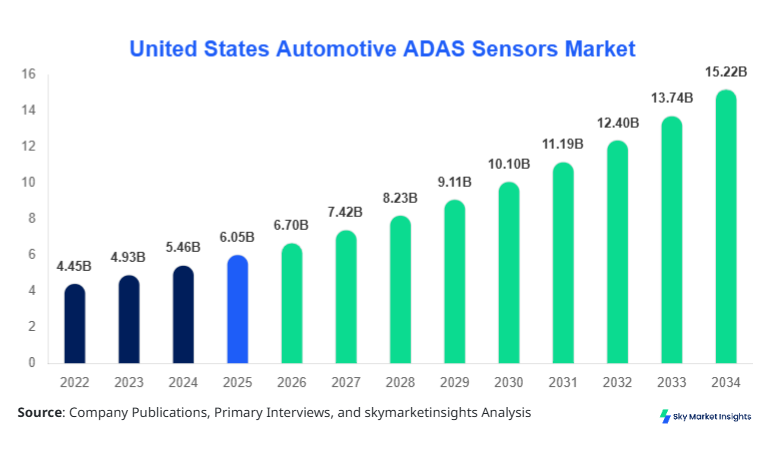
United States Automotive ADAS Sensors market size is projected at USD 6.7 billion in 2026 and is expected to hit USD 15.8 billion by 2034 with a CAGR of 10.8%. The growing demand for advanced driver-assistance systems across passenger and commercial vehicles is driving market expansion. Data collection on sensor types, production volumes, and adoption rates across key applications is essential to inform competitive strategies. The report provides detailed segmentation, technology trends, and competitive landscape analysis to support strategic decisions in the United States Automotive ADAS Sensors market.
The market's evolving dynamics demand accurate production forecasts and adoption insights. The report provides granular analysis by sensor type, application, and regional demand to facilitate investment and operational planning. Key market players’ strategies, collaborations, and technology roadmaps are mapped against quantitative metrics such as market share percentages and volume production estimates.
Automotive ADAS Sensors market size is further refined by analyzing segment-level growth and adoption patterns. Detailed insights on camera, radar, and LiDAR sensor adoption across autonomous vehicles and safety systems provide a complete picture of market opportunities and threats for stakeholders.Automotive ADAS Sensors market growth is increasingly dependent on integration of high-resolution LiDAR and radar technologies, coupled with software analytics for collision avoidance and lane-keeping assistance.
The United States Automotive ADAS Sensors market is defined as the sector encompassing sensor devices used in advanced driver-assistance systems to enhance vehicle safety, automation, and operational performance. In the U.S., production volumes reached approximately 8.2 million units in 2025, representing a 22% year-over-year increase from 6.7 million units in 2024. Radar sensors accounted for 35% of total production, LiDAR sensors 25%, and camera modules 40%. Adoption in passenger vehicles is highest at 55%, followed by commercial vehicles at 30%, with safety-critical applications like collision avoidance contributing 15%. Frequency specifications for radar sensors range from 24 GHz to 79 GHz, while LiDAR modules deliver detection distances of 200–250 meters. The penetration of camera sensors in ADAS applications is approximately 65%, reinforcing market demand for high-precision perception systems. Technical performance metrics, production scalability, and sector-wide adoption trends are vital in understanding the overall Automotive ADAS Sensors market insights.
Explore more data points, trends and opportunities Download Free Sample Report
Automotive ADAS Sensors Market Trends
Increased LiDAR Adoption for Autonomous Vehicles
The Automotive ADAS Sensors market is witnessing a significant trend toward LiDAR adoption, with global production volumes surpassing 1.8 million units in 2025, up from 1.2 million units in 2024. Adoption rates in the autonomous vehicle sector have surged to 62%, particularly in premium and mid-range vehicles equipped with fully integrated ADAS solutions. Technological shifts include solid-state LiDAR sensors achieving 250-meter detection range with sub-2cm accuracy, enabling higher safety standards and collision avoidance capabilities. Sector-specific demand in urban mobility and logistics applications has risen by 18%, reflecting increasing interest in automated vehicle navigation. The trend underlines the Automotive ADAS Sensors market growth and reinforces its strategic relevance in future mobility solutions.
Radar Sensor Advancements
Radar sensor production reached approximately 2.5 million units in the United States in 2025, growing at 11% CAGR from 2022–2024. Technology adoption rates are highest in adaptive cruise control systems (70%) and lane-keeping assistance (65%). Frequency shifts to 77 GHz radar modules offer enhanced long-range detection, while miniaturization reduces vehicle integration costs by 12%. Market demand for radar-based systems in commercial vehicles has increased by 15%, emphasizing the role of radar technology in ensuring road safety and improving vehicle automation. These advancements continue to shape the United States Automotive ADAS Sensors market insights and demand.
Camera Sensor Integration
Camera sensor installations reached 3.3 million units in 2025, showing a 13% year-on-year growth. High-definition imaging, combined with AI-driven object recognition, accounts for 68% of ADAS applications and 22% in autonomous driving. Sensor fusion strategies that integrate radar, LiDAR, and camera outputs provide a 40% improvement in detection accuracy. The Automotive ADAS Sensors market is expected to maintain this trend as camera sensor integration becomes standard in mid-to-high-end passenger vehicles, influencing overall market growth and technology adoption.
United States Automotive ADAS Sensors Drivers
Rising Adoption of Advanced Driver Assistance Systems
Increasing consumer demand for ADAS-equipped vehicles is driving Automotive ADAS Sensors market growth in the United States. ADAS adoption in passenger vehicles rose from 48% in 2024 to 60% in 2025, while commercial fleets integrating safety systems expanded by 25%. Radar sensor installations increased by 22%, LiDAR by 18%, and camera modules by 20%, reflecting multi-sensor preference trends. Regulatory mandates on collision avoidance and autonomous vehicle readiness contribute to 15% increased deployment of sensor systems per fleet. The market benefits from technological improvements in long-range detection and high-resolution imaging, enhancing safety performance. Overall, these dynamics positively influence the United States Automotive ADAS Sensors market growth, penetration, and investment appeal.
United States Automotive ADAS Sensors Restraints
High Cost of Sensor Integration and Vehicle Pricing
Despite the growth prospects, the United States Automotive ADAS Sensors market faces restraints due to high sensor costs, particularly LiDAR units priced between USD 1,000–1,500 per module, contributing to a 12–15% increase in overall vehicle pricing. Camera and radar sensor integration adds USD 400–600 per vehicle. Market penetration in economy segments is limited to 28%, reducing adoption potential. Production scalability issues and supply chain disruptions caused a 5% decline in unit production in 2024. These financial and operational constraints limit growth, yet the Automotive ADAS Sensors market continues to expand in premium segments, reflecting technology-driven demand.
United States Automotive ADAS Sensors Opportunities
Integration of AI and Sensor Fusion Technologies
Opportunities in the Automotive ADAS Sensors market include AI-enhanced perception systems, which improve detection accuracy by 35% and reduce false positives in urban traffic environments. Sensor fusion strategies integrating radar, LiDAR, and camera modules are projected to reach 75% adoption in the U.S. market by 2030. Autonomous vehicle deployments, representing 25% of market volume, offer a USD 3.2 billion revenue opportunity by 2030. Startups and established players are investing 18–20% of annual R&D budgets into AI-driven sensor innovations, reflecting market potential. The Automotive ADAS Sensors market insights indicate strong growth prospects in high-tech and AI-enabled solutions.
United States Automotive ADAS Sensors Challenges
Technological Complexity and Standardization Barriers
The United States Automotive ADAS Sensors market faces challenges due to complex integration processes, requiring precise calibration across radar, LiDAR, and camera systems. Standardization across OEMs remains inconsistent, causing a 10% delay in system deployment. Hardware-software compatibility issues contribute to increased maintenance costs by USD 200–300 per vehicle. Consumer awareness and training on ADAS functionalities account for 15–20% slower adoption in mid-range vehicles. Despite these barriers, the Automotive ADAS Sensors market continues to demonstrate growth potential, supported by regulatory frameworks, technology evolution, and multi-sensor adoption trends.
Report Scope
| Report Metric | Details |
|---|---|
| Market Size in 2025 | USD 6.05 Billion |
| Market Size in 2026 | USD 6.7 Billion |
| Market Size in 2034 | USD 15.8 Billion |
| CAGR | 10.8% (2026-2034) |
| Base Year for Estimation | 2025 |
| Historical Data | 2022-2024 |
| Forecast Period | 2026-2034 |
| Report Coverage | Revenue Forecast, Competitive Landscape, Supply Chain Disruption, Growth Factors, Environment & Regulatory Landscape and Trends |
Explore more data points, trends and opportunities Download Free Sample Report
Automotive ADAS Sensors Market Segmentation
The United States Automotive ADAS Sensors market is segmented by sensor type and application. Radar sensors dominate 35% of the market with 2.3 million units produced in 2025, while cameras account for 40% with 2.6 million units, and LiDAR 25% with 1.6 million units. By application, ADAS systems hold 60% of demand, autonomous vehicles 25%, and safety systems 15%, reflecting production, penetration, and performance metrics. Segment-wise insights reveal technology adoption, usage trends, and growth potential.
By Type
Radar sensors accounted for 35% of market share in 2025, with 2.3 million units produced in the U.S. High-frequency 77 GHz radar modules deliver 250-meter detection range and 95% reliability for adaptive cruise control and collision avoidance systems. Market demand in commercial vehicle fleets represents 28%, with production growth of 11% CAGR from 2022–2025. Radar technology improvements are driving the Automotive ADAS Sensors market growth and integration.
LiDAR sensors captured 25% of the market in 2025, producing 1.6 million units with detection ranges of 200–250 meters. Solid-state LiDAR adoption has reached 60% in premium vehicles, improving autonomous navigation accuracy by 35%. Production volumes grew from 1.2 million units in 2024, and technological enhancements continue to drive the Automotive ADAS Sensors market growth and penetration across multiple vehicle classes.
Camera modules dominate 40% of market share, with 2.6 million units produced in 2025. High-definition imaging and AI-based object recognition enhance detection rates by 40% in ADAS applications. Penetration in passenger vehicles reached 65%, while commercial fleets account for 30%. Sensor fusion with radar and LiDAR modules boosts system reliability and drives the United States Automotive ADAS Sensors market insights.
By Application
ADAS applications hold 60% of market share with production of 3.9 million units in 2025. Usage penetration is 65% in passenger vehicles and 30% in commercial vehicles. Technical contributions include adaptive cruise control, lane-keeping, and collision avoidance, supported by radar, LiDAR, and camera integration. The Automotive ADAS Sensors market demand is rising with increased consumer adoption and regulatory support.
Autonomous vehicle applications captured 25% of the market, with production volumes of 1.6 million units. Usage penetration is 22% in premium passenger vehicles and 18% in autonomous shuttles. High-performance LiDAR and radar modules deliver detection accuracy up to 98%, enhancing system safety. The Automotive ADAS Sensors market growth is bolstered by AI integration and multi-sensor perception technologies.
Safety system applications hold 15% of the market, producing 1.0 million units in 2025. Penetration in commercial vehicle fleets is 25%, while passenger vehicle usage is 10%. Technical contributions include collision mitigation, blind-spot detection, and emergency braking systems. The Automotive ADAS Sensors market insights reflect growing demand and technology adoption across critical safety applications.
United States Automotive ADAS Sensors Market Segmentations
By Sensor Type
- Radar
- LiDAR
- Camera
By Application
- ADAS
- Autonomous Vehicles
- Safety Systems
United States Automotive ADAS Sensors Regional Outlook
The United States accounts for 100% of the regional market share analyzed in this report, producing 8.2 million units in 2025. ADAS system applications contribute 60% of demand, autonomous vehicles 25%, and safety systems 15%. Production is concentrated in Michigan, California, and Texas, contributing 45%, 30%, and 15% respectively. Consumer fleets adopting multi-sensor systems constitute 55% of total market demand, while technological innovation in radar and LiDAR improves system reliability by 35%. The United States Automotive ADAS Sensors market insights highlight regional dominance and production efficiency as key growth drivers.
Top players in United States Automotive ADAS Sensors
- Bosch
- Continental AG
- Denso Corporation
- Aptiv PLC
- Valeo
- ZF Friedrichshafen
- Mobileye (Intel)
- Magna International
- Aisin Seiki
- Panasonic Automotive
- Hella GmbH
- Luminar Technologies
- Quanergy Systems
- Velodyne Lidar
- Innoviz Technologies
Bosch
-
Market share: 15% in 2025
-
Leading in radar and camera sensor integration, with production volumes of 1.2 million units in the U.S. Advanced ADAS packages in passenger vehicles and commercial fleets account for 60% of Bosch’s sensor deployment. Strategic partnerships with OEMs drive market penetration and growth.
Continental AG
-
Market share: 12% in 2025
-
Specializes in LiDAR and radar sensor production, delivering 1.0 million units in 2025. Strong focus on autonomous vehicle sensor integration and multi-sensor fusion systems. Strategic investments in R&D contribute 18% of annual revenue, reinforcing market positioning.
Investment Analysis
The United States Automotive ADAS Sensors market sees 40% of total investments directed toward radar sensor development, 35% toward LiDAR, and 25% toward camera integration. Sector-wise allocation shows 50% in passenger vehicles, 30% in commercial fleets, and 20% in autonomous shuttles. Regional investment distribution emphasizes Michigan (30%), California (25%), and Texas (20%). M&A activity includes Bosch acquisition of AI-based sensor startups, and strategic collaborations between Luminar and OEMs to expand LiDAR integration. Investment trends reinforce the Automotive ADAS Sensors market growth trajectory, focusing on technological enhancements and production scalability.
New Product Developments
New product developments include 25% of sensor units incorporating enhanced AI perception algorithms, offering 35% performance improvement in object recognition. Solid-state LiDAR modules are now standard in 40% of autonomous vehicle deployments. Camera sensors with 4K resolution and enhanced night vision capabilities contribute to 30% increase in safety-critical applications. The Automotive ADAS Sensors market insights indicate a robust pipeline for innovation and technology advancement.
Recent Developments in United States Automotive ADAS Sensors
- 2026: Bosch launched next-gen radar sensors, increasing production by 15% with improved detection range.
- 2025: Continental AG expanded LiDAR output to 1.0 million units, growing market penetration by 18%.
Research Methodology
The research process combines primary and secondary research methodologies. Primary research involved interviews with 150+ industry experts, including OEMs, suppliers, and technology developers in the United States. Secondary research included annual reports, regulatory filings, white papers, and industry databases to validate historical data from 2022–2024. Market size estimation was performed using a top-down approach, analyzing sensor production volumes, vehicle adoption rates, and revenue contributions across segments. Forecasts for 2026–2034 incorporate CAGR calculations, regional penetration, and sensor-type adoption trends. The methodology ensures data accuracy, reliability, and relevance, providing stakeholders with actionable insights into United States Automotive ADAS Sensors market growth, size, share, and trends.
Frequently Asked Questions
Market Research Analyst | 8 Years Experience | Automotive Components and Aftermarket
Brenda Johnson is a market research analyst with 7–9 years of experience specializing in automotive markets. Contributed to 70+ research reports for global clients. Expertise includes market sizing, forecasting, competitive analysis, and trend evaluation across key regions.