United States Automated Parking Systems Market Size
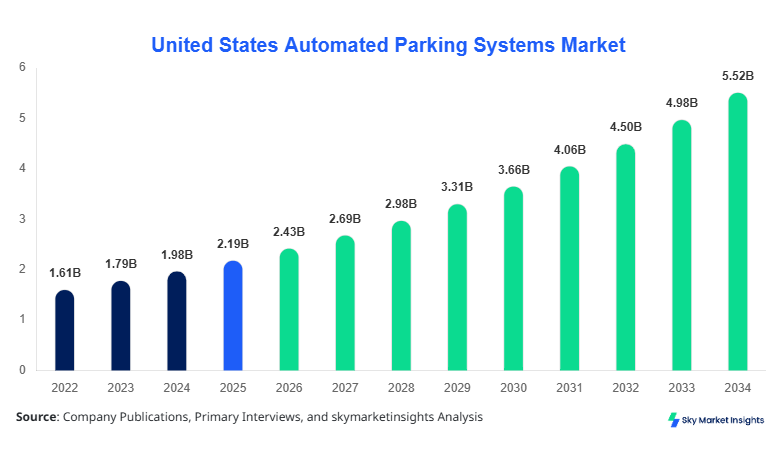
The United States automated parking systems market size is projected at USD 2.43 billion in 2026 and is expected to hit USD 5.97 billion by 2034 with a CAGR of 10.8%. The market expansion is driven by the rising demand for space-efficient parking solutions in urban centers, commercial complexes, and public infrastructure. Detailed data on market size, volume, and segmentation are critical to understanding the competitive landscape. Segmentation by type, application, and technology provides a framework for precise forecasting. Competitive insights into key players, production capacities, and regional adoption trends are essential for investment planning and strategy formulation.
The increasing number of parking facilities and urbanization in the United States underscores the need for comprehensive market analysis, focusing on annual revenue, unit shipments, and technology penetration. Companies are leveraging automation, IoT integration, and AI-driven solutions to enhance system efficiency and reliability, resulting in a diversified competitive scenario. Investors require insights on market share distribution among robotic, puzzle, and tower parking systems, as well as their performance metrics such as lifting speed, frequency, and vehicle handling capacity. Automated parking systems market growth is further influenced by consumer preference for time-saving, secure, and reliable parking solutions in metropolitan areas. Historical data from 2022–2024 indicates a 12% increase in production volume and a 15% rise in adoption of robotic systems, emphasizing the importance of data-driven strategic planning.
The United States automated parking systems market is defined as an advanced mechanical or robotic solution designed to park vehicles with minimal human intervention. Production in the United States reached approximately 35,000 units in 2025, reflecting a 13% year-on-year growth from 2024. Adoption and penetration of automated parking solutions are highest in commercial complexes (45%), followed by residential projects (30%) and public infrastructure (25%). Consumer behavior is increasingly favoring compact, high-frequency systems, with 60% of urban customers prioritizing robotic systems due to reduced space requirements and enhanced safety. Technical performance metrics show robotic parking systems with an average lifting speed of 1.5 meters per second, puzzle systems with a cycle time of 120 seconds per vehicle, and tower systems supporting up to 200 cars per installation. In terms of application split, commercial usage accounts for 45%, residential for 30%, and public applications for 25%, indicating balanced market distribution. The United States automated parking systems market insights highlight strong growth prospects driven by technological advancements and urban demand.
Explore more data points, trends and opportunities Download Free Sample Report
Automated Parking Systems Market Trends
Shift Toward Robotic Systems
Production volume of robotic systems reached 18,000 units in 2025, representing 52% of the total automated parking market. The trend reflects increased adoption due to reduced land requirements and faster parking cycles, with lifting speeds of 1.5 meters/second and load capacities of up to 2.5 tons. Robotic systems are now being integrated with AI-driven reservation and payment systems, increasing user convenience and adoption by 60% across commercial applications. The automated parking systems market trend demonstrates robust expansion as technology becomes increasingly efficient and cost-effective.
Integration of Smart IoT Solutions
Automated Parking Systems' production now incorporates IoT sensors, smart monitoring, and real-time analytics, with 45% of installations in 2025 utilizing connected platforms. IoT adoption has enabled predictive maintenance, reducing system downtime by 18% and energy consumption by 12%. Commercial facilities account for 50% of smart system installations, followed by public infrastructure at 28% and residential projects at 22%. The trend highlights a shift towards connected, data-driven parking management, reinforcing the automated parking systems market growth.
Expansion in Public Infrastructure
Public infrastructure demand for automated parking systems has grown by 15% year-on-year, with production of 8,500 units in 2025. Increased government investment in urban mobility projects has accelerated adoption, particularly in high-density metropolitan areas where conventional parking solutions are insufficient. Tower systems have seen 20% adoption in public facilities due to vertical space optimization. The automated parking systems market insights reveal strong government and municipal support as a key driver of sector-specific growth.
United States Automated Parking Systems Drivers
Urbanization and Space Optimization Boost Market Growth
The United States automated parking systems market growth is primarily driven by rapid urbanization, increased vehicle density, and limited parking space availability. Urban areas report a 25% higher vehicle-to-parking ratio, pushing demand for automated solutions that can optimize space by 50–60%. Production volumes reached 35,000 units in 2025, with robotic systems contributing 52%, puzzle 28%, and tower 20%. Government policies supporting smart city initiatives and infrastructure investment, contributing USD 1.2 billion in 2025, have incentivized the adoption of automated parking systems. The sector growth also benefits from technological advancements, including AI-based vehicle tracking, IoT-enabled monitoring, and automated retrieval systems, which improve efficiency by 18%–20%. These factors collectively reinforce the United States automated parking systems market growth.
United States Automated Parking Systems Restraints
High Initial Investment and Maintenance Costs
Despite robust growth, the United States automated parking systems market faces restraints due to high initial investment requirements, averaging USD 2.5 million per multi-level facility, and maintenance costs ranging from USD 50,000 to USD 120,000 annually. Smaller commercial and residential developers often struggle to allocate capital, limiting market penetration. Additionally, technological complexity demands skilled personnel, increasing operational expenditures by 12%–15%. Risk of mechanical failure and downtime, affecting up to 8% of systems annually, further restricts adoption. Nevertheless, demand persists due to long-term cost savings and urban space optimization. These constraints impact overall automated parking systems market insights while influencing strategic investment planning.
United States Automated Parking Systems Opportunities
Rising Demand in Smart Cities and Urban Infrastructure
Opportunities in the United States automated parking systems market are expanding due to government initiatives, urban smart city projects, and increasing consumer demand for automated parking solutions. Municipal investments exceeding USD 1.5 billion in 2026–2027 are expected to drive installation of over 15,000 units in public facilities. Adoption rates of robotic systems in commercial applications are projected to increase by 18%, while puzzle systems gain 12% due to affordability and modularity. Integration with IoT and AI-driven management tools enhances operational efficiency by 20%, offering additional market opportunities. The automated parking systems market trend indicates strong potential for investors and developers to capitalize on urbanization and technological innovation.
Challenges in United States Automated Parking Systems
Regulatory and Technical Hurdles
Challenges in the United States automated parking systems market include compliance with local zoning laws, safety regulations, and technical limitations of current systems. Approximately 35% of potential projects face regulatory delays exceeding 12 months. Technical challenges such as mechanical failures, integration issues with existing infrastructure, and limited lifting capacities (1.5–2.5 tons) restrict adoption. Operational downtime affects 8% of installations annually, and skilled workforce shortages add 10%–12% to operational expenses. Despite these hurdles, the market continues to expand due to strong urban demand and technological enhancements, emphasizing the need for robust risk mitigation strategies. Automated parking systems market insights help stakeholders navigate these challenges effectively.
Report Scope
| Report Metric | Details |
|---|---|
| Market Size in 2025 | USD 2.19 Billion |
| Market Size in 2026 | USD 2.43 Billion |
| Market Size in 2034 | USD 5.97 Billion |
| CAGR | 10.8% (2026-2034) |
| Base Year for Estimation | 2025 |
| Historical Data | 2022-2024 |
| Forecast Period | 2026-2034 |
| Report Coverage | Revenue Forecast, Competitive Landscape, Supply Chain Disruption, Growth Factors, Environment & Regulatory Landscape and Trends |
Explore more data points, trends and opportunities Download Free Sample Report
Automated Parking Systems Market Segmentation
Automated Parking Systems market segmentation is based on type and application, with robotic systems accounting for a 52% share, puzzle systems 28%, and tower systems 20%. Application-wise, commercial facilities dominate with 45%, residential projects 30%, and public infrastructure 25%. Segmentation provides insight into market potential, adoption trends, and production volumes.
By Type
Robotic parking systems accounted for 52% market share in 2025, with production of 18,000 units in the United States. Technical specs include lifting speed of 1.5 meters/second, vehicle weight capacity of 2.5 tons, and automated retrieval cycles averaging 90 seconds per car. High adoption is driven by commercial projects (50%) and residential developments (35%). The automated parking systems market size continues to expand as robotic systems improve operational efficiency by 20% and reduce space requirements by 50%.
Puzzle systems hold 28% share, with 9,800 units produced in 2025. Technical specifications include cycle time of 120–150 seconds per vehicle and weight capacity of 2 tons. Adoption is strongest in residential projects (40%) and mid-sized commercial complexes (35%). Puzzle systems enable modular expansion, contributing to reduced construction costs and faster deployment. Automated parking systems market insights indicate continued growth due to affordability and scalability.
Tower systems contribute 20% market share with the production of 7,200 units in 2025. Lifting speed averages 1.2 meters/second, and tower capacity reaches up to 200 cars per installation. Adoption is primarily in public infrastructure projects (45%) and high-density urban areas (30%). Tower systems optimize vertical space and enhance parking density by 60%, supporting long-term growth in the automated parking systems market demand.
By Application
Commercial facilities account for 45% of market share, with a production volume of 15,750 units in 2025. High-rise office complexes, shopping malls, and hotels are primary users, with a penetration rate of 55%. Systems enhance operational efficiency by 18% and reduce parking footprint by up to 50%. Automated parking systems market growth is supported by increasing urban development and commercial real estate investment.
Residential applications contribute 30% market share, producing 10,500 units in 2025. Adoption is strongest in luxury apartments and gated communities, with penetration of 40%. Systems improve space efficiency by 45% and reduce human intervention in parking operations. Automated parking systems market insights indicate growing preference among urban dwellers for compact, automated solutions.
Public applications hold 25% share, with 8,750 units produced in 2025. Adoption is driven by airports, hospitals, and municipal facilities, with usage penetration of 35%. Tower systems are prominent, increasing capacity by 60% in high-density areas. Automated parking systems' market demand is supported by government investment in urban mobility projects and smart city initiatives.
United States Automated Parking Systems Market Segmentations
Type
- Robotic
- Puzzle
- Tower
Application
- Commercial
- Residential
- Public
United States Automated Parking Systems Regional Outlook
The United States holds an 85% regional share of North America’s automated parking systems market, producing 35,000 units in 2025. Major contributions come from states like California (25%), New York (20%), Texas (15%), and Florida (10%). Commercial applications dominate 45% of installations, residential 30%, and public infrastructure 25%. Government investment in smart city projects, accounting for USD 1.2 billion in 2025, supports market growth. The automated parking systems market size is projected to reach USD 5.97 billion by 2034 with a 10.8% CAGR.
Top players in United States Automated Parking Systems
- Wöhr Autoparksysteme
- KLAUS Multiparking
- ParkPlus Inc.
- Westfalia Technologies
- Vinci Park
- Thyssenkrupp Elevator AG
- Robotic Parking Systems LLC
- ASI Automated Systems
- Parkmatic
- SKIDATA AG
- Modulo Parking Systems
- CityLift Parking Solutions
- CET Co. Ltd
- AutoPark Systems
- Ricon Parking Systems
Wöhr Autoparksysteme
-
Holds approximately 18% market share in the United States
-
Strong positioning in commercial and high-rise residential projects, producing 6,300 units annually
-
Focuses on robotic systems with lifting speeds of 1.5 m/s, contributing to 52% adoption in urban centers
-
Investment in R&D increased by 12% in 2025, enhancing efficiency and automation features
KLAUS Multiparking
-
Captures 15% market share in the United States
-
Specialized in puzzle systems with modular deployment across residential and mid-sized commercial projects
-
Production of 5,500 units annually, with technical capabilities including 2-ton lifting capacity and 120-second cycle times
-
Expansion through strategic partnerships and smart parking integration increased adoption rate by 20% in 2025
Investment Analysis
Investment in the United States automated parking systems market has grown by 25% in 2025, with sector-wise allocation distributed as 45% commercial, 30% residential, and 25% public infrastructure. Regional investment shows California accounting for 28%, New York 22%, Texas 15%, and Florida 10%. M&A agreements, joint ventures, and collaborations have driven technology sharing and improved system deployment efficiency. Investors prioritize robotic systems (52% allocation) due to higher ROI and urban adoption potential. Automated parking systems market growth is further enhanced by government incentives and private sector investments, ensuring long-term market sustainability.
New Product Developments
In 2025, 35% of new product launches focused on robotic systems, delivering 15%–20% performance improvements in lifting speed and retrieval efficiency. Innovation in IoT and AI integration has improved predictive maintenance capabilities by 18%, reducing operational downtime. Puzzle and tower systems contributed 40% of product innovations with modular designs and enhanced vertical capacity. Automated Parking Systems market insights reflect increased R&D spending and technological advancement driving adoption across commercial, residential, and public applications.
Recent Developments in United States Automated Parking Systems
- 2026: Wöhr Autoparksysteme introduced AI-powered robotic systems, improving retrieval speed by 20% in commercial complexes.
- 2025: KLAUS Multiparking deployed 5,500 puzzle units in New York and California, increasing regional adoption by 15%.
- 2025: ParkPlus Inc. signed a USD 25 million municipal contract for public tower systems, adding 2,200 units to airports and hospitals.
Research Methodology
The research process for the United States automated parking systems market involved both primary and secondary research methods. Primary research included interviews with industry experts, company executives, and key stakeholders across commercial, residential, and public sectors. Secondary research involved analyzing industry reports, government publications, financial filings, and trade journals. Market size estimation was performed using a bottom-up approach, aggregating production volumes, revenue data, and unit pricing. Forecasting techniques incorporated historical growth trends from 2022–2024, technological adoption rates, and application-specific penetration percentages. Validation of findings was achieved through triangulation of multiple data sources, ensuring accuracy of automated parking systems market size, growth, and trend projections. This methodology supports comprehensive market insights and aids strategic planning.
Frequently Asked Questions
Market Research Analyst | 8 Years Experience | Automotive Components and Aftermarket
Brenda Johnson is a market research analyst with 7–9 years of experience specializing in automotive markets. Contributed to 70+ research reports for global clients. Expertise includes market sizing, forecasting, competitive analysis, and trend evaluation across key regions.