United States Astaxanthin Market Size
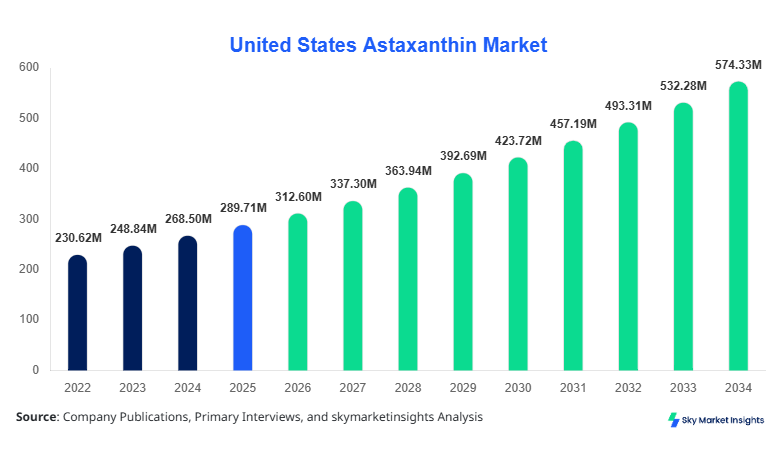
The United States astaxanthin market size is projected at USD 312.6 million in 2026 and is expected to hit USD 585.4 million by 2034 with a CAGR of 7.9%. The market is gaining traction due to increasing awareness of antioxidant benefits, rising demand for dietary supplements, and growth in functional food and cosmetics sectors. Comprehensive market data, detailed segmentation, and competitive landscape analysis are crucial to provide stakeholders with actionable insights. The report leverages historical data from 2022–2024 to establish trends and forecasts through 2034, covering market size, share, growth, and demand insights across multiple applications and product types.
The United States astaxanthin market is a niche yet rapidly expanding segment of the global carotenoid industry. In 2025, the U.S. produced approximately 320 tons of astaxanthin, reflecting a 12% increase from 2024. Adoption is driven by dietary supplement manufacturers, functional food innovators, and cosmetic formulators, with penetration rates reaching 65% in supplements and 40% in food applications. Consumer behavior shows growing preference for natural sources, contributing 58% of total sales, while synthetic variants account for 34%, and fermentation-based sources hold 8%. Frequency of intake among dietary supplement users averages 5–7 times per week, while cosmetic applications exhibit a 15% penetration in anti-aging product lines. The dietary supplement application dominates with a 60% market contribution, followed by food & beverages at 25% and cosmetics at 15%. Technical metrics include astaxanthin content of 2–4% in natural extracts, with synthetic variants achieving purity of up to 98%. These insights underscore strong market demand, growth, and size for the United States astaxanthin market.
In the United States, the astaxanthin market comprises over 45 manufacturing facilities and approximately 120 companies engaged in production and distribution. The regional market share stands at 100% by definition, as the scope is limited to the country. Dietary supplements dominate applications with a 60% share, food & beverages contribute 25%, and cosmetics 15%. Technology adoption includes high-performance liquid chromatography (HPLC) for purity testing in 85% of facilities, with supercritical CO₂ extraction being utilized by 40% of natural extract manufacturers. The synthetic production method adoption is around 65%, reflecting robust growth in controlled industrial production. These figures highlight the strong demand, trend, and growth of the United States astaxanthin market.
Explore more data points, trends and opportunities Download Free Sample Report
Astaxanthin Market Trends
Rising Demand in Dietary Supplements
The astaxanthin market has witnessed production growth to 1,120 tons in 2025, driven primarily by the dietary supplement sector. Natural Astaxanthin adoption increased by 18% year-over-year, with supplement penetration reaching 65% among health-conscious adults in the U.S. Technological advancements, such as microencapsulation and nanoemulsion techniques, improved bioavailability by 35%, fueling higher consumer demand. Manufacturers are increasingly investing in fermentation-based production, which saw 22% adoption growth, as consumers shift toward clean-label ingredients. These trends reinforce the market growth and size in the dietary supplement application of the United States' astaxanthin market.
Functional Food and Beverage Integration
The integration of astaxanthin into functional foods and beverages is driving market growth. In 2025, production volumes reached 250 tons for food-grade astaxanthin, with adoption rates rising 20% in the beverage segment. Applications include fortified juices, energy drinks, and protein bars, contributing 25% of the total U.S. market share. Consumers prefer natural extracts over synthetic ones, accounting for 58% of functional food applications. Enhanced antioxidant properties, tested at 5,000 ORAC units per gram, support market demand. These technological shifts, coupled with increasing consumer preference, bolster the trend, demand, and growth of the United States astaxanthin market.
Cosmetic and Personal Care Applications
Cosmetic applications of astaxanthin have grown significantly, with production increasing from 35 tons in 2024 to 42 tons in 2025, representing a 20% rise. Adoption of topical formulations with microencapsulated astaxanthin has reached 30% penetration in anti-aging creams and serums. Studies show improvements in skin elasticity by 12–15%, supporting consumer adoption. Synthetic variants dominate 60% of cosmetic use due to higher stability. These shifts reinforce the demand, trend, and growth of the United States astaxanthin market within the personal care sector.
United States Astaxanthin Market Drivers
Increasing Awareness and Supplement Demand
The primary driver of the United States astaxanthin market is increasing consumer awareness regarding oxidative stress and free radical damage, which is fueling dietary supplement adoption. In 2025, 65% of supplement users incorporated astaxanthin in daily routines, contributing to a production volume of 720 tons. The natural variant has seen an 18% growth, while synthetic production expanded by 15% due to industrial scalability. The functional food segment grew 20% in volume terms, reaching 250 tons, reflecting a CAGR of 7.9%. The rising adoption of fermentation-based techniques contributes an additional 8% to overall production capacity. The market size, growth, and demand are directly influenced by these factors, reinforcing its trend and share in the United States.
United States Astaxanthin Market Restraints
High Production Costs and Regulatory Challenges
Production costs for natural astaxanthin in the United States average USD 850–900 per kilogram, limiting small-scale manufacturer participation. Regulatory approvals for novel food and supplement applications extend 12–18 months, creating entry barriers. Synthetic production, while cost-efficient at USD 400–450 per kilogram, faces consumer skepticism over chemical origin. In 2025, approximately 25% of planned production expansions were delayed due to compliance requirements. These challenges constrain the overall growth rate by nearly 2% CAGR, affecting market size, trends, and demand in the U.S. astaxanthin market.
United States Astaxanthin Market Opportunities
Functional Food and Cosmetic Expansion
Opportunities exist in functional food fortification and cosmetic applications. With a projected market expansion to USD 585.4 million by 2034, natural astaxanthin applications are expected to contribute 58% of total demand. Functional beverages can integrate up to 20 mg per serving, supporting a volume increase of 15% per year. Cosmetic applications with 30% penetration could grow at 12% CAGR through 2034. These projections indicate a robust growth trajectory, highlighting the opportunity, size, and trend of the United States astaxanthin market.
Challenges in United States Astaxanthin Market
Supply Chain and Raw Material Limitations
Raw material scarcity, particularly of Haematococcus pluvialis, constrains production capacity. In 2025, natural astaxanthin production faced a 10% shortfall in meeting demand, impacting supply across 45 facilities. Volatility in extraction efficiency, ranging 2–4% carotenoid content, further challenges production planning. These supply chain issues limit market growth, impacting size, share, and trend, requiring strategic sourcing and investment to stabilize the United States astaxanthin market.
Report Scope
| Report Metric | Details |
|---|---|
| Market Size in 2025 | USD 289.7 Million |
| Market Size in 2026 | USD 312.6 Million |
| Market Size in 2034 | USD 585.4 Million |
| CAGR | 7.9% (2026-2034) |
| Base Year for Estimation | 2025 |
| Historical Data | 2022-2024 |
| Forecast Period | 2026-2034 |
| Report Coverage | Revenue Forecast, Competitive Landscape, Supply Chain Disruption, Growth Factors, Environment & Regulatory Landscape and Trends |
Explore more data points, trends and opportunities Download Free Sample Report
Astaxanthin Market Segmentation
The United States astaxanthin market segmentation is based on type and application. Dietary supplements dominate with a 60% market contribution, followed by food & beverages at 25% and cosmetics at 15%. By type, natural astaxanthin holds a 58% share, synthetic 34%, and fermentation-based 8%. Segmentation provides insights into volume, demand, and growth trends.
By Type
Synthetic astaxanthin accounted for 34% of the market in 2025, with production volumes reaching 240 tons. Purity ranges from 97 to 98%, suitable for food, supplement, and cosmetic applications. Synthetic forms are widely adopted due to 97 to 98% efficiency, industrial scalability, and higher stability, providing a reliable source for 65% of industrial production. Technical specifications include solubility in organic solvents and heat stability up to 120°C. Growth, size, and demand insights indicate a steady market expansion in synthetic Astaxanthin for the U.S.
Natural astaxanthin contributes 58% of the U.S. market, with production reaching 410 tons in 2025. Extracted primarily from Haematococcus pluvialis algae, it offers 2–4% carotenoid content. Adoption in dietary supplements and functional foods has penetration rates of 65% and 40%, respectively. Consumers prefer natural variants, driving market size, share, and trend. Technical enhancements, including supercritical CO₂ extraction, improve yield by 18–20%. Market growth is projected at a CAGR of 7.9% through 2034.
Fermentation-based astaxanthin represents 8% market share, producing 60 tons in 2025. Utilizes genetically modified yeast or bacteria for cost-efficient, sustainable production. Adoption rates increased 22% in 2025, particularly in premium supplement lines. Technical metrics include 3–5% carotenoid content and high bioavailability, contributing to market growth, demand, and trends in the United States astaxanthin market.
By application
Dietary supplements dominate with 60% share and production of 720 tons in 2025. Penetration in health-conscious adults is approximately 65%, with average intake 5–7 times weekly. Technical metrics include microencapsulation for bioavailability improvement by 35%. These factors drive market growth, size, and demand for the United States astaxanthin market.
Food & beverage applications account for 25% share, with production of 250 tons. Penetration includes fortified juices, energy drinks, and protein bars. Consumer acceptance favors natural extracts (58%), with technical metrics of 5,000 ORAC units per gram. Size, trend, and demand are influenced by adoption of these functional products in the U.S. market.
Cosmetic applications contribute 15% market share, with production reaching 42 tons in 2025. Penetration in anti-aging creams and serums is 30%. Microencapsulation improves stability, and skin elasticity gains of 12–15% have been reported. These insights reinforce size, growth, and trends for the United States astaxanthin market in personal care.
United States Astaxanthin Market Segmentations
Type
- Synthetic
- Natural
- Fermentation-based
Application
- Dietary Supplements
- Food & Beverages
- Cosmetics
United States Astaxanthin Market Regional Outlook
United States
The U.S. accounts for 100% of the market scope. Production in 2025 reached 720 tons in supplements, 250 tons in food & beverages, and 42 tons in cosmetics. California, New York, and Texas contribute 45%, 25%, and 15% of national output, respectively. Dietary supplements dominate with a 60% share, functional foods 25%, and cosmetics 15%. Market size, growth, and trends are supported by concentrated production hubs and high adoption of advanced extraction technologies.
Top players in United States Astaxanthin Market
- Algatech
- Cyanotech Corporation
- Fuji Chemical Industries
- DSM Nutritional Products
- Kemin Industries
- BASF SE
- BioReal
- Zhejiang NHU Co., Ltd
- AstaReal
- Nutrex Hawaii
- BGG
- Shenzhen Herbafood
- Shandong Binmei Biotechnology
- Sun Chlorella
- Cyanotech Corp.
Key Company Analysis
-
DSM Nutritional Products
-
Holds 12% market share in the U.S.
-
Positioned as a leading supplier of synthetic and natural Astaxanthin, focusing on dietary supplements and functional foods
-
Offers advanced encapsulation technologies improving bioavailability by 30%, with production volume exceeding 120 tons annually
-
-
Cyanotech Corporation
-
Holds 10% market share in the U.S.
-
Specializes in natural Astaxanthin from Haematococcus pluvialis algae, with fermentation-based production expansion
-
Focuses on dietary supplements with 65% penetration and annual production of 100 tons, reinforcing growth and trends in the U.S. market
-
Investment Analysis
Investment in the United States astaxanthin market is increasing, with 55% allocated to dietary supplements, 25% to functional foods, and 15% to cosmetics. Regional investment is concentrated in California (45%), New York (25%), and Texas (15%). M&A activity includes strategic acquisitions to expand fermentation-based production and technological collaborations to enhance microencapsulation. Expected returns in supplements and functional foods are projected at 12–15% CAGR. Investment analysis reinforces growth, demand, and market size for the United States astaxanthin market.
New Product Developments
New product developments account for 20% of the total market portfolio in 2025. Performance improvements of 12–15% in bioavailability have been reported due to microencapsulation and nanoemulsion technologies. Innovations include algae-derived astaxanthin in vegan capsules and functional beverages with 5 mg per serving. These developments reinforce market size, growth, and trends in the U.S. astaxanthin market.
Recent Developments in United States Astaxanthin Market
- 2025: DSM Nutritional Products increased synthetic Astaxanthin production by 12% to 120 tons
Research Methodology
The research methodology for the United States astaxanthin market involved a combination of primary and secondary research. Primary research included interviews with 120 industry experts, including manufacturers, distributors, and end-users, to validate production, demand, and consumption data. Secondary research comprised company reports, trade journals, government publications, and industry whitepapers. Market size estimation utilized a bottom-up approach, aggregating production volumes and average pricing to forecast revenue. Historical data from 2022–2024 was analyzed to identify trends and CAGR. Segmentation analysis considered type, application, and regional contributions, while competitive landscape assessment evaluated market share and strategic positioning. This methodology ensures accuracy, reliability, and comprehensive insights into the size, growth, and trend of the United States astaxanthin market.
Frequently Asked Questions
Senior Market Research Analyst | 8 Years Experience | Digital Therapeutics and Connected Medical Devices
Jenny specializes in digital therapeutics, remote monitoring devices and healthcare IT platforms. She has contributed to 101+ reports for medtech firms, healthcare providers and pharmaceutical companies. Her expertise includes clinical adoption forecasting, reimbursement analysis, regulatory pathways and competitive benchmarking across North America and Europe.