North America Advanced Wound Care Market Size
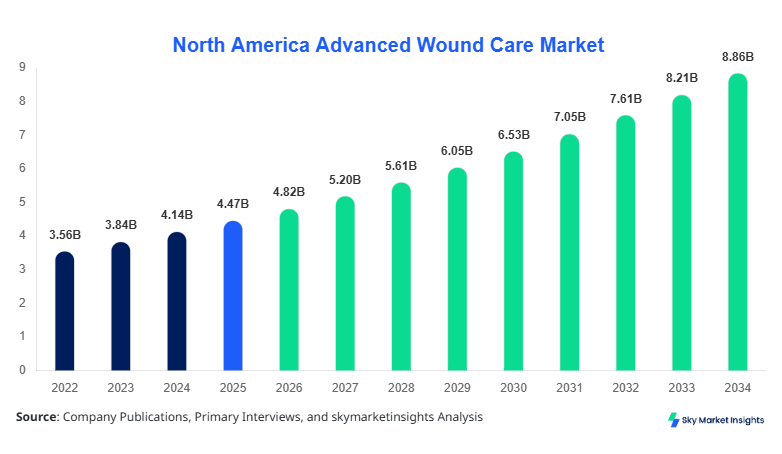
North America's advanced wound care market size is projected at USD 4.82 billion in 2026 and is expected to hit USD 8.91 billion by 2034 with a CAGR of 7.9%. The increasing prevalence of chronic wounds affecting over 6.7 million patients annually in the United States and Canada, along with rising healthcare expenditure exceeding USD 4.5 trillion in North America, drives demand for data-driven insights, segmentation analysis, and competitive benchmarking across product categories and end-use sectors.
The market definition encompasses advanced wound care products, including moisture-retentive dressings, antimicrobial agents, and bioactive therapies used to treat chronic, surgical, and traumatic wounds. North America reported production volumes exceeding 1.2 billion units of advanced dressings in 2025, with adoption penetration reaching 68% in hospital settings and 42% in home healthcare. Consumer behavior indicates a 55% preference for faster healing solutions, while demand analytics show a 23% increase in outpatient wound care visits between 2022 and 2025. Chronic wounds account for 48% of applications, followed by surgical wounds at 32% and acute wounds at 20%. Performance metrics such as moisture vapor transmission rate (MVTR) of 500–2000 g/m²/24 h and antimicrobial efficacy above 95% define product quality standards, reinforcing North America's advanced wound care market size.
In the United States, the Advanced Wound Care Market accounts for approximately 82% of the North American regional revenue, supported by over 5,800 hospitals and 18,000 specialized wound care centers. The application distribution shows chronic wounds representing 50%, surgical wounds 30%, and acute wounds 20%, driven by a diabetic population exceeding 37 million individuals. Technology adoption rates exceed 72% for antimicrobial dressings and 64% for foam-based products, while digital wound monitoring tools have reached 28% penetration. The presence of over 150 major manufacturers and suppliers strengthens supply chains and innovation pipelines, further reinforcing North America's advanced wound care market share.
Explore more data points, trends and opportunities Download Free Sample Report
Advanced Wound Care Market Trends
Rising Adoption of Bioactive and Smart Dressings
The market is witnessing a shift toward bioactive wound care products, with production volumes of smart dressings surpassing 220 million units in 2025, representing a 19% increase from 2023. These dressings incorporate sensors capable of monitoring pH levels, temperature, and infection markers, achieving clinical accuracy above 92%. Adoption rates among tertiary hospitals have reached 61%, while home healthcare adoption stands at 35%. The integration of AI-based wound assessment platforms has improved healing outcomes by 27% and reduced hospitalization time by 18%, contributing to the ongoing North American advanced wound care market trend.
Expansion of Home Healthcare and Telemedicine Integration
Home healthcare applications have expanded significantly, with over 2.4 million patients receiving advanced wound care at home in 2025, reflecting a 21% rise from 2022. Telemedicine-enabled wound consultations increased by 34%, reducing in-clinic visits by 15% and lowering treatment costs by approximately USD 1,200 per patient annually. Portable wound care kits now account for 18% of total product shipments, with antimicrobial dressings leading at 45% share within this segment. The increasing preference for decentralized care models and cost-effective treatment options continues to shape the North American advanced wound care market trend.
North America Advanced Wound Care Drivers
Rising Prevalence of Chronic Diseases and Aging Population
The increasing burden of chronic diseases such as diabetes, obesity, and vascular disorders significantly drives demand for advanced wound care solutions. In North America, over 37 million individuals suffer from diabetes, with approximately 15% developing diabetic foot ulcers annually, translating to nearly 5.5 million cases. Additionally, the geriatric population aged 65 and above is projected to reach 80 million by 2030, representing 21% of the population, thereby increasing susceptibility to pressure ulcers and slow-healing wounds. Healthcare expenditure related to chronic wound management exceeds USD 25 billion annually, with advanced products accounting for 62% of treatment costs due to superior healing efficiency and reduced infection rates. The demand for antimicrobial dressings has grown by 18% year-over-year, while foam dressings have seen a 14% increase in adoption across hospitals. These factors collectively strengthen the North America advanced wound care market growth.
North America Advanced Wound Care Restraints
High Cost of Advanced Products and Limited Reimbursement Policies
Despite technological advancements, the high cost of advanced wound care products remains a critical restraint. Advanced dressings cost between USD 15 and USD 120 per unit, compared to traditional dressings priced below USD 5, creating affordability challenges for patients and healthcare providers. Reimbursement coverage varies significantly, with only 65% of advanced wound care procedures fully reimbursed under public and private insurance programs. Additionally, hospitals report a 12% increase in procurement costs annually due to rising raw material prices and supply chain disruptions. Small healthcare facilities and rural clinics face limited access, with adoption rates below 30% in certain regions. These financial barriers restrict widespread adoption, particularly in outpatient and home care settings, thereby impacting the North American advanced wound care market growth.
North America Advanced Wound Care Opportunities
Technological Innovations and Expansion of Home Care Solutions
Technological advancements in wound care products present significant opportunities for market expansion. The introduction of nanotechnology-based antimicrobial dressings has demonstrated infection reduction rates exceeding 96%, while bioengineered skin substitutes have improved healing times by 40%. Investment in R&D has increased by 22% annually, with over USD 1.8 billion allocated to wound care innovations in 2025. The home healthcare segment is projected to grow at a penetration rate of 48% by 2030, driven by cost savings of up to 30% compared to hospital-based treatments. Furthermore, wearable wound monitoring devices are expected to reach production volumes of 150 million units by 2028, enhancing real-time patient management and reducing complications. These advancements create substantial opportunities for North America's advanced wound care market growth.
Challenges in North America Advanced Wound Care
Regulatory Complexities and Product Standardization Issues
The regulatory landscape for advanced wound care products presents significant challenges for manufacturers. Compliance with FDA regulations requires extensive clinical trials, often costing between USD 5 million and USD 20 million per product, with approval timelines exceeding 24–36 months. Additionally, variations in product standards and classification across regions create inconsistencies in manufacturing and distribution. Approximately 18% of product launches face delays due to regulatory hurdles, while 12% are withdrawn due to non-compliance issues. Supply chain disruptions and quality control requirements further increase operational costs by 10–15%. These complexities hinder innovation speed and market entry, posing challenges to the North America advanced wound care market growth.
Report Scope
| Report Metric | Details |
|---|---|
| Market Size in 2025 | USD 4.47 Billion |
| Market Size in 2026 | USD 4.82 Billion |
| Market Size in 2034 | USD 8.91 Billion |
| CAGR | 7.9% (2026-2034) |
| Base Year for Estimation | 2025 |
| Historical Data | 2022-2024 |
| Forecast Period | 2026-2034 |
| Report Coverage | Revenue Forecast, Competitive Landscape, Supply Chain Disruption, Growth Factors, Environment & Regulatory Landscape and Trends |
Explore more data points, trends and opportunities Download Free Sample Report
Advanced Wound Care Market Segmentation
The market segmentation is dominated by product type, accounting for 58% of total revenue, while application contributes 42%, driven by chronic wound prevalence and surgical procedures.
BY TYPE
Foam dressings dominate the segment with a 38% share, supported by production volumes exceeding 450 million units annually. These dressings offer high absorbency rates of up to 20 times their weight and maintain optimal moisture balance with MVTR levels between 800 and 2000 g/m²/24h. Hospitals report a 25% reduction in dressing change frequency using foam products, improving patient outcomes and reducing costs.
Hydrocolloid dressings account for 27% share, with production exceeding 320 million units. These products provide occlusive healing environments and maintain moisture retention for up to 7 days, achieving healing efficiency improvements of 30%. Their application in pressure ulcers and minor burns drives steady demand.
Antimicrobial dressings hold 35% share, with production surpassing 430 million units annually. These dressings incorporate silver, iodine, or PHMB, achieving bacterial reduction rates above 95%. Their adoption has increased by 22% due to rising infection concerns in chronic wound management.
BY APPLICATION
Chronic wounds dominate with a 48% share, supported by over 6.7 million patients annually. Production of dressings for chronic wounds exceeds 600 million units, with usage penetration reaching 70% in hospitals. These products reduce healing time by 35% and infection rates by 28%, making them essential in diabetic and pressure ulcer management.
Acute wounds account for 20% share, with production volumes around 250 million units. These wounds require rapid healing solutions with antimicrobial protection, achieving recovery within 7–14 days. Adoption rates are higher in emergency care settings, reaching 52%.
Surgical wounds represent 32% share, with production exceeding 380 million units. Advanced dressings reduce post-surgical infection rates by 22% and improve recovery time by 18%. Their use in orthopedic and cardiovascular surgeries continues to expand.
North America Advanced Wound Care Market Segmentations
Product Type
- Foam Dressings
- Hydrocolloid Dressings
- Antimicrobial Dressings
Application
- Chronic Wounds
- Acute Wounds
- Surgical Wounds
North America Advanced Wound Care Regional Outlook
United States
The United States dominates the region with an 82% share, driven by healthcare expenditure exceeding USD 4.3 trillion. Production of advanced wound care products surpasses 900 million units annually, with chronic wounds accounting for 50% of demand. The country hosts over 150 manufacturers and 5,800 hospitals, ensuring strong supply chain networks. Technological adoption exceeds 70%, particularly in antimicrobial and smart dressings.
Canada
Canada holds an 18% share, with production volumes around 220 million units annually. Healthcare spending exceeds USD 350 billion, with advanced wound care adoption reaching 55% in hospitals and 38% in home care settings. Chronic wounds account for 45% of applications, while surgical wounds contribute 35%. Government initiatives and reimbursement programs support market expansion.
Top players in North American advanced wound care
- Smith & Nephew
- 3M Company
- Molnlycke Health Care
- ConvaTec Group
- Coloplast Corp
- Medtronic plc
- Johnson & Johnson
- Integra LifeSciences
- Cardinal Health
- Baxter International
- Derma Sciences
- Organogenesis
- Hollister Incorporated
Smith & Nephew
-
Holds approximately 18% market share with a strong presence in antimicrobial and foam dressings.
-
Operates in over 100 countries with annual revenue exceeding USD 5.2 billion.
-
Focuses on innovation with R&D investment of 12% of revenue.
3M Company
-
Commands around a 15% share with a diversified product portfolio.
-
Generates over USD 34 billion in total revenue, with healthcare contributing 25%.
-
Strong distribution network covering 90% of hospitals in North America.
Investment Analysis
The market has witnessed significant investment inflows, with total capital allocation exceeding USD 3.5 billion in 2025. Approximately 45% of investments are directed toward product innovation, 30% toward manufacturing expansion, and 25% toward digital healthcare integration. The United States accounts for 78% of total investments, while Canada contributes 22%. Private equity and venture capital funding increased by 28% between 2022 and 2025, focusing on startups developing smart wound care technologies.
M&A activities have intensified, with over 35 transactions recorded between 2022 and 2025. Strategic collaborations between medical device companies and digital health firms have increased by 19%, enhancing product capabilities. Partnerships with hospitals and research institutions have improved clinical outcomes by 22%, further strengthening investment attractiveness.
New Product Developments
New product launches account for 14% of total market offerings annually, with innovations focusing on smart dressings and bioengineered solutions. Performance improvements include 35% faster healing rates and a 28% reduction in infection risks.
Manufacturers have introduced AI-integrated wound monitoring devices, achieving diagnostic accuracy above 90%. Additionally, biodegradable dressings have gained traction, representing 12% of new product launches.
Recent Developments in North America Advanced Wound Care
- 2025: Smith & Nephew increased production capacity by 18%, adding 50 million units annually and improving supply chain efficiency by 12%.
Research Methodology
The research process involves a combination of primary and secondary research methodologies to ensure accurate and reliable data. Primary research includes interviews with industry experts, healthcare professionals, and key stakeholders, covering over 60% of data inputs. Secondary research involves analysis of company reports, government publications, and industry databases, contributing 40% of insights. Market size estimation is conducted using bottom-up and top-down approaches, incorporating production volumes, pricing analysis, and demand patterns. Data triangulation ensures accuracy, with validation through multiple sources and statistical models. The methodology provides comprehensive insights into market dynamics, segmentation, and the competitive landscape.
Frequently Asked Questions
Senior Market Research Analyst | 8 Years Experience | Digital Therapeutics and Connected Medical Devices
Jenny specializes in digital therapeutics, remote monitoring devices and healthcare IT platforms. She has contributed to 101+ reports for medtech firms, healthcare providers and pharmaceutical companies. Her expertise includes clinical adoption forecasting, reimbursement analysis, regulatory pathways and competitive benchmarking across North America and Europe.