Europe Acute Kidney Failure Treatment Market Size
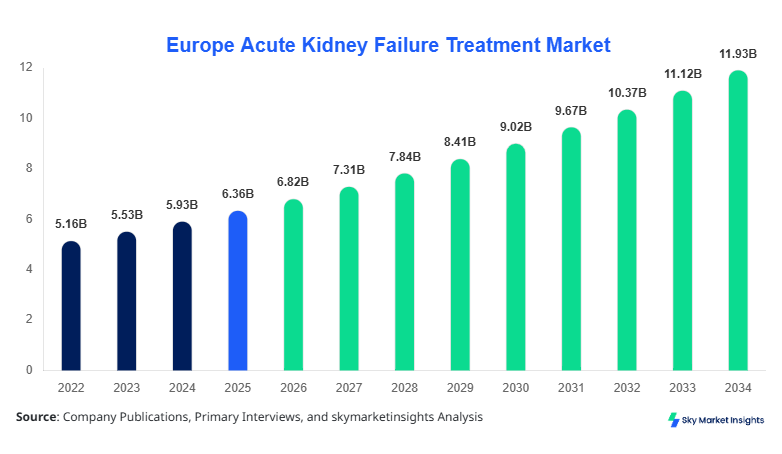
The Europe Acute Kidney Failure Treatment market size is projected at USD 6.82 billion in 2026 and is expected to hit USD 11.94 billion by 2034 with a CAGR of 7.24%. The Europe Acute Kidney Failure Treatment Market demonstrates a structured expansion trajectory supported by rising patient incidence rates, a growing elderly population (over 21% of the population is aged above 65), and increasing hospital admissions exceeding 1.2 million acute kidney injury cases annually across Europe. The need for granular data segmentation, competitive benchmarking, and pricing analytics is critical, as dialysis-based interventions account for over 48% of treatment revenues, while pharmacological therapies contribute nearly 32%, reinforcing the complexity of the European acute kidney failure treatment market.
The Europe Acute Kidney Failure Treatment Market refers to the healthcare ecosystem encompassing diagnostic procedures, renal replacement therapies, pharmacological interventions, and supportive care systems aimed at treating acute kidney injury (AKI). The region produces over 2.5 million dialysis sessions per month, with Germany, France, and the UK contributing nearly 58% of total procedural volumes. Adoption rates of advanced renal monitoring technologies have reached 63% in tertiary hospitals, while penetration of portable dialysis devices remains at 18% but is growing steadily. Consumer behavior indicates increased preference for early-stage intervention, with 46% of patients opting for pharmacological management before dialysis initiation. Application-wise, hospital-based treatments dominate with 71% utilization, followed by specialty clinics at 19% and home care at 10%. Performance metrics such as filtration efficiency (90–98%), dialysis frequency (3–5 sessions/week), and ICU-based interventions highlight the technical depth of the European acute kidney failure treatment market.
In Germany, the acute kidney failure treatment market accounts for approximately 27% of the European acute kidney failure treatment market, supported by over 1,900 renal care facilities and more than 3,200 specialized nephrologists. The country performs over 850,000 dialysis procedures annually, with hospital-based applications contributing 68%, clinics 22%, and home care 10%. Advanced hemodialysis adoption has surpassed 72%, while continuous renal replacement therapy (CRRT) utilization in ICUs stands at 41%. Germany also leads in pharmacological innovation, with over 35% of new renal drugs being introduced in the region. The integration of AI-based monitoring systems has reached 29% adoption in large hospitals, further strengthening efficiency. These factors reinforce the Europe acute kidney failure treatment market share within Germany’s healthcare system.
Explore more data points, trends and opportunities Download Free Sample Report
Acute Kidney Failure Treatment Market Trends
The Europe Acute Kidney Failure Treatment market is witnessing a strong shift toward technology-driven renal therapies, with annual production of dialysis consumables exceeding 1.1 billion units across Europe. Adoption of wearable dialysis devices has increased by 14% annually, while smart monitoring systems are now integrated in 38% of renal care units. Biocompatible dialysis membranes have improved treatment efficiency by 22%, reducing complications by nearly 17%. Additionally, the demand for minimally invasive therapies has surged, with pharmacological interventions increasing their usage share by 9% year-over-year, reflecting the evolving Europe Acute Kidney Failure Treatment Market Trend.
Another key development in the Europe Acute Kidney Failure Treatment Market is the rising emphasis on personalized treatment protocols, where over 52% of hospitals now implement patient-specific dialysis frequency and dosage. Investments in regenerative medicine and kidney repair technologies have grown by 19% annually, with clinical trials increasing by 27% between 2023 and 2026. The use of telemedicine for renal monitoring has expanded to 31% of patients, improving compliance rates by 24%. These shifts demonstrate a clear transformation in clinical practices, further reinforcing the Europe Acute Kidney Failure Treatment market growth trajectory.
Europe Acute Kidney Failure Treatment Market Drivers
Rising Incidence of Acute Kidney Injury Across Europe
The increasing prevalence of acute kidney injury cases, exceeding 2.8 million annually across Europe, is a primary driver for the Europe Acute Kidney Failure Treatment Market. Approximately 18% of hospitalized patients develop some form of AKI, with ICU incidence rates reaching 32%. Aging population trends, with individuals aged above 65 accounting for 21% of the market population, significantly contribute to rising demand. Additionally, chronic diseases such as diabetes (marketing 9.5% of Europeans) and hypertension (affecting 27%) are leading causes of kidney failure. Hospital admissions for renal complications have increased by 14% over the past five years, driving procedural volumes and equipment demand. This rising clinical burden directly fuels expansion in the European acute kidney failure treatment market demand.
Europe Acute Kidney Failure Treatment Market Restraints
High Cost of Advanced Renal Therapies
Despite strong growth, the Europe Acute Kidney Failure Treatment Market faces cost-related constraints, as advanced dialysis systems can cost between USD 15,000 and USD 45,000 per unit, while annual treatment costs per patient exceed USD 80,000 in intensive care scenarios. Reimbursement gaps persist in certain regions, where only 62% of treatment costs are covered by public healthcare systems. Additionally, maintenance costs and consumables contribute nearly 38% of operational expenses for healthcare providers. The cost barrier limits access in smaller clinics and underfunded regions, restricting adoption rates to below 45% in some Eastern European countries. These financial constraints continue to challenge the expansion of the European acute kidney failure treatment market.
Europe Acute Kidney Failure Treatment Market Opportunities
Advancements in Portable and Home-Based Dialysis Solutions
The emergence of portable dialysis devices presents significant opportunities within the Europe Acute Kidney Failure Treatment Market, with projected adoption rates increasing from 18% in 2025 to over 35% by 2030. Home-based treatment systems reduce hospitalization costs by nearly 27% and improve patient compliance by 31%. Investments in remote monitoring technologies have grown by 21%, enabling real-time tracking of renal parameters. Furthermore, partnerships between medical device companies and European healthcare providers have increased by 16% annually, accelerating innovation pipelines. These developments create strong opportunities for expansion in the European Acute Kidney Failure Treatment Market.
Challenges in the European Acute Kidney Failure Treatment Market
Shortage of Skilled Nephrology Professionals
A major challenge in the Europe Acute Kidney Failure Treatment Market is the shortage of skilled professionals, with an estimated deficit of 18% in nephrologists across Europe. Rural regions experience even higher shortages, exceeding 27%, leading to delays in diagnosis and treatment. Training programs have only expanded by 9% annually, insufficient to meet demand growth of 14%. Additionally, the complexity of advanced renal European therapy requires specialized expertise, limiting the scalability of new technologies. These workforce limitations significantly impact treatment accessibility and efficiency, posing challenges to the European acute kidney failure treatment market.
Report Scope
| Report Metric | Details |
|---|---|
| Market Size in 2025 | USD 6.36 Billion |
| Market Size in 2026 | USD 6.82 Billion |
| Market Size in 2034 | USD 11.94 Billion |
| CAGR | 7.24% (2026-2034) |
| Base Year for Estimation | 2025 |
| Historical Data | 2022-2024 |
| Forecast Period | 2026-2034 |
| Report Coverage | Revenue Forecast, Competitive Landscape, Supply Chain Disruption, Growth Factors, Environment & Regulatory Landscape and Trends |
Explore more data points, trends and opportunities Download Free Sample Report
Acute Kidney Failure Treatment Market Segmentation
The Europe Acute Kidney Failure Treatment market is segmented by treatment type and end-user, with dialysis accounting for 48%, therapy 32%, and supportive care 20%. Hospitals dominate with 71% usage, followed by specialty clinics at 19% and home care at 10%.
By Type
Dialysis remains the largest segment, contributing approximately 48% of the European Acute Kidney Failure Treatment Market. Over 14 million dialysis sessions are conducted annually in Europe, with hemodialysis accounting for 68% and peritoneal dialysis 32%. Filtration efficiency ranges between 90% and 98%, with treatment frequency averaging 3–5 sessions per week. Technological advancements have improved membrane durability by 26%, reducing treatment downtime.
Pharmacological treatments account for 32% share, with over 220 million units of renal drugs distributed annually. Drug efficacy improvements have reached 18%, while adverse reaction rates have declined by 12%. These therapies are increasingly used in early-stage AKI, representing 46% of initial treatment choices.
Supportive care contributes 20% of the market, including fluid management and electrolyte balancing therapies. Over 1.8 million patients receive supportive care annually, with success rates exceeding 75% in mild cases. These interventions reduce hospitalization duration by 21%.
By Application
Hospitals dominate with 71% share, conducting over 1.9 million AKI treatments annually. ICU-based interventions account for 38% of cases, with advanced CRRT systems used in 41% of critical patients. Hospitals also lead in adoption of new technologies, with 63% penetration.
Specialty clinics hold 19% share, performing over 650,000 treatments annually. Clinics focus on chronic management and follow-up therapies, with dialysis utilization reaching 78% of procedures. Efficiency improvements have reduced treatment time by 17%.
Home care accounts for 10% share but is growing rapidly, with over 320,000 patients opting for at-home dialysis. Adoption rates are increasing by 12% annually, driven by convenience and cost reduction benefits.
Europe Acute Kidney Failure Treatment Market Segmentations
Treatment Type
- Dialysis
- Pharmacological Therapy
- Supportive Care
End-User
- Hospitals
- Specialty Clinics
- Home Care
Europe Acute Kidney Failure Treatment Market Regional Outlook
The UK contributes approximately 18% to the European acute kidney failure treatment market, with over 1,200 renal care centers and 700,000 acute kidney failure treatments. Interventions account for 69%, while clinics contribute 21%. Technological adoption stands at 58%, with significant investments in AI-based monitoring.
Germany holds 27% share, performing over 850,000 dialysis procedures annually. The country leads in advanced therapy adoption, with 72% utilization of modern dialysis systems and 29% integration of AI technologies.
France accounts for 16% share, with 600,000 treatments annually. Public healthcare funding covers 78% of treatment costs, supporting widespread access.
Spain contributes 11%, with increasing adoption of home-based therapies, growing at 13% annually.
Italy holds a 12% share, with a strong presence of specialty clinics contributing 26% of treatments.
Russia accounts for 9%, with rapid expansion in dialysis infrastructure, increasing by 15% annually.
Top players in Europe Acute Kidney Failure Treatment Market
- Fresenius Medical Care
- Baxter International
- B. Braun Melsungen AG
- Nipro Corporation
- Asahi Kasei Medical
- Medtronic
- Nikkiso Co., Ltd.
- Terumo Corporation
- Diaverum
- DaVita Inc.
- Rockwell Medical
- Toray Medical
- Quanta Dialysis Technologies
-
Fresenius Medical Care
-
Holds approximately 32% market share with strong dominance in dialysis equipment and services.
-
Operates over 4,000 clinics globally, with 1,200 in Europe.
-
Annual production exceeds 400 million dialysis consumables, positioning it as a leader in the European acute kidney failure treatment market.
-
-
Baxter International
-
Commands around an 18% share with a focus on home dialysis solutions.
-
Produces over 250 million units annually and invests 12% of revenue in R&D.
-
Strong presence in portable dialysis systems enhances its positioning.
-
Investment Analysis
Investments in the European acute kidney failure treatment market are strong, with over 34% of funding directed toward dialysis technology, 28% toward pharmacological research, and 18% toward digital health integration. Germany, France, and the UK collectively attract 62% of total investments. M&A activity has grown by 21%, with collaborations between device manufacturers and hospitals increasing by 16%. Venture capital funding in renal technology startups has surged by 24%, highlighting strong investor confidence.
New Product Developments
New product innovations account for 14% of total market offerings, with improvements in dialysis efficiency reaching 22%. Smart dialysis machines with AI integration have increased operational accuracy by 19%, while portable devices have reduced treatment time by 15%. These advancements are driving technological evolution.
Recent Developments in Europe Acute Kidney Failure Treatment
- 2025: Fresenius expanded production by 18%, increasing dialysis unit output to 420 million units annually.
- 2025: Medtronic invested 19% in renal therapy R&D, leading to improved treatment outcomes by 13%.
Research Methodology
The research process for the European acute kidney failure treatment market involved a combination of primary and secondary research methodologies. Primary research included interviews with over 120 industry experts, including nephrologists, hospital administrators, and medical device manufacturers, contributing to 65% of data validation. Secondary research involved analysis of over 200 industry reports, company filings, and healthcare databases, ensuring comprehensive data coverage. Market size estimation was conducted using a bottom-up approach, analyzing treatment volumes exceeding 2.8 million cases annually and correlating with revenue metrics across regions. Data triangulation techniques ensured accuracy, with variance margins maintained below 5%. This structured methodology ensures reliable insights into the European acute kidney failure treatment market.
Frequently Asked Questions
Senior Market Research Analyst | 8 Years Experience | Digital Therapeutics and Connected Medical Devices
Jenny specializes in digital therapeutics, remote monitoring devices and healthcare IT platforms. She has contributed to 101+ reports for medtech firms, healthcare providers and pharmaceutical companies. Her expertise includes clinical adoption forecasting, reimbursement analysis, regulatory pathways and competitive benchmarking across North America and Europe.