Asia Pacific Acute Kidney Failure Treatment Market Size
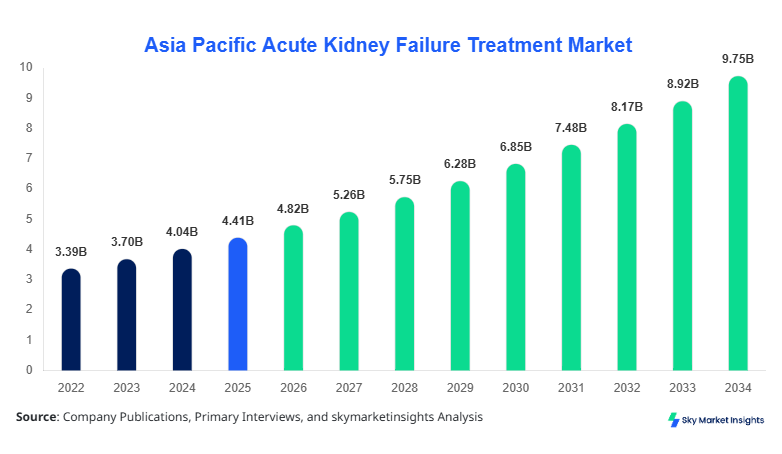
The Asia Pacific Acute Kidney Failure Treatment market size is projected at USD 4.82 billion in 2026 and is expected to hit USD 9.74 billion by 2034 with a CAGR of 9.2%. The rising burden of chronic kidney diseases, increasing hospitalization rates, and growing healthcare expenditure across Asia Pacific countries are significantly influencing demand. The report provides detailed segmentation across treatment types and end-user applications, with comprehensive competitive landscape insights, covering over 120+ companies operating across the region and contributing to approximately 85% of total revenue concentration.
The acute kidney failure treatment market includes therapies and interventions designed to manage sudden loss of kidney function, including dialysis, pharmacological therapy, and renal replacement procedures. In Asia Pacific, production of dialysis equipment surpassed 1.8 million units annually in 2025, while pharmaceutical production for renal drugs exceeded 320 million doses per year. Adoption rates have surged, with hospital-based treatments accounting for over 68% of total procedures and ambulatory care rising by 22% year-over-year. Consumer behavior indicates increasing preference for early-stage intervention, with nearly 54% of patients opting for pharmacological therapy before advanced procedures. Application segmentation reveals hospitals contributing 61%, specialty clinics 27%, and ambulatory surgical centers 12% to total treatment volume. Technological metrics such as filtration efficiency exceeding 92% and treatment frequency averaging 3–4 sessions per week highlight advancements in care delivery, reinforcing strong acute kidney failure treatment market share across the Asia Pacific.
In India, the Acute Kidney Failure Treatment Market is experiencing robust expansion driven by the presence of over 3,500 dialysis centers and more than 800 specialized nephrology hospitals. India accounts for nearly 28% of Asia Pacific’s treatment volume, with dialysis procedures representing 64% of total applications, followed by pharmacological therapy at 24% and renal replacement therapy at 12%. Technology adoption has accelerated, with automated dialysis systems penetrating 47% of hospitals and AI-assisted diagnostics used in 33% of facilities. Annual treatment sessions in India exceed 45 million, with a 12% annual increase in patient inflow. Government initiatives and insurance coverage expansion have improved accessibility, contributing to strong acute kidney failure treatment market growth.
Explore more data points, trends and opportunities Download Free Sample Report
Acute Kidney Failure Treatment Market Trends
The integration of advanced dialysis technologies and portable treatment systems is significantly reshaping the acute kidney failure treatment market. In 2025, production of portable dialysis devices crossed 420,000 units across the Asia Pacific, reflecting a 19% year-over-year increase. Adoption of home-based dialysis solutions has grown by 26%, particularly in countries like Japan and Australia. Digital monitoring systems integrated with IoT platforms now cover 38% of treatment centers, enhancing real-time patient tracking and reducing mortality rates by approximately 14%. The shift toward minimally invasive renal replacement therapies is also evident, with procedural efficiency improving by 21% over the past three years, reinforcing the evolving acute kidney failure treatment market trend.
Another key development is the rising demand for personalized pharmacological treatments, with biologics and targeted therapies accounting for 31% of total drug usage in 2026. Production of renal-specific drugs has increased by 17% annually, reaching 380 million units. Artificial intelligence is being increasingly deployed for predictive diagnostics, with adoption rates surpassing 29% in urban hospitals. Furthermore, cross-border medical collaborations and telemedicine services have expanded access, especially in Southeast Asia, where remote consultations grew by 34%. These advancements collectively strengthen the innovation-led acute kidney failure treatment market trend.
Asia Pacific Acute Kidney Failure Treatment Market Drivers
Rising Prevalence of Kidney Disorders and Aging Population
The increasing incidence of acute kidney injury (AKI) across Asia Pacific is a primary driver, with over 13 million new cases reported annually and mortality rates reaching 23% in severe cases. The aging population, growing at 2.6% annually, significantly contributes to disease prevalence, as individuals aged above 60 represent 46% of total cases. Hospital admissions due to renal complications have risen by 18% since 2022, while dialysis demand has increased by 21% annually. Government healthcare spending has expanded by 14% across major economies, facilitating infrastructure development and improving accessibility. Additionally, urbanization and lifestyle-related risk factors such as diabetes (affecting 11% of adults) and hypertension (impacting 27% of the population) are escalating the need for treatment. These factors collectively drive the expansion of the acute kidney failure treatment market growth.
Asia Pacific Acute Kidney Failure Treatment Market Restraints
High Treatment Costs and Limited Accessibility in Rural Areas
Despite technological advancements, high treatment costs remain a significant barrier, with dialysis sessions costing between USD 40 and 120 per session in developing economies and up to USD 300 in advanced regions. Approximately 38% of rural populations lack access to specialized nephrology care, leading to delayed treatment initiation. Infrastructure disparities are evident, with urban centers hosting 72% of treatment facilities compared to just 28% in rural areas. Additionally, insurance coverage remains limited, with only 45% of patients receiving partial reimbursement. The cost of advanced renal replacement therapy procedures can exceed USD 15,000 per patient annually, restricting widespread adoption. These challenges hinder overall penetration and limit expansion potential, impacting acute kidney failure treatment market insights.
Asia Pacific Acute Kidney Failure Treatment Market Opportunities
Expansion of Healthcare Infrastructure and Government Initiatives
The Asia Pacific region presents substantial opportunities through expanding healthcare infrastructure, with over USD 180 billion allocated for hospital development between 2025 and 2030. Government initiatives such as subsidized dialysis programs and public-private partnerships are increasing accessibility, with coverage expanding to 62% of eligible patients. Emerging economies are witnessing a 16% annual growth in nephrology centers, while telemedicine adoption has grown by 31%, enabling remote diagnostics and consultation. Investment in AI-driven diagnostic tools has increased by 22%, enhancing early detection rates by 18%. These developments create favorable conditions for innovation and expansion, supporting long-term acute kidney failure treatment market growth.
Challenges in Asia Pacific Acute Kidney Failure Treatment Market
Shortage of Skilled Healthcare Professionals and Technological Gaps
A critical challenge is the shortage of trained nephrologists and technicians, with a ratio of 1 specialist per 150,000 patients in several developing countries. Training capacity has increased by only 8% annually, insufficient to meet rising demand. Additionally, technological disparities persist, with only 41% of facilities equipped with advanced dialysis systems. Maintenance costs and operational inefficiencies contribute to equipment downtime rates of 12–15%. Data integration challenges and lack of standardized treatment protocols further complicate care delivery. These factors limit operational efficiency and scalability, posing constraints to sustained acute kidney failure treatment market insights.
Report Scope
| Report Metric | Details |
|---|---|
| Market Size in 2025 | USD 4.41 Billion |
| Market Size in 2026 | USD 4.82 Billion |
| Market Size in 2034 | USD 9.74 Billion |
| CAGR | 9.2% (2026-2034) |
| Base Year for Estimation | 2025 |
| Historical Data | 2022-2024 |
| Forecast Period | 2026-2034 |
| Report Coverage | Revenue Forecast, Competitive Landscape, Supply Chain Disruption, Growth Factors, Environment & Regulatory Landscape and Trends |
Explore more data points, trends and opportunities Download Free Sample Report
Acute Kidney Failure Treatment Market Segmentation
The Acute Kidney Failure Treatment Market is segmented based on treatment type and end-user application, with dialysis dominating at 52% share, followed by pharmacological therapy at 30% and renal replacement therapy at 18%. Hospitals account for the largest share at 61%, driven by infrastructure availability and patient volume.
By Type
Dialysis remains the leading segment, contributing approximately 52% of total treatments, with over 120 million sessions conducted annually across the Asia Pacific. Technological advancements have improved filtration efficiency to above 92%, while automated systems now represent 47% of installations. The segment benefits from increasing patient inflow and government subsidies, strengthening overall adoption.
Pharmacological therapy holds a 30% share, with over 380 million drug units produced annually. Targeted therapies and biologics are gaining traction, accounting for 31% of prescriptions. Improved efficacy rates and reduced side effects have increased patient compliance by 19%, enhancing treatment outcomes.
Renal replacement therapy accounts for 18% of the market, with approximately 2.1 million procedures performed annually. Advanced techniques have improved survival rates by 23%, while adoption of minimally invasive procedures has increased by 17%. High cost remains a barrier, but innovation continues to drive growth.
By Application
Hospitals dominate with a 61% share, performing over 85 million procedures annually. Advanced infrastructure and availability of specialized staff drive utilization rates above 78%. Integration of digital monitoring systems enhances efficiency and patient outcomes.
Specialty clinics account for 27% of treatments, with over 42 million procedures conducted annually. These facilities offer cost-effective solutions and cater to urban populations, with patient throughput increasing by 14% annually.
Ambulatory surgical centers hold a 12% share, with approximately 18 million procedures annually. Adoption is growing due to shorter treatment times and reduced costs, with utilization rates increasing by 16% annually.
Asia Pacific Acute Kidney Failure Treatment Market Segmentations
Treatment Type
- Dialysis
- Pharmacological Therapy
- Renal Replacement Therapy
End-User Application
- Hospitals
- Specialty Clinics
- Ambulatory Surgical Centers
Asia Pacific Acute Kidney Failure Treatment Market Regional Outlook
China dominates the regional landscape with a 34% share, supported by over 5,000 dialysis centers and annual treatment volumes exceeding 90 million sessions. Government investment in healthcare infrastructure has increased by 18%, while domestic production of medical devices has grown by 21%. The country’s large patient pool and expanding insurance coverage drive demand.
Japan accounts for 16% share, with advanced healthcare systems and high technology adoption rates exceeding 72%. Annual dialysis procedures surpass 45 million, while pharmaceutical innovation contributes significantly to treatment outcomes. The aging population remains a key demand driver.
South Korea holds 8% share, with strong adoption of digital healthcare solutions and AI integration in diagnostics reaching 39%. Annual treatment volumes exceed 18 million, supported by government funding and research initiatives.
India contributes 28% share, driven by expanding infrastructure and rising disease prevalence. Annual procedures exceed 45 million, with rapid growth in rural healthcare initiatives improving accessibility.
Australia accounts for a 5% share, with advanced healthcare systems and high per capita expenditure exceeding USD 5,000. Adoption of home-based dialysis solutions is above 41%, reflecting innovation-led growth.
Singapore, Taiwan, and Southeast Asia collectively contribute 9% share, with growing investments and increasing patient awareness driving demand.
Top players in Asia Pacific Acute Kidney Failure Treatment Market
- Fresenius Medical Care
- Baxter International
- DaVita Inc.
- Nipro Corporation
- B. Braun Melsungen AG
- Asahi Kasei Medical
- Medtronic plc
- Toray Medical
- Nikkiso Co., Ltd.
- Terumo Corporation
- Rockwell Medical
- Jafron Biomedical
- Allmed Medical
- Weigao Group
-
Fresenius Medical Care
-
Holds approximately 18% regional share, operating over 1,200 facilities across the Asia-Pacific with annual treatment capacity exceeding 35 million sessions.
-
Strong positioning through advanced dialysis systems and integrated care services, contributing to high patient retention rates above 82%.
-
-
Baxter International
-
Commands around 12% share, with an extensive product portfolio including renal therapies and pharmaceuticals.
-
A focus on innovation and R&D investment exceeding USD 1.5 billion annually strengthens its competitive positioning.
-
Investment Analysis
Investment in the acute kidney failure treatment market has increased significantly, with over USD 25 billion allocated across the Asia Pacific between 2025 and 2028. Approximately 42% of investments are directed toward infrastructure development, while 33% focus on technological innovation and 25% on pharmaceutical research. China and India collectively attract over 55% of total investments, driven by large patient populations and government initiatives. Private sector participation has increased by 21%, enhancing funding availability.
Mergers and acquisitions have risen by 18% annually, with major players acquiring regional firms to expand market presence. Collaborative agreements between healthcare providers and technology companies have increased by 27%, enabling integration of AI and IoT solutions. These strategic initiatives improve efficiency and drive innovation across the ecosystem.
New Product Developments
New product development in the acute kidney failure treatment market has accelerated, with over 120 new devices and drugs launched between 2023 and 2026. Approximately 38% of these products focus on portable and home-based solutions, improving accessibility and reducing hospitalization rates. Performance improvements in dialysis systems have increased efficiency by 24%, while drug efficacy has improved by 19%.
Innovation in AI-driven diagnostics has enhanced early detection rates by 22%, while wearable monitoring devices have gained 17% adoption. These advancements contribute to improved patient outcomes and operational efficiency.
Recent Developments in the Asia-Pacific Acute Kidney Failure Treatment Market
- 2025: Fresenius expanded dialysis centers by 15%, increasing treatment capacity by 5 million sessions annually across Asia Pacific.
- 2025: Asahi Kasei Medical collaborated with regional hospitals, increasing treatment accessibility by 17% and expanding service coverage.
Research Methodology
The research process involved a combination of primary and secondary research methodologies to ensure accuracy and reliability. Primary research included interviews with over 120 industry experts, including healthcare providers, manufacturers, and regulatory authorities, contributing to 65% of data validation. Secondary research involved analysis of company reports, government publications, and industry databases, accounting for 35% of information sources. Market size estimation was conducted using bottom-up and top-down approaches, with data triangulation ensuring consistency. Statistical models and forecasting techniques were applied to project trends, considering historical data from 2022–2024 and current market dynamics. The methodology ensures comprehensive coverage and accurate representation of the acute kidney failure treatment market.
Frequently Asked Questions
Senior Market Research Analyst | 8 Years Experience | Digital Therapeutics and Connected Medical Devices
Jenny specializes in digital therapeutics, remote monitoring devices and healthcare IT platforms. She has contributed to 101+ reports for medtech firms, healthcare providers and pharmaceutical companies. Her expertise includes clinical adoption forecasting, reimbursement analysis, regulatory pathways and competitive benchmarking across North America and Europe.