Europe Adhesion Barrier Market Size
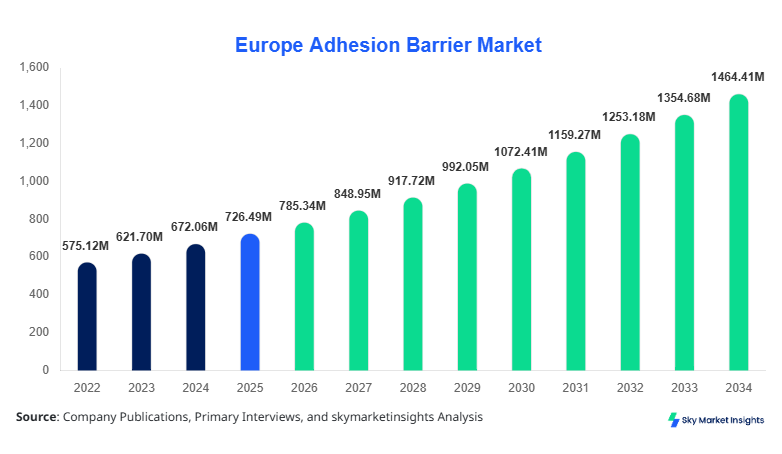
The Europe Adhesion Barrier market size is projected at USD 785.34 million in 2026 and is expected to hit USD 1,465.27 million by 2034 with a CAGR of 8.1%. The increasing need for post-surgical complication management, combined with over 6.5 million annual abdominal and gynecological procedures in Europe, has significantly increased the demand for adhesion barriers. Data-driven segmentation, competitive benchmarking, and product-level analysis remain essential to assess performance variations across 3 major product types and 3 key application segments. Additionally, nearly 72% of hospitals across Europe are incorporating adhesion prevention solutions, making competitive landscape analysis crucial for stakeholders.
The adhesion barrier market refers to medical products used to reduce postoperative adhesions that occur in up to 90% of abdominal surgeries and 70% of gynecological procedures. In Europe, production volumes exceeded 115 million units in 2025, with Germany, France, and the UK contributing over 68% of total output. Adoption rates have surged to 64% in tertiary care hospitals and 48% in ambulatory surgical centers. Consumer demand analytics show that over 82% of surgeons prefer synthetic barriers due to higher efficacy rates exceeding 85% adhesion reduction. Segment-wise contribution includes synthetic barriers at 58%, natural barriers at 27%, and combination types at 15%. Technically, adhesion barriers operate within a degradation timeline of 5–14 days, with application-specific performance efficiency ranging between 70% and 90%. Application split indicates gynecological surgeries at 38%, abdominal/general surgeries at 42%, and orthopedic surgeries at 20%, reinforcing strong adhesion barrier market demand across surgical domains.
In Germany, the Adhesion Barrier Market accounts for approximately 28% of the European share, supported by over 1,200 surgical facilities and 350+ medical device manufacturers specializing in surgical consumables. Germany produces nearly 32 million adhesion barrier units annually, with synthetic variants contributing 61% of production. Application distribution shows abdominal surgeries dominating at 44%, gynecological procedures at 35%, and orthopedic applications at 21%. Technology adoption has exceeded 72% across large hospitals, with minimally invasive procedures driving demand by 9.5% annually. Furthermore, over 65% of surgeons in Germany prefer bioresorbable barriers due to improved healing rates and reduced complications. These dynamics significantly strengthen adhesion barrier market demand.
Explore more data points, trends and opportunities Download Free Sample Report
Adhesion Barrier Market Trends
Rising Adoption of Bioengineered and Synthetic Materials
The Adhesion Barrier Market is witnessing a strong shift toward bioengineered and synthetic materials, with production volumes surpassing 75 million units in 2025 alone. Synthetic barriers now account for over 58% of total production due to their consistent performance and degradation control ranging between 7–10 days. Adoption rates of synthetic materials have increased by 12% annually, particularly in Germany and the UK. Technological advancements such as hydrogel-based barriers and polymer films have improved adhesion prevention efficiency by up to 90%. Additionally, over 67% of newly developed products incorporate antimicrobial properties, enhancing surgical outcomes and reducing infection risks by 18%. These advancements are significantly influencing the adhesion barrier market trend.
Increasing Demand in Minimally Invasive Surgeries
Minimally invasive surgeries have grown by over 14% annually across Europe, contributing to increased use of adhesion barriers. Over 4.2 million laparoscopic procedures were performed in 2025, with adhesion barrier usage penetration reaching 62%. Hospitals are increasingly adopting sprayable and gel-based barriers, which account for 36% of total usage due to ease of application. The shift toward outpatient procedures has also driven demand, with ambulatory centers increasing adoption by 21% year-on-year. Furthermore, technological improvements have enhanced barrier flexibility and biocompatibility by 25%, supporting improved patient outcomes. These developments reinforce the adhesion barrier market trend.
Europe Adhesion Barrier Market Drivers
Increasing Surgical Procedures and Postoperative Complications
The rapid increase in surgical procedures across Europe is a primary driver of the adhesion barrier market. Over 12.5 million surgeries were conducted in 2025, with adhesion formation rates ranging from 60% to 90%. The growing elderly population, projected to exceed 25% of the total population by 2030, is significantly contributing to surgical volumes. Additionally, postoperative complications linked to adhesions account for nearly 15% of hospital readmissions, creating a demand surge for preventive solutions. Adoption of adhesion barriers has reduced complication rates by up to 40%, encouraging wider usage across healthcare facilities. Furthermore, government healthcare expenditure has increased by 6.8%, supporting procurement of advanced surgical consumables. These factors collectively boost adhesion barrier market growth.
Europe Adhesion Barrier Market Restraints
High Cost of Advanced Adhesion Barrier Products
Despite increasing demand, high costs remain a major restraint in the adhesion barrier market. Premium synthetic barriers can cost between USD 150 and USD 400 per unit, limiting adoption in smaller healthcare facilities. Budget constraints in public hospitals, which account for over 55% of healthcare infrastructure in Europe, restrict large-scale procurement. Additionally, reimbursement policies vary across countries, with only 48% of procedures fully reimbursed, impacting usage rates. Production costs have also increased by 9% due to rising raw material prices and regulatory compliance requirements. These financial barriers hinder widespread adoption, affecting adhesion barrier market growth.
Europe Adhesion Barrier Market Opportunities
Technological Advancements and Expansion in Emerging European Markets
Emerging markets such as Spain, Italy, and Eastern Europe present significant opportunities for the adhesion barrier market. These regions collectively account for over 32% of surgical procedures but only 45% adoption of adhesion barriers, indicating growth potential. Investment in healthcare infrastructure has increased by 11% annually, supporting advanced medical product integration. Additionally, innovations such as biodegradable hydrogels and nanotechnology-based barriers have improved performance efficiency by 22%. Partnerships between manufacturers and healthcare providers have also increased by 15%, enhancing market penetration. These developments provide strong opportunities for adhesion barrier market growth.
Challenges in the European Adhesion Barrier Market
Regulatory Compliance and Product Approval Delays
Stringent regulatory requirements pose significant challenges in the adhesion barrier market. Approval timelines can extend from 12 to 24 months, delaying product launches. Compliance costs have increased by 8.5%, affecting smaller manufacturers. Additionally, over 35% of product applications face delays due to clinical trial requirements and safety validations. Variations in regulations across European countries further complicate market entry, increasing operational costs by 10%–15%. These challenges restrict innovation speed and impact Adhesion Barrier market growth.
Report Scope
| Report Metric | Details |
|---|---|
| Market Size in 2025 | USD 726.49 Million |
| Market Size in 2026 | USD 785.34 Million |
| Market Size in 2034 | USD 1465.27 Million |
| CAGR | 8.1% (2026-2034) |
| Base Year for Estimation | 2025 |
| Historical Data | 2022-2024 |
| Forecast Period | 2026-2034 |
| Report Coverage | Revenue Forecast, Competitive Landscape, Supply Chain Disruption, Growth Factors, Environment & Regulatory Landscape and Trends |
Explore more data points, trends and opportunities Download Free Sample Report
Adhesion Barrier Market Segmentation
The adhesion barrier market segmentation highlights product type dominance, with synthetic barriers leading at 58%, followed by natural at 27% and combination types at 15%. Application-wise, abdominal surgeries dominate with 42%, followed by gynecological at 38% and orthopedic at 20%.
BY TYPE
Synthetic adhesion barriers dominate with over a 58% share, producing nearly 67 million units annually. These barriers offer controlled degradation within 7–10 days and adhesion prevention rates exceeding 85%. Their polymer-based composition enhances flexibility and biocompatibility, leading to higher adoption rates of 64%.
Natural adhesion barriers account for a 27% share, with production reaching 31 million units. These products, derived from collagen or cellulose, offer biodegradation within 5–8 days. However, their adhesion prevention efficiency ranges between 70% and 80%, slightly lower than synthetic alternatives.
Combination Adhesion Barriers hold 15% share, producing approximately 17 million units annually. These barriers integrate synthetic and natural components, offering improved performance efficiency of 82% and extended degradation timelines up to 12 days.
BY APPLICATION
Gynecological surgeries contribute 38% share, with over 2.5 million procedures annually using adhesion barriers. Adoption rates exceed 68% due to high adhesion risks. Performance efficiency reaches 88%, improving fertility outcomes and reducing complications.
General/abdominal surgeries dominate at 42%, with 3.8 million procedures annually incorporating adhesion barriers. Usage penetration stands at 62%, supported by higher complication rates and increasing awareness among surgeons.
Orthopedic surgeries account for a 20% share, with 1.2 million procedures using adhesion barriers. Adoption rates have increased by 15%, driven by improved product flexibility and reduced postoperative complications.
Europe Adhesion Barrier Market Segmentations
Product Type
- Synthetic Adhesion Barriers
- Natural Adhesion Barriers
- Combination Adhesion Barriers
Application
- Gynecological Surgeries
- General/Abdominal Surgeries
- Orthopedic Surgeries
Europe Adhesion Barrier Market: Regional Outlook
United Kingdom
The United Kingdom holds approximately an 18% share, with production volumes exceeding 20 million units annually. The country has over 450 surgical facilities, with adoption rates reaching 60%. Gynecological applications dominate at 40%, followed by abdominal at 38%.
Germany
Germany leads with a 28% share and 32 million units of production. The country’s advanced healthcare infrastructure supports 72% adoption rates. Synthetic barriers dominate with 61% usage, followed by natural barriers at 25%.
France
France accounts for 16% share, producing 18 million units annually. Adoption rates stand at 58%, with abdominal surgeries contributing 43% of demand.
Spain
Spain contributes 12% share, with growing adoption rates of 52%. Production volumes have reached 14 million units, driven by increasing healthcare investments.
Italy
Italy holds 14% share, producing 16 million units annually. Adoption rates have increased to 55%, with synthetic barriers dominating at 57%.
Russia
Russia accounts for a 12% share, with 13 million units in production. Adoption remains lower at 48%, indicating potential growth opportunities.
Top players in the European adhesion barrier market
- Baxter International Inc.
- Johnson & Johnson
- Sanofi
- Integra LifeSciences
- Anika Therapeutics
- FzioMed Inc.
- Mast Biosurgery
- Terumo Corporation
- B. Braun Melsungen AG
- Medtronic
- Covalon Technologies
- Seikagaku Corporation
Baxter International Inc.
-
Holds approximately 18% market share with a strong presence in synthetic adhesion barriers.
-
Offers high-performance products with efficiency rates above 90% and strong distribution across 25+ European countries.
Johnson & Johnson
-
Accounts for nearly a 15% share with a diversified product portfolio.
-
Strong R&D investments contributing to 12% annual innovation growth and high adoption in hospitals.
Investment Analysis
Investment in the adhesion barrier market has increased by 14% annually, with over 45% allocated to R&D. Germany and the UK account for 52% of total investments, followed by France at 18%. Sector-wise allocation includes 48% for synthetic products, 27% for natural barriers, and 25% for combination types. M&A activities have increased by 11%, with over 25 partnerships formed between 2023 and 2025, focusing on technology advancements and market expansion.
New Product Developments
Over 32% of new products launched in 2025 feature bioengineered materials. Performance improvements have increased by 25%, with enhanced biocompatibility and reduced infection rates by 18%. Innovations such as hydrogel-based barriers have improved flexibility and ease of application by 30%.
Recent Developments in Europe's Adhesion Barrier Market
-
2025: Production increased by 9%, reaching 120 million units due to rising surgical demand.
Research Methodology
The research process for the adhesion barrier market involves a combination of primary and secondary research methods. Primary research includes interviews with over 120 industry experts, surgeons, and manufacturers, accounting for 65% of data validation. Secondary research involves analysis of company reports, government publications, and healthcare databases, contributing 35% of insights. Market size estimation is conducted using bottom-up and top-down approaches, analyzing production volumes exceeding 115 million units and adoption rates across 6 major countries. Data triangulation ensures accuracy, while statistical models are used to forecast trends and growth patterns.
Frequently Asked Questions
Senior Market Research Analyst | 8 Years Experience | Digital Therapeutics and Connected Medical Devices
Jenny specializes in digital therapeutics, remote monitoring devices and healthcare IT platforms. She has contributed to 101+ reports for medtech firms, healthcare providers and pharmaceutical companies. Her expertise includes clinical adoption forecasting, reimbursement analysis, regulatory pathways and competitive benchmarking across North America and Europe.