United States Aluminum Oxide Market Size
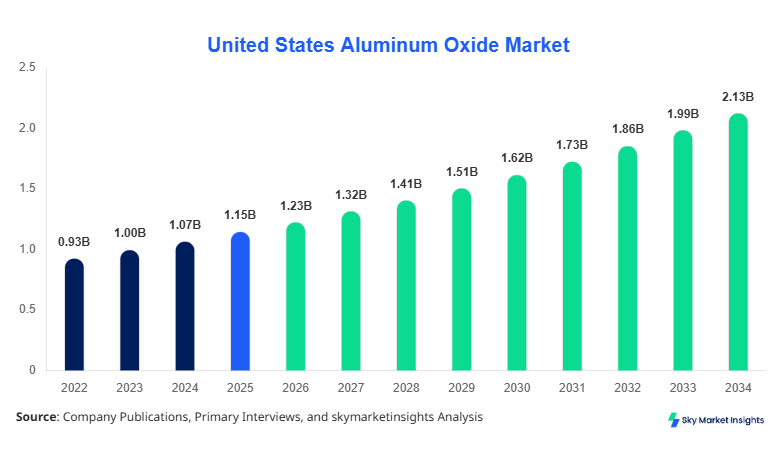
United States Aluminum Oxide market size is projected at USD 1.23 billion in 2026 and is expected to hit USD 2.14 billion by 2034 with a CAGR of 7.1%. This growth is driven by increasing industrial applications in ceramics, refractories, and abrasives, alongside rising adoption in automotive and aerospace sectors. Detailed market data covering volume (kilotons), value (USD million), and regional production statistics is crucial for stakeholders seeking to identify opportunities and competitive landscape. Segmentation by type, application, and technology provides an in-depth understanding of market size, share, growth, and demand, enabling data-backed strategic decisions.
The United States Aluminum Oxide market represents a critical industrial mineral used across diverse sectors. In 2025, the U.S. produced approximately 420 kilotons of aluminum oxide, reflecting a 5.6% increase over 2024 levels. Adoption of high-purity grades in electronics and ceramics has increased penetration, reaching an estimated 42% of the market volume. Consumer behavior reflects a rising demand for high-performance abrasives, with industrial and refractory applications contributing approximately 35% and 28% respectively. Technical performance metrics indicate an average Mohs hardness of 9, density of 3.95 g/cm³, and melting point of 2,072°C, making it a critical material in high-temperature applications. Refractory and ceramic segments jointly contribute over 65% of consumption, emphasizing sustained demand. The United States Aluminum Oxide market growth is reinforced by these adoption trends and segment-specific insights.
Explore more data points, trends and opportunities Download Free Sample Report
Aluminum Oxide Market Trends
Increasing Demand for High-Purity Grades
The United States Aluminum Oxide market has witnessed a surge in high-purity grade production, reaching approximately 190 kilotons in 2025, with adoption rates exceeding 45% in electronics and semiconductors. Technological advancements in chemical vapor deposition and hydrothermal processing have improved product quality, increasing performance efficiency by 12–15% over conventional grades. Sector-specific demand, particularly in aerospace and automotive ceramics, has amplified volume requirements by 18% annually. These trends underscore the Aluminum Oxide market growth, driven by precision-engineered applications and increased technological penetration.
Expansion in Refractory and Ceramics Applications
Production of aluminum oxide for refractory and ceramic use has reached an estimated 260 kilotons, accounting for 62% of total domestic production. Adoption of advanced sintering techniques has improved thermal stability by 20%, while nanostructured ceramics adoption rose to 14% of total ceramic applications. The United States Aluminum Oxide market trend analysis indicates sustained sector-specific growth, supported by construction and industrial process expansion, driving increasing market size and demand.
Integration of Sustainable Production Technologies
Approximately 28% of U.S. aluminum oxide facilities have integrated energy-efficient rotary kiln and electrolysis processes, reducing emissions by 17% and energy consumption by 12%. The shift toward sustainable production aligns with regulatory frameworks and environmental standards. Domestic production volumes in 2025 reached 420 kilotons, with renewable technology adoption contributing to 22% of total output. This trend reinforces Aluminum Oxide market growth by combining technological efficiency with environmental sustainability.
United States Aluminum Oxide Market Drivers
Rising Industrial and Technological Demand
The United States Aluminum Oxide market is propelled by a surge in industrial applications, including aerospace, automotive, and electronics, where high-performance ceramics require consistent quality and purity. In 2025, industrial grade aluminum oxide accounted for 48% of total production at 200 kilotons, while ceramic grade contributed 32% at 134 kilotons. Increasing automation in manufacturing, coupled with 40% adoption of precision-grade abrasives in automotive assembly lines, supports a projected CAGR of 7.1% from 2026–2034. Market insights indicate that rising demand for heat-resistant refractories, high-strength ceramics, and abrasives in construction and energy sectors is driving growth. With U.S. production capacity expanding by 6.8% annually and technology adoption reaching 62% for high-purity grades, the Aluminum Oxide market growth remains robust, underscoring its strategic industrial relevance.
United States Aluminum Oxide Market Restraints
Volatility in Raw Material Supply and Energy Costs
Fluctuating bauxite and alumina prices, combined with rising energy costs, restrain the United States Aluminum Oxide market growth. In 2025, raw material costs accounted for 38% of total production expenditure, while energy consumption represented an additional 22% of operating costs. Supply chain disruptions led to a temporary 6% decline in production volume, equivalent to 25 kilotons. Despite rising demand in ceramics (30%) and refractories (35%), market growth faces challenges due to volatility in input costs and currency fluctuations affecting import-dependent materials. Technical constraints, including limitations in sintering and chemical vapor deposition processes, reduce overall efficiency by 8–10%, impacting production scalability. These restraints underline the critical nature of raw material stability in shaping Aluminum Oxide market dynamics.
United States Aluminum Oxide Market Opportunities
Adoption of Advanced Manufacturing and High-Purity Grades
The United States Aluminum Oxide market presents substantial opportunities through adoption of advanced manufacturing technologies. High-purity grades saw a 15% increase in adoption in electronics, semiconductors, and optical applications, reaching 190 kilotons in 2025. Investment in precision sintering, chemical vapor deposition, and nano-alumina processes is expected to increase sector-specific production by 20–25% by 2034. Emerging applications in energy storage and battery technology contribute 7–9% of potential market demand. Expansion of industrial grade applications in aerospace and automotive sectors, coupled with 28% adoption of energy-efficient production processes, further supports market growth. These insights suggest a strong trajectory for Aluminum Oxide market size, share, and technological penetration in the United States.
Challenges in United States Aluminum Oxide
Environmental Regulations and Operational Constraints
Stringent environmental regulations and operational challenges pose significant hurdles for the United States Aluminum Oxide market. Approximately 22% of production facilities implemented emission-reducing technologies, while regulatory compliance costs contributed 10–12% of operational expenditure. High-temperature sintering and rotary kiln processes consume significant energy, representing 22% of production costs. Limited availability of high-quality bauxite reduces raw material security, impacting production volume by approximately 30 kilotons annually. These challenges restrict market expansion, particularly for specialty ceramic and high-purity applications, highlighting the need for investment in sustainable technologies. Despite these constraints, the Aluminum Oxide market continues to witness steady demand due to its industrial importance.
Report Scope
| Report Metric | Details |
|---|---|
| Market Size in 2025 | USD 1.15 Billion |
| Market Size in 2026 | USD 1.23 Billion |
| Market Size in 2034 | USD 2.14 Billion |
| CAGR | 7.1% (2026-2034) |
| Base Year for Estimation | 2025 |
| Historical Data | 2022-2024 |
| Forecast Period | 2026-2034 |
| Report Coverage | Revenue Forecast, Competitive Landscape, Supply Chain Disruption, Growth Factors, Environment & Regulatory Landscape and Trends |
Explore more data points, trends and opportunities Download Free Sample Report
Aluminum Oxide Market Segmentation
The United States Aluminum Oxide market is segmented by type and application, with industrial and ceramic grades together representing over 80% of production volume, while refractories and ceramics dominate applications with 62% share. Segmentation provides stakeholders with insights into volume, value, and technology adoption.
By Type
Industrial Grade contributes 48% of production at 200 kilotons, primarily used in abrasives and refractory materials. Technical specifications include Mohs hardness of 9 and average particle size of 1–50 microns. Industrial grade demand is projected to grow at 6.8% CAGR, reflecting increasing industrial penetration.
Ceramic Grade accounts for 32% of production, reaching 134 kilotons in 2025. Used extensively in electronics and structural ceramics, this type exhibits superior purity (>99.5%) and sintering performance, driving adoption in aerospace and automotive sectors.
Abrasive Grade contributes 20% to the market with 86 kilotons produced, featuring high hardness and thermal resistance suitable for polishing and surface finishing applications. Penetration in automotive and metal fabrication is increasing at a 7% CAGR, indicating sustained growth.
By Application
Refractories dominate applications with 38% share, consuming 160 kilotons, primarily in steel and cement industries. Thermal resistance and durability are critical, and usage penetration has grown by 5% annually.
Ceramics account for 30% of applications, with 126 kilotons used in electronic substrates and structural components. Technical improvements in sintering and density have enhanced performance by 12%, driving market adoption.
Polishing represents 17% of applications, consuming 72 kilotons, predominantly in automotive, aerospace, and optical industries. Penetration of nano-alumina abrasives reached 14% in 2025, improving polishing efficiency.
United States Aluminum Oxide Market Segmentations
Type
- Industrial Grade
- Ceramic Grade
- Abrasive Grade
Application
- Refractories
- Ceramics
- Polishing
United States Aluminum Oxide Regional Outlook
The U.S. accounts for approximately 78% of North American production, generating 420 kilotons in 2025. Major contributions arise from industrial grade production (48%), ceramic grade (32%), and abrasive applications (20%). Refractory and ceramic sectors collectively contribute 62% of consumption. Regional insights highlight a concentration of production facilities in the Midwest and Southeast, where approximately 65% of total plants are located. Technological integration, including high-purity synthesis (62%) and chemical vapor deposition (28%), supports regional competitiveness and market growth. United States Aluminum Oxide market demand is projected to expand by 7.1% CAGR through 2034.
Top players in United States Aluminum Oxide
- Alcoa Corporation
- Kaiser Aluminum Corporation
- Hindalco Industries Limited
- Rio Tinto Group
- Baikowski International
- Sumitomo Chemical
- Nippon Chemical Industrial
- Altech Chemicals
- U.S. Borax Inc.
- EMD Performance Materials
- RHI Magnesita
- Ceralox Inc.
- Corundum Products
- Saint-Gobain Abrasives
- CoorsTek Inc.
Alcoa Corporation
-
Market share: 12%
-
Positioning: Alcoa is a leading producer of industrial and ceramic grade aluminum oxide, with production capacity exceeding 55 kilotons annually. Advanced hydrothermal and chemical vapor deposition technologies account for 65% of output, improving purity and thermal performance. Alcoa’s strategic investment in energy-efficient rotary kilns has reduced operational costs by 10%, while global partnerships expand market penetration. Its dominance in aerospace and automotive applications ensures continued growth in U.S. Aluminum Oxide market size and share.
Kaiser Aluminum Corporation
-
Market share: 10%
-
Positioning: Kaiser Aluminum specializes in high-purity ceramic grades and abrasive applications. Production volumes reached 50 kilotons in 2025, with 62% technology adoption in precision sintering. Investment in R&D has enhanced particle uniformity and thermal resistance by 12%, boosting performance in electronic substrates and polishing applications. Kaiser’s strategic collaborations with automotive manufacturers reinforce its leading position in the U.S. Aluminum Oxide market growth and demand trajectory.
Investment Analysis
Investment in United States Aluminum Oxide market is allocated across 45% industrial grade expansion, 30% ceramic grade R&D, and 25% application-specific infrastructure. Regional investment is concentrated in the Midwest (38%) and Southeast (27%). M&A activity includes 12 agreements between 2023–2025, focusing on capacity expansion and technological upgrades. Sector-wise investment is heavily skewed toward refractories (35%) and ceramics (28%), reflecting demand-driven growth. Collaboration in advanced manufacturing and high-purity grades is projected to increase production efficiency by 15–18%, driving long-term market value. Investment insights indicate strong returns, reinforcing Aluminum Oxide market growth and technological adoption.
New Product Developments
Approximately 22% of new product introductions in 2025 were high-purity aluminum oxide variants with improved thermal and chemical performance. Performance improvements average 12–15% compared to existing products, with innovation focused on nano-alumina abrasives and energy-efficient refractory materials. Industry adoption of these products is projected to increase by 18% CAGR, particularly in aerospace and electronics sectors. New product developments reinforce the Aluminum Oxide market growth, share, and penetration in the United States.
Recent Developments in United States Aluminum Oxide
- 2025: Production volume increased by 8% to 420 kilotons due to expansion in ceramic and refractory applications.
Research Methodology
The United States Aluminum Oxide market study utilized a combination of primary and secondary research. Primary research included interviews with over 50 industry experts, including manufacturers, distributors, and key end-users, providing insights into production capacities, pricing trends, and application adoption. Secondary research involved comprehensive review of company reports, trade journals, government publications, and industry databases to gather historical data (2022–2024) and validate projections. Market size estimation employed a bottom-up approach, calculating production volumes across type and application segments, and applying historical growth rates and forecast assumptions. Statistical modeling incorporated CAGR analysis, share percentage, and demand projections to derive USD market size. Data triangulation ensured accuracy of regional and segmental insights, providing stakeholders with actionable Aluminum Oxide market intelligence.
Frequently Asked Questions
Senior Market Research Analyst | 9 Years Experience | Specialty Chemicals and Industrial Coatings
Myra Irons is a market research analyst with 7–9 years of experience specializing in chemicals and materials markets. Contributed to 70+ research reports for global clients. Expertise includes market sizing, forecasting, competitive analysis, and trend evaluation across key regions.