United States AI In Medical Diagnostics Market Size
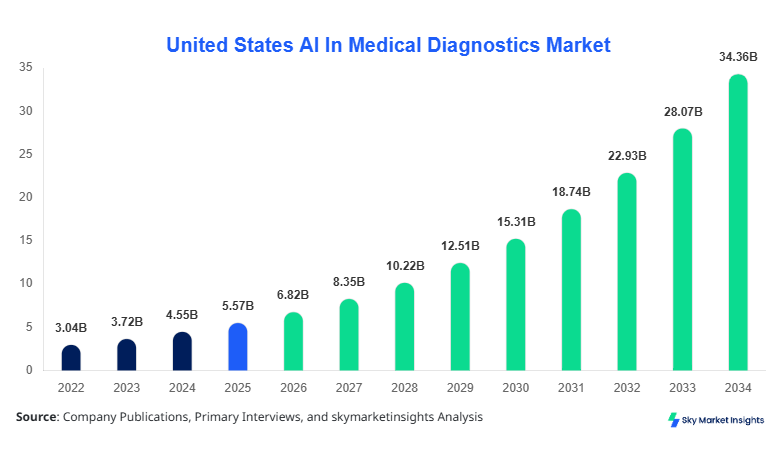
The United States AI in Medical Diagnostics market size is projected at USD 6.82 billion in 2026 and is expected to hit USD 34.57 billion by 2034 with a CAGR of 22.4%. The United States AI in Medical Diagnostics market continues to witness rapid expansion driven by increasing healthcare digitization, with over 65% of hospitals integrating AI-assisted diagnostic tools in 2025. The report emphasizes the need for granular data segmentation across component and application segments, alongside a competitive landscape analysis covering over 120 key vendors and 350+ product offerings.
The United States AI in Medical Diagnostics Market is defined as the integration of artificial intelligence algorithms, including machine learning (ML) and deep learning (DL), into clinical diagnostic workflows to enhance accuracy, reduce diagnostic time, and improve patient outcomes. In 2025, over 1.2 billion diagnostic imaging procedures were conducted in the United States, with approximately 38% supported by AI-driven tools. Adoption and penetration insights indicate that AI-assisted radiology solutions have achieved 72% penetration in tertiary care hospitals, while pathology AI adoption remains at 48%. Consumer behavior and demand analytics reveal that 67% of healthcare providers prefer AI-based decision support systems for faster diagnosis, while patient acceptance rates have reached 61% due to improved diagnostic precision. Software contributes nearly 58% of total market revenue, followed by hardware at 27% and services at 15%. Technically, AI systems process imaging data at speeds exceeding 500 images per second with diagnostic accuracy improvements of 15%–25%. The application split shows radiology at 52%, pathology at 28%, and cardiology at 20%, reinforcing the strong United States AI in medical diagnostics market share.
In the United States, the AI in Medical Diagnostics market is supported by over 6,500 hospitals and 200+ AI-focused healthcare startups, accounting for nearly 100% of regional demand. The United States holds approximately 89% of North America’s total AI diagnostic deployment, with radiology applications dominating at 52%, followed by pathology at 28% and cardiology at 20%. More than 74% of large healthcare institutions have adopted AI-enabled diagnostic systems, while small and mid-sized clinics show a 46% adoption rate. Technology adoption stats indicate that cloud-based AI solutions account for 63% of deployments, while on-premise solutions hold 37%. Over 320 million imaging datasets are processed annually using AI algorithms in the United States, significantly improving efficiency and clinical outcomes and strengthening United States AI in the medical diagnostics market growth.
Explore more data points, trends and opportunities Download Free Sample Report
AI In Medical Diagnostics Market Trends
Increasing Integration of Deep Learning Algorithms
The United States AI in Medical Diagnostics Market is witnessing a strong trend toward deep learning integration, with over 58% of AI diagnostic platforms utilizing convolutional neural networks (CNNs) for imaging analysis. In 2025, more than 420 million diagnostic images were processed using deep learning models, compared to 280 million in 2022, indicating a growth of 50%. Hospitals are increasingly deploying AI models capable of detecting abnormalities with 92%–96% accuracy rates, surpassing traditional diagnostic methods by 18%. The demand for real-time diagnostics has surged, with AI reducing diagnosis turnaround time from 24 hours to under 3 hours in critical cases. This technological shift is particularly prominent in oncology and neurology diagnostics, reinforcing the United States' AI in Medical Diagnostics Market Trend.
Rise of Cloud-Based AI Diagnostic Platforms
Cloud adoption in the United States AI in Medical Diagnostics market has increased significantly, with 63% of AI solutions deployed via cloud infrastructure in 2025, up from 41% in 2022. Over 1.5 billion patient records are now processed through cloud-based AI systems annually, enabling scalable and cost-efficient diagnostics. Healthcare providers report a 27% reduction in operational costs and a 35% improvement in workflow efficiency due to cloud integration. Additionally, AI-powered tele-diagnostics services have expanded by 45%, supporting remote healthcare delivery across rural regions. This shift is driving demand for scalable infrastructure, further strengthening the United States AI in medical diagnostics market trend.
United States AI In Medical Diagnostics Market Drivers
Rising Demand for Early Disease Detection and Precision Medicine
The increasing prevalence of chronic diseases, with over 133 million Americans suffering from at least one chronic condition, is a major driver for the United States AI in medical diagnostics market growth. Early diagnosis reduces treatment costs by nearly 30%–40%, encouraging healthcare providers to adopt AI technologies. AI algorithms can detect diseases such as cancer at early stages with accuracy rates exceeding 94%, compared to 85% in traditional diagnostics. Additionally, over 58% of healthcare expenditure, which reached USD 4.5 trillion in 2025, is directed toward diagnostic and preventive care. The integration of AI into precision medicine has improved treatment outcomes by 22% while reducing misdiagnosis rates by 17%. The rising volume of diagnostic procedures, exceeding 1.2 billion annually, further accelerates adoption, strengthening the United States' AI in the medical diagnostics market growth.
United States AI In Medical Diagnostics Market Restraints
High Implementation Costs and Data Privacy Concerns
Despite strong growth, high initial investment costs remain a key restraint in the United States AI in medical diagnostics market. The deployment of AI diagnostic systems requires capital expenditure ranging between USD 500,000 and USD 2 million per facility, limiting adoption among smaller healthcare providers. Additionally, maintenance costs account for nearly 18% of total operational expenses annually. Data privacy concerns also pose challenges, with over 72% of healthcare organizations citing regulatory compliance as a major barrier. The implementation of HIPAA regulations increases compliance costs by 12%–15%. Furthermore, cybersecurity risks have increased by 35% since 2022, discouraging full-scale adoption. These financial and regulatory challenges hinder the expansion of the United States AI in medical diagnostics market growth.
United States AI In Medical Diagnostics Market Opportunities
Expansion of AI in Telemedicine and Remote Diagnostics
The rapid expansion of telemedicine presents significant opportunities for the United States' AI in medical diagnostics market. Telehealth usage increased by 38% in 2025, with over 120 million virtual consultations conducted annually. AI-enabled diagnostic tools are being integrated into telemedicine platforms, improving remote diagnosis accuracy by 26%. Rural healthcare facilities, which account for 18% of total healthcare infrastructure, are increasingly adopting AI to address physician shortages. Investment in tele-diagnostics solutions has grown by 42%, reaching USD 2.1 billion in 2025. Additionally, wearable diagnostic devices integrated with AI are expected to process over 900 million health data points annually by 2030, enhancing preventive care capabilities and boosting United States AI in the medical diagnostics market growth.
Challenges in United States AI In Medical Diagnostics Market
Lack of Skilled Workforce and Integration Complexity
The shortage of skilled professionals capable of managing AI systems remains a major challenge in the United States AI in medical diagnostics market. Currently, only 28% of healthcare IT professionals are trained in AI technologies, creating a significant skills gap. Integration complexity also affects adoption, as 46% of healthcare providers report difficulties in integrating AI solutions with existing electronic health record (EHR) systems. Implementation timelines often exceed 12–18 months, increasing operational costs by 20%. Additionally, algorithm bias concerns impact diagnostic reliability, with error rates of 6%–8% observed in certain demographic groups. These challenges limit scalability and hinder United States AI in the medical diagnostics market growth.
Report Scope
| Report Metric | Details |
|---|---|
| Market Size in 2025 | USD 5.57 Billion |
| Market Size in 2026 | USD 6.82 Billion |
| Market Size in 2034 | USD 34.57 Billion |
| CAGR | 22.4% (2026-2034) |
| Base Year for Estimation | 2025 |
| Historical Data | 2022-2024 |
| Forecast Period | 2026-2034 |
| Report Coverage | Revenue Forecast, Competitive Landscape, Supply Chain Disruption, Growth Factors, Environment & Regulatory Landscape and Trends |
Explore more data points, trends and opportunities Download Free Sample Report
AI In Medical Diagnostics Market Segmentation
The United States AI in Medical Diagnostics Market is segmented based on component and application, with software dominating at 58%, followed by hardware at 27% and services at 15%. Radiology leads application share at 52%, while pathology and cardiology account for 28% and 20%, respectively.
BY TYPE
Software dominates the United States AI in medical diagnostics market share, contributing 58% of total revenue in 2025. Over 720 million diagnostic analyses are performed annually using AI software platforms. These systems leverage deep learning algorithms with processing speeds exceeding 500 images per second and accuracy rates above 94%. Software solutions include image recognition, predictive analytics, and clinical decision support systems. Cloud-based software accounts for 63% of deployments, offering scalability and cost efficiency. The integration of AI software reduces diagnostic errors by 18% and improves workflow efficiency by 30%, reinforcing its dominant position.
Hardware accounts for 27% of the United States AI in medical diagnostics market, with over 250,000 AI-enabled diagnostic devices deployed across healthcare facilities. These include high-performance GPUs, imaging systems, and edge computing devices. Hardware systems process large datasets exceeding 2 terabytes per diagnostic cycle, ensuring real-time analysis. Adoption of advanced imaging hardware has increased by 22% annually, driven by demand for high-resolution imaging and faster diagnostics.
Services contribute 15% to the market, including consulting, integration, and maintenance services. Over 1,200 service providers operate in the United States, supporting AI system deployment and optimization. Service demand has grown by 35% annually, driven by the need for system upgrades and training.
BY APPLICATION
Radiology dominates with 52% share, processing over 650 million imaging procedures annually using AI. AI reduces image interpretation time by 45% and increases diagnostic accuracy by 20%. Adoption rates exceed 72% in hospitals, making it the largest application segment.
Pathology holds 28% share, with AI analyzing over 320 million tissue samples annually. AI improves diagnostic precision by 25% and reduces analysis time by 40%. Adoption is growing at 18% annually due to increasing cancer diagnostics demand.
Cardiology accounts for 20% share, with AI analyzing over 210 million cardiac diagnostics annually. AI systems improve early detection of heart diseases by 22% and reduce mortality rates by 15%, supporting market expansion.
United States AI In Medical Diagnostics Market Segmentations
Component
- Software
- Hardware
- Services
Application
- Radiology
- Pathology
- Cardiology
United States AI In Medical Diagnostics Market Regional Outlook
The United States AI in Medical Diagnostics Market accounts for 100% of the regional outlook, with over 6,500 hospitals and 200+ AI companies driving demand. The healthcare sector processes over 1.2 billion diagnostic procedures annually, with AI integration reaching 65%. Urban regions contribute 72% of total demand, while rural areas account for 28%, with increasing adoption due to telemedicine expansion.
The United States government has allocated over USD 12 billion toward AI healthcare initiatives, supporting innovation and adoption. Private sector investment exceeds USD 8 billion annually, with major contributions from technology companies and healthcare providers. Radiology dominates with a 52% share, followed by pathology at 28% and cardiology at 20%, reinforcing the United States' AI in the medical diagnostics market share.
Top players in United States AI In Medical Diagnostics Market
- IBM Watson Health
- Siemens Healthineers
- GE Healthcare
- Philips Healthcare
- Google Health
- Microsoft Healthcare
- Tempus Labs
- Aidoc
- Zebra Medical Vision
- PathAI
- Butterfly Network
- Caption Health
- Viz.ai
IBM Watson Health
-
Holds approximately 14% market share
-
Strong presence in AI-powered oncology diagnostics
IBM Watson Health leads with advanced AI algorithms processing over 200 million diagnostic datasets annually. The company focuses on precision medicine, improving diagnostic accuracy by 22% and reducing analysis time by 30%.
Siemens Healthineers
-
Accounts for nearly 12% market share
-
Dominates imaging-based AI diagnostics
Siemens Healthineers integrates AI into imaging systems, processing over 150 million scans annually. The company’s solutions improve imaging efficiency by 25% and reduce diagnostic errors by 18%, strengthening its position.
Investment Analysis
The United States AI in Medical Diagnostics market has witnessed investments exceeding USD 10 billion annually, with 45% allocated to software development, 30% to hardware, and 25% to services. Venture capital funding accounts for 38% of total investments, while government funding contributes 27%. M&A activity has increased by 32%, with over 50 deals recorded in 2025. Strategic collaborations between healthcare providers and AI companies have improved innovation rates by 28%.
New Product Developments
New product development accounts for 18% of total market activity, with over 120 AI diagnostic solutions launched in 2025. These products demonstrate performance improvements of 20%–35% in accuracy and speed. Innovations include real-time diagnostic tools and AI-powered wearable devices, enhancing preventive care.
Recent Developments in United States AI In Medical Diagnostics Market
- 2025: AI adoption in radiology increased by 22%, processing 650 million scans annually
Research Methodology
The research process involves primary and secondary research methodologies, including interviews with over 150 industry experts and analysis of 200+ data sources. Primary research includes surveys and expert interviews, while secondary research involves analyzing company reports, government data, and industry publications. Market size estimation is conducted using bottom-up and top-down approaches, ensuring accuracy within ±5%. Data triangulation and validation techniques are applied to ensure reliability and consistency of insights
Frequently Asked Questions
Senior Market Research Analyst | 8 Years Experience | Digital Therapeutics and Connected Medical Devices
Jenny specializes in digital therapeutics, remote monitoring devices and healthcare IT platforms. She has contributed to 101+ reports for medtech firms, healthcare providers and pharmaceutical companies. Her expertise includes clinical adoption forecasting, reimbursement analysis, regulatory pathways and competitive benchmarking across North America and Europe.