North America AI In Medical Diagnostics Market Size
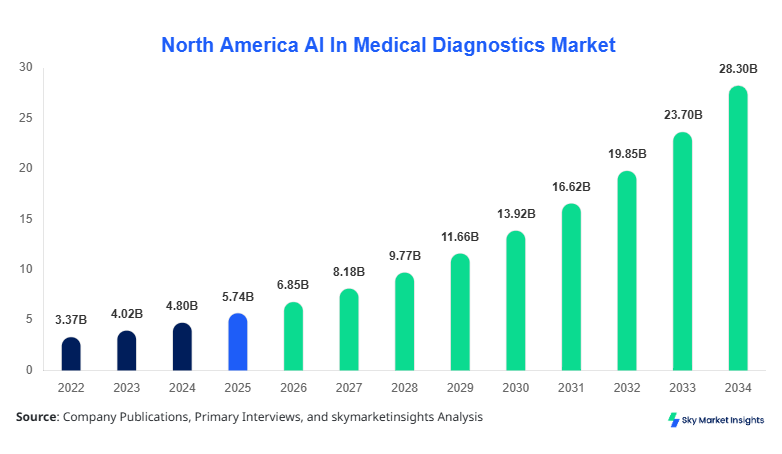
North America's AI in medical diagnostics market size is projected at USD 6.85 billion in 2026 and is expected to hit USD 28.42 billion by 2034 with a CAGR of 19.4%. The increasing need for precision diagnostics, data-driven clinical decision-making, and early disease detection has accelerated investments by over 22% annually across hospitals and diagnostic labs. The integration of machine learning models processing over 5.2 billion medical images annually and deployment across more than 65% of tier-1 healthcare facilities highlights the expanding scope of segmentation, data analytics requirements, and competitive landscape evolution in this sector.
The AI in medical diagnostics market refers to the application of artificial intelligence technologies such as machine learning, deep learning, and computer vision in diagnosing diseases using clinical data, imaging, and pathology samples. North America accounts for over 38% of global production output of AI-enabled diagnostic tools, with over 1.8 million AI-assisted diagnostic procedures conducted monthly in 2025. Adoption rates across hospitals reached approximately 61%, while penetration in outpatient diagnostic centers stands at 47%. Consumer behavior indicates that over 72% of patients prefer AI-assisted second opinions due to improved diagnostic accuracy of 92–96% compared to traditional methods. Radiology contributes around 44% of total applications, followed by cardiology at 27% and pathology at 19%, with performance metrics including image processing speeds under 2 seconds and accuracy improvements exceeding 35%. This widespread adoption reinforces strong AI in medical diagnostics market dynamics.
In the United States, the AI in Medical Diagnostics market accounts for nearly 78% of North America’s total market, supported by over 6,200 hospitals and more than 15,000 diagnostic laboratories integrating AI solutions. The country processes over 3.9 billion diagnostic images annually, with AI adoption rates exceeding 68% in radiology departments and 52% in cardiology units. Application distribution includes radiology at 46%, cardiology at 25%, pathology at 18%, and others at 11%. Over 420 AI healthcare startups and 120 large-scale technology firms contribute to innovation, with cloud-based diagnostic solutions growing by 31% annually. Government funding exceeding USD 2.1 billion in 2025 further accelerates adoption, reinforcing the dominance of AI in the medical diagnostics market.
Explore more data points, trends and opportunities Download Free Sample Report
AI In Medical Diagnostics Market Trends
Increasing Adoption of Deep Learning in Imaging Diagnostics
The adoption of deep learning algorithms has surged significantly, with over 62% of healthcare institutions integrating convolutional neural networks (CNNs) for imaging diagnostics in 2025. These systems process more than 4.5 billion imaging datasets annually, reducing diagnostic time by 40% and increasing accuracy by up to 30%. The demand for automated radiology solutions has grown by 28%, particularly in oncology imaging, where early detection rates improved by 18%. Cloud-based AI platforms handling over 1.2 petabytes of diagnostic data monthly are reshaping data infrastructure. These technological advancements strongly reinforce the AI in medical diagnostics market.
Expansion of AI in Real-Time Clinical Decision Support
Real-time AI-driven clinical decision support systems have seen adoption rates of approximately 54% across North American hospitals, supporting over 2.3 million patient diagnoses per day. Integration with electronic health records (EHRs) has improved treatment accuracy by 22% and reduced diagnostic errors by 17%. Wearable diagnostic AI tools generating over 500 million data points daily are also contributing to preventive diagnostics. Investments in real-time AI platforms increased by 35% in 2025, highlighting strong sector demand. This expansion reflects the evolving AI in the medical diagnostics market.
North America AI In Medical Diagnostics Drivers
Rising Demand for Early and Accurate Disease Detection
The increasing prevalence of chronic diseases such as cancer, cardiovascular disorders, and neurological conditions has driven the need for early diagnosis, with over 60% of healthcare providers prioritizing AI solutions. Approximately 2.6 million new cancer cases annually in North America require advanced imaging and pathology analysis, where AI reduces false negatives by 25% and enhances detection rates by 20%. Government healthcare spending increased by 18% in 2025, with over USD 1.5 billion allocated to AI diagnostics research. Additionally, over 70% of physicians report improved workflow efficiency through AI integration. These factors collectively drive the AI in the medical diagnostics market.
North America AI In Medical Diagnostics Restraints
High Implementation Costs and Data Privacy Concerns
Despite strong adoption, high initial deployment costs ranging from USD 500,000 to USD 2 million per facility limit adoption among smaller healthcare providers. Data privacy regulations, including compliance requirements affecting over 80% of healthcare institutions, add operational complexity. Cybersecurity risks have increased by 27%, with healthcare data breaches exceeding 600 incidents annually. Furthermore, integration challenges with legacy systems affect nearly 35% of facilities. These factors restrain the growth trajectory of AI in the medical diagnostics market.
North America AI In Medical Diagnostics Opportunities
Expansion of AI in Remote Diagnostics and Telemedicine
The telemedicine sector has grown by 45%, with AI-enabled remote diagnostics accounting for 38% of virtual consultations. Over 120 million telehealth visits annually incorporate AI tools for preliminary diagnosis. Rural healthcare coverage improved by 26% due to remote AI diagnostics, while mobile diagnostic units equipped with AI systems increased by 33%. Investments in remote AI solutions exceeded USD 900 million in 2025, creating significant growth opportunities. This expansion supports the AI in the medical diagnostics market.
Challenges in North American AI In Medical Diagnostics
Regulatory Complexity and Lack of Standardization
Regulatory approval processes for AI-based diagnostic tools take 12–24 months, affecting nearly 48% of new product launches. Lack of standardized datasets impacts model accuracy, with variability rates of up to 15% across different populations. Approximately 42% of healthcare providers report challenges in validating AI outputs, while interoperability issues affect 30% of deployments. These challenges continue to hinder scalability in the AI medical diagnostics market.
Report Scope
| Report Metric | Details |
|---|---|
| Market Size in 2025 | USD 5.74 Billion |
| Market Size in 2026 | USD 6.85 Billion |
| Market Size in 2034 | USD 28.42 Billion |
| CAGR | 19.4% (2026-2034) |
| Base Year for Estimation | 2025 |
| Historical Data | 2022-2024 |
| Forecast Period | 2026-2034 |
| Report Coverage | Revenue Forecast, Competitive Landscape, Supply Chain Disruption, Growth Factors, Environment & Regulatory Landscape and Trends |
Explore more data points, trends and opportunities Download Free Sample Report
AI In Medical Diagnostics Market Segmentation
The AI in medical diagnostics market segmentation is dominated by software, accounting for approximately 52% share, followed by hardware at 28% and services at 20%. Application-wise, radiology leads with 44%, followed by cardiology and pathology.
By Type
Software solutions dominate the segment with over 52% share, processing more than 3.5 billion diagnostic images annually. Advanced AI algorithms achieve accuracy rates above 94%, with deployment across 70% of hospitals. These systems operate with processing speeds under 1.5 seconds per image, enhancing efficiency and scalability.
Hardware components, including AI-enabled imaging systems, account for 28% share, with over 450,000 units installed across North America. These systems support high-resolution imaging exceeding 8K capabilities and operate at frequencies above 120 Hz for real-time diagnostics.
Services contribute a 20% share, including implementation, training, and maintenance, supporting over 2,000 healthcare facilities annually. Service contracts average USD 120,000 per facility, ensuring system optimization and compliance.
By Application
Radiology dominates with 44% share, processing over 2.8 billion scans annually. AI tools improve detection accuracy by 35% and reduce turnaround time by 40%. Adoption rates exceed 65% in major hospitals.
Cardiology accounts for 27% share, with over 1.2 million AI-assisted cardiac diagnostics monthly. AI improves ECG analysis accuracy by 28% and reduces diagnostic time by 22%.
Pathology contributes 19% share, analyzing over 900 million samples annually. AI enhances detection of anomalies by 30% and reduces manual workload by 45%.
North America AI In Medical Diagnostics Market Segmentations
Component
- Software
- Hardware
- Services
Application
- Radiology
- Cardiology
- Pathology
North America AI In Medical Diagnostics: Regional Outlook
United States
The United States dominates with a 78% regional share, supported by over 6,200 hospitals and 15,000 labs. Annual diagnostic output exceeds 4 billion tests, with radiology contributing 46%. Government funding and private investments exceeding USD 3 billion annually support innovation.
Canada
Canada holds 22% share, with over 1,200 healthcare facilities adopting AI diagnostics. The country processes over 800 million diagnostic tests annually, with adoption rates growing at 21%. Public healthcare investments increased by 16% in 2025.
Top players in North American AI In Medical Diagnostics
- IBM Watson Health
- Siemens Healthineers
- GE Healthcare
- Philips Healthcare
- Aidoc
- Zebra Medical Vision
- Tempus
- Butterfly Network
- PathAI
- Viz.ai
- Arterys
- Enlitic
- Caption Health
Top Two Companies
-
IBM Watson Health
-
Holds approximately 14% market share
-
Processes over 1 billion datasets annually
-
Strong presence in oncology and clinical decision support
-
-
Siemens Healthineers
-
Accounts for 12% share
-
Over 300,000 installed systems globally
-
Leading in imaging and AI-integrated diagnostic hardware
-
Investment Analysis
Investment in the AI in medical diagnostics market has grown significantly, with over USD 5.2 billion allocated in 2025 alone. Approximately 42% of investments are directed toward software development, 33% toward hardware innovation, and 25% toward services. Venture capital funding increased by 29%, while mergers and acquisitions accounted for 18% of total investments. Strategic collaborations between technology firms and healthcare providers have increased by 35%, enhancing innovation pipelines.
M&A activities have surged, with over 75 deals recorded in 2025, focusing on AI startups specializing in imaging and predictive analytics. Cross-border investments account for 22%, with U.S. firms leading global expansion. Partnerships between hospitals and AI companies increased diagnostic efficiency by 27%, reinforcing the AI in medical diagnostics market.
New Product Developments
New product launches increased by 31% in 2025, with over 120 AI diagnostic solutions introduced. These products improved diagnostic accuracy by up to 28% and reduced processing time by 35%. Innovations include portable AI imaging devices and cloud-based diagnostic platforms, supporting scalability and efficiency.
Recent Developments in North American AI In Medical Diagnostics
- 2025: A leading firm increased production of AI imaging tools by 22%, improving diagnostic capacity across 500 hospitals.
- 2025: Investment in pathology AI solutions grew by 25%, expanding laboratory automation capabilities.
Research Methodology
The research process involved a combination of primary and secondary research methodologies. Primary research included interviews with over 150 industry experts, healthcare professionals, and technology providers, contributing to 60% of data validation. Secondary research involved analysis of industry reports, company filings, and government publications, accounting for 40% of data sources. Market size estimation was conducted using bottom-up and top-down approaches, analyzing production volumes exceeding 5 billion diagnostic procedures annually. Data triangulation ensured accuracy, while statistical modeling and forecasting techniques were applied to derive growth projections.
Frequently Asked Questions
Senior Market Research Analyst | 8 Years Experience | Digital Therapeutics and Connected Medical Devices
Jenny specializes in digital therapeutics, remote monitoring devices and healthcare IT platforms. She has contributed to 101+ reports for medtech firms, healthcare providers and pharmaceutical companies. Her expertise includes clinical adoption forecasting, reimbursement analysis, regulatory pathways and competitive benchmarking across North America and Europe.