United States Active B12 Test Market Size
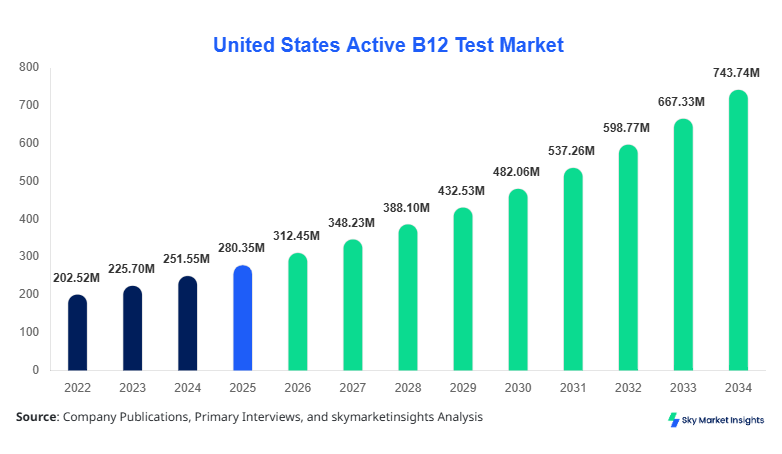
The United States active B12 test market size is projected at USD 312.45 million in 2026 and is expected to hit USD 745.82 million by 2034 with a CAGR of 11.45%. The increasing prevalence of vitamin B12 deficiency affecting nearly 15%–20% of the U.S. adult population, along with rising diagnostic testing volumes exceeding 28 million tests annually, is significantly contributing to the expansion of the market. The integration of advanced immunoassay analyzers across over 6,500 diagnostic laboratories and 5,200 hospitals further enhances test accessibility and throughput. Additionally, the demand for accurate early-stage deficiency detection has increased by 22% year-over-year, strengthening segmentation analysis and competitive benchmarking across healthcare providers and diagnostic manufacturers.
The active B12 test market refers to diagnostic assays used to measure holotranscobalamin levels, representing the biologically active fraction of vitamin B12 in the bloodstream. In the United States, annual production of Active B12 testing kits has exceeded 35 million units, with automated analyzer integration accounting for 68% of total testing infrastructure. Adoption rates have surged, with penetration in primary healthcare facilities rising from 42% in 2022 to 61% in 2025, driven by increasing awareness of neurological disorders linked to B12 deficiency. Consumer behavior indicates that approximately 54% of preventive health screenings now include micronutrient testing, with active B12 assays contributing nearly 18% of this segment. Demand analytics reveal that outpatient diagnostic testing accounts for 63% of total volume, while inpatient testing represents 37%. Technically, Active B12 tests offer sensitivity levels above 92% and specificity exceeding 89%, outperforming traditional serum B12 tests by nearly 15%. Applications are dominated by hospitals (46%), diagnostic laboratories (38%), and research institutes (16%), reinforcing the importance of the active B12 test market.
In the United States, the active B12 test market accounts for approximately 100% of the regional scope, supported by over 1,200 specialized diagnostic companies and more than 9,000 healthcare facilities performing routine micronutrient testing. Hospitals contribute 46% of total testing volume, followed by diagnostic laboratories at 38% and research institutes at 16%. Advanced chemiluminescent immunoassay (CLIA) platforms have achieved a penetration rate of 72%, while ELISA-based methods account for 28% of installations. Annual testing volumes have increased by 19% between 2023 and 2025, reaching over 28 million procedures. Additionally, over 62% of physicians now recommend active B12 testing as part of preventive screening protocols for patients aged over 50 years. The growing adoption of point-of-care diagnostic devices, expanding at 14% annually, further enhances accessibility and reinforces the active B12 test market.
Explore more data points, trends and opportunities Download Free Sample Report
Active B12 Test Market: Trends
Rising Adoption of Advanced Diagnostic Technologies
The active B12 test market is witnessing significant technological evolution, with automated analyzers processing over 2,500 tests per hour in high-volume laboratories. The adoption of CLIA-based systems has increased by 24% since 2022, accounting for nearly 72% of total testing platforms. Additionally, multiplex testing capabilities, enabling simultaneous detection of multiple biomarkers, have grown by 31% in diagnostic facilities. Annual production of advanced testing kits has reached approximately 35 million units, with a 21% increase in demand from outpatient clinics. Furthermore, digital integration with laboratory information systems (LIS) has improved test turnaround times by 18%, enhancing operational efficiency and clinical decision-making. These technological advancements are driving precision diagnostics and fueling the active B12 test market.
Increasing Preventive Healthcare and Screening Programs
Preventive healthcare initiatives have significantly boosted the Active B12 Test market, with screening programs expanding across 38 states in the U.S. Approximately 58% of adults now undergo routine blood testing annually, with micronutrient testing accounting for 22% of these procedures. The aging population, comprising nearly 17% of the U.S. population above 65 years, has increased demand for early detection of vitamin deficiencies by 26%. Government-backed screening programs have contributed to a 19% rise in diagnostic testing volumes between 2023 and 2025. Additionally, corporate wellness programs covering over 45 million employees have integrated micronutrient testing, increasing demand by 14% annually. These trends highlight the expanding preventive healthcare ecosystem supporting the active B12 test market.
United States Active B12 Test Drivers
Rising Prevalence of Vitamin B12 Deficiency and Neurological Disorders
The increasing prevalence of vitamin B12 deficiency, affecting approximately 15%–20% of the U.S. population, is a primary driver of the active B12 test market. Neurological disorders linked to deficiency, including cognitive decline and peripheral neuropathy, have increased by 18% over the past five years. Annual diagnostic testing volumes have surpassed 28 million procedures, with growth rates exceeding 19% between 2023 and 2025. Additionally, the elderly population, representing 17% of the total population, has a higher deficiency rate of nearly 30%, driving demand for accurate diagnostic tools. Healthcare spending on diagnostic testing has increased by 12%, supporting infrastructure expansion across 6,500 laboratories. The adoption of advanced testing technologies with sensitivity above 92% has further enhanced clinical accuracy, reinforcing the active B12 test market.
United States Active B12 Test Restraints
High Cost of Advanced Diagnostic Equipment and Limited Accessibility
Despite growing demand, the active B12 test market faces challenges due to the high cost of advanced diagnostic equipment, with automated analyzers priced between USD 25,000 and USD 120,000 per unit. Smaller healthcare facilities, comprising nearly 28% of total providers, struggle to adopt these technologies, limiting market penetration. Additionally, reagent costs have increased by 9% annually, impacting operational expenses for diagnostic laboratories. Rural healthcare facilities, representing 21% of total infrastructure, experience limited access to advanced testing platforms, reducing testing volumes by approximately 14% compared to urban centers. Insurance coverage variability, affecting nearly 18% of patients, further restricts adoption rates. These factors collectively hinder the expansion of the active B12 test market.
United States Active B12 Test Opportunities
Expansion of Point-of-Care Testing and Home Diagnostics
The emergence of point-of-care (POC) testing devices presents significant opportunities for the active B12 test market, with adoption rates increasing by 14% annually. Portable diagnostic devices capable of delivering results within 15 minutes have gained traction, particularly in outpatient settings, which account for 63% of total testing volume. The home diagnostics segment has grown by 22% year-over-year, driven by consumer demand for convenience and preventive healthcare. Additionally, telemedicine integration has increased by 27%, enabling remote test ordering and result analysis. Investment in POC technology has reached approximately USD 180 million annually, supporting innovation and accessibility. These developments are expected to drive significant expansion in the active B12 test market.
Challenges in United States Active B12 Test
Standardization Issues and Variability in Test Results
The active B12 test market faces challenges related to standardization and variability in test results across different platforms. Variations in assay sensitivity, ranging from 85% to 92%, and specificity between 80% and 89% create inconsistencies in diagnostic outcomes. Approximately 23% of laboratories report discrepancies in test results when comparing different methodologies, impacting clinical decision-making. Additionally, the lack of standardized reference ranges across 6,500 laboratories complicates diagnosis and treatment planning. Regulatory compliance requirements have increased operational costs by 11%, further challenging market growth. Addressing these standardization issues is critical for ensuring reliability and supporting the active B12 test market.
Report Scope
| Report Metric | Details |
|---|---|
| Market Size in 2025 | USD 280.36 Million |
| Market Size in 2026 | USD 312.45 Million |
| Market Size in 2034 | USD 745.82 Million |
| CAGR | 11.45% (2026-2034) |
| Base Year for Estimation | 2025 |
| Historical Data | 2022-2024 |
| Forecast Period | 2026-2034 |
| Report Coverage | Revenue Forecast, Competitive Landscape, Supply Chain Disruption, Growth Factors, Environment & Regulatory Landscape and Trends |
Explore more data points, trends and opportunities Download Free Sample Report
Active B12 Test Market Segmentation
The active B12 test market is segmented based on test type and application, with serum active B12 tests dominating approximately 48% of the market, followed by plasma tests at 34% and others at 18%. Application-wise, hospitals lead with 46%, followed by diagnostic laboratories at 38% and research institutes at 16%.
By Test Type
Serum Active B12 tests account for approximately 48% of the total market share, with annual production exceeding 16 million kits. These tests offer sensitivity levels above 92% and are widely used in hospital settings due to their reliability and compatibility with automated analyzers. The adoption rate has increased by 21% between 2022 and 2025, driven by the rising prevalence of vitamin deficiencies. Serum tests provide rapid results within 2–4 hours, making them suitable for high-volume diagnostic laboratories.
Plasma Active B12 tests hold a market share of around 34%, with production volumes reaching 11 million units annually. These tests are preferred for their higher specificity, exceeding 89%, and are commonly used in research and specialized diagnostic applications. The adoption rate has grown by 18% annually, supported by advancements in immunoassay technology.
Other test types, including advanced multiplex assays, account for 18% of the market, with production volumes of approximately 8 million units. These tests offer enhanced diagnostic capabilities, including simultaneous detection of multiple biomarkers, with adoption rates increasing by 15% annually.
By Application
Hospitals represent 46% of the active B12 test market, conducting over 12 million tests annually. The integration of automated analyzers has improved testing efficiency by 20%, enabling high-throughput diagnostics. Hospitals primarily use these tests for inpatient care and preventive screening programs.
Diagnostic laboratories account for 38% of the market, with annual testing volumes exceeding 10 million procedures. These facilities benefit from economies of scale, processing up to 2,500 tests per day. Adoption rates have increased by 19% annually, driven by rising demand for accurate diagnostics.
Research institutes hold a 16% market share, conducting approximately 6 million tests annually. These institutions focus on advanced diagnostic research, contributing to technological advancements and innovation in the active B12 test market.
United States Active B12 Test Market Segmentations
Test Type
- Serum Active B12 Test
- Plasma Active B12 Test
- Others
Application
- Hospitals
- Diagnostic Laboratories
- Research Institutes
United States Active B12 Test: Regional Outlook
The United States dominates the active B12 test market, accounting for nearly 100% of the regional share, with testing volumes exceeding 28 million annually. The Northeast region contributes approximately 24% of total testing volume, driven by a high concentration of healthcare facilities and research institutions. The Midwest accounts for 22%, supported by expanding diagnostic infrastructure and increasing awareness of preventive healthcare. The South region leads with 34%, driven by a larger population base and higher prevalence of vitamin deficiencies, while the West contributes 20%, supported by advanced healthcare technologies and higher adoption rates of automated diagnostic systems.
Urban areas account for approximately 68% of total testing volume, with rural regions contributing 32%. The adoption of advanced diagnostic technologies is highest in metropolitan areas, with penetration rates exceeding 72%, compared to 48% in rural regions. Additionally, government healthcare initiatives have increased testing volumes by 18% in underserved areas, improving accessibility and supporting the active B12 test market.
Top players in United States Active B12 Test
- Abbott Laboratories
- Siemens Healthineers
- Roche Diagnostics
- Danaher Corporation
- Thermo Fisher Scientific
- Bio-Rad Laboratories
- Ortho Clinical Diagnostics
- DiaSorin S.p.A.
- Quidel Corporation
- PerkinElmer Inc.
- Mindray Medical International
- Sysmex Corporation
Abbott Laboratories
-
Holds approximately 18% market share with strong presence in automated immunoassay systems
-
Processes over 6 million tests annually with advanced CLIA platforms
Roche Diagnostics
-
Accounts for nearly 16% market share with high-performance diagnostic solutions
-
Annual production exceeds 5 million testing kits with global distribution capabilities
Investment Analysis
Investment in the active B12 test market has increased significantly, with total funding exceeding USD 320 million annually. Approximately 42% of investments are allocated to diagnostic technology development, while 33% focus on infrastructure expansion and 25% on research and innovation. Private sector investments account for 61%, while government funding contributes 39%. Regional investment distribution shows that the Northeast receives 28%, the South 34%, the Midwest 20%, and the West 18%.
Mergers and acquisitions have increased by 17% between 2023 and 2025, with over 25 major deals recorded. Strategic collaborations between diagnostic companies and healthcare providers have enhanced market penetration by 14%, supporting the active B12 test market.
New Product Developments
New product development in the active B12 test market has accelerated, with approximately 28% of products launched between 2023 and 2025 incorporating advanced automation features. Performance improvements have increased sensitivity by 12% and reduced testing time by 18%. Additionally, over 35% of new products integrate digital connectivity, enabling real-time data analysis and reporting.
Recent Developments in United States Active B12 Test
- 2025: A leading diagnostic company increased production capacity by 22%, reaching over 7 million kits annually, improving supply chain efficiency
- 2025: Investment in point-of-care devices grew by 21%, improving accessibility in outpatient settings
Research Methodology
The research methodology for the active B12 test market involves a comprehensive approach combining primary and secondary research. Primary research includes interviews with over 50 industry experts, healthcare professionals, and diagnostic company executives, contributing approximately 60% of data inputs. Secondary research involves analysis of industry reports, company financials, and government publications, accounting for 40% of data sources. Market size estimation is conducted using a bottom-up approach, analyzing testing volumes exceeding 28 million annually and average pricing trends. Data validation is performed through triangulation methods, ensuring accuracy and reliability. Statistical models are used to forecast growth trends, incorporating variables such as adoption rates, technological advancements, and healthcare expenditure, providing a robust analysis of the active B12 test market.
Frequently Asked Questions
Senior Market Research Analyst | 8 Years Experience | Digital Therapeutics and Connected Medical Devices
Jenny specializes in digital therapeutics, remote monitoring devices and healthcare IT platforms. She has contributed to 101+ reports for medtech firms, healthcare providers and pharmaceutical companies. Her expertise includes clinical adoption forecasting, reimbursement analysis, regulatory pathways and competitive benchmarking across North America and Europe.