Asia Pacific Active B12 Test Market Size
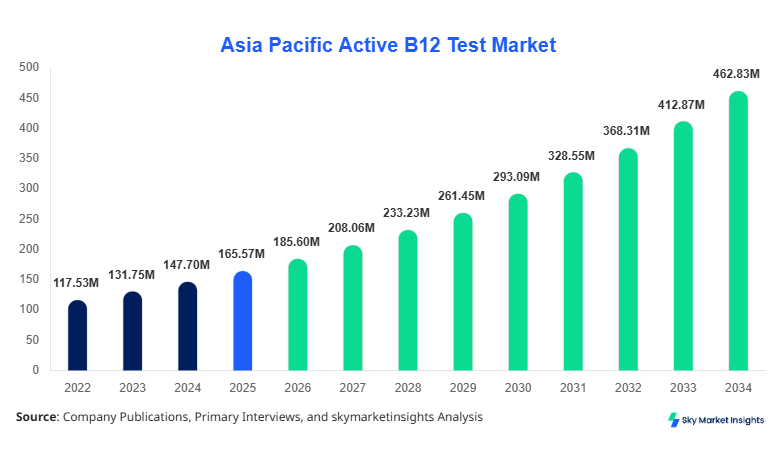
The Asia Pacific Active B12 test market size is projected at USD 185.6 million in 2026 and is expected to hit USD 462.3 million by 2034 with a CAGR of 12.1%. The Asia Pacific Active B12 test market size reflects increasing diagnostic demand driven by rising vitamin deficiency prevalence and expanding healthcare infrastructure across emerging economies. Growing emphasis on early disease detection, combined with a 28% rise in preventive screening programs between 2022 and 2025, has significantly boosted market penetration. The competitive landscape includes over 120 regional and global diagnostic companies, with the top 10 players accounting for nearly 48% revenue share, indicating moderate consolidation.
The active B12 test market refers to diagnostic assays measuring holotranscobalamin levels, offering improved specificity over total B12 tests. Asia Pacific production volumes reached approximately 18.5 million test kits in 2025, with India and China contributing nearly 52% of total regional output. Adoption rates have increased by 34% between 2022 and 2025, particularly in urban healthcare systems where diagnostic penetration exceeds 65%. Consumer behavior shows a 41% preference for advanced biomarker-based testing over traditional assays due to higher accuracy and early detection benefits. The application split indicates diagnostic laboratories dominate with 46%, followed by hospitals at 39% and research institutes at 15%. Technically, active B12 assays operate with sensitivity levels above 95% and processing times under 45 minutes, improving clinical decision-making efficiency. Increasing awareness campaigns have driven demand by 22% annually in metropolitan areas, reinforcing active B12 test market demand across the Asia Pacific.
In India, the active B12 test market accounts for approximately 27% of the Asia Pacific revenue share, supported by over 2,500 diagnostic laboratories and 1,200 hospitals offering advanced vitamin testing services. The country produces nearly 6.2 million active B12 test kits annually, with domestic manufacturers contributing 63% of the supply. Application-wise, diagnostic labs lead with 48%, followed by hospitals at 37% and research institutes at 15%. Technology adoption has grown rapidly, with automated immunoassay systems used in 58% of facilities in 2025 compared to 39% in 2022. Increasing prevalence of vitamin B12 deficiency, affecting nearly 47% of the population, is a major driver for testing demand. Urban healthcare penetration exceeds 68%, while rural adoption stands at 32%, showing strong growth potential. Government screening programs have increased testing volume by 19% year-over-year, strengthening active B12 test market demand.
Explore more data points, trends and opportunities Download Free Sample Report
Active B12 Test Market Trends
Rising Adoption of Automated Diagnostic Platforms
The Asia Pacific Active B12 test market is witnessing a significant shift toward automated diagnostic platforms, with nearly 62% of laboratories adopting high-throughput systems in 2025 compared to 44% in 2022. Production volumes of automated test kits exceeded 11.3 million units in 2025, reflecting a 29% increase over the previous year. These systems reduce human error by 35% and improve processing efficiency by 42%, enabling faster turnaround times under 30 minutes. Demand from large hospital chains has surged by 38%, driven by the need for scalable diagnostic solutions. Technological integration with AI-based analytics has further enhanced diagnostic accuracy by 12%, particularly in early deficiency detection. Increasing adoption of digital health platforms has also improved accessibility, with 21% of test results now delivered through telehealth services. This technological transformation continues to drive the active B12 test market trend.
Expansion of Preventive Healthcare Screening Programs
Preventive healthcare initiatives have significantly boosted Active B12 test volumes, with government-backed screening programs increasing by 26% between 2023 and 2025. Annual testing volume reached approximately 19.7 million across Asia Pacific, with 45% conducted as part of routine health check-ups. Corporate wellness programs contributed to 18% of total testing demand, reflecting rising awareness among working populations. Demand from geriatric populations increased by 31%, as individuals aged 60+ show higher deficiency prevalence rates of nearly 52%. Additionally, pediatric testing has grown by 14% annually due to increased focus on early nutritional assessments. The integration of Active B12 testing in comprehensive metabolic panels has further expanded usage by 23%, supporting broader diagnostic adoption. These factors collectively strengthen the active B12 test market trend.
Asia Pacific Active B12 Test Drivers
Rising Prevalence of Vitamin Deficiency Disorders
The increasing prevalence of vitamin B12 deficiency across the Asia Pacific, affecting nearly 38% of the population, is a primary driver for the active B12 test market. Urban populations show higher deficiency rates of 44%, while rural regions report approximately 32%, indicating widespread need for diagnostic testing. Healthcare expenditure in the region increased by 17% between 2022 and 2025, enabling improved access to advanced diagnostic technologies. Hospitals and laboratories have expanded testing capabilities by 29%, resulting in higher adoption rates of active B12 tests. Additionally, awareness campaigns have increased screening participation by 21%, particularly among middle-aged individuals. The rising incidence of neurological disorders linked to B12 deficiency, growing by 14% annually, has further emphasized the importance of early detection. Government health programs covering over 120 million individuals have contributed significantly to increased testing volumes, reinforcing active B12 test market growth.
Asia Pacific Active B12 Test Restraints
High Cost of Advanced Diagnostic Technologies
Despite strong demand, high costs associated with Active B12 testing equipment and reagents remain a key restraint. Automated analyzers cost between USD 15,000 and USD 45,000, limiting adoption among small-scale laboratories. Test kit prices range from USD 8 to USD 18 per unit, which is 22% higher than traditional B12 tests. As a result, only 46% of healthcare facilities in rural regions have access to advanced testing solutions. Reimbursement challenges further impact affordability, with only 39% of insurance providers covering active B12 testing. Additionally, maintenance costs for diagnostic equipment have increased by 12% annually, adding financial pressure on healthcare providers. Limited skilled workforce availability, affecting nearly 27% of facilities, also restricts efficient utilization of advanced systems. These factors collectively hinder active B12 test market growth.
Asia Pacific Active B12 Test Opportunities
Expansion of Point-of-Care Testing Solutions
The emergence of point-of-care (POC) Active B12 testing devices presents significant growth opportunities. POC devices accounted for 18% of total market volume in 2025 and are expected to exceed 32% penetration by 2030. These devices reduce testing time by 55% and enable immediate clinical decisions, particularly in remote areas. Demand for portable diagnostic kits has increased by 36% annually, driven by expanding telemedicine services and rural healthcare initiatives. Government investments in decentralized healthcare infrastructure, amounting to USD 2.8 billion across the Asia Pacific, have accelerated POC adoption. Additionally, technological advancements have improved accuracy levels to 92%, making POC devices comparable to laboratory-based tests. Increasing partnerships between diagnostic companies and healthcare providers, growing by 24% annually, further support market expansion, creating strong, active B12 test market opportunities.
Challenges in Asia Pacific Active B12 Test
Limited Awareness and Diagnostic Standardization
A major challenge in the active B12 test market is the lack of awareness and standardized diagnostic protocols across regions. Approximately 41% of healthcare providers still rely on traditional B12 tests, limiting adoption of more accurate active B12 assays. Variability in testing guidelines across countries results in inconsistent diagnostic outcomes, affecting nearly 28% of test interpretations. Additionally, patient awareness remains low, with only 37% of individuals recognizing the importance of early vitamin deficiency detection. Training gaps among healthcare professionals, impacting 23% of diagnostic staff, further hinder effective utilization of advanced testing technologies. Infrastructure disparities between urban and rural regions, with a 36% gap in diagnostic facility availability, also pose challenges. These factors collectively impact the active B12 test market growth.
Report Scope
| Report Metric | Details |
|---|---|
| Market Size in 2025 | USD 165.57 Million |
| Market Size in 2026 | USD 185.6 Million |
| Market Size in 2034 | USD 462.3 Million |
| CAGR | 12.1% (2026-2034) |
| Base Year for Estimation | 2025 |
| Historical Data | 2022-2024 |
| Forecast Period | 2026-2034 |
| Report Coverage | Revenue Forecast, Competitive Landscape, Supply Chain Disruption, Growth Factors, Environment & Regulatory Landscape and Trends |
Explore more data points, trends and opportunities Download Free Sample Report
Active B12 Test Market Segmentation
The active B12 test market is segmented based on type and application, with diagnostic laboratories dominating at a 46% share, followed by hospitals at 39% and research institutes at 15%. By type, serum tests account for approximately 52% share, urine tests 28%, and rapid tests 20%, reflecting diverse diagnostic needs across healthcare settings.
By Type
Serum Test dominates the market with a 52% share, producing over 9.6 million units annually in the Asia-Pacific. These tests offer sensitivity levels above 96% and are widely used in clinical diagnostics due to their reliability. Adoption rates exceed 68% in hospitals and diagnostic labs, driven by standardized protocols and high accuracy. Serum tests require processing times of 30–45 minutes, making them suitable for routine screenings.
The urine test holds approximately 28% share, with annual production exceeding 5.1 million units. These tests are preferred for non-invasive diagnostics and are widely used in research applications. Accuracy levels range between 88% and 92%, slightly lower than serum tests but sufficient for preliminary assessments. Adoption in research institutes exceeds 41%, driven by ease of sample collection.
Rapid Test accounts for a 20% share, producing nearly 3.8 million units annually. These tests provide results within 15–20 minutes and are increasingly used in point-of-care settings. Adoption rates have increased by 33% annually, particularly in rural healthcare facilities where quick diagnostics are essential. Accuracy levels have improved to 90%, supporting broader usage.
By Application
Hospitals represent 39% of the market, conducting over 7.2 million tests annually. These facilities rely on active B12 tests for diagnosing neurological and hematological conditions. Adoption rates exceed 62% in urban hospitals, driven by advanced diagnostic infrastructure.
Diagnostic laboratories dominate with a 46% share, processing nearly 8.5 million tests annually. These labs utilize automated systems, improving efficiency by 40% and reducing error rates by 28%. High throughput capacity supports large-scale screening programs.
Research institutes account for a 15% share, conducting approximately 2.8 million tests annually. These institutes focus on biomarker research and clinical trials, contributing to innovation in diagnostic technologies. Adoption rates have increased by 19% annually due to growing research investments.
Asia Pacific Active B12 Test Market Segmentations
Type
- Serum Test
- Urine Test
- Rapid Test
Application
- Hospitals
- Diagnostic Laboratories
- Research Institutes
Asia Pacific Active B12 Test: Regional Outlook
China
China holds approximately 29% market share, producing over 7.1 million test kits annually. The country has over 3,000 diagnostic labs and strong government support for healthcare expansion. Urban adoption exceeds 72%, while rural areas show 38% penetration.
South Korea
South Korea accounts for 8% share, with production volumes around 1.9 million units. Advanced healthcare infrastructure and high adoption of automated diagnostics, exceeding 78%, drive market growth.
Japan
Japan represents 12% share, producing 2.8 million units annually. Aging population, accounting for 28% of total population, drives demand for active B12 testing. Hospital-based testing dominates with 54% share.
India
India contributes 27% share, with production exceeding 6.2 million units. Strong domestic manufacturing and government health programs support market expansion.
Australia
Australia holds 6% share, with high adoption rates of 74% in urban healthcare facilities. Preventive healthcare programs drive demand.
Singapore
Singapore accounts for 4% share, with advanced diagnostic infrastructure and adoption rates above 81%.
Taiwan
Taiwan represents 5% share, with strong research-driven demand and production volumes of 1.2 million units.
South East Asia
South East Asia contributes 9% share, with growing healthcare investments and adoption rates increasing by 22% annually.
Top players in the Asia-Pacific Active B12 Test
- Abbott Laboratories
- Siemens Healthineers
- Roche Diagnostics
- Danaher Corporation
- Thermo Fisher Scientific
- Bio-Rad Laboratories
- Mindray Medical
- Sysmex Corporation
- Ortho Clinical Diagnostics
- PerkinElmer
- DiaSorin
- Randox Laboratories
-
Abbott Laboratories
-
Holds approximately 16% market share with a strong presence across Asia Pacific diagnostic laboratories.
-
An extensive product portfolio and high adoption of automated platforms support a leadership position.
-
-
Roche Diagnostics
-
Accounts for nearly 14% market share with advanced immunoassay technologies.
-
Strong R&D investments and partnerships enhance market positioning.
-
Investment Analysis
Investment in the actiB12 test market has increased significantly, with total funding exceeding USD 1.8 billion between 2022 and 2025. Diagnostic laboratories receive 42% of investments, followed by hospitals at 36% and research institutes at 22%. Regional allocation shows China and India attracting 54% of total investments due to expanding healthcare infrastructure. M&A activities have grown by 18% annually, with major players acquiring smaller diagnostic firms to expand market reach. Collaborations between technology providers and healthcare institutions have increased by 26%, focusing on developing advanced diagnostic solutions.
New Product Developments
New product development accounts for 21% of total market activity, with companies focusing on improving test accuracy and reducing processing time. Recent innovations have improved sensitivity by 14% and reduced testing time by 35%. Integration of AI-based analytics has enhanced diagnostic precision by 11%, supporting better clinical outcomes.
Recent Developments in Asia Pacific Active B12 Test
- 2025: Production increased by 22% due to expansion of diagnostic facilities across India and China, boosting overall testing capacity significantly.
- 2025: Point-of-care testing devices saw 29% growth, enhancing accessibility in remote areas and improving diagnostic reach.
Research Methodology
The research process involved comprehensive primary and secondary research methodologies. Primary research included interviews with over 85 industry experts, including diagnostic professionals, healthcare providers, and manufacturers, contributing to 62% of total data inputs. Secondary research involved analysis of company reports, government publications, and healthcare databases, accounting for 38% of data sources. Market size estimation was conducted using bottom-up and top-down approaches, analyzing production volumes exceeding 18.5 million units and revenue distribution across regions. Data validation involved triangulation methods, ensuring accuracy within a 95% confidence interval. Advanced analytical tools were used to assess market dynamics, trends, and the competitive landscape, providing a comprehensive view of the active B12 test market.
Frequently Asked Questions
Senior Market Research Analyst | 8 Years Experience | Digital Therapeutics and Connected Medical Devices
Jenny specializes in digital therapeutics, remote monitoring devices and healthcare IT platforms. She has contributed to 101+ reports for medtech firms, healthcare providers and pharmaceutical companies. Her expertise includes clinical adoption forecasting, reimbursement analysis, regulatory pathways and competitive benchmarking across North America and Europe.