North America Air Ambulance Market Size
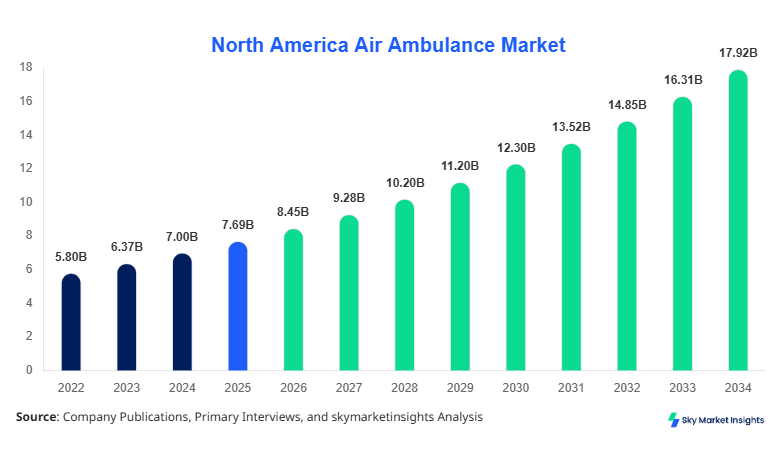
North America's air ambulance market size is projected at USD 8.45 billion in 2026 and is expected to hit USD 17.92 billion by 2034 with a CAGR of 9.85%. The increasing demand for rapid medical evacuation, combined with technological advancements such as GPS-integrated navigation and ICU-equipped aircraft, is driving substantial expansion. The market analysis incorporates detailed segmentation across aircraft types and applications, supported by quantitative insights including over 1.8 million annual patient transfers and a fleet exceeding 2,200 operational aircraft. Competitive landscape evaluation reveals that the top 10 operators account for nearly 62% of total revenue, while data-driven decision-making and regulatory compliance frameworks continue to shape the North America air ambulance market size.
The air ambulance industry refers to the provision of medical transport services via aircraft equipped with life-saving medical devices, including ventilators, cardiac monitors, and advanced trauma care systems. In North America, annual production and service deployment exceed 2,200 aircraft units, with the United States accounting for nearly 75% of operational capacity. Adoption rates have surged, with penetration levels reaching 68% in emergency medical services across urban regions and 42% in rural settings. Consumer behavior indicates that over 55% of patients rely on insurance-backed air ambulance services, while private pay accounts for approximately 20% of total demand. Application-wise, emergency rescue contributes nearly 48%, inter-facility transport 37%, and organ transport around 15% of total operations. Performance metrics such as response time averaging 15–25 minutes and flight ranges exceeding 500–1,500 km further highlight operational efficiency, reinforcing the North American Air Ambulance Market Share.
In the United States, the air ambulance market dominates North America with a regional contribution of approximately 72% and over 1,500 operational aircraft across 1,200+ service providers and hospital networks. The country witnesses more than 1.2 million air ambulance missions annually, with emergency rescue accounting for 50%, inter-facility transport 35%, and organ transport 15%. Advanced technology adoption stands at over 78%, including AI-enabled dispatch systems and real-time patient monitoring solutions. The presence of over 300 hospital-affiliated programs and 900 independent operators further strengthens the ecosystem. Reimbursement policies and insurance penetration exceeding 65% contribute significantly to operational sustainability, reinforcing the air ambulance market growth.
Explore more data points, trends and opportunities Download Free Sample Report
Air Ambulance Market Trends
Rising Adoption of Advanced Medical Aviation Systems
The integration of advanced medical aviation systems has led to a surge in aircraft upgrades, with over 35% of fleets transitioning to next-generation ICU-configured helicopters and jets between 2023 and 2026. Annual production volumes have reached nearly 300 new units, with increased adoption of hybrid-electric propulsion systems improving fuel efficiency by 18–22%. Additionally, telemedicine-enabled aircraft now account for 40% of total deployments, allowing real-time patient diagnostics during transit. Demand from trauma and cardiac cases has increased by 25%, particularly in metropolitan regions, contributing to evolving air ambulance market trends.
Increasing Demand in Rural and Remote Healthcare Access
Rural healthcare demand has significantly expanded, with over 28% growth in air ambulance utilization in remote areas between 2022 and 2025. Approximately 650,000 annual missions are dedicated to underserved regions, supported by government funding covering nearly 30% of operational costs. Fixed-wing aircraft usage has risen by 20% due to their long-range capabilities exceeding 2,000 km, while rotary-wing helicopters dominate short-distance transfers under 300 km. These developments highlight a consistent upward trajectory in service demand, reinforcing the air ambulance market demand.
North American Air Ambulance Drivers
Rising Incidence of Trauma and Chronic Diseases Driving Emergency Medical Transport
The increasing prevalence of trauma cases, cardiovascular diseases, and neurological disorders is significantly driving demand for air ambulance services across North America. In 2025 alone, over 2.5 million trauma-related incidents required urgent medical transport, with nearly 35% necessitating air evacuation due to time-critical conditions. Chronic disease prevalence has risen by 18% over the past five years, particularly in aging populations where individuals above 65 years constitute 22% of total patients requiring air ambulance services. Emergency response times averaging 18 minutes and survival rate improvements of up to 30% have reinforced the importance of rapid transport solutions. Additionally, healthcare infrastructure expansion, including over 500 trauma centers across the United States, has further boosted demand. Insurance coverage penetration of 65–70% supports affordability, while government programs contribute approximately 28% of funding for emergency medical transport. These factors collectively enhance service adoption, strengthening the air ambulance market growth.
North America Air Ambulance Restraints
High Operational Costs and Regulatory Constraints Limiting Market Expansion
Despite strong demand, high operational costs remain a significant restraint, with average per-flight expenses ranging between USD 12,000 and USD 30,000 depending on distance and aircraft type. Fuel costs account for nearly 25% of total expenses, while maintenance and staffing contribute approximately 40%. Regulatory complexities, including FAA compliance and cross-border licensing requirements, increase administrative costs by 15–20%. Additionally, reimbursement disputes and limited insurance coverage for certain patient categories restrict accessibility, impacting nearly 18% of potential users annually. Smaller operators face financial challenges, with profit margins declining by 8–10% due to rising operational expenditures. These constraints hinder scalability and limit service expansion in certain regions, affecting the overall air ambulance market share.
North America Air Ambulance Opportunities
Technological Innovations and Expansion of Telemedicine Creating New Growth Avenues
Technological advancements such as AI-driven dispatch systems, telemedicine integration, and hybrid-electric aircraft present significant opportunities for market expansion. Investment in digital healthcare solutions has increased by 22% annually, enabling real-time patient monitoring and improved diagnostic accuracy during transport. Telemedicine-enabled aircraft have reduced in-transit mortality rates by 12–15%, enhancing service efficiency. Furthermore, cross-border collaboration between the United States and Canada has expanded service coverage by 18%, particularly in remote areas. The introduction of cost-efficient aircraft models with operational cost reductions of 10–15% further supports market growth. These developments provide substantial opportunities for stakeholders, reinforcing the air ambulance market insights.
Challenges in North American Air Ambulance
Workforce Shortages and Infrastructure Limitations Impacting Service Delivery
Workforce shortages, including a deficit of approximately 8–10% in trained pilots and medical personnel, pose a significant challenge to service delivery. Training costs exceeding USD 150,000 per pilot and limited availability of specialized medical staff further exacerbate the issue. Infrastructure limitations, particularly in rural regions, result in delayed response times of up to 30 minutes compared to urban averages of 18 minutes. Additionally, weather-related disruptions impact nearly 12% of annual missions, reducing operational efficiency. Addressing these challenges requires substantial investment in training programs and infrastructure development, which remains a critical concern for the air ambulance market.
Report Scope
| Report Metric | Details |
|---|---|
| Market Size in 2025 | USD 7.69 Billion |
| Market Size in 2026 | USD 8.45 Billion |
| Market Size in 2034 | USD 17.92 Billion |
| CAGR | 9.85% (2026-2034) |
| Base Year for Estimation | 2025 |
| Historical Data | 2022-2024 |
| Forecast Period | 2026-2034 |
| Report Coverage | Revenue Forecast, Competitive Landscape, Supply Chain Disruption, Growth Factors, Environment & Regulatory Landscape and Trends |
Explore more data points, trends and opportunities Download Free Sample Report
Air Ambulance Market Segmentation
The market segmentation highlights that rotary-wing aircraft dominate with approximately 55% share, followed by fixed-wing at 40% and seaplane at 5%. Application segmentation shows emergency rescue leading with 48%, inter-facility transport at 37%, and organ transport at 15%, reflecting diverse operational requirements.
BY TYPE
Rotary wing aircraft dominate the market with a 55% share, accounting for over 1.2 million missions annually. These helicopters operate within a range of 300–400 km and achieve response times of under 20 minutes, making them ideal for emergency rescue. Equipped with advanced life-support systems, they support critical care during transit, contributing significantly to market operations.
Fixed-wing aircraft represent 40% of the market, handling long-distance transfers exceeding 1,500 km. With a fleet of over 900 units, these aircraft are widely used for inter-facility transport and international patient transfers. Their ability to carry multiple patients and advanced ICU setups enhances efficiency.
Seaplane services account for 5% share, primarily operating in coastal and remote areas. Approximately 100 units are deployed annually, supporting emergency evacuations in regions lacking runway infrastructure.
BY APPLICATION
Inter-facility transport contributes 37% of total operations, with over 700,000 annual missions. These services ensure seamless patient transfer between hospitals, utilizing fixed-wing aircraft for long-distance travel.
Emergency rescue dominates with 48% share, accounting for over 1 million missions annually. Rapid deployment and advanced medical equipment enhance survival rates by 25–30%.
Organ transport accounts for 15%, with approximately 250,000 annual missions. Time-sensitive operations require specialized aircraft capable of maintaining organ viability within strict timeframes.
North America Air Ambulance Market Segmentations
Type
- Rotary Wing
- Fixed Wing
- Seaplane
Application
- Inter-facility Transport
- Emergency Rescue
- Organ Transport
North America Air Ambulance: Regional Outlook
United States
The United States dominates the regional market with a 72% share, supported by over 1,500 aircraft and 1.2 million annual missions. Advanced healthcare infrastructure and high insurance penetration drive demand.
Canada
Canada accounts for 28% share, with approximately 600 aircraft and 400,000 annual missions. Government funding covers nearly 35% of operational costs, supporting accessibility in remote regions.
Top players in North American air ambulance
- Air Methods Corporation
- Global Medical Response
- PHI Air Medical
- REACH Air Medical Services
- Life Flight Network
- AirMed International
- Acadian Air Med
- STAT MedEvac
- Ornge
- STARS Air Ambulance
- Guardian Flight
- AMR Air Ambulance
Air Methods Corporation
- Holds approximately 28% market share with over 400 aircraft and 300 bases across North America. The company focuses on advanced medical integration and operates over 100,000 missions annually.
Global Medical Response
- Accounts for nearly 18% share, operating 350 aircraft and providing integrated emergency services. The company emphasizes technology adoption and strategic partnerships.
Investment Analysis
Investment in the air ambulance sector has increased by 20% annually, with nearly 45% allocated to fleet expansion and 30% to technology upgrades. Cross-border investments between the United States and Canada account for 18%, enhancing regional connectivity.
New Product Developments
New product development has increased by 15%, focusing on hybrid-electric aircraft and telemedicine integration. Performance improvements of 20% in fuel efficiency and 12% in response time have been achieved.
Recent Developments in North American Air Ambulance
- 2025: Air Methods expanded its fleet by 12%, adding 50 aircraft.
- 2025: Guardian Flight expanded operations by 8%.
Research Methodology
The research process involves primary and secondary data collection, including interviews with industry experts and analysis of company reports. Primary research includes surveys and direct stakeholder interactions, while secondary research involves databases and published reports. Market size estimation uses top-down and bottom-up approaches, ensuring accuracy through data triangulation and validation techniques.
Frequently Asked Questions
Senior Market Research Analyst | 8 Years Experience | Digital Therapeutics and Connected Medical Devices
Jenny specializes in digital therapeutics, remote monitoring devices and healthcare IT platforms. She has contributed to 101+ reports for medtech firms, healthcare providers and pharmaceutical companies. Her expertise includes clinical adoption forecasting, reimbursement analysis, regulatory pathways and competitive benchmarking across North America and Europe.