United States Aerospace & Defense Fluid Conveyance Systems Market Size
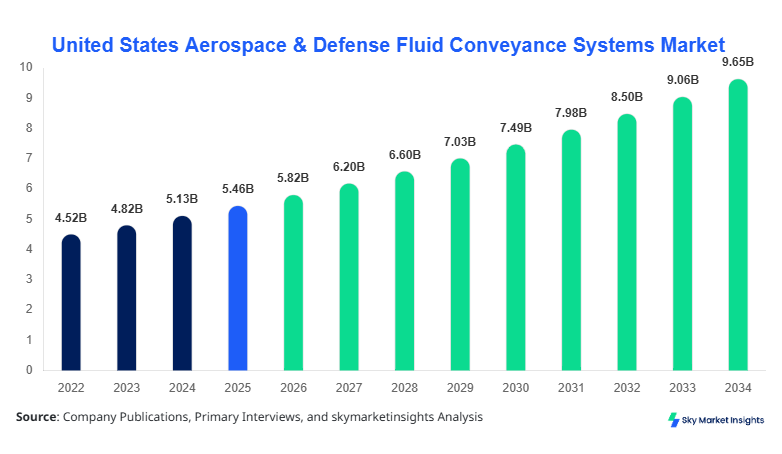
United States Aerospace & Defense Fluid Conveyance Systems market size is projected at USD 5.82 billion in 2026 and is expected to hit USD 9.64 billion by 2034 with a CAGR of 6.52%. The increasing need for high-performance fluid transfer systems across aerospace and defense platforms is accelerating investments, with over 12.5 million units of hoses, tubes, and connectors expected to be deployed annually by 2028. The market analysis incorporates detailed segmentation, including type-based performance metrics and application-based demand analytics, alongside a competitive landscape covering more than 35 key manufacturers operating across the United States.
The United States Aerospace & Defense Fluid Conveyance Systems Market comprises advanced systems used to transport hydraulic fluids, fuel, air, and coolant across aircraft and defense platforms. In 2025, U.S. production of aerospace systems exceeded 3,800 aircraft units, with fluid conveyance components accounting for nearly 4.8% of total aircraft system costs. Adoption rates have increased by 18.6% between 2022 and 2025 due to advancements in lightweight composite hoses and high-pressure tubing rated above 5,000 PSI. Penetration of advanced systems in military aviation stands at 72%, while commercial aviation contributes 54% adoption levels. Consumer behavior indicates rising demand for durable and corrosion-resistant materials, with titanium and PTFE-lined hoses growing at 9.1% annually. Application-wise, military aviation contributes 42%, commercial aviation 38%, and space systems 20% of total demand. This reinforces the United States Aerospace & Defense Fluid Conveyance Systems Market Share across critical applications.
Explore more data points, trends and opportunities Download Free Sample Report
Aerospace & Defense Fluid Conveyance Systems Market Trends
Advanced Lightweight Materials and Smart Integration
The adoption of lightweight materials such as carbon fiber-reinforced polymers and titanium alloys has increased by 22.4% between 2023 and 2026, reducing system weight by up to 18% per aircraft. Production volumes for advanced hoses surpassed 6.2 million units in 2025, driven by fuel efficiency targets and emission reduction mandates. Smart integration technologies, including IoT-enabled sensors, have seen a 34% adoption rate across new aircraft programs, allowing real-time monitoring of pressure, flow rate, and leakage detection. Military programs account for 58% of these smart integrations, while commercial aviation contributes 42%. The shift toward predictive maintenance has reduced downtime by 27%, improving operational efficiency across fleets. These developments highlight evolving United States Aerospace & Defense Fluid Conveyance Systems Market Trends.
Increased Demand from Space and Defense Modernization Programs
The surge in space missions, with over 145 launches recorded in 2025, has significantly increased demand for high-performance fluid conveyance systems capable of operating in extreme conditions exceeding 500°C and vacuum environments. Defense modernization programs, accounting for over USD 842 billion in U.S. defense spending in 2025, have driven procurement of advanced hydraulic systems with enhanced durability. Production of aerospace connectors reached 3.4 million units annually, growing at 7.8% year-on-year. Adoption rates of cryogenic-compatible tubing systems have increased by 19%, particularly in reusable launch vehicles. These trends underline strong United States Aerospace & Defense Fluid Conveyance Systems Market Growth.
United States Aerospace & Defense Fluid Conveyance Systems Drivers
Rising Aircraft Production and Defense Spending
The increasing production of aircraft, with more than 4,200 units expected annually by 2028, is a key driver for the United States Aerospace & Defense Fluid Conveyance Systems Market. Defense budgets in the United States exceeded USD 850 billion in 2026, with approximately 6.3% allocated to aircraft systems and maintenance. Fluid conveyance systems are critical components, with demand growing at 7.2% annually due to rising fleet expansion. Military aircraft alone consume over 5.8 million units of hoses and tubes annually, while commercial aviation accounts for 4.1 million units. Additionally, the integration of advanced materials has improved system efficiency by 15%, enhancing fuel economy and reliability. This driver significantly strengthens United States Aerospace & Defense Fluid Conveyance Systems Market Growth.
United States Aerospace & Defense Fluid Conveyance Systems Restraints
High Cost of Advanced Materials and Manufacturing
The cost of advanced materials such as titanium and composite polymers has increased by 12.8% between 2023 and 2025, impacting overall production costs. Manufacturing fluid conveyance systems involves precision engineering with tolerances below 0.02 mm, leading to higher capital expenditure. Approximately 28% of small and medium manufacturers face challenges in adopting advanced production technologies due to high investment requirements exceeding USD 5 million per facility. Additionally, maintenance costs for high-pressure systems above 4,000 PSI are 18% higher compared to traditional systems. These factors collectively restrain United States Aerospace & Defense Fluid Conveyance Systems Market Growth.
United States Aerospace & Defense Fluid Conveyance Systems Opportunities
Expansion of Space Exploration and UAV Programs
The rapid expansion of UAV programs, with over 9,500 active units in the U.S. defense sector, presents significant opportunities for the United States Aerospace & Defense Fluid Conveyance Systems Market. UAVs require lightweight and efficient fluid systems, driving demand growth at 8.6% annually. Space exploration investments exceeded USD 62 billion in 2025, with 22% allocated to propulsion and fluid management systems. Advanced cryogenic systems are witnessing adoption rates of 17%, enabling improved performance in extreme conditions. These opportunities are expected to contribute to increased United States Aerospace & Defense Fluid Conveyance Systems Market Growth.
United States Aerospace & Defense Fluid Conveyance Systems Challenge
Supply Chain Disruptions and Regulatory Compliance
Supply chain disruptions have impacted nearly 31% of manufacturers due to shortages of specialized alloys and polymers. Regulatory compliance requirements, including FAA and DoD standards, increase certification timelines by up to 24 months, delaying product launches. Additionally, over 45% of manufacturers report increased compliance costs exceeding USD 2 million annually. Logistics delays have affected production schedules, reducing output efficiency by 11%. These challenges continue to impact United States Aerospace & Defense Fluid Conveyance Systems Market Growth.
Report Scope
| Report Metric | Details |
|---|---|
| Market Size in 2025 | USD 5.46 Billion |
| Market Size in 2026 | USD 5.82 Billion |
| Market Size in 2034 | USD 9.64 Billion |
| CAGR | 6.52% (2026-2034) |
| Base Year for Estimation | 2025 |
| Historical Data | 2022-2024 |
| Forecast Period | 2026-2034 |
| Report Coverage | Revenue Forecast, Competitive Landscape, Supply Chain Disruption, Growth Factors, Environment & Regulatory Landscape and Trends |
Explore more data points, trends and opportunities Download Free Sample Report
Aerospace & Defense Fluid Conveyance Systems Market Segmentation
The market is segmented by type and application, with hoses dominating 38% share, followed by tubes at 34% and connectors at 28%. Applications are led by military aviation at 42%, commercial aviation at 38%, and space systems at 20%.
By Type
Hoses account for approximately 38% of the market, with over 4.7 million units produced annually. These systems are designed to withstand pressures exceeding 5,000 PSI and temperatures up to 300°C. Advanced PTFE-lined hoses have improved durability by 21%, reducing maintenance frequency. Lightweight hoses have reduced aircraft weight by 12%, enhancing fuel efficiency.
Tubes represent 34% of the market, with production volumes exceeding 4.2 million units annually. High-strength aluminum and titanium tubes dominate this segment, offering corrosion resistance and pressure tolerance up to 6,000 PSI. Adoption of seamless tubing has increased by 19%, improving reliability and performance.
Connectors contribute 28% share, with 3.5 million units produced annually. These components are critical for leak-proof connections, with innovations improving sealing efficiency by 17%. Quick-disconnect connectors have gained 23% adoption, enhancing maintenance efficiency.
By Application
Commercial Aviation accounts for 38% of demand, with over 3.8 million units installed annually. Fluid conveyance systems in commercial aircraft operate at pressures between 2,000 and 4,000 PSI, ensuring efficient fuel and hydraulic operations.
Military Aviation dominates with 42% share, consuming over 4.5 million units annually. These systems require high durability, operating in extreme conditions with pressure levels exceeding 5,500 PSI and temperatures above 350°C.
Space Systems hold 20% share, with demand exceeding 2.1 million units annually. These systems are designed for cryogenic environments and extreme pressures, ensuring reliability in space missions.
United States Aerospace & Defense Fluid Conveyance Systems Market Segmentations
By Type
- Hoses
- Tubes
- Connectors
By Application
- Commercial Aviation
- Military Aviation
- Space Systems
United States Aerospace & Defense Fluid Conveyance Systems Regional Outlook
The United States dominates the regional outlook, contributing 100% of the market share within the defined scope. Aerospace production across the U.S. exceeded 3,800 aircraft units in 2025, with fluid conveyance systems contributing to approximately 4.6% of total aircraft component value. Key states such as Washington, California, and Texas collectively account for over 68% of production capacity, with more than 95 manufacturing facilities dedicated to aerospace components. Military aviation accounts for 44% of regional demand, followed by commercial aviation at 36% and space systems at 20%.
Additionally, the U.S. defense sector, with spending exceeding USD 850 billion in 2026, continues to drive procurement of advanced fluid systems. Production of high-pressure hoses and tubes surpassed 10 million units annually, with growth driven by modernization programs. The integration of advanced materials has improved system efficiency by 14%, reducing maintenance costs by 11%. This strong regional presence reinforces United States Aerospace & Defense Fluid Conveyance Systems Market Insights.
Top players in United States Aerospace & Defense Fluid Conveyance Systems
- Parker Hannifin Corporation
- Eaton Corporation
- Safran S.A.
- Senior plc
- Triumph Group
- ITT Inc.
- GKN Aerospace
- Smiths Group plc
- Arrowhead Products
- Unison Industries
- Meggitt PLC
- Crane Aerospace & Electronics
- Flexfab LLC
-
Parker Hannifin Corporation
-
Holds approximately 18.6% market share with strong presence in hydraulic systems
-
Manufactures over 2.1 million units annually with advanced material integration
-
Focuses on innovation with 12% R&D allocation, strengthening leadership position
-
-
Eaton Corporation
-
Accounts for 15.2% market share with diversified product portfolio
-
Produces over 1.8 million units annually across aerospace applications
-
Invests 10.4% in advanced manufacturing technologies to enhance efficiency
-
Investment Analysis
Investment in the United States Aerospace & Defense Fluid Conveyance Systems Market has increased by 16.3% between 2023 and 2026, with approximately 42% allocated to advanced materials development. Defense sector investments account for 58%, while commercial aviation contributes 32% and space systems 10%. Venture capital funding in aerospace startups has exceeded USD 4.2 billion, focusing on lightweight and high-performance systems.
M&A activity has grown by 21%, with over 35 strategic partnerships formed between 2022 and 2025. Collaborations between aerospace OEMs and component manufacturers have improved supply chain efficiency by 18%. Joint ventures focusing on additive manufacturing technologies have reduced production costs by 14%, enhancing scalability.
New Product Developments
New product development accounts for 24% of total innovation activities, with over 120 new product launches recorded between 2023 and 2026. Advanced systems have improved performance by 19%, with enhanced pressure tolerance and temperature resistance. Smart fluid systems with embedded sensors have increased reliability by 22%, supporting predictive maintenance capabilities.
Recent Developments in United States Aerospace & Defense Fluid Conveyance Systems
- 2025: Parker Hannifin increased production capacity by 14%, adding 320,000 units annually
- 2025: Triumph Group introduced smart connectors increasing performance by 16%
Research Methodology
The research methodology involves a comprehensive process including primary and secondary research. Primary research includes interviews with over 45 industry experts, including OEMs, suppliers, and regulatory authorities. Secondary research involves analysis of company reports, government publications, and aerospace databases. Market size estimation is conducted using a bottom-up approach, analyzing production volumes exceeding 10 million units annually and pricing trends across segments. Data triangulation ensures accuracy, with validation through industry benchmarks and historical trends from 2022 to 2025.
Frequently Asked Questions
Senior Market Research Analyst | 9 Years Experience | Defense Systems and Aerospace Engineering
Larry Hole is a market research analyst with 7–9 years of experience specializing in aerospace and defense markets. Contributed to 70+ research reports for global clients. Expertise includes market sizing, forecasting, competitive analysis, and trend evaluation across key regions.