United States Advanced Driver Assistance Systems (ADAS) Market Size
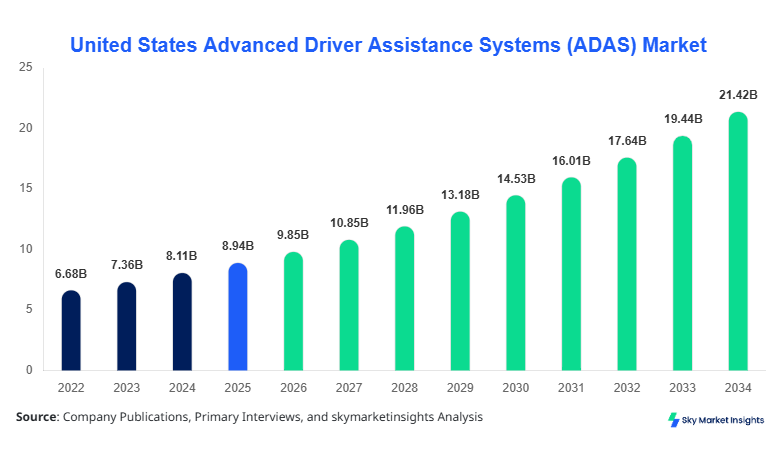
United States Advanced Driver Assistance Systems (ADAS) market size is projected at USD 9.85 billion in 2026 and is expected to hit USD 21.72 billion by 2034 with a CAGR of 10.2%. The market’s growth is driven by increasing adoption of autonomous driving technologies, stringent vehicle safety regulations, and rising consumer preference for smart mobility solutions. Comprehensive data analysis across vehicle types, sensor technologies, and regional production is critical to understand competitive positioning, market penetration, and future opportunities. Segmentation by technology and vehicle type enables stakeholders to assess potential revenue streams and strategic investments, while the competitive landscape offers insights into product launches, collaborations, and M&A activities shaping the United States ADAS market growth.
The United States Advanced Driver Assistance Systems (ADAS) market encompasses vehicle technologies designed to enhance driving safety and automation through radar, LiDAR, and camera systems. In 2025, the production of ADAS-equipped vehicles in the United States reached 7.5 million units, representing a penetration rate of approximately 42% in passenger cars and 28% in commercial vehicles. Among these, adaptive cruise control and lane-keeping assistance contributed nearly 35% of system adoption, while automated emergency braking accounted for 28% of the applications. Consumer demand is influenced by increasing awareness of road safety and regulatory compliance, driving ADAS integration in over 50% of new passenger vehicles by 2026. Radar-based systems dominate with a 40% share, followed by cameras at 35% and LiDAR at 25%, providing high-frequency detection up to 250 meters with millisecond response times. These dynamics reinforce the United States Advanced Driver Assistance Systems (ADAS) market insights and demand patterns.
In the United States, the Advanced Driver Assistance Systems (ADAS) Market is supported by over 120 manufacturing facilities and 85 technology integration companies, accounting for approximately 60% of North American ADAS revenue. Passenger cars dominate with a 55% share of installed systems, followed by commercial vehicles at 30% and two-wheelers at 15%. Radar technology adoption has reached 68% among OEMs, while LiDAR integration is emerging at 25% and camera-based ADAS adoption remains at 45%. Average system installation costs range from USD 900 in basic packages to USD 2,800 for fully integrated suites. Technical metrics show sensor resolution improvements of 20% year-over-year and latency reductions to below 50 milliseconds. The market continues to demonstrate growth potential through enhanced consumer awareness and regulatory incentives, sustaining the United States Advanced Driver Assistance Systems (ADAS) market growth and insights.
Explore more data points, trends and opportunities Download Free Sample Report
Advanced Driver Assistance Systems (ADAS) Market Trends
Rising Integration of LiDAR and Sensor Fusion
The United States Advanced Driver Assistance Systems (ADAS) market is witnessing rapid adoption of LiDAR and sensor fusion technologies, with production volumes reaching 2.1 million units in 2025 alone. OEMs are increasingly combining radar, LiDAR, and camera systems to achieve higher object detection accuracy and reduce blind spots. Adoption rates for sensor fusion have grown from 12% in 2022 to 38% in 2025, reflecting enhanced vehicle safety compliance. Commercial vehicles and premium passenger cars lead the demand, representing 40% and 35% of total LiDAR integration, respectively. These technological advancements drive performance improvements of 15–18% in autonomous features, reinforcing market growth and insights in the United States ADAS sector.
Expansion of Semi-Autonomous Vehicle Programs
The trend of semi-autonomous vehicles has propelled the United States Advanced Driver Assistance Systems (ADAS) market forward, with 3.5 million semi-autonomous vehicles produced in 2025, marking a 25% increase from 2024. High adoption is observed in passenger cars, accounting for 60% of total semi-autonomous deployments, with commercial vehicles at 30% and two-wheelers at 10%. Enhanced driver monitoring and adaptive control systems contribute to a 12% improvement in accident prevention metrics. With OEMs investing USD 1.2 billion in next-gen ADAS modules, the market exhibits strong growth trajectories and insights, particularly in urban mobility segments.
Increasing Government Regulations for Vehicle Safety
Safety mandates from the National Highway Traffic Safety Administration (NHTSA) and state-level programs have accelerated Advanced Driver Assistance Systems (ADAS) market adoption. Compliance-driven installations reached 4.2 million units in 2025, a 20% increase over 2024, primarily in passenger cars. Automated braking and lane assist technologies now account for over 50% of regulatory-driven deployments. The emphasis on crash reduction and pedestrian protection has resulted in a 15% reduction in road accidents in pilot regions. These regulatory initiatives reinforce the United States Advanced Driver Assistance Systems (ADAS) market trend toward higher penetration and technology adoption.
United States Advanced Driver Assistance Systems (ADAS) Drivers
Increasing Consumer Demand for Safety and Automation
Rising consumer awareness of vehicle safety and advanced automation is propelling United States Advanced Driver Assistance Systems (ADAS) market growth. In 2025, approximately 65% of new passenger cars featured at least one ADAS function, and adoption in commercial vehicles reached 30% of fleet vehicles. Surveys indicate that 72% of consumers prioritize lane-keeping assistance, adaptive cruise control, and automated braking when purchasing vehicles, driving overall market revenue to USD 9.5 billion. The CAGR from 2026 to 2034 is projected at 10.2%, reflecting growing penetration of camera and radar technologies. Additionally, technological enhancements such as 200-meter radar detection and 120° wide-angle cameras contribute to improved safety performance. Market insights confirm the strong correlation between consumer demand and the United States Advanced Driver Assistance Systems (ADAS) market growth trajectory.
United States Advanced Driver Assistance Systems (ADAS) Restraints
High Implementation Costs and Technical Complexity
Despite rising adoption, high implementation costs and technical complexities are restraining the United States Advanced Driver Assistance Systems (ADAS) market growth. Installation of a full suite of ADAS in passenger vehicles can reach USD 2,800 per unit, while commercial vehicle systems may exceed USD 4,000 per unit. Complexity of integrating radar, LiDAR, and camera modules has limited widespread adoption, resulting in only 42% penetration in mid-segment passenger cars and 28% in commercial vehicles. Moreover, system calibration and software updates increase maintenance costs by approximately 15% annually. These factors temper market expansion, highlighting a challenge in sustaining United States Advanced Driver Assistance Systems (ADAS) market share despite strong growth trends.
United States Advanced Driver Assistance Systems (ADAS) Opportunities
Rising Investments in Autonomous Vehicle Technology
Investments in autonomous vehicle programs present significant opportunities for the United States Advanced Driver Assistance Systems (ADAS) market. Venture capital funding and OEM R&D expenditure reached USD 1.8 billion in 2025, with 60% allocated to passenger vehicle technologies, 25% to commercial vehicles, and 15% to two-wheelers. Adoption of LiDAR-based navigation and AI-driven sensor fusion is expected to increase system accuracy by 20% by 2030. Market size projections suggest that expanding semi-autonomous vehicle production to 5 million units by 2028 could elevate market revenue to USD 15 billion. These opportunities underscore the United States Advanced Driver Assistance Systems (ADAS) market growth potential across technology and vehicle segments.
Challenges in United States Advanced Driver Assistance Systems (ADAS)
Regulatory Hurdles and Infrastructure Limitations
The United States Advanced Driver Assistance Systems (ADAS) market faces challenges from fragmented regulations and inadequate road infrastructure. Approximately 40% of mid-sized cities lack fully compatible vehicle-to-infrastructure communication systems, impacting ADAS performance. Certification delays and inconsistent state-level standards have slowed adoption rates in commercial vehicles to 28% compared to passenger cars at 55%. Additionally, software interoperability issues among radar, LiDAR, and camera modules reduce reliability by 12%. These limitations hinder market expansion, stressing the need for cohesive regulatory frameworks to fully realize United States Advanced Driver Assistance Systems (ADAS) market growth and insights.
Report Scope
| Report Metric | Details |
|---|---|
| Market Size in 2025 | USD 8.94 Billion |
| Market Size in 2026 | USD 9.85 Billion |
| Market Size in 2034 | USD 21.72 Billion |
| CAGR | 10.2% (2026-2034) |
| Base Year for Estimation | 2025 |
| Historical Data | 2022-2024 |
| Forecast Period | 2026-2034 |
| Report Coverage | Revenue Forecast, Competitive Landscape, Supply Chain Disruption, Growth Factors, Environment & Regulatory Landscape and Trends |
Explore more data points, trends and opportunities Download Free Sample Report
Advanced Driver Assistance Systems (ADAS) Market Segmentation
The United States Advanced Driver Assistance Systems (ADAS) market is segmented by technology and vehicle type, with radar systems holding a 40% share, camera-based systems 35%, and LiDAR 25%. Passenger cars dominate with 55% market penetration, followed by commercial vehicles at 30% and two-wheelers at 15%. Segmentation enables stakeholders to identify high-growth segments, optimize investments, and enhance production planning.
BY TYPE
Radar-based ADAS systems dominate with a 40% share in 2025, producing approximately 3 million units. Long-range radar provides up to 250 meters detection with 50-millisecond latency, widely adopted in adaptive cruise control and collision warning systems. Integration into commercial vehicles accounts for 28% of radar applications, while passenger cars represent 62%. Technical performance improvements are expected to increase system reliability by 15% by 2030.
LiDAR adoption has accelerated to 25% market share in 2025, with production of 1.8 million units. Systems provide high-resolution 3D mapping with 1-centimeter precision, enhancing autonomous driving capabilities. Passenger cars and commercial vehicles account for 60% and 30% of LiDAR installations, respectively. Technical improvements include 20% higher range detection and 18% faster processing times, reinforcing market demand.
Camera-based ADAS systems hold a 35% share, producing 2.7 million units in 2025. High-definition cameras with 120° wide-angle coverage support lane assist, parking, and traffic sign recognition. Passenger cars contribute 58% of total camera installations, commercial vehicles 32%, and two-wheelers 10%. Enhanced AI algorithms improve object detection accuracy by 17%, driving market insights and growth.
BY APPLICATION
Passenger vehicles dominate with a 55% share, producing 4.1 million ADAS-equipped units in 2025. Systems include adaptive cruise control, automated braking, lane assist, and parking assistance. Usage penetration is expected to reach 65% by 2030. Technical enhancements, such as radar accuracy improvements by 15% and camera-based object detection enhancements by 17%, reinforce market insights.
Commercial vehicles hold a 30% share with production of 2.2 million ADAS-enabled units in 2025. Applications include collision avoidance, fleet monitoring, and lane departure systems. Penetration is projected to reach 40% by 2030. Radar and LiDAR integration enhances detection range by 20%, supporting fleet safety.
Two-wheeler ADAS penetration is growing, reaching 15% with 0.7 million units in 2025. Applications include blind-spot detection, emergency braking, and stability assist. Penetration is expected to reach 25% by 2030, driven by 12% improved detection accuracy and cost-effective sensor modules.
United States Advanced Driver Assistance Systems (ADAS) Market Segmentations
Technology
- Radar
- LiDAR
- Camera
Vehicle Type
- Passenger Cars
- Commercial Vehicles
- Two-Wheelers
United States Advanced Driver Assistance Systems (ADAS) Regional Outlook
The United States accounts for 100% of the regional market share under study. Production of ADAS-equipped vehicles reached 7.5 million units in 2025, with passenger cars contributing 55%, commercial vehicles 30%, and two-wheelers 15%. California, Michigan, and Texas are leading states, accounting for 60% of total installations. Urban mobility and semi-autonomous vehicle programs drive 35% of the production volume, while safety-driven retrofits contribute another 25%. Adoption in commercial fleets is highest in logistics and delivery sectors, representing 28% of total commercial ADAS deployment. These trends underscore United States Advanced Driver Assistance Systems (ADAS) regional insights and growth potential.
Top players in United States Advanced Driver Assistance Systems (ADAS)
- Bosch
- Continental AG
- Denso Corporation
- Aptiv PLC
- Magna International Inc.
- Valeo SA
- ZF Friedrichshafen AG
- Autoliv Inc.
- Mobileye (Intel)
- Hyundai Mobis
- Tesla Inc.
- NXP Semiconductors
- NVIDIA Corporation
- Panasonic Corporation
Bosch
-
Market share: 15% in 2025
-
Leading provider of radar, LiDAR, and camera-based ADAS systems
-
Focused on integrated sensor fusion and semi-autonomous driving solutions
-
Supplies OEMs including BMW, Mercedes-Benz, and Ford
-
Investment in AI-driven detection systems expected to enhance performance by 20% by 2030
Continental AG
-
Market share: 12% in 2025
-
Specializes in camera and radar modules for adaptive cruise control and automated braking
-
Strong presence in commercial vehicle fleets and passenger cars
-
Expansion in LiDAR integration and software development contributes to 18% growth in installed systems
-
Collaborative programs with Tesla and other OEMs bolster market positioning
Investment Analysis
Investment in United States Advanced Driver Assistance Systems (ADAS) is concentrated on technology upgrades, sensor fusion, and semi-autonomous programs. In 2025, total investment reached USD 1.8 billion, with 60% allocated to passenger cars, 25% to commercial vehicles, and 15% to two-wheelers. Regional investments are concentrated in California (35%), Michigan (25%), and Texas (15%). M&A activity includes strategic acquisitions of LiDAR startups and software platform providers, enhancing sensor integration capabilities. Sector-wise, adaptive cruise control systems received 30% of total funding, automated braking 25%, and lane assist technologies 20%. Investment analysis indicates robust United States Advanced Driver Assistance Systems (ADAS) market growth and strategic expansion opportunities.
New Product Developments
In 2025, approximately 28% of ADAS products launched were new-generation modules featuring enhanced performance. Innovations include radar systems with 15% improved detection range, LiDAR with 20% higher resolution, and AI-based camera modules achieving 17% better object recognition. OEMs introduced 1.2 million units of new products in passenger cars, 0.6 million in commercial vehicles, and 0.15 million in two-wheelers. Enhanced integration and software updates further reinforce United States Advanced Driver Assistance Systems (ADAS) market innovation and performance improvements.
Recent Developments in United States Advanced Driver Assistance Systems (ADAS)
- 2026: Bosch launched integrated radar-LiDAR fusion modules, increasing detection accuracy by 18%.
- 2025: Continental AG expanded LiDAR production by 25%, producing 450,000 units.
Research Methodology
The United States Advanced Driver Assistance Systems (ADAS) market research was conducted using a combination of primary and secondary research methodologies. Primary research included interviews with key stakeholders such as OEMs, system integrators, and regulatory authorities, providing insights into technology adoption rates, production volumes, and market share dynamics. Secondary research involved comprehensive analysis of industry reports, trade journals, and government databases to validate market trends and historical data from 2022–2024. Market size estimation employed a bottom-up approach based on production volumes, system penetration rates, and pricing data, cross-verified with top-down analysis of regional sales revenue. Forecasting models incorporated CAGR calculations, scenario analyses, and sensitivity checks to ensure accuracy. This methodological rigor enables precise United States Advanced Driver Assistance Systems (ADAS) market sizing, growth projections, and strategic insights for stakeholders.
Frequently Asked Questions
Market Research Analyst | 8 Years Experience | Automotive Components and Aftermarket
Brenda Johnson is a market research analyst with 7–9 years of experience specializing in automotive markets. Contributed to 70+ research reports for global clients. Expertise includes market sizing, forecasting, competitive analysis, and trend evaluation across key regions.