United Kingdom Smart Pole Market Size
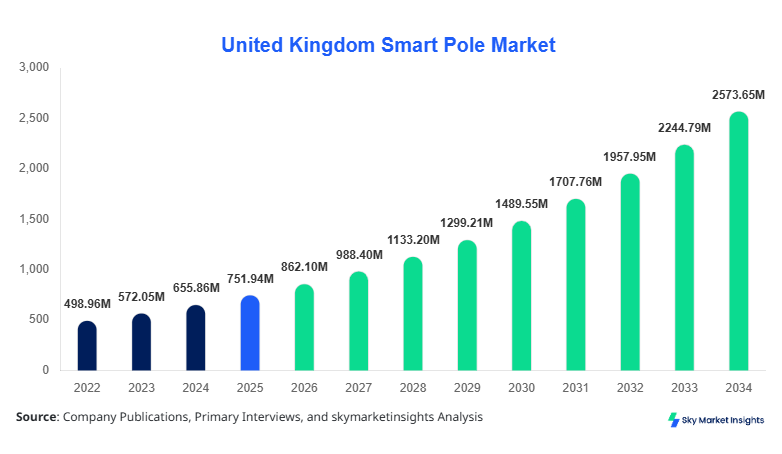
United Kingdom Smart Pole Market size is projected at USD 862.10 million in 2026 and is expected to hit USD 2,541.87 million by 2034 with a CAGR of 14.65%. Smart poles integrate connected lighting, sensing, communications, monitoring, and control infrastructure into multifunctional urban assets. Market assessment requires detailed evaluation of hardware, software, services, installation models, applications, connectivity technologies, materials, procurement patterns, and the competitive landscape.
Key Takeaways
- Hardware dominates the offerings segment at approximately 45.8% of the 2026 total, reaching USD 394.91 million, while services are the fastest-growing offering at a 15.39% CAGR through 2034.
- New installation dominates installation type with approximately 56.3% of the supplied 2026 installation total, valued at USD 486.36 million, and records the fastest CAGR of 15.11%.
- Retrofit installation represents approximately 43.7% of the supplied 2026 installation total at USD 377.56 million and is projected to expand at a 14.19% CAGR.
- Hardware is forecast to reach USD 1,155.28 million by 2034, while software and services reach USD 946.27 million and USD 440.32 million, respectively.
- England is expected to remain the principal deployment geography, while emerging county-level opportunities are concentrated around smart-city, transport, connectivity, and public-realm infrastructure programs; county-level market forecasts were not supplied.
Smart poles are multifunctional street infrastructure combining luminaires with sensors, controllers, communication devices, management software, and installation or maintenance services. Based on supplied offering data, the market increased from USD 753.16 million in 2025 to USD 862.10 million in 2026. Hardware contributes approximately 45.8% of the 2026 total, software about 37.9%, and services approximately 16.2%. Supplied installation data separately places new installations at USD 486.36 million and retrofits at USD 377.56 million in 2026. United Kingdom production-unit and penetration-rate figures were not provided, so no unsupported production volumes are assigned.
Explore more data points, trends and opportunities Download Free Sample Report
United Kingdom Smart Pole Market Trends
Connected Lighting Evolves into Multi-Service Urban Infrastructure
Smart-pole deployments are shifting from conventional lighting replacement toward platforms capable of supporting 4G/5G, NB-IoT, Wi-Fi, environmental sensing, cameras, traffic monitoring, charging interfaces, and edge-connected devices. A single pole can therefore accommodate multiple digital functions instead of supporting only 1 lighting function, enabling councils and infrastructure operators to consolidate 2 or more technology layers within common street assets.
Software-defined control is becoming increasingly important as connected infrastructure generates continuous operational data. Management and analytics platforms can coordinate thousands of lighting and sensing endpoints, while LED dimming, remote diagnostics, adaptive illumination, and sensor-based operation can reduce unnecessary operating hours and maintenance visits. Demand increasingly spans highways, roadways, parks, plazas, railways, and harbors, with connectivity architectures combining cellular networks and short-range or wired technologies.
United Kingdom Smart Pole Market Drivers
Smart-City Modernization and 5G Infrastructure Accelerate Connected Pole Deployment
Modernization of municipal lighting and telecommunications infrastructure is strengthening deployment economics as a single smart pole can combine 5 or more functions including illumination, sensing, surveillance, connectivity, and control. LED systems can deliver materially lower electricity consumption than legacy lighting in suitable applications, while remote monitoring can reduce repeated physical inspection requirements. The transition from 4G toward 5G and the use of NB-IoT create additional demand for dense connected street assets, particularly where thousands of urban endpoints require centralized management and near-real-time diagnostics.
United Kingdom Smart Pole Market Restraints
High Upfront Integration Costs and Complex Public Procurement Limit Deployment Pace
Smart-pole projects require expenditure across several cost layers rather than 1 conventional lighting asset, including luminaires, sensors, communication equipment, controllers, civil works, software, networking, and maintenance. Projects supporting 4G/5G connectivity, multiple sensor classes, and 24/7 data availability can introduce additional cybersecurity and interoperability costs. Public-sector procurement cycles, planning requirements, legacy street infrastructure, and the need to coordinate 2 or more technology suppliers can consequently lengthen deployment timelines despite favorable long-term operating economics.
United Kingdom Smart Pole Market Opportunities
Multi-Function Infrastructure Creates New Revenue and Service Models
Combining 5G small-cell capability, EV-related infrastructure, environmental sensing, public Wi-Fi, digital signage, and adaptive lighting can improve utilization of each installed pole. One physical asset can potentially support 3–6 digital or municipal functions, reducing the need for separate street furniture. Expanding connected-device density, increasing requirements for 24/7 urban monitoring, and migration toward remotely managed lighting create opportunities for subscription software, predictive maintenance, data analytics, and infrastructure-as-a-service models.
Challenges in United Kingdom Smart Pole Market
Cybersecurity, Interoperability and Technology Obsolescence Increase System Complexity
A connected pole may integrate 4G, 5G, NB-IoT, Wi-Fi, Zigbee, Bluetooth, fiber, or PLC alongside several sensor and control technologies. Supporting 5 or more communications and device standards increases integration complexity, while systems operating 24 hours per day require reliable authentication, software updates, network availability, and data governance. Equipment lifecycles can also differ substantially: structural poles can remain operational for decades while communications modules and software may require upgrades within considerably shorter technology cycles.
Report Scope
| Report Metric | Details |
|---|---|
| Market Size in 2025 | USD 752.43 Million |
| Market Size in 2026 | USD 862.1 Million |
| Market Size in 2034 | USD 2541.87 Million |
| CAGR | 14.65% (2026-2034) |
| Base Year for Estimation | 2025 |
| Historical Data | 2022-2024 |
| Forecast Period | 2026-2034 |
| Report Coverage | Revenue Forecast, Competitive Landscape, Supply Chain Disruption, Growth Factors, Environment & Regulatory Landscape and Trends |
Explore more data points, trends and opportunities Download Free Sample Report
United Kingdom Smart Pole Market Segmentation
The market is segmented by offerings, installation type, application, connectivity technology, and material. Supplied 2026 offering data indicates hardware dominance at approximately 45.8%, followed by software at 37.9% and services at 16.2%. Within installation type, new installations account for approximately 56.3% of the supplied 2026 installation total, compared with 43.7% for retrofit installations.
By Offerings
Hardware is the largest offering, increasing from USD 345.32 million in 2025 to USD 394.91 million in 2026 and USD 1,155.28 million by 2034, at a 14.36% CAGR. Its approximately 45.8% contribution in 2026 reflects continued spending on poles, luminaires, sensors, communication devices, and controllers.
Services are the fastest-growing offering at a 15.39% CAGR, rising from USD 121.41 million in 2025 to USD 140.09 million in 2026 and USD 440.32 million in 2034. Software expands at a 14.20% CAGR, from USD 327.10 million in 2026 to USD 946.27 million by 2034.
By Installation Type
New installation is the largest category, valued at USD 422.52 million in 2025 and USD 486.36 million in 2026 before reaching USD 1,499.22 million by 2034. The category records a 15.11% CAGR and represents approximately 56.3% of the supplied 2026 installation total.
Retrofit installation increases from USD 330.64 million in 2025 to USD 377.56 million in 2026 and USD 1,091.46 million by 2034, recording a 14.19% CAGR. New installation is consequently both the largest and fastest-growing category in the supplied installation dataset.
By Application
Highways and roadways represent a core deployment environment because lighting, traffic sensing, communications, and monitoring can be consolidated within 1 connected asset. Public places including parks and plazas form another deployment category, while railways and harbors provide transport-oriented applications. Numerical subsegment sizes and CAGRs for these 3 categories were not supplied.
Demand across these applications is shaped by the number of functions integrated per pole, with configurations potentially combining 4G/5G connectivity, illumination, environmental sensors, cameras, and control modules. No application-level market size or CAGR is inferred beyond the supplied tables.
By Connectivity Technology
Cellular connectivity comprises 4G, 5G, and NB-IoT technologies, providing 3 major cellular options for connected infrastructure. The alternative group combines Wi-Fi, Zigbee, Bluetooth, fiber, and PLC, representing 5 additional wireless or wired technologies. Numerical market sizes and CAGRs by connectivity technology were not supplied.
Cellular architectures are suited to wide-area connectivity, whereas Wi-Fi, Zigbee, and Bluetooth can support localized communication and fiber or PLC can provide wired alternatives. Hybrid designs can therefore incorporate 2 or more connectivity layers according to bandwidth, latency, coverage, and reliability requirements.
By Material
Metallic poles, principally steel and aluminum, remain established structural options, while composite materials represent an emerging lightweight alternative. The segmentation therefore contains 2 principal material classes serving structural, durability, installation, and equipment-integration requirements. Material-level revenue and CAGR figures were not provided.
Composite systems can address applications prioritizing reduced weight and installation handling, whereas steel and aluminum benefit from mature supply chains and established engineering practices. No numerical material dominance or fastest-growing CAGR is assigned because those figures are absent from the mandatory dataset.
United Kingdom Smart Pole Market Segmentations
By Offerings
- Hardware (poles, luminaires, sensor modules, communication devices, controllers)
- Software (management, analytics platforms)
- Services (installation, maintenance)
By Installation Type
- New Installation
- Retrofit Installation
By Application
- Highways and Roadways
- Public Places (parks, plazas)
- Railways and Harbors
By Connectivity Technology
- Cellular (4G/5G/NBIoT)
- Wi-Fi, Zigbee, Bluetooth, Fiber, PLC
By Material
- Metallic (steel, aluminum)
- Composite (emerging lightweight materials)
United Kingdom Smart Pole Market Outlook
England is expected to account for the largest deployment concentration because it contains the United Kingdom's largest urban areas, transport networks, municipal lighting estates, and major digital-infrastructure programs. Scotland, Wales, and Northern Ireland provide additional opportunities through public-realm modernization, transport connectivity, and energy-efficient lighting. The supplied national dataset places 2026 offerings revenue at USD 862.10 million, including approximately 45.8% hardware, 37.9% software, and 16.2% services.
County and nation-level revenue shares, production volumes, and CAGRs were not supplied and are therefore not fabricated. Deployment potential is nevertheless distributed across highways and roadways, public places, and railway and harbor environments, while installation data indicates USD 486.36 million from new installations and USD 377.56 million from retrofits in 2026. These figures are national segment values rather than county-level estimates.
Top players in United Kingdom Smart Pole Market
- Signify
- Schréder
- Siemens
- Itron
- Nokia
- Ericsson
- Huawei Technologies
- Cisco Systems
- Telensa
- Urbis Schréder
- Lucy Zodion
- Zumtobel Group
- Valmont Industries
- Siklu
- Orange Business
Top Two Companies
-
Signify
Signify maintains a strong position through connected LED lighting, centralized management, sensors, and smart-city infrastructure capabilities. Its portfolio aligns with the convergence of lighting and digital services, where smart poles can combine 4G/5G connectivity, environmental monitoring, controls, and adaptive illumination. The company addresses hardware and software layers and can participate in both new-build and retrofit projects. Exact United Kingdom company market share percentages were not supplied; therefore, assigning a numerical share would be unsupported.
-
Schréder
Schréder is positioned around professional outdoor lighting and connected urban infrastructure, supporting municipal, roadway, and public-space applications. Smart-pole configurations can accommodate multiple services while integrating connected luminaires and management technologies. This positioning aligns with a market in which new installation represents approximately 56.3% of the supplied 2026 installation total and retrofit installation approximately 43.7%. No verified company-level United Kingdom percentage share was provided, so an exact competitive share is not assigned.
Recent Developments in United Kingdom Smart Pole Market
- 2026: UK smart-infrastructure deployments increasingly emphasize multifunctional street assets capable of supporting lighting, sensing, communications, and centralized controls.
- 2025: Municipal infrastructure modernization continued to emphasize connected LED lighting, remote asset management, and data-enabled maintenance.
- 2025: 5G and small-cell infrastructure requirements increased the relevance of street furniture capable of hosting telecommunications equipment alongside lighting.
Research Methodology
The assessment uses 2025 as the base year, 2026 as the current year, 2022–2024 as the historical period, and 2026–2034 as the forecast period. Mandatory supplied numerical tables were treated as the primary quantitative source. Offering data indicates USD 753.16 million in 2025, USD 862.10 million in 2026, and USD 2,541.87 million in 2034 at a 14.65% CAGR. The separately supplied installation table reports USD 753.16 million, USD 863.92 million, and USD 2,590.68 million for the same respective years; this discrepancy is retained rather than reconciled by altering source values. Segment shares stated in the report are calculated directly from the relevant supplied totals, while unsupported regional, application, technology, material, production, and company-share figures are not fabricated.
Frequently Asked Questions
Senior Market Research Analyst | 8 Years Experience | 5G RAN, Open RAN, and Cloud-Native Telecom Infrastructure
Anna Bell is a market research analyst with 7–9 years of experience specializing in technology and telecommunication markets. Contributed to 70+ research reports for global clients. Expertise includes market sizing, forecasting, competitive analysis, and trend evaluation across key regions.