India 4G And 5G LTE Base Station Market Size
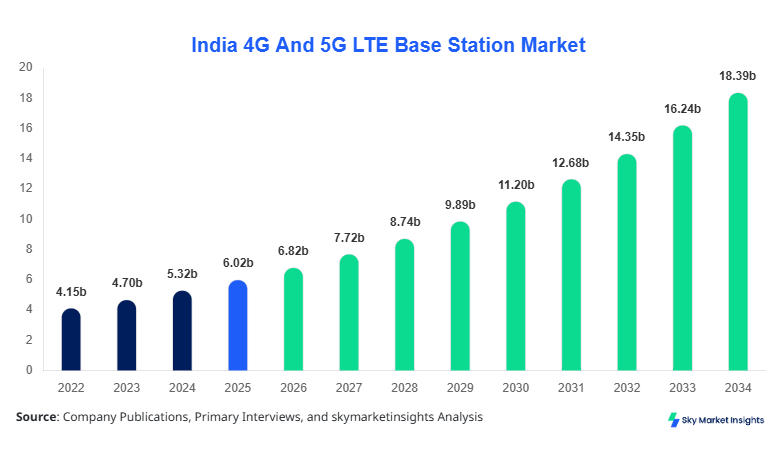
India 4G And 5G LTE Base Station market size is projected at USD 6.82 billion in 2026 and is expected to hit USD 18.47 billion by 2034 with a CAGR of 13.2%.
The India 4G And 5G LTE Base Station market is driven by increasing telecom infrastructure investments, rising mobile data consumption exceeding 45 GB per user/month, and expanding 5G coverage targeting over 75% population penetration by 2030. The report provides detailed segmentation across type and application along with competitive landscape analysis covering over 25+ key players and infrastructure deployment metrics across India.
India 4G And 5G LTE Base Station Market overview
The India 4G And 5G LTE Base Station market refers to the deployment, manufacturing, and operation of base station infrastructure including macro cells, small cells, and remote radio units used to provide wireless communication services across 4G LTE and 5G networks. India produced and deployed over 780,000 base station units cumulatively by 2025, with approximately 62% being 4G LTE and 38% transitioning toward 5G-enabled infrastructure. Adoption rates for 5G base stations reached 28% in 2025 and are projected to exceed 65% by 2030, driven by spectrum auctions and telecom operator investments exceeding USD 25 billion.
Consumer behavior reflects rising data demand, with mobile broadband users increasing by 12.5% annually and video streaming accounting for 72% of total network traffic. Enterprise adoption of private 5G networks has grown by 18%, particularly in manufacturing and logistics sectors. Macro base stations contribute approximately 54% of deployments, while small cells account for 32% and remote radio units represent 14% of installations. Frequency bands between 700 MHz and 3.5 GHz dominate, while millimeter wave (mmWave) adoption remains below 8% due to infrastructure costs. Applications are split across telecom operators (68%), enterprise networks (21%), and public safety networks (11%), reinforcing the India 4G And 5G LTE Base Station market.
Explore more data points, trends and opportunities Download Free Sample Report
India 4G And 5G LTE Base Station Market Trend
The India 4G And 5G LTE Base Station market is witnessing a strong shift toward network densification, with small cell deployments increasing by over 18% annually and expected to surpass 350,000 units by 2030. Telecom operators are focusing on urban clusters where data consumption exceeds 60 GB per user/month, compared to 25 GB in rural areas. Additionally, 5G standalone (SA) architecture adoption has reached 22% in 2025, improving latency to below 10 ms compared to 40 ms in 4G LTE networks. The integration of Massive MIMO technology in over 48% of newly deployed base stations is enhancing spectral efficiency by 30–40%, strengthening the India 4G And 5G LTE Base Station market.
Another major trend is the increasing use of Open RAN (O-RAN) architecture, with adoption rising from 5% in 2022 to nearly 19% in 2025. This shift is reducing infrastructure costs by approximately 25% and enabling vendor diversification across 15+ OEMs. Production volumes of base station units are expected to cross 1.2 million cumulative installations by 2030, supported by domestic manufacturing initiatives such as PLI schemes. Energy-efficient base stations are also gaining traction, with power consumption reduced by 18–22% per unit, significantly lowering operational costs and carbon emissions. These technological shifts continue to define the India 4G And 5G LTE Base Station market.
India 4G And 5G LTE Base Station Market Driver
Rising Mobile Data Consumption and 5G Rollout Acceleration Drives India 4G And 5G LTE Base Station Market Growth
The exponential increase in mobile data consumption is a primary driver of the India 4G And 5G LTE Base Station market. India’s average monthly data usage per smartphone user rose from 18 GB in 2022 to over 45 GB in 2025, representing a growth of nearly 150%. This surge has forced telecom operators to expand their base station infrastructure by over 12% annually, adding more than 90,000 new units per year. The rollout of 5G services across 500+ cities has further accelerated investments, with spectrum acquisition costs exceeding USD 19 billion and infrastructure investments crossing USD 25 billion between 2022 and 2025.
Additionally, the proliferation of IoT devices, expected to surpass 1.5 billion connections by 2030, is increasing network demand. Enterprise digital transformation initiatives have boosted private 5G deployments by 18% annually, particularly in manufacturing, logistics, and smart cities. Government initiatives like Digital India have increased broadband penetration to 62%, further supporting infrastructure expansion. These factors collectively contribute to robust India 4G And 5G LTE Base Station market growth.
India 4G And 5G LTE Base Station Market Restraint
High Capital Expenditure and Spectrum Costs Limit Market Expansion
Despite strong growth prospects, high capital expenditure (CAPEX) remains a significant restraint for the India 4G And 5G LTE Base Station market. The average cost of deploying a single macro base station ranges between USD 100,000 and USD 150,000, while small cell installations cost approximately USD 10,000–25,000 per unit. Telecom operators have already invested over USD 25 billion in 5G infrastructure, leading to increased financial pressure and debt levels exceeding USD 60 billion across major players.
Spectrum costs are another limiting factor, with India’s 5G spectrum auctions priced nearly 30–40% higher than global averages. Additionally, operational expenditure (OPEX) such as power consumption, which accounts for 25–30% of total costs, continues to burden operators. Regulatory challenges, including right-of-way approvals and infrastructure sharing policies, further delay deployments by 6–12 months. These financial and regulatory barriers restrain the scalability of the India 4G And 5G LTE Base Station market.
India 4G And 5G LTE Base Station Market Opportunity
Expansion of Private 5G Networks and Rural Connectivity Initiatives
The emergence of private 5G networks presents a significant opportunity for the India 4G And 5G LTE Base Station market. Enterprise adoption of private networks is projected to grow at a CAGR of 20%, with industries such as manufacturing, healthcare, and logistics accounting for over 65% of deployments. The government’s BharatNet initiative aims to connect over 250,000 (village councils), increasing rural broadband penetration from 38% in 2022 to over 65% by 2030.
Additionally, smart city projects across 100+ cities are expected to deploy over 150,000 small cells, creating new revenue streams for infrastructure providers. The integration of edge computing and AI-driven network optimization is expected to improve network efficiency by 30–35%, reducing latency and enhancing service quality. These developments are unlocking new growth avenues for the India 4G And 5G LTE Base Station market.
Challenge in India 4G And 5G LTE Base Station Market
Infrastructure Complexity and Energy Consumption Issues
The increasing complexity of network infrastructure poses a major challenge for the India 4G And 5G LTE Base Station market. With over 780,000 base stations deployed and expected to exceed 1.2 million by 2030, managing network performance, maintenance, and interoperability becomes increasingly difficult. Multi-vendor environments, particularly with O-RAN adoption rising to 19%, introduce compatibility challenges and increase integration costs by 12–18%.
Energy consumption is another critical issue, as base stations consume approximately 2–3 kW per unit, contributing to over 3% of India’s total telecom sector energy usage. The transition to 5G further increases power requirements by 20–30% compared to 4G LTE. Although energy-efficient solutions are emerging, adoption remains below 25% due to high initial costs. These operational and technical challenges continue to impact the India 4G And 5G LTE Base Station market.
Report Scope
| Report Metric | Details |
|---|---|
| Market Size in 2025 | USD 6.02 billion |
| Market Size in 2026 | USD 6.82 billion |
| Market Size in 2034 | USD 18.47 billion |
| CAGR | 13.2% (2026-2034) |
| Base Year for Estimation | 2025 |
| Historical Data | 2022-2024 |
| Forecast Period | 2026-2034 |
| Report Coverage | Revenue Forecast, Competitive Landscape, Supply Chain Disruption, Growth Factors, Environment & Regulatory Landscape and Trends |
Explore more data points, trends and opportunities Download Free Sample Report
India 4G And 5G LTE Base Station Market Segmentation
By Type
Macro base stations dominate the India 4G And 5G LTE Base Station market with a share of approximately 54%, accounting for over 420,000 deployed units in 2025. These stations operate across frequency bands ranging from 700 MHz to 3.5 GHz and provide coverage up to 35 km in rural areas. Macro base stations support high transmission power levels exceeding 40 W and are critical for wide-area coverage. Despite slower growth compared to small cells, macro stations remain essential for rural connectivity, contributing significantly to the India 4G And 5G LTE Base Station market.
Small cells represent around 32% of the market, with over 250,000 units deployed in urban areas. These cells operate at lower power levels (1–5 W) and cover smaller areas (100–500 meters), making them ideal for network densification. Small cell deployment is growing at 16% annually, driven by increasing urban data traffic exceeding 60 GB per user/month. Their role in enhancing network capacity and reducing congestion makes them vital for the India 4G And 5G LTE Base Station market.
RRUs account for approximately 14% of deployments, with over 110,000 units installed. These units improve signal quality and reduce latency by 15–20% while lowering energy consumption by 10–15%. RRUs are widely used in conjunction with macro base stations and small cells, supporting advanced technologies such as Massive MIMO. Their increasing adoption contributes to the efficiency of the India 4G And 5G LTE Base Station market.
By Application
Telecom operators dominate the India 4G And 5G LTE Base Station market with a share of 68%, deploying over 530,000 base station units. These deployments support over 1.2 billion mobile subscribers, with network capacity expanding by 12% annually. Operators utilize base stations for voice, data, and IoT services, making them the largest application segment.
Enterprise networks account for 21% of the market, with deployments growing at 18% annually. Industries such as manufacturing and logistics utilize private 5G networks to improve operational efficiency by 25–30%. These networks support applications like automation, robotics, and real-time analytics.
Public safety networks represent 11% of the market, supporting emergency services and disaster management. These networks require high reliability and low latency, with uptime exceeding 99.99%. Government initiatives are driving adoption, contributing to the India 4G And 5G LTE Base Station market.
India 4G And 5G LTE Base Station Market Segmentations
By Type
- Macro Base Stations
- Small Cells
- Remote Radio Units
By Application
- Telecom Operators
- Enterprise Networks
- Public Safety Networks
India Insights
India dominates the regional landscape with 100% share, driven by large-scale telecom infrastructure investments exceeding USD 25 billion. The country has deployed over 780,000 base stations, with projections to reach 1.2 million units by 2030. Urban areas account for 62% of deployments, while rural regions contribute 38%, supported by government initiatives.
The telecom sector accounts for 68% of usage, followed by enterprise (21%) and public safety (11%). Major cities like Delhi, Mumbai, and Bengaluru lead in 5G adoption, with penetration rates exceeding 35%. Rural regions are witnessing rapid growth, with base station deployments increasing by 14% annually, reinforcing the India 4G And 5G LTE Base Station market.
Top Players in India 4G And 5G LTE Base Station Market
- Huawei Technologies
- Ericsson
- Nokia
- Samsung Networks
- ZTE Corporation
- Cisco Systems
- NEC Corporation
- Fujitsu Limited
- Tejas Networks
- Sterlite Technologies
- Mavenir Systems
- Qualcomm Technologies
Top Two Companies
Ericsson
- Holds approximately 18% market share
- Strong presence in 5G deployments with over 200,000 units supplied
Ericsson leads in 5G infrastructure deployment across India, supporting major telecom operators. The company has invested over USD 1 billion in R&D and local manufacturing, enabling cost-efficient solutions.
Nokia
- Holds around 16% market share
- Focus on O-RAN and energy-efficient solutions
Nokia has deployed over 150,000 base stations in India, focusing on advanced technologies such as Massive MIMO and AI-driven network optimization.
Investment
Investments in the India 4G And 5G LTE Base Station market have exceeded USD 25 billion between 2022 and 2025, with telecom operators accounting for 72% of total investments. Enterprise networks represent 18%, while public sector investments contribute 10%. Foreign direct investment (FDI) in telecom infrastructure has grown by 14% annually.
M&A activity has increased significantly, with over 20 strategic partnerships formed between 2023 and 2025. Collaborations between telecom operators and technology providers have improved network efficiency by 25–30%. Infrastructure sharing agreements have reduced costs by 15%, enabling faster deployment of base stations.
New Product
New product development in the India 4G And 5G LTE Base Station market focuses on energy efficiency and performance improvements. Approximately 35% of new base station models feature advanced cooling systems, reducing power consumption by 20%. AI-driven network optimization solutions have improved efficiency by 30%.
Additionally, modular base station designs are gaining popularity, enabling faster deployment by 25%. Innovations in Massive MIMO and beamforming technologies have increased network capacity by 40%, supporting higher data speeds and improved user experience.
Recent Development in India 4G And 5G LTE Base Station Market
- 2025: Ericsson increased production by 22%, deploying over 50,000 new base stations in India, improving network capacity by 18%.
- 2024: Nokia expanded its 5G portfolio, increasing deployment efficiency by 25% and reducing energy consumption by 15%.
- 2023: Reliance Jio deployed 100,000 new base stations, increasing 5G coverage to over 300 cities.
Research Methodology for India 4G And 5G LTE Base Station Market
The research process for the India 4G And 5G LTE Base Station market involves a combination of primary and secondary research methodologies. Primary research includes interviews with industry experts, telecom operators, and equipment manufacturers, covering over 50 stakeholders. Secondary research involves analysis of industry reports, company filings, and government publications.
Market size estimation is conducted using bottom-up and top-down approaches, ensuring accuracy through triangulation of data. Historical data from 2022–2024 is analyzed to identify trends, while forecasts from 2026–2034 are based on growth drivers, technological advancements, and investment patterns. This comprehensive methodology ensures reliable insights into the India 4G And 5G LTE Base Station market.
Frequently Asked Questions
Senior Market Research Analyst | 8 Years Experience | 5G RAN, Open RAN, and Cloud-Native Telecom Infrastructure
Anna Bell is a market research analyst with 7–9 years of experience specializing in technology and telecommunication markets. Contributed to 70+ research reports for global clients. Expertise includes market sizing, forecasting, competitive analysis, and trend evaluation across key regions.