South Korea Smart Pole Market Size
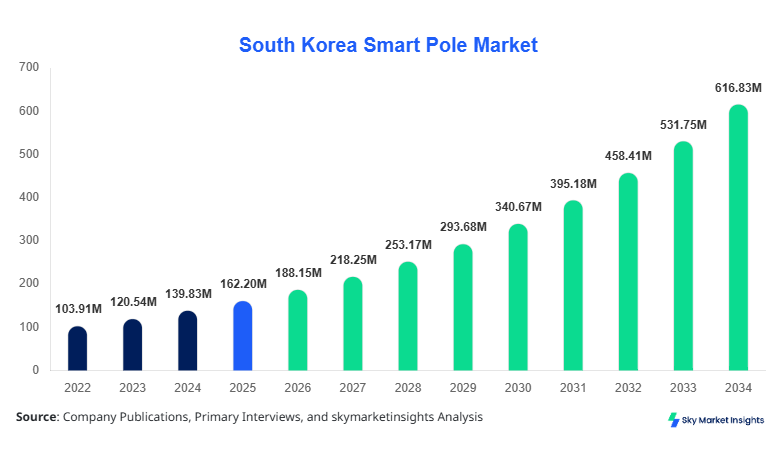
South Korea Smart Pole Market size is projected at USD 188.15 million in 2026 and is expected to hit USD 614.30 million by 2034 with a CAGR of 16.00%. The industry is advancing as municipalities consolidate lighting, CCTV, environmental sensing, public Wi-Fi, IoT connectivity, traffic monitoring, and communication infrastructure onto multifunctional poles. Assessment of offering-level data, installation models, application requirements, connectivity architecture, material selection, and the competitive landscape is essential for identifying procurement priorities through 2034.
Key Takeaways
- Hardware dominates the offerings category at USD 94.20 million in 2026, equivalent to approximately 50.1% of the offerings-based total, and reaches USD 305.44 million by 2034 at a 15.84% CAGR.
- Services are the fastest-growing offering, expanding at a 16.28% CAGR from USD 36.06 million in 2026 to USD 120.52 million by 2034.
- New installation dominates installation type with USD 122.01 million in 2026, representing approximately 64.8% of the installation-based total, and expands at a 16.33% CAGR.
- Retrofit installation increases from USD 66.39 million in 2026 to USD 212.76 million by 2034, registering a 15.67% CAGR.
- Seoul represents the country's most visible municipal deployment cluster; the city reported 1,065 S-Poles across its districts and Han River parks as of December 2025.
The market encompasses multifunctional urban poles integrating luminaires, controllers, CCTV, sensors, telecommunications equipment, Wi-Fi, IoT nodes, EV-charging interfaces, and related management software. Hardware contributes approximately 50.1% of the 2026 offerings total, compared with 30.8% for software and 19.2% for services. New installations account for about 64.8% of the installation-type value in 2026. Physical deployment is increasingly measurable: Seoul had 872 smart-pole locations at year-end 2024 and reported 1,065 units by December 2025, an increase of 193 units, or approximately 22.1%.
Explore more data points, trends and opportunities Download Free Sample Report
South Korea Smart Pole Market Trends
Convergence of Lighting, Safety and Connectivity Infrastructure
Municipal infrastructure is shifting from single-purpose street furniture toward integrated digital nodes. Seoul's smart-pole architecture combines lighting, traffic signals and CCTV with public Wi-Fi, IoT sensors, smart crossings, EV charging and drone-station functionality. The city's installed base surpassed 1,000 poles after deployment began in 2020, creating an increasingly dense platform for connected public services.
Connectivity requirements are also becoming more data-intensive. Seoul reported more than 34,000 public Wi-Fi installations, planned 280 additional units and replacement of 450 units with Wi-Fi 6 or newer equipment. Annual public Wi-Fi traffic reached 36,449 TB, up 52% year over year, while connections increased 124%, illustrating the scale of digital demand that multifunctional street infrastructure can support.
South Korea Smart Pole Market Drivers
Smart-City Safety and Connectivity Programs Accelerate Deployment
Public safety, communications and infrastructure consolidation are central deployment drivers. Seoul's network increased from 872 smart-pole locations at the end of 2024 to more than 1,000 operational units during 2025, while public Wi-Fi traffic rose 52% and connections advanced 124%. A 7-month Seoul AI Foundation assessment conducted from April to October 2025 also evaluated smart-pole effects on pedestrian visibility and child-protection-zone safety, strengthening the evidence base for continued municipal deployment.
South Korea Smart Pole Market Restraints
Integration Complexity Raises Deployment and Lifecycle Requirements
Combining 4G/5G, Wi-Fi, IoT sensing, CCTV, lighting controls and power electronics in one structure increases engineering and lifecycle complexity. Seoul's infrastructure already includes more than 34,000 public Wi-Fi installations alongside over 1,000 smart poles, meaning integration must address thousands of communications endpoints. With data traffic rising 52% annually and connections increasing 124%, network capacity, cybersecurity, maintenance and interoperability requirements become progressively more demanding.
South Korea Smart Pole Market Opportunities
AI, 5G and Edge Services Expand Pole Functionality
The transition from lighting assets to distributed digital-service platforms creates opportunities in AI video analytics, environmental sensing, edge computing, EV charging and next-generation wireless infrastructure. KT highlights nationwide NB-IoT infrastructure and approximately 310,000 location-based infrastructure points supporting smart-city applications. Meanwhile, Seoul's addition of 193 smart poles between year-end 2024 and December 2025 demonstrates the scalability of multifunctional municipal infrastructure.
Report Scope
| Report Metric | Details |
|---|---|
| Market Size in 2025 | USD 162.20 Million |
| Market Size in 2026 | USD 188.15 Million |
| Market Size in 2034 | USD 614.3 Million |
| CAGR | 16% (2026-2034) |
| Base Year for Estimation | 2025 |
| Historical Data | 2022-2024 |
| Forecast Period | 2026-2034 |
| Report Coverage | Revenue Forecast, Competitive Landscape, Supply Chain Disruption, Growth Factors, Environment & Regulatory Landscape and Trends |
Explore more data points, trends and opportunities Download Free Sample Report
South Korea Smart Pole Market Segmentation
The industry is segmented by offerings, installation type, application, connectivity technology and material. In 2026, hardware represents approximately 50.1% of offerings revenue, while new installation accounts for approximately 64.8% of installation-type revenue. These structures indicate continued preference for capital-intensive integrated equipment and greenfield municipal deployment.
By Offerings
Hardware is the largest offering, valued at USD 94.20 million in 2026 and projected to reach USD 305.44 million by 2034, registering a 15.84% CAGR. It represents approximately 50.1% of the USD 188.15 million offerings-based 2026 total, reflecting expenditure on poles, luminaires, sensors, communication devices and controllers.
Services are the fastest-growing offering at a 16.28% CAGR, increasing from USD 36.06 million in 2026 to USD 120.52 million in 2034. Software simultaneously rises from USD 57.89 million to USD 188.34 million at a 15.89% CAGR, supported by management and analytics requirements.
By Installation Type
New installation is the largest category at USD 122.01 million in 2026 and is projected to reach USD 409.18 million in 2034 at a 16.33% CAGR. It contributes approximately 64.8% of the USD 188.40 million installation-based 2026 total.
New installation is also the faster-growing category at 16.33%, compared with 15.67% for retrofit installation. Retrofit deployments increase from USD 66.39 million in 2026 to USD 212.76 million in 2034 as municipalities modernize existing lighting and roadside infrastructure.
By Application
Highways and roadways form a core deployment environment because smart poles consolidate lighting, traffic monitoring, CCTV and communications functions. Public places extend use cases into parks and plazas, while railways and harbors require resilient connectivity, surveillance and sensor integration.
Demand across these applications is reinforced by urban safety and digital-service requirements. Seoul's deployment includes major streets, intersections, child-protection zones, parks and 11 Han River parks, demonstrating the breadth of practical smart-pole environments.
By Connectivity Technology
Cellular technologies including 4G, 5G and NB-IoT support high-bandwidth and wide-area smart-city services, while Wi-Fi, Zigbee, Bluetooth, fiber and PLC provide complementary connectivity. KT reports nationwide NB-IoT infrastructure and approximately 310,000 location-based infrastructure points.
By Material
Metallic poles, principally steel and aluminum, remain the established structural solution because they accommodate luminaires, cameras, controllers, antennas and power equipment. Composite materials are emerging where reduced structural weight, corrosion resistance and specialized installation requirements justify alternative designs.
Material engineering is increasingly influenced by the number of integrated devices per pole. Seoul's S-Pole concept combines at least 3 traditional infrastructure functions—lighting, signaling and CCTV—with multiple digital systems such as Wi-Fi, IoT and charging, increasing requirements for structural durability and modular mounting.
South Korea Smart Pole Market Segmentations
By Offerings
- Hardware (poles, luminaires, sensor modules, communication devices, controllers)
- Software (management, analytics platforms)
- Services (installation, maintenance)
By Installation Type
- New Installation
- Retrofit Installation
By Application
- Highways and Roadways
- Public Places (parks, plazas)
- Railways and Harbors
By Connectivity Technology
- Cellular (4G/5G/NBIoT)
- Wi-Fi, Zigbee, Bluetooth, Fiber, PLC
By Material
- Metallic (steel, aluminum)
- Composite (emerging lightweight materials)
South Korea Smart Pole Market Outlook
Seoul is the country's most clearly documented deployment center, with 1,065 S-Poles installed as of December 2025. Guro-gu accounted for 370 units, or approximately 34.7% of Seoul's installed total; Jongno-gu represented 178 units, or 16.7%; Gangdong-gu accounted for 121 units, or 11.4%. Together, these three districts represented approximately 62.8% of Seoul's documented installed base.
Other deployment clusters include Dongdaemun-gu with 51 poles, Dongjak-gu with 50, Gangseo-gu with 42 and the 11 Han River parks with 39. In value terms, the national offerings-based market progresses from USD 188.15 million in 2026 to USD 614.30 million in 2034, while hardware contributes USD 94.20 million in 2026. Seoul's deployment pattern demonstrates particularly strong use across roadways, pedestrian corridors, parks and child-protection zones.
Top players in South Korea Smart Pole Market
- Samsung Electronics
- KT Corporation
- SK Telecom
- LG Uplus
- LG Electronics
- Signify
- Schreder
- Siemens
- Cisco Systems
- Nokia
- Ericsson
- Huawei Technologies
Top Companies
-
Samsung Electronics
A major domestic technology supplier positioned across telecommunications equipment, electronics, IoT and smart-infrastructure ecosystems. Samsung has participated in South Korean smart-grid and connected-infrastructure initiatives, including consortium activity alongside major telecom and industrial organizations. A verified percentage of South Korean smart-pole revenue attributable specifically to KT is not publicly disclosed.
Recent Developments in South Korea Smart Pole Market
- 2026: Seoul published results from analysis of more than 1,000 S-Poles, reporting improved visibility and reduced traffic accidents in child-protection zones.
- 2025: Seoul reported that 1,027 smart poles had been installed and operated since the program began in 2020, with further expansion focused on children's routes.
- 2025: A 7-month evaluation running from April through October assessed the operational effects of smart poles on urban safety and efficiency.
Research Methodology
The assessment uses 2025 as the base year, 2026 as the current year and 2026–2034 as the forecast period. Mandatory supplied market values were retained as provided: the offerings framework records USD 162.28 million in 2025, USD 188.15 million in 2026 and USD 614.30 million in 2034 at a 16.00% CAGR. The installation framework records USD 188.40 million in 2026 and USD 621.94 million in 2034; its difference from the offerings totals is preserved rather than normalized. Segment percentages were calculated directly from supplied values, while deployment evidence was cross-checked against Seoul municipal and industry sources. Company-specific revenue shares and unsupported application, connectivity or material CAGRs were not fabricated.
Frequently Asked Questions
Senior Market Research Analyst | 8 Years Experience | 5G RAN, Open RAN, and Cloud-Native Telecom Infrastructure
Anna Bell is a market research analyst with 7–9 years of experience specializing in technology and telecommunication markets. Contributed to 70+ research reports for global clients. Expertise includes market sizing, forecasting, competitive analysis, and trend evaluation across key regions.