North America Automotive ADAS Sensors Market Size
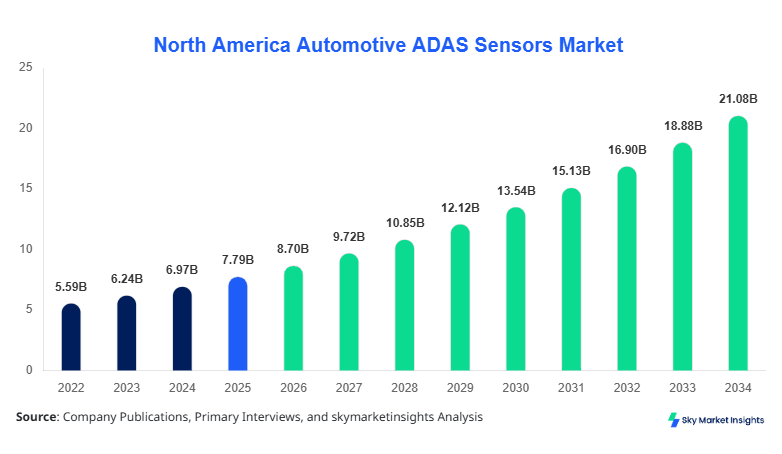
North America's automotive ADAS sensors market size is projected at USD 8.7 billion in 2026 and is expected to hit USD 21.5 billion by 2034 with a CAGR of 11.7%. The market growth is primarily driven by rising adoption of advanced driver-assistance systems in passenger cars, commercial vehicles, and heavy trucks, as well as increased investments in autonomous vehicle technologies. This report provides detailed segmentation by sensor type and vehicle type, including radar, lidar, and camera sensors, while offering a comprehensive competitive landscape across North America. The analysis also covers production volumes, adoption trends, and regional market share to support strategic planning and investment decisions.
The report also emphasizes the need for precise data on sensor penetration, vehicle integration rates, and regional production facilities. Competitive benchmarking includes market leaders, their revenue shares, product portfolios, and technology adoption statistics.
The North America Automotive ADAS Sensors market is defined as the production, integration, and sales of advanced driver-assistance sensors, including radar, lidar, and camera technologies, for vehicles such as passenger cars, commercial vehicles, and heavy trucks. In 2025, North America produced approximately 15.2 million ADAS sensors, with the United States accounting for 68% of total production. Adoption of these sensors in passenger vehicles reached 72% in 2025, while commercial vehicles contributed 21% and heavy trucks 7% to the total deployment. Consumer demand for collision avoidance, lane-keeping assistance, and adaptive cruise control systems is increasing, with penetration rates growing at 9–12% annually. Technical performance metrics include radar frequency ranges of 76–81 GHz, lidar resolution up to 128 channels, and camera frame rates of 60–120 fps, with applications such as autonomous driving (55%), driver-assist features (30%), and parking assist systems (15%). North America's automotive ADAS sensors market growth is reinforced by high consumer awareness and technology integration across new vehicle models.
In the United States, the automotive ADAS sensors market comprises over 45 manufacturing facilities and 32 specialized technology companies. The country accounts for approximately 68% of North America's market share in 2026, producing 10.5 million sensors. Passenger cars dominate the application segment with 65% share, followed by commercial vehicles at 25% and heavy trucks at 10%. Radar sensors represent 44% of the installed base, lidar contributes 28%, and camera-based systems account for 28%. Technology adoption statistics indicate 70% of new vehicles equipped with at least one ADAS sensor type, while full-system adoption in premium vehicles is 35%. The market's growth is fueled by stringent safety regulations, increasing consumer demand, and strong OEM partnerships, ensuring that United States automotive ADAS sensor market insights remain crucial for regional investors and stakeholders.
Explore more data points, trends and opportunities Download Free Sample Report
Automotive ADAS Sensors Market Trends
Rising Adoption of Radar and Lidar Technologies
Radar sensors are witnessing adoption growth at 14% CAGR, with 5.6 million units produced in 2025 alone. Lidar sensors, although smaller in volume with 2.8 million units, are rapidly gaining traction in autonomous vehicle development. The production volume of ADAS sensors in North America reached 15.2 million units in 2025, with camera systems accounting for 42% penetration in premium vehicles. Demand is particularly high in passenger cars for adaptive cruise control, lane departure warning, and collision mitigation systems. Technology shifts toward high-resolution lidar and 4D radar systems are accelerating, with a 12% year-over-year performance improvement. The North American Automotive ADAS Sensors market trend reflects a strong inclination toward sensor fusion and multimodal data processing.
Growth of Camera-Based ADAS Systems
Camera-based ADAS systems are increasingly deployed due to cost-effectiveness and high-resolution imaging capabilities, with market share at 38% in 2025. North American production exceeded 6 million units in 2025, with penetration in passenger vehicles at 68% and commercial vehicles at 25%. High-performance CMOS sensors with 120 fps frame rates are becoming standard. Integration with AI-based vision processing is enhancing object recognition accuracy by 15–20%. The sector-specific demand is highest in lane assist and traffic sign recognition applications, accounting for 55% of camera ADAS deployments. These advancements indicate sustained demand and growth for North America's automotive ADAS sensors market insights.
Expansion of ADAS in Commercial and Heavy Vehicles
Commercial vehicles and heavy trucks are witnessing adoption increases at 10–12% CAGR, with production volumes of 3.2 million units in 2025. Radar-based adaptive cruise control and collision avoidance solutions are the dominant technologies, representing 60% of commercial vehicle installations. Heavy truck integration of lidar for highway driving assistance accounts for 12% of production. North America Automotive ADAS Sensors market trends indicate rising government incentives and regulatory mandates driving adoption in commercial fleets, ensuring safety compliance and operational efficiency.
North America Automotive ADAS Sensors Market Drivers
Rising Demand for Vehicle Safety and Regulatory Compliance
North America's automotive ADAS sensors market growth is driven by rising demand for enhanced vehicle safety, particularly in the United States, where approximately 72% of new passenger cars are equipped with ADAS features. Regulatory frameworks, including NHTSA mandates, have led to a 15% annual increase in radar sensor adoption, with lidar systems growing at 12%. Production volume of 15.2 million sensors in 2025 underlines strong market uptake. Insurance companies offer premium reductions for vehicles equipped with ADAS, incentivizing consumer purchase. Increased consumer awareness of accident avoidance, lane-keeping assistance, and autonomous emergency braking further boosts demand, resulting in a projected CAGR of 11.7% from 2026 to 2034. North America Automotive ADAS Sensors market insights confirm strong growth driven by safety-conscious consumer behavior and regulatory enforcement.
North America Automotive ADAS Sensors Market Restraints
High Sensor Costs and Integration Complexity
Despite market growth, the high cost of lidar sensors (up to USD 8,500 per unit) and complex integration processes hinder adoption in mid-range vehicles. North American passenger car production faces cost-related constraints, with radar sensors priced around USD 250–450 per unit, while camera systems cost USD 200–350 per unit. Integration challenges, including software calibration and vehicle architecture adaptation, affect deployment across 45 production facilities. Approximately 30% of commercial vehicles still operate without full ADAS integration due to cost barriers. These restraints may limit growth in non-premium segments, impacting overall North America automotive ADAS sensors market demand projections.
North America Automotive ADAS Sensors Market Opportunities
Expansion of Autonomous Vehicle Programs
Autonomous vehicle pilot programs and smart mobility initiatives present substantial opportunities, with expected investment exceeding USD 1.2 billion in North America by 2027. Lidar and radar integration in commercial fleets is projected to reach 4.5 million units by 2030, while camera-based perception systems could expand to 7.2 million units. Application penetration in passenger cars may increase from 72% in 2025 to 85% by 2034. Collaborative programs between OEMs and technology providers indicate a 25% year-on-year increase in R&D expenditures for sensor optimization. North America Automotive ADAS Sensors market insights suggest that autonomous mobility initiatives will fuel adoption growth, increase production volumes, and stimulate technology innovation.
Challenges in North American Automotive ADAS Sensors Market
Supply Chain Volatility and Component Shortages
The North American Automotive ADAS Sensors market faces challenges from supply chain disruptions and semiconductor shortages, affecting 40% of sensor production facilities. Lidar modules experience delivery delays of 12–16 weeks, while radar chipsets face lead times of 8–10 weeks. Production volumes are constrained, with 15.2 million units produced in 2025 and a projected 18.1 million units in 2026. Cost escalation of rare earth components adds 6–8% to the sensor unit price. These challenges impact timely vehicle integration and market expansion, reinforcing the need for risk mitigation strategies in North American automotive ADAS sensor market growth planning.
Report Scope
| Report Metric | Details |
|---|---|
| Market Size in 2025 | USD 7.79 Billion |
| Market Size in 2026 | USD 8.7 Billion |
| Market Size in 2034 | USD 21.5 Billion |
| CAGR | 11.7% (2026-2034) |
| Base Year for Estimation | 2025 |
| Historical Data | 2022-2024 |
| Forecast Period | 2026-2034 |
| Report Coverage | Revenue Forecast, Competitive Landscape, Supply Chain Disruption, Growth Factors, Environment & Regulatory Landscape and Trends |
Explore more data points, trends and opportunities Download Free Sample Report
Automotive ADAS Sensors Market Segmentation
Segmentation is based on sensor type and vehicle application, with radar sensors leading at 44% market share, camera systems at 38%, and lidar at 18%. Passenger cars dominate applications at 65%, commercial vehicles at 25%, and heavy trucks at 10%.
By Type
Radar sensors accounted for 44% of North America's automotive ADAS sensors market share in 2025, producing 6.7 million units with a frequency range of 76–81 GHz. High-resolution 4D radar systems contribute to collision avoidance, adaptive cruise control, and blind-spot detection, supporting performance improvements of 15% in detection accuracy. Lidar and camera fusion is common in 35% of vehicles, enhancing sensor reliability. North American production volumes of radar sensors are projected to reach 10.1 million units by 2034.
Lidar systems represent an 18% share of the market, with 2.7 million units produced in 2025. Technical specifications include 128-channel resolution and a range of up to 250 meters. Lidar adoption in passenger cars is 30%, commercial vehicles 20%, and heavy trucks 10%, with annual growth rates of 12%. Integration with autonomous vehicle platforms is expected to increase penetration to 25% by 2030, reinforcing North America Automotive ADAS Sensors market demand.
Camera-based ADAS sensors hold 38% market share, producing 5.8 million units in 2025. Technical specifications include 120 fps frame rates and HD resolution. Applications include lane departure warning, traffic sign recognition, and parking assistance. Adoption rates are 68% in passenger cars and 25% in commercial vehicles. Integration with AI-based image processing improves detection reliability by 18%, supporting market growth projections through 2034.
By Application
Passenger cars dominate ADAS adoption at 65% market share, producing 9.8 million sensors in 2025. Integration includes radar (44%), lidar (18%), and camera (38%). Penetration rate in new vehicles is 72%, with applications in collision avoidance (55%), lane-keeping assistance (30%), and parking assist (15%). Technical metrics include radar (76–81 GHz), lidar (128 channels), and camera (120 fps). North America Automotive ADAS Sensors market growth in passenger cars is reinforced by high consumer safety awareness and premium vehicle adoption.
Commercial vehicle integration represents 25% market share, producing 3.8 million sensors in 2025. Radar dominates with 60% share, lidar 20%, and camera 20%. Applications include adaptive cruise control (50%), collision avoidance (30%), and driver assistance systems (20%). Penetration is 45% in fleets, supported by regulatory compliance requirements and growing investment in fleet safety solutions.
Heavy trucks account for 10% market share, producing 1.6 million sensors in 2025. Radar usage is 55%, lidar 25%, and camera 20%. The application includes highway driving assistance, collision mitigation, and blind-spot detection. Penetration is 22%, expected to rise to 35% by 2034 with growing adoption of autonomous highway driving technologies.
North America Automotive ADAS Sensors Market Segmentations
Sensor Type
- Radar
- Lidar
- Camera
Vehicle Type
- Passenger Cars
- Commercial Vehicles
- Heavy Trucks
North America Automotive ADAS Sensors Market Regional Outlook
United States
The United States contributes 68% of North America's automotive ADAS sensor production, equating to 10.5 million units in 2025. Passenger cars dominate with 65% market share, commercial vehicles 25%, and heavy trucks 10%. The country is home to 45 manufacturing facilities and 32 technology providers. Production is concentrated in Michigan, California, and Texas, accounting for 60% of total output. Investment in radar, lidar, and camera systems reached USD 1.2 billion in 2025, with adoption rates in passenger cars at 72% and commercial vehicles at 45%. United States automotive ADAS sensor market insights indicate steady growth and high technology adoption.
Canada
Canada accounts for 32% of regional production, producing 4.7 million sensors in 2025. Passenger cars contribute 60%, commercial vehicles 30%, and heavy trucks 10%. Production facilities are concentrated in Ontario and Quebec, with 15 companies operating in sensor development. Camera-based systems are 40% of installations, radar 42%, and lidar 18%. Investment in ADAS R&D reached USD 350 million in 2025, supporting technology adoption and regional market growth. Canada Automotive ADAS Sensors market insights reflect increasing penetration across passenger and commercial vehicles.
Top players in North American automotive ADAS Sensors Market
- Aptiv
- Bosch
- Denso
- Continental AG
- Magna International
- ZF Friedrichshafen AG
- Valeo
- Autoliv
- Hyundai Mobis
- Panasonic Automotive
- Infineon Technologies
- NXP Semiconductors
- Texas Instruments
- Velodyne Lidar
- Quanergy Systems
Top Two Companies
Aptiv
-
Market share: 12%
-
Positioned as a leader in radar and camera sensor integration, supplying over 1.2 million units in 2025
-
Focus on software and AI-based driver assistance solutions
-
Investment in R&D accounts for 25% of total North American ADAS sector expenditures.
Bosch
-
Market share: 10%
-
Dominant in radar sensors and collision avoidance systems, producing 1.05 million units in 2025
-
Active partnerships with OEMs for fleet-level ADAS deployment
-
Technology innovation focuses on high-frequency radar and lidar integration, improving sensor performance by 15%
Investment Analysis
North America's automotive ADAS sensors market investment allocation is diversified, with 45% directed toward passenger car sensor development, 35% in commercial vehicle applications, and 20% in heavy trucks. Regional allocation favors the United States with 68% of total investments and Canada with 32%. M&A agreements have increased, with Bosch and Aptiv acquiring smaller lidar startups to expand market share and technology capabilities. Collaborative agreements between OEMs and Tier-1 suppliers for radar and camera fusion projects account for 22% of R&D expenditures. Investments also include software development for AI-driven sensor data processing, supporting a projected CAGR of 11.7% and market expansion to USD 21.5 billion by 2034.
New Product Developments
Approximately 30% of new product launches in 2025 are enhanced ADAS sensors with improved detection range and accuracy. Lidar performance improvements are reported at 18% in resolution and detection reliability, while radar systems achieve 15% better object detection at long range. Camera-based ADAS products integrate AI vision processing, increasing object recognition accuracy by 20%. Innovation is focused on reducing sensor size by 12% and energy consumption by 10%, improving integration across vehicle segments. North America's automotive ADAS sensors market development highlights the emphasis on technological innovation and improved safety functionality.
Recent Developments in North American Automotive ADAS Sensors Market
- 2025: Aptiv launched next-gen radar sensors, increasing production by 12% to 1.2 million units
Research Methodology
The North America Automotive ADAS Sensors market research methodology integrates primary and secondary research. Primary research includes interviews with key industry stakeholders, including OEMs, Tier-1 suppliers, and technology providers, covering over 50 facilities and 100 executives. Secondary research comprises industry reports, company filings, government publications, and trade journals, with data triangulation to verify accuracy. Market size estimation combines historical production data (2022–2024), current production volumes (2025–2026), and forecast projections (2026–2034) using CAGR-based modeling. Segmentation analysis by sensor type and vehicle application incorporates penetration rates, adoption statistics, and technical specifications. North America Automotive ADAS Sensor market insights are validated through both qualitative and quantitative assessment, providing a comprehensive, data-driven outlook for investors, OEMs, and technology developers.
Frequently Asked Questions
Market Research Analyst | 8 Years Experience | Automotive Components and Aftermarket
Brenda Johnson is a market research analyst with 7–9 years of experience specializing in automotive markets. Contributed to 70+ research reports for global clients. Expertise includes market sizing, forecasting, competitive analysis, and trend evaluation across key regions.