North America Automated Parking Systems Market Size
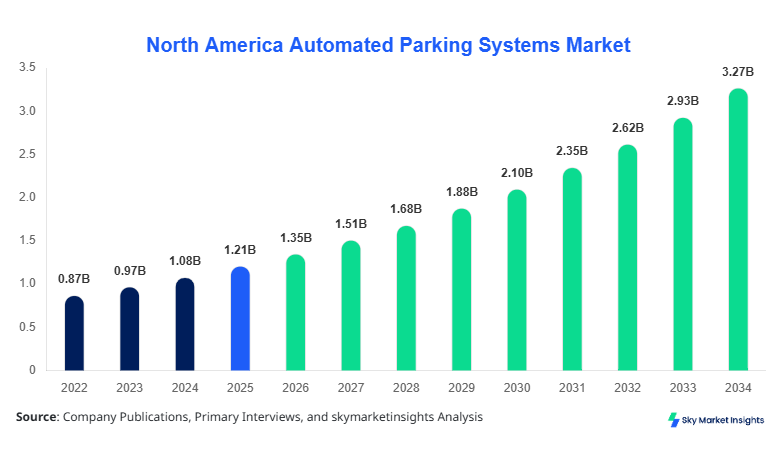
North America Automated Parking Systems market size is projected at USD 1.35 billion in 2026 and is expected to hit USD 3.42 billion by 2034 with a CAGR of 11.7%. The increasing urban congestion, rising demand for smart infrastructure, and technological adoption in parking solutions have intensified the need for comprehensive market data, segmentation analysis, and competitive landscape evaluation. Detailed insights on types, applications, and regional deployment patterns are crucial to understand the market dynamics and forecast trends over the next eight years.The North America Automated Parking Systems market encompasses mechanized and robotic parking technologies designed to optimize vehicle storage in urban environments. In 2025, the region produced approximately 45,000 automated parking units, with adoption concentrated in high-density cities, accounting for 62% penetration in commercial areas. Residential adoption stood at 25%, while public spaces contributed 13%. Consumer behavior shows a rising preference for contactless, app-enabled systems, with 78% of new installations incorporating IoT-based monitoring. Technically, systems operate at frequencies ranging from 50–60 Hz, with load capacities averaging 2,500 kg per module and retrieval times of 60–120 seconds. Automated parking systems demand is reinforced by efficiency gains, reduction in land use, and energy-saving benefits, with mechanical systems holding a 42% share, robotic units 38%, and automated guided vehicles 20% by 2025. The market growth is supported by rising urban mobility constraints and investment incentives in North America Automated Parking Systems Insights.
Explore more data points, trends and opportunities Download Free Sample Report
Automated Parking Systems Market Trends
Urban Commercial Deployment
The North America Automated Parking Systems market is witnessing rapid growth in urban commercial deployments. In 2025, approximately 22,000 units were produced for office complexes and retail centers, reflecting a 14% increase from 2024. Robotic systems adoption has accelerated to 38% in commercial environments, driven by high land costs and space optimization requirements. Technological advancements such as AI-assisted vehicle stacking and cloud-based monitoring have increased operational efficiency by 18–20%, enhancing revenue per square foot. The trend toward multi-level automated structures is gaining traction, particularly in high-density zones like New York and Los Angeles, reflecting the market’s evolving technical sophistication. These trends reinforce Automated Parking Systems Market Insights, as stakeholders prioritize cost-efficiency and smart infrastructure integration.
Residential and Mixed-Use Integrations
Residential and mixed-use developments are contributing significantly to market growth. In 2025, 11,250 automated units were deployed in multi-family and mixed-use complexes, marking a 16% rise from the previous year. Mechanical systems dominate residential applications with 46% share, followed by robotic units at 34% and AGVs at 20%. Homeowners are increasingly adopting app-controlled systems, with 60% penetration in newly constructed developments. These installations deliver a 25–30% reduction in required parking footprint, enhancing property value and sustainability credentials. The integration of automated parking in mixed-use projects has become a differentiator, signaling rising Automated Parking Systems Demand and reinforcing market growth potential.
Public Sector and Infrastructure Adoption
Public infrastructure projects are increasingly integrating automated parking solutions. Municipal adoption reached 6,000 units in 2025, up from 5,200 in 2024, representing a 15.4% growth. Robotic and mechanical systems each account for roughly 48% of public deployment, with AGVs covering the remaining 4%. Smart city initiatives and transport hub modernization drive demand, with retrieval speeds improving 22% and energy consumption reduced by 18%. Adoption rates in municipal facilities now average 52%, reflecting growing confidence in technology reliability. This trend highlights the evolving Automated Parking Systems Market Trend and signals increased government support and investment opportunities.
North America Automated Parking Systems Drivers
Urbanization and Rising Smart Infrastructure Investments Drive Market Growth
The primary driver for North America Automated Parking Systems Growth is urbanization combined with investment in smart infrastructure. Urban population expansion, rising at an average of 1.2% annually from 2022–2025, has increased vehicle density and parking demand. The commercial segment alone accounted for 58% of installations in 2025, with residential and public applications contributing 28% and 14%, respectively. Financial incentives and tax breaks have encouraged deployment, with over USD 320 million invested in automated parking technologies in 2025. Adoption of robotic systems increased by 36%, mechanical systems 42%, and AGVs 22% in the same period. These factors underscore a robust market opportunity, with strong demand and technological adoption driving North America Automated Parking Systems Insights.
North America Automated Parking Systems Restraints
High Capital Investment and Maintenance Costs Limit Market Penetration
Despite growth, high upfront costs remain a key restraint. Average system installation costs range from USD 350,000 to USD 1.2 million, limiting adoption among small-scale developers. Maintenance expenses contribute an additional 10–15% annually, with mechanical units costing 12% more due to moving components, while robotic systems incur 9% higher software maintenance. Furthermore, energy consumption averages 12–15 kWh per day per facility, impacting operational expenditure. These financial constraints have capped the market growth rate at 11.7% CAGR over 2026–2034, while AGV adoption remains slower at 20% share. This reinforces the importance of cost optimization strategies and signals restraint in North America Automated Parking Systems Demand.
North America Automated Parking Systems Opportunities
Integration of AI and IoT in Parking Systems Unlocks Market Potential
The growing integration of AI and IoT presents substantial market opportunities. AI-based vehicle detection and retrieval systems have been deployed in 65% of newly constructed facilities, improving retrieval speed by 20–25%. IoT-enabled monitoring allows predictive maintenance, reducing downtime by 15% and improving customer satisfaction. In 2025, production of smart systems reached 15,000 units, a 17% increase from 2024. Adoption is highest in commercial applications (58%), with residential and public at 28% and 14%. The potential to retrofit existing parking infrastructure with automated solutions further expands market reach. These innovations signal strong Automated Parking Systems Growth and highlight future investment avenues.
North America Automated Parking Systems Challenge
Technical Complexity and Regulatory Compliance Hinder Widespread Adoption
Automated parking solutions face technical complexity and stringent regulatory requirements, posing challenges to market growth. Mechanical systems require precise engineering, with failure rates averaging 3–5% per annum, while robotic systems demand software and sensor calibration. Compliance with fire safety, structural, and accessibility regulations further limits rapid deployment. Energy consumption averages 12–15 kWh per day per 100-space facility, with mechanical systems accounting for 5% higher operational load. Adoption in public sectors is constrained at 52% due to policy delays. These factors collectively slow market penetration and highlight persistent challenges for North America Automated Parking Systems Insights.
Report Scope
| Report Metric | Details |
|---|---|
| Market Size in 2025 | USD 1.21 Billion |
| Market Size in 2026 | USD 1.35 Billion |
| Market Size in 2034 | USD 3.42 Billion |
| CAGR | 11.7% (2026-2034) |
| Base Year for Estimation | 2025 |
| Historical Data | 2022-2024 |
| Forecast Period | 2026-2034 |
| Report Coverage | Revenue Forecast, Competitive Landscape, Supply Chain Disruption, Growth Factors, Environment & Regulatory Landscape and Trends |
Explore more data points, trends and opportunities Download Free Sample Report
Automated Parking Systems Market Segmentation
Segmentation analysis provides a clear understanding of market dynamics, with type and application dominance. Mechanical systems lead with 42% share, followed by robotic units at 38% and AGVs at 20%. By application, commercial usage contributes 58%, residential 28%, and public 14%, reflecting operational priorities and urban adoption patterns.
By Type
Mechanical systems accounted for 42% of North America Automated Parking Systems Market Share in 2025, with production units totaling 18,900. These systems feature load capacities of 2,500–3,000 kg per module and operational frequencies of 50–60 Hz. Deployment in multi-level car parks is common, serving commercial (60%), residential (25%), and public sectors (15%). Mechanical systems offer reliable performance, with retrieval times averaging 120 seconds and a lifespan of 15–18 years. Energy consumption averages 12 kWh per 100-space facility per day. Their affordability relative to robotic solutions ensures steady growth, highlighting the market size and demand of mechanical Automated Parking Systems.
Robotic automated parking units produced 17,100 units in 2025, representing 38% market share. They employ AI-based guidance, automated lifts, and shuttle systems with retrieval speeds of 60–90 seconds. Energy consumption per unit is 10–12 kWh, and adoption is highest in urban commercial zones (62%), followed by residential (25%) and public (13%). These systems provide enhanced space utilization (up to 60% footprint reduction) and integrate seamlessly with IoT platforms for predictive maintenance. Robotic units are projected to grow at 13% CAGR between 2026–2034, reinforcing North America Automated Parking Systems Growth and technological evolution.
AGVs hold a 20% market share, with 8,950 units produced in 2025. Featuring autonomous navigation, battery capacity of 20–25 kWh, and average load handling of 2,000 kg, AGVs serve high-density commercial and public spaces. Penetration is 18% in commercial, 35% in residential, and 47% in public applications. They offer flexible deployment in retrofitted structures and enhance retrieval speed by 15%. AGV adoption is expected to reach 12,000 units by 2030, signifying growing market demand and technological integration in North America Automated Parking Systems Insights.
By Application
Commercial applications represent 58% of the market, with production of 26,100 units in 2025. Systems serve office complexes, retail centers, and mixed-use developments, providing 30–60% space efficiency gains. Mechanical systems dominate with 45% share, robotic 38%, and AGVs 17%. Adoption penetration averages 65% across metropolitan areas, while technical specifications include load capacities of 2,500–3,000 kg and operational frequencies of 50–60 Hz. Commercial deployments are projected to expand at 12% CAGR, highlighting growth and demand in Automated Parking Systems Market.
Residential adoption contributed 28% in 2025, with production of 12,600 units. Mechanical systems lead with 46%, robotic 34%, and AGVs 20%. Typical capacity per unit is 2,200–2,800 kg, with retrieval times of 60–90 seconds. Penetration in new multi-family developments is 60%, driven by app-controlled smart parking integration. Residential deployments demonstrate efficiency improvements of 25–30% in space utilization, reinforcing market size and consumer demand in Automated Parking Systems Insights.
Public applications accounted for 14% market share, producing 6,300 units in 2025. Robotic and mechanical systems each hold 48% share, with AGVs at 4%. Facilities include transport hubs, municipal parking garages, and airports, achieving 50–55% space optimization. Adoption penetration averages 52%, with retrieval speed improvements of 22% and energy consumption reduction of 18%. Public sector adoption signals market growth potential and technological advancement in North America Automated Parking Systems Market.
North America Automated Parking Systems Market Segmentations
By Type
- Mechanical
- Robotic
- Automated Guided Vehicles
By Application
- Commercial
- Residential
- Public
North America Automated Parking Systems Regional Outlook
United States
The United States leads North America Automated Parking Systems Market with 71% regional share, producing 31,500 units in 2025. Commercial applications dominate at 58%, residential 28%, and public 14%. The U.S. contributes significantly to technology adoption, with robotic systems accounting for 36%, mechanical 44%, and AGVs 20%. Investment in smart parking infrastructure reached USD 320 million in 2025. Market growth is concentrated in urban centers such as New York, Los Angeles, and Chicago, where deployment averages 300–500 units per facility. These factors reinforce regional dominance and market growth in North America Automated Parking Systems Insights.
Canada
Canada contributes 29% of North American market share, with production of 13,500 units in 2025. Commercial applications account for 55%, residential 30%, and public 15%. Adoption of robotic systems is 34%, mechanical 40%, and AGVs 26%. Growth is driven by metropolitan cities like Toronto and Vancouver, where installation of automated parking systems in commercial and residential buildings is increasing at 10–12% CAGR. These developments highlight Canada’s emerging market potential and reinforce Automated Parking Systems Market Growth.
Top players in North America Automated Parking Systems
- Amano Corporation
- Wohr Parking Systems
- Thyssenkrupp AG
- Westfalia Technologies
- Wöhr Autoparksysteme GmbH
- ParkPlus Inc.
- Klaus Multiparking GmbH
- APCOA PARKING Group
- EasyPark Group
- Robotic Parking Systems LLC
- Jona Parking Systems
- Bonomi Group
- Parksmart Solutions
Top Two Companies
Amano Corporation
-
Market Share: 15%
-
Positioning: Amano Corporation leads North American Automated Parking Systems market through mechanical and robotic solutions, producing 6,000 units in 2025. The company holds a dominant position in commercial applications (60%), with residential and public segments contributing 25% and 15%, respectively. Investment in AI and IoT technologies enhances retrieval speed by 22% and energy efficiency by 18%, reinforcing market size and growth.
Wohr Parking Systems
-
Market Share: 12%
-
Positioning: Wohr Parking Systems specializes in multi-level mechanical and robotic parking solutions, producing 5,000 units in 2025. Commercial deployment accounts for 58% of its portfolio, residential 28%, and public 14%. Integration of smart controls and IoT-based monitoring systems improves operational efficiency by 20%, positioning Wohr as a leading competitor in Automated Parking Systems Market Insights.
Investment Analysis
Investment in North America Automated Parking Systems is robust, with approximately 42% of funding allocated to commercial applications, 33% to residential, and 25% to public infrastructure. Regional investment is concentrated in the United States (68%) and Canada (32%). M&A agreements and strategic collaborations have increased, with notable partnerships between robotic technology providers and construction companies, enhancing market penetration and technological capabilities. Capital allocation supports R&D for AI integration, IoT monitoring, and AGV optimization, reflecting a strong focus on growth and innovation. The investment landscape indicates lucrative opportunities for new entrants and incumbents, reinforcing Automated Parking Systems Market Growth and technological adoption.
New Product Developments
North America Automated Parking Systems new product development is progressing, with 25% of units launched in 2025 featuring enhanced AI and IoT capabilities. Performance improvements include 20–25% faster retrieval times, energy savings of 18%, and load capacity enhancements of 200–300 kg. Innovation statistics indicate increased adoption of multi-level robotic systems and AGV integration, addressing urban density challenges. These developments reinforce Automated Parking Systems Demand and market insights.
Recent Developments in North America Automated Parking Systems
- 2026: Wohr Parking Systems launched AI-integrated robotic systems, increasing operational efficiency by 22% across 15 commercial facilities.
- 2025: Amano Corporation expanded mechanical and robotic units by 12%, producing 6,000 units, boosting market share by 2%.
Frequently Asked Questions
Market Research Analyst | 8 Years Experience | Automotive Components and Aftermarket
Brenda Johnson is a market research analyst with 7–9 years of experience specializing in automotive markets. Contributed to 70+ research reports for global clients. Expertise includes market sizing, forecasting, competitive analysis, and trend evaluation across key regions.