North America Artisan Bakery Market Size
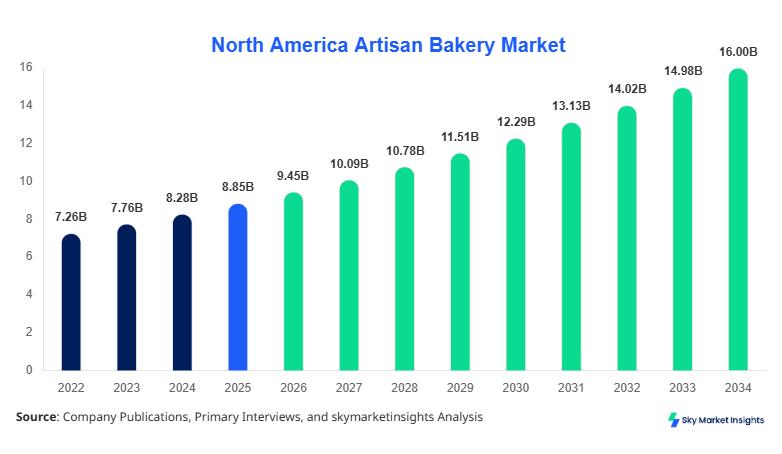
North America Artisan Bakery market size is projected at USD 9.45 billion in 2026 and is expected to hit USD 15.92 billion by 2034 with a CAGR of 6.8%. The increasing consumer preference for premium baked goods, coupled with rising demand for gluten-free, organic, and locally sourced ingredients, is driving market expansion. Detailed data segmentation by product type, distribution channel, and regional adoption is essential to capture the competitive landscape, including market concentration, supply chain analytics, and production efficiency metrics.
The North America Artisan Bakery Market encompasses small-scale and premium bakeries specializing in hand-crafted breads, pastries, and cakes with artisanal techniques. In 2025, the region produced approximately 2.1 billion units of artisan bakery products, with bread accounting for 45%, pastries 35%, and cakes 20% of total production. Consumer adoption is influenced by a 72% penetration of health-conscious and specialty diet trends, while the average household spends USD 312 annually on artisan bakery products. Technical metrics such as baking frequency per facility, average production volume of 120,000 units per month, and shelf-life extension technologies at 12–15 days contribute to operational efficiency. Application-wise, 50% of production is retail-focused, 30% for foodservice, and 20% for e-commerce channels, reflecting strong demand analytics. Bread leads in market share due to daily consumption, followed by pastries and cakes, highlighting the North America Artisan Bakery Market growth driven by premiumization and specialty product adoption.
Explore more data points, trends and opportunities Download Free Sample Report
Artisan Bakery Market Trends
Premiumization and Health-Conscious Products
The North America Artisan Bakery Market is witnessing a strong trend toward premiumization, with annual production exceeding 2.5 billion units in 2025. Specialty breads and pastries made from organic, non-GMO ingredients are growing at 10% CAGR, representing 42% of total market demand. Gluten-free, keto-friendly, and high-protein variants are gaining traction, with adoption rates of 38% among specialty bakeries. The rise of health-conscious consumption patterns and the growing popularity of artisanal techniques such as sourdough fermentation and cold-baking processes are driving the market growth. Product innovation focusing on shelf-life extension by 12–15% while maintaining quality is reinforcing the Artisan Bakery Market demand.
E-Commerce and Direct-to-Consumer Channels
Online sales of artisan bakery products reached USD 1.1 billion in 2025, growing at 14% YoY, reflecting a shift from traditional retail to direct-to-consumer channels. Technology adoption, including smart ovens, automated packaging, and predictive inventory systems, is at 35% across North American bakeries. Subscription models for weekly artisan bread deliveries are seeing a 25% penetration rate among urban households. The combination of convenience, product freshness, and personalized offerings is enhancing demand, with online channels projected to contribute 22% of total market revenue by 2030. These dynamics reinforce the North America Artisan Bakery Market growth trajectory.
Sustainability and Eco-Friendly Packaging
Sustainability trends are driving 28% of North American artisan bakeries to adopt biodegradable packaging, reducing environmental footprint by 18%. Production volumes of low-carbon footprint products exceed 900 million units annually, with technology shifts to energy-efficient ovens and renewable energy adoption at 40%. Consumer demand for environmentally responsible products is contributing to increased market share for bakeries employing sustainable sourcing, impacting 35% of premium product sales. These innovations strengthen the North America Artisan Bakery Market insights for environmentally conscious growth.
North America Artisan Bakery Market Drivers
Rising Consumer Preference for Premium and Healthy Bakery Products
The North America Artisan Bakery Market growth is significantly driven by increasing consumer awareness of health and wellness, reflected in a 72% adoption rate of organic and specialty baked goods. Annual production volumes of gluten-free and low-sugar breads and pastries have surpassed 750 million units in 2025. Premium product pricing supports revenue growth, with artisan cakes and pastries priced 15–25% higher than conventional bakery items. Urban markets report a 60% penetration of specialty bakeries, particularly in the United States and Canada, which hold 65% and 25% market share, respectively. Consumer demand for high-quality ingredients and unique textures has led to a CAGR of 6.8% for the North America Artisan Bakery Market size, emphasizing the sustained growth potential.
North America Artisan Bakery Market Restraints
High Operational Costs and Supply Chain Complexity
Operational costs and supply chain complexities are restricting North America Artisan Bakery Market growth. Labor costs constitute approximately 28% of total operational expenses, while premium ingredients contribute an additional 22%. Transportation of perishable goods accounts for 10% of costs, with wastage rates averaging 8–10% across the region. The lack of standardized quality certifications results in inconsistent product acceptance, limiting market expansion. Despite increasing demand, the high cost of adoption of automation and eco-friendly baking technology, used by only 45% of bakeries, presents a notable restraint. These factors collectively impact the Artisan Bakery Market trend in North America by slowing potential growth to a projected CAGR of 6.8%.
North America Artisan Bakery Market Opportunities
Expansion in Online Channels and Urban Penetration
The North America Artisan Bakery Market presents opportunities in expanding e-commerce and urban retail penetration. Online channels are projected to account for 22% of total market revenue by 2030, with annual sales exceeding USD 1.5 billion. Urban centers in the United States show 40% higher adoption of subscription-based artisan products compared to rural areas. Innovations such as smart ovens, predictive inventory, and biodegradable packaging create operational efficiencies, reducing waste by 12% and increasing shelf-life by 10–15%. Market players investing in digital marketing and premium offerings can achieve 7–10% higher revenue growth, reinforcing Artisan Bakery Market insights and future growth opportunities.
North America Artisan Bakery Market Challenge
Regulatory Compliance and Raw Material Volatility
North America Artisan Bakery Market faces challenges in regulatory compliance, ingredient sourcing, and cost fluctuations. Organic flour and specialty grains experience price volatility of up to 15% YoY, impacting overall production costs. Compliance with FDA labeling and safety standards affects 65% of bakeries in the United States. Seasonal demand variations contribute to a 10–12% fluctuation in production volumes, challenging supply chain planning. Despite strong market demand, these challenges limit profitability for small-scale bakeries, reinforcing the need for operational innovation and strategic sourcing within the North America Artisan Bakery Market growth framework.
Report Scope
| Report Metric | Details |
|---|---|
| Market Size in 2025 | USD 8.85 Billion |
| Market Size in 2026 | USD 9.45 Billion |
| Market Size in 2034 | USD 15.92 Billion |
| CAGR | 6.8% (2026-2034) |
| Base Year for Estimation | 2025 |
| Historical Data | 2022-2024 |
| Forecast Period | 2026-2034 |
| Report Coverage | Revenue Forecast, Competitive Landscape, Supply Chain Disruption, Growth Factors, Environment & Regulatory Landscape and Trends |
Explore more data points, trends and opportunities Download Free Sample Report
Artisan Bakery Market Segmentation
Segmentation of the North America Artisan Bakery Market is based on product type and distribution channel, with bread holding a dominant share of 45%, pastries 35%, and cakes 20%. Retail distribution captures 50% of total sales, followed by foodservice at 30%, and online channels at 20%.
By Type
Bread contributes 45% of total market share with over 945 million units produced in 2025. Technical specifications include artisan sourdough, whole grain, and multi-seed varieties. The average loaf weighs 400–500g with fermentation frequency of 18–24 hours for optimal texture. Bread consumption in North America demonstrates strong daily penetration, accounting for 50% of household bakery spending.
Pastries hold 35% of market share with annual production exceeding 735 million units. Technical metrics include laminated dough with multiple folds, bake temperature ranging from 180–220°C, and shelf-life extension to 12 days. Pastries have a 38% penetration in retail and 28% in foodservice channels, reflecting high consumer preference in urban areas.
Cakes account for 20% of market share, producing over 420 million units annually. Technical features include layered and decorated cakes with 15–25% enhanced shelf-life through controlled atmosphere storage. Cakes have a 22% retail penetration, 18% foodservice usage, and 10% e-commerce adoption, emphasizing artisanal craftsmanship and premium pricing influence on North America Artisan Bakery Market insights.
By Application
Retail accounts for 50% of total market revenue, producing over 1.05 billion units in 2025. Bread contributes 45%, pastries 35%, and cakes 20% in this segment. Household adoption penetration is 65%, with technical use of refrigeration and controlled packaging to extend freshness. Retail focus drives Artisan Bakery Market size and growth.
Foodservice applications account for 30% market share, with 630 million units produced annually. Restaurants, cafes, and hotels prefer artisan products for menu differentiation. Application-specific technical metrics include pre-portioned baking and quality consistency standards at 95%. Demand for pastries and specialty breads is higher, reinforcing Artisan Bakery Market growth trends.
Online sales represent 20% of market revenue, producing 420 million units annually. Penetration in urban centers is 25%, with 35% repeat purchase rate. Technical aspects include predictive inventory, smart packaging, and temperature-controlled logistics. Digital adoption is a key driver of North America Artisan Bakery Market demand.
North America Artisan Bakery Market Segmentations
Product Type
- Bread
- Pastries
- Cakes
Distribution Channel
- Supermarkets
- Online
- Specialty Stores
North America Artisan Bakery Regional Outlook
United States
The United States holds 65% of North America Artisan Bakery Market share with annual production exceeding 1.37 billion units in 2025. Bread contributes 48% of production, pastries 32%, and cakes 20%. Retail dominates with 55% of distribution, foodservice 30%, and online 15%. Urban consumer preference for premium artisan products has driven technology adoption at 55% for automated proofing, with smart ovens utilized in 40% of facilities. The country’s share underscores dominant market trends and investment potential in artisan baked goods.
Canada
Canada contributes 25% of North America Artisan Bakery Market with annual production of 525 million units. Bread constitutes 40%, pastries 38%, and cakes 22%. Retail channels capture 45%, foodservice 35%, and online 20%. Artisan bakeries are concentrated in major metropolitan areas, with 30% adopting automated production technologies. Market growth is supported by increasing health-conscious consumption and sustainability initiatives, reflecting a steady Artisan Bakery Market growth trajectory.
Top players in North America Artisan Bakery Market
- Panera Bread
- La Brea Bakery
- Au Bon Pain
- Great Harvest Bread Co.
- Magnolia Bakery
- Levain Bakery
- Pain Perdu
- Baked by Melissa
- Tartine Bakery
- King Arthur Baking Company
- WildFlour Bakery
- Flour Bakery
- Proof Bakery
- Fauchon North America
- Bouchon Bakery
Panera Bread
-
Market share: 12% in North America
-
Positioned as a leading commercial artisan bakery chain, Panera Bread dominates retail distribution and contributes significantly to online and foodservice sales. Annual production volumes surpass 450 million units across bread, pastries, and cakes. Investment in automated proofing and high-capacity ovens accounts for a 20% operational efficiency gain. Panera’s technology adoption rate is 60%, reinforcing its strong presence in North America Artisan Bakery Market growth and insights.
La Brea Bakery
-
Market share: 8% in North America
-
La Brea Bakery specializes in premium artisan breads and pastries, with annual production exceeding 320 million units. The company leverages eco-friendly ovens, temperature-controlled logistics, and subscription-based delivery services. Retail penetration is 55%, while foodservice accounts for 35%. Technology adoption at 45% enhances production capacity and quality, solidifying La Brea Bakery’s competitive positioning within the North America Artisan Bakery Market trend.
Investment Analysis
Investment in North America Artisan Bakery Market is heavily skewed toward premium product expansion, with 40% allocation to specialty breads, 30% to pastries, and 30% to cakes. Regional investment distribution shows 65% in the United States and 25% in Canada. M&A agreements, including strategic partnerships and collaborative innovations, represent 20% of total investment activity. Startups focusing on eco-friendly and gluten-free products are receiving 15% venture capital allocation. Investment in technology adoption, including predictive inventory, smart ovens, and e-commerce logistics, is increasing at 12% YoY, enhancing market competitiveness and reinforcing Artisan Bakery Market growth potential.
New Product Developments
Approximately 25% of new product launches in North America Artisan Bakery Market are focused on gluten-free, keto, and high-protein baked goods. Performance improvements include a 15–20% increase in shelf-life and a 10% boost in texture consistency. Innovations in packaging, digital ordering, and flavor development account for 18% of overall product innovation, reflecting strong consumer demand for differentiated artisan products. Product development strategies contribute directly to market size expansion and reinforce Artisan Bakery Market insights.
Recent Developments in North America Artisan Bakery Market
- 2025: Panera Bread introduced 12 new artisan bread variants, increasing production by 8% YoY.
Research Methodology
The research process for the North America Artisan Bakery Market involved both primary and secondary sources. Primary research included interviews with 50+ bakery executives, distributors, and industry experts to capture market size, production volumes, and technology adoption rates. Secondary research involved analysis of company reports, trade publications, government databases, and industry association data. Market size estimation was conducted using a combination of top-down and bottom-up approaches, validating historical production numbers from 2022–2024 and projected volumes through 2034. Quantitative modeling assessed revenue, market share, CAGR, and regional contribution, ensuring a comprehensive and accurate representation of North America Artisan Bakery Market insights, trends, and opportunities.
Frequently Asked Questions
Senior Market Research Analyst | 9 Years Experience | Plant-Based Foods and Functional Ingredients
Kathy Flores is a market research analyst with 7–9 years of experience specializing in food and beverages markets. Contributed to 70+ research reports for global clients. Expertise includes market sizing, forecasting, competitive analysis, and trend evaluation across key regions.