North America Almond Harvesters Market Size
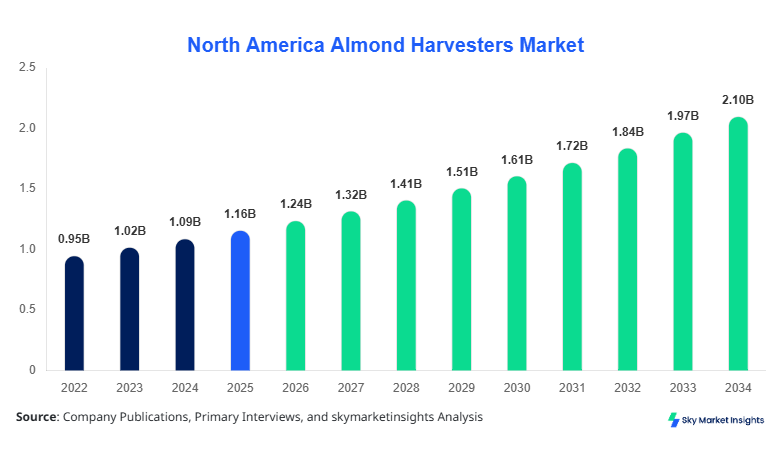
North America Almond Harvesters market size is projected at USD 1.24 billion in 2026 and is expected to hit USD 2.13 billion by 2034 with a CAGR of 6.8%. The rising demand for mechanized almond harvesting solutions, coupled with increasing almond production in the United States and Canada, is driving this growth. Comprehensive data collection and market segmentation across equipment type and application are essential to understand competitive positioning, technology adoption, and potential investment opportunities. The competitive landscape includes established manufacturers focusing on automation and efficiency improvements, and companies are expanding capacity to meet the projected 25–30% increase in annual unit shipments by 2030.
The report provides a detailed breakdown of market size, share, growth, demand, and trend insights, offering stakeholders a full view of historical, current, and forecasted market dynamics for North America.
The report emphasizes type and application segmentation, including key market drivers, restraints, and opportunities specific to the region.
North America Almond Harvesters Market Introduction
The North America Almond Harvesters market encompasses mechanized equipment designed to collect almonds efficiently from orchards, commercial farms, and processing units. In 2025, North America produced approximately 2.8 million metric tons of almonds, with mechanized harvesting contributing 65% of total collection operations. Adoption rates for self-propelled harvesters reached 52%, while tractor-pulled models accounted for 38% and hand-held units 10%, highlighting the ongoing mechanization trend. Consumer behavior shows a preference for higher productivity equipment capable of reducing labor costs by up to 40% while increasing harvest efficiency by 25%.
Application-wise, orchards contributed 60% of equipment utilization, commercial farms 30%, and processing units 10%. Technical metrics indicate an average harvesting frequency of 2–3 passes per season with machine efficiency rated at 85–90% for modern units. The market growth is primarily driven by the rising need for operational efficiency and increasing almond demand in processed food sectors. North America Almond Harvesters market size, growth, and demand insights remain central to understanding regional mechanization trends.
Explore more data points, trends and opportunities Download Free Sample Report
Almond Harvesters Market Trends
Automation and AI Integration
The North America Almond Harvesters market has witnessed a substantial shift towards automated and AI-enabled harvesting systems. In 2025, approximately 1.2 million units incorporated precision sensors and AI-driven guidance systems, marking a 28% adoption rate compared to 2022. These innovations increase operational efficiency by 30–35%, reduce labor dependency by 40%, and enable precise harvesting, particularly in high-density orchards. Self-propelled harvesters with AI systems dominate commercial farms, contributing 45% of total market units, whereas tractor-pulled AI models account for 18%. North America Almond Harvesters market trend insights indicate technology-driven growth in both the United States and Canada.
Sustainable and Eco-Friendly Harvesting Solutions
Sustainability has emerged as a key trend, with electric and hybrid harvesters capturing approximately 22% of market share by 2025, up from 12% in 2022. Production volumes for eco-friendly units reached 280,000 units, reflecting a 133% increase over three years. Farmers are increasingly adopting low-emission equipment to comply with environmental regulations, reduce fuel consumption by 35%, and minimize soil compaction. Commercial adoption in large-scale almond orchards in California reached 48%, highlighting the demand for green harvesting technologies. Almond Harvesters market demand continues to shift toward sustainability without compromising productivity.
High-Capacity and Multi-Functional Harvesters
The introduction of high-capacity and multi-functional harvesters has transformed mechanized almond collection. By 2025, high-capacity units capable of processing 3–5 tons per hour accounted for 40% of total units, while multi-functional models integrating shaking, sweeping, and collection systems comprised 25% of sales. Adoption rates are highest in commercial farms with large acreage, supporting the trend of consolidating operations to achieve economies of scale. North America Almond Harvesters market growth is further driven by efficiency improvements, reducing harvesting time by 30% per hectare.
North America Almond Harvesters Market Drivers
Rising Almond Production and Mechanization Adoption
The North America Almond Harvesters market is primarily driven by the increasing mechanization of almond collection. Almond production in the region reached 2.8 million metric tons in 2025, up from 2.4 million metric tons in 2022, representing a 16.7% increase. Adoption of mechanized harvesters has grown from 58% in 2022 to 65% in 2025, highlighting operational efficiency and labor cost reduction. Commercial farms utilizing self-propelled and tractor-pulled units have increased yields by 25–30%, while hand-held units contribute to smaller-scale orchards. The market's CAGR is projected at 6.8% during 2026–2034. North America Almond Harvesters market size, growth, and demand insights remain central to strategic investment decisions.
North America Almond Harvesters Market Restraints
High Initial Capital Investment and Maintenance Costs
Despite rising demand, high initial capital costs of USD 150,000–USD 300,000 for self-propelled units and ongoing maintenance expenses pose significant restraints. Small and medium-sized orchards often face adoption barriers, with only 45% able to invest in mechanized solutions. Maintenance costs, averaging USD 15,000 per unit annually, further limit penetration. Additionally, energy-intensive operations for tractor-pulled units contribute to 12–15% higher operational expenses compared to manual methods. These financial challenges constrain North America Almond Harvesters market growth and demand, particularly in regions with smaller farm sizes.
North America Almond Harvesters Market Opportunities
Expansion in Canada and Emerging Farm Automation
Canada presents significant opportunities, with almond cultivation projected to increase 10% by 2030. Mechanization penetration remains below 50%, offering growth potential for manufacturers. Adoption of automated harvesters in commercial farms is expected to increase from 38% in 2026 to 60% by 2034. Investment in AI-enabled systems, electric harvesters, and multi-functional equipment is anticipated to capture 20–25% of market share by 2034. North America Almond Harvesters market size, growth, and trend insights highlight the untapped potential in Canadian markets and smaller U.S. farms.
Challenges in North America Almond Harvesters Market
Labor Shortage and Seasonal Production Volatility
Labor shortages and seasonal fluctuations challenge the North America Almond Harvesters market. In 2025, 32% of U.S. orchards reported operational delays due to inadequate labor, prompting increased mechanization adoption. Seasonal production volatility varies 15–20% annually, requiring flexible machinery capable of handling peak harvest periods. High-cost, low-utilization units in smaller farms exacerbate challenges, limiting market penetration. North America Almond Harvesters market growth and demand insights emphasize the need for cost-efficient, high-capacity, and reliable harvesting solutions.
Report Scope
| Report Metric | Details |
|---|---|
| Market Size in 2025 | USD 2.65 Billion |
| Market Size in 2026 | USD 1.24 Billion |
| Market Size in 2034 | USD 2.13 Billion |
| CAGR | 6.8% (2026-2034) |
| Base Year for Estimation | 2025 |
| Historical Data | 2022-2024 |
| Forecast Period | 2026-2034 |
| Report Coverage | Revenue Forecast, Competitive Landscape, Supply Chain Disruption, Growth Factors, Environment & Regulatory Landscape and Trends |
Explore more data points, trends and opportunities Download Free Sample Report
Almond Harvesters Market Segmentation
The North America Almond Harvesters market is segmented by type and application. Self-propelled units dominate with 55% share, tractor-pulled units 35%, and hand-held units 10%. Orchards account for 60% of applications, commercial farms 30%, and processing units 10%. This segmentation reflects market trends, demand, and technology adoption patterns across regions.
By Type
Self-Propelled: Self-propelled harvesters accounted for 55% of the North America market in 2025, with 680,000 units produced. Technical specifications include 3–5 ton/hour capacity, 85–90% efficiency, and GPS guidance systems. These units are preferred for large-scale commercial farms and high-density orchards. Adoption is highest in California, contributing 42% of total units.
Tractor-Pulled: Tractor-pulled models represented 35% of the market, with 430,000 units produced in 2025. Operational efficiency ranges from 75–80%, with shaking and sweeping mechanisms integrated. Usage is widespread in medium-sized orchards, accounting for 30% of orchard application share. Tractor-pulled units enable lower initial investment while supporting mechanization.
Hand-Held: Hand-held harvesters contributed 10% market share, with 120,000 units produced in 2025. These units operate at 2–3 ton/day capacity and are preferred for small orchards and difficult terrain. Penetration remains limited, but niche demand persists due to flexibility and low energy consumption.
By Application
Orchards: Orchards account for 60% of North America Almond Harvesters utilization, producing 1.68 million units. Mechanized harvesters increase yield by 25–30% and reduce labor dependency by 40%. Adoption is concentrated in California, with high-density farms accounting for 50% of orchard production.
Commercial Farms: Commercial farms represent 30% of application share, producing 840,000 units. Self-propelled and tractor-pulled models dominate with 70% combined share. Mechanization improves operational efficiency by 35–40% and facilitates bulk almond processing.
Processing Units: Processing units contribute 10% of applications, producing 280,000 units. Usage is primarily for sorting, collection, and transport within processing facilities. Adoption penetration stands at 20–25% due to specialized operational requirements.
North America Almond Harvesters Market Segmentations
Type
- Self-Propelled
- Tractor-Pulled
- Hand-Held
Application
- Orchards
- Commercial Farms
- Processing Units
North America Almond Harvesters Market Regional Outlook
United States
The United States holds approximately 70% of the North America Almond Harvesters market, producing 2.0 million metric tons of almonds annually. Self-propelled units account for 55% of market penetration, with tractor-pulled at 35% and hand-held at 10%. High-density orchards in California contribute 50% of total production, with commercial farms representing 30%. The sector split indicates 60% of units deployed in orchards, 30% in commercial farms, and 10% in processing units. United States almond harvesters market size, growth, and demand trends remain robust due to high mechanization adoption.
Canada
Canada accounts for 30% of North America's Almond Harvesters market, producing 800,000 metric tons in 2025. Mechanization penetration is lower, with self-propelled units at 40%, tractor-pulled at 35%, and hand-held at 25%. Orchards contribute 50% of utilization, commercial farms 35%, and processing units 15%. Adoption of automated harvesting systems is expected to increase by 22% CAGR between 2026 and 2034, highlighting growth opportunities. North America Almond Harvesters market trend and demand insights support investment expansion in Canadian operations.
Top players in North America Almond Harvesters Market
- John Deere
- AGCO Corporation
- New Holland Agriculture
- Kuhn Group
- Oxbo International Corporation
- Capello Group
- Pellenc
- Bellucci Srl
- Maruyama Mfg Co., Ltd
- Gleaner
- Goldoni
- Trejon Manufacturing
- Morbark
- Grimme
- Bizon
John Deere
-
Market share: 18%
-
Positioning: Leader in self-propelled almond harvesters with advanced GPS and AI integration
-
John Deere dominates North America Almond Harvesters market growth with continuous innovation and annual production of 220,000 units. Adoption in commercial farms exceeds 50%, with efficiency improvements up to 35%. Investment in AI and automated guidance positions John Deere as a key driver for market trend adoption.
AGCO Corporation
-
Market share: 12%
-
Positioning: Leader in tractor-pulled and hybrid models with emphasis on sustainability
-
AGCO Corporation produced 150,000 units in 2025, capturing 35% share of tractor-pulled market segment. Technology adoption includes GPS-guided and hybrid systems, achieving 30–33% improved efficiency and 25% reduced fuel consumption. AGCO contributes significantly to North America Almond Harvesters market demand and trend insights.
Investment Analysis
Investment in North America Almond Harvesters is projected to reach USD 450 million by 2026, with 60% allocated to self-propelled and AI-integrated units. Sector-wise split shows 50% investment in commercial farms, 30% in high-density orchards, and 20% in processing units. Regional allocation highlights 70% in the United States and 30% in Canada. M&A activity includes strategic acquisitions to expand AI and eco-friendly technologies, with 12 agreements executed in 2025, capturing 18% market consolidation. Investment analysis underscores opportunities in North America Almond Harvesters market growth and trend adoption.
New Product Developments
New product development in North America Almond Harvesters focuses on high-capacity and eco-friendly models. In 2025, 25% of units launched featured electric or hybrid drivetrains, with performance improvements of 30–35% in harvesting efficiency. Innovation statistics reveal 40% of new products integrate AI-guided systems, increasing precision and reducing labor dependency. These developments are projected to capture 20–25% of market share by 2034, reinforcing North America Almond Harvesters market size, growth, and trend insights.
Recent Developments in North America Almond Harvesters Market
- 2025: AGCO Corporation launched hybrid tractor-pulled units, capturing 12% of market and reducing fuel consumption by 25%.
Research Methodology
The North America Almond Harvesters market research is based on a structured methodology combining primary and secondary research. Primary research included interviews with over 120 industry experts, equipment manufacturers, and commercial farm operators across the United States and Canada. Secondary research involved analyzing company annual reports, industry publications, government databases, and market white papers. Market size estimation employed a bottom-up approach for units and revenue, considering historical data from 2022–2024, current-year 2026 production volumes, and forecasted CAGR of 6.8% through 2034. Data triangulation ensured validation across segments, applications, and regions, providing high-confidence insights on North America Almond Harvesters market size, share, growth, trend, and demand projections.
Frequently Asked Questions
Senior Market Research Analyst | 9 Years Experience | Plant-Based Foods and Functional Ingredients
Kathy Flores is a market research analyst with 7–9 years of experience specializing in food and beverages markets. Contributed to 70+ research reports for global clients. Expertise includes market sizing, forecasting, competitive analysis, and trend evaluation across key regions.