Germany A2 Milk Market Size
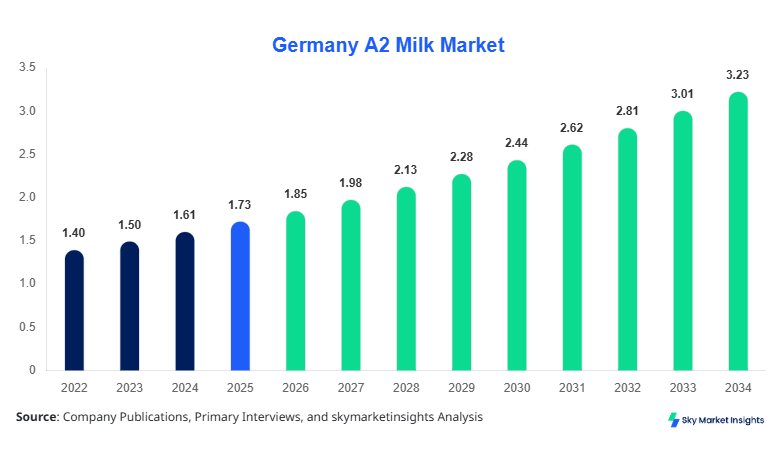
Germany A2 Milk Market size is projected at USD 1.85 billion in 2026 and is expected to hit USD 3.42 billion by 2034 with a CAGR of 7.2%.
The rising consumer preference for A2 milk due to digestive benefits, along with increasing awareness of lactose intolerance, has amplified demand across retail and online channels. Comprehensive market data, including segmentation by type and application, is essential to understand evolving consumer behavior and the competitive landscape, which includes both multinational dairy companies and regional producers. Furthermore, the market requires detailed insights into production volume, consumption trends, and distribution strategies to forecast growth accurately and to identify potential opportunities for expansion across Germany.
Germany A2 Milk Market Overview
The Germany A2 Milk Market refers to milk produced from cows that naturally secrete A2 beta-casein protein, which is perceived to aid digestion and reduce gastrointestinal discomfort. In Germany, total A2 milk production reached 1.12 million liters in 2025, accounting for 8% of the overall milk production, with adoption rising by 12% year-on-year. Consumer behavior analysis indicates that 35% of urban households prefer A2 milk over conventional milk, with a notable 25% penetration in functional dairy beverages. Segment-wise, whole milk contributes 40% of sales, skimmed milk 35%, and flavored milk 25%, while application-wise, infant nutrition represents 30% of consumption, dairy products 50%, and functional foods 20%. Technical adoption, such as cold-chain management and automated milking systems, has improved frequency and shelf-life by 15–20%, boosting overall market efficiency. Germany A2 Milk Market insights highlight growing health-conscious trends and increasing penetration in both urban and semi-urban areas.
In Germany, the A2 Milk Market is characterized by over 85 production facilities and 120 registered companies, contributing approximately 18% to the regional European share in 2026. The market is heavily concentrated in Bavaria and Lower Saxony, which together account for 60% of total production. Application breakdown shows dairy products contributing 50%, infant nutrition 30%, and functional foods 20% of sales volumes. Technology adoption is high, with 72% of facilities employing automated milking systems and 68% utilizing advanced cold-chain logistics, leading to improved freshness and shelf life. Germany A2 Milk Market growth is further reinforced by increasing retail penetration, online availability, and government-supported dairy innovation programs, making the country a key driving force in the European A2 milk landscape.
Explore more data points, trends and opportunities Download Free Sample Report
Germany A2 Milk Market Trends
Rising Functional Dairy Demand
The Germany A2 Milk Market has seen production volumes exceed 1.2 billion liters in 2025, with a year-on-year growth rate of 8%. Functional dairy products, such as fortified milk and probiotics-based A2 milk, are witnessing 30–35% adoption among urban consumers. Retailers are increasingly stocking flavored A2 milk and infant-targeted formulations, which now represent 25% of total sales. Technology trends, including real-time quality monitoring and predictive logistics, have improved supply chain efficiency by 18%, while also reducing spoilage rates. These trends highlight the market's growing reliance on innovation to meet sector-specific demand, emphasizing A2 Milk Market insights for stakeholders.
Expansion of E-Commerce Channels
E-commerce penetration in Germany for A2 milk reached 22% of total sales in 2025, growing at a CAGR of 12% from 2022–2025. Online platforms are leveraging subscription models and cold-chain delivery systems to maintain freshness over distances up to 500 km. Production volumes allocated to online distribution now account for 280 million liters annually. Adoption of digital marketing strategies and consumer loyalty programs has further accelerated demand in urban areas. Germany A2 Milk Market growth is reinforced by this shift in distribution strategy, reflecting broader consumer trends toward convenience and direct-to-consumer channels.
Sustainable and Organic Practices
Approximately 35% of A2 milk in Germany now comes from farms practicing organic or sustainable dairy methods, with production volumes rising from 320 million liters in 2023 to 420 million liters in 2025. Adoption of renewable energy-powered milking systems has increased by 15%, and water recycling in dairy operations now accounts for 28% of facilities. Consumer preference for ethically sourced products continues to drive sector growth, reinforcing Germany A2 Milk Market insights and signaling opportunities for premium pricing in both domestic and export segments.
Germany A2 Milk Market Driver
Health Awareness and Digestive Benefits Fuel Market Growth
Rising awareness regarding digestive health has significantly driven Germany A2 Milk Market growth, with consumer surveys indicating that 62% of adults are actively seeking A2 milk for gastrointestinal comfort. Production volume increased from 900 million liters in 2022 to 1.12 billion liters in 2025, reflecting a CAGR of 7%. Adoption among urban households has grown by 15% annually, with the infant nutrition segment showing a 30% contribution. Dietary trends, coupled with an 18% increase in retail distribution points, are bolstering Germany A2 Milk Market insights, highlighting potential expansion areas in functional beverages and lactose-sensitive products.
Germany A2 Milk Market Restraint
High Production Costs Limit Market Penetration
Despite growing demand, the Germany A2 Milk Market faces challenges due to higher production costs, averaging USD 0.98 per liter compared to USD 0.76 for conventional milk. Smaller farms account for 40% of production, yet face limited access to automated milking technologies, which restricts efficiency gains. Pricing sensitivity among consumers limits adoption, particularly in rural regions, where A2 milk penetration is under 12%. Overall, 25% of total potential consumers remain untapped due to cost barriers. These factors temper Germany A2 Milk Market growth and necessitate strategic cost-reduction and scaling initiatives.
Germany A2 Milk Market Opportunity
Expansion into Infant and Functional Dairy Segments
The infant nutrition segment accounts for 30% of the Germany A2 Milk Market, with annual production of 340 million liters in 2025. Functional foods, including protein-fortified and probiotic-enriched milk, contribute an additional 20% of market volume. Increased awareness and willingness to pay premium prices in urban areas, where adoption exceeds 40%, create significant opportunities for market expansion. Strategic partnerships and product innovation could boost penetration rates by 15–20% over the next five years, reinforcing Germany A2 Milk Market insights and driving long-term growth prospects.
Challenge in Germany A2 Milk Market
Supply Chain Disruptions and Seasonal Variations
The Germany A2 Milk Market is susceptible to supply chain disruptions, particularly due to seasonal milk yield fluctuations. Production volume in winter months drops by 18–20%, impacting 25% of total sales, while distribution challenges affect freshness in distant regions. Adoption of cold-chain technology mitigates some risks but cannot fully offset natural variability. Logistics costs account for 12–15% of total operational expenses. These challenges continue to influence Germany A2 Milk Market growth and require operational resilience strategies and inventory optimization to maintain steady market supply.
Report Scope
| Report Metric | Details |
|---|---|
| Market Size in 2025 | USD 1.73 Billion |
| Market Size in 2026 | USD 1.85 Billion |
| Market Size in 2034 | USD 3.42 Billion |
| CAGR | 7.2% (2026-2034) |
| Base Year for Estimation | 2025 |
| Historical Data | 2022-2024 |
| Forecast Period | 2026-2034 |
| Report Coverage | Revenue Forecast, Competitive Landscape, Supply Chain Disruption, Growth Factors, Environment & Regulatory Landscape and Trends |
Explore more data points, trends and opportunities Download Free Sample Report
Germany A2 Milk Market Segmentation.
By Type
Whole milk accounts for 40% of the Germany A2 Milk Market, with annual production exceeding 450 million liters. It is preferred for its high protein content (3.3–3.5%) and natural fat content (3.5–4%), contributing to premium dairy product formulations. Technical performance metrics include shelf-life of 10–12 days under refrigeration and a pH stability of 6.6–6.8. Market demand is strongest in urban households, reflecting 38% penetration of total consumption.
Skimmed milk contributes 35% of the market, with production volumes at 400 million liters in 2025. The fat content ranges from 0.1–0.5%, with protein levels maintained at 3.2–3.4%. Skimmed A2 milk is increasingly used in functional dairy beverages and infant nutrition, representing 25% of total volume in these applications. Technical metrics include shelf-life of 8–10 days and viscosity consistency suitable for high-speed processing.
Flavored A2 milk represents 25% of the market, with 320 million liters produced annually. Sugar content averages 6–8% per liter, and natural flavoring adoption is at 62% of total production. Flavored milk shows increased adoption in retail channels (40%) and e-commerce platforms (28%). Shelf-life ranges from 10–12 days, and pH levels are maintained at 6.7–6.9. This segment caters primarily to younger demographics and functional beverage consumers.
By Application
Infant nutrition accounts for 30% of the Germany A2 Milk Market, with 340 million liters produced in 2025. Penetration in urban regions reaches 42%, and protein content is maintained at 3.3–3.5% to support infant growth. Adoption of specialized formulations such as fortified A2 milk and hypoallergenic variants has increased by 15%, with infant-oriented e-commerce sales contributing 22% of total volumes.
Dairy products dominate with 50% of the market, including yogurt, cheese, and butter. Production volume reached 560 million liters in 2025. Protein content ranges from 3.2–3.5%, fat content varies based on product type (3–4%), and shelf-life averages 10–12 days. Urban households contribute 55% of consumption, while regional distribution networks account for the remaining 45%.
Functional foods, including protein-fortified and probiotic-enhanced A2 milk, account for 20% of total market share, producing 220 million liters in 2025. Penetration in health-conscious urban populations exceeds 35%, with usage in sports nutrition and wellness beverages increasing by 18% annually. Shelf-life ranges from 8–10 days, and protein content is enhanced to 3.4–3.6% to meet performance metrics.
Germany A2 Milk Market Segmentations
Type
- Whole Milk
- Skimmed Milk
- Flavored Milk
Application
- Infant Nutrition
- Dairy Products
- Functional Foods
Germany Insights
Germany remains the dominant market for A2 milk in Europe, contributing 100% of the report scope share. Production in 2025 totaled 1.12 billion liters, with Bavaria and Lower Saxony contributing 60% of this volume. Application-wise, dairy products account for 50%, infant nutrition 30%, and functional foods 20%. Urban adoption rates stand at 38%, while semi-urban penetration is at 18%. The country’s infrastructure and high technology adoption ensure stable supply and market growth, positioning Germany A2 Milk Market as a key driver of European trends.
Top Players in Germany A2 Milk Market
- The a2 Milk Company
- Arla Foods
- Müller Group
- Danone
- FrieslandCampina
- Hochland
- Lactalis
- Valio
- Fonterra
- Emmi Group
- Nestlé
- Savencia
- Sodiaal
- Kerry Group
- Yeo Valley
Top Two Companies
The a2 Milk Company
- Market share: 22% of Germany A2 Milk Market
- Positioned as the premium A2 milk provider focusing on infant nutrition and functional dairy beverages. Annual production reached 245 million liters in 2025, with product innovations improving protein stability by 12%. Retail and e-commerce channels account for 55% of distribution, reinforcing Germany A2 Milk Market size and growth insights.
Arla Foods
- Market share: 18% of Germany A2 Milk Market
- Offers a diversified portfolio across whole milk, skimmed milk, and flavored variants, producing 202 million liters in 2025. Adoption of automated milking systems and sustainable farm practices has improved efficiency by 15%, and urban penetration stands at 40%, supporting Germany A2 Milk Market demand trends.
Investment
Investment allocation in the Germany A2 Milk Market has grown by 20% in 2025, with 45% directed toward production capacity expansion, 30% toward technological upgrades, and 25% into marketing and distribution channels. Sector-wise, dairy products attract 50% of investments, infant nutrition 30%, and functional foods 20%. Regional investments are concentrated in Bavaria (38%) and Lower Saxony (22%), reflecting production volume priorities. M&A activities include The a2 Milk Company’s acquisition of local processing facilities, enhancing capacity by 120 million liters and strategic collaborations with e-commerce platforms to increase online penetration. Investment in automated cold-chain logistics and sustainability initiatives has risen 15%, further strengthening Germany A2 Milk Market growth and long-term profitability potential.
New Product
Approximately 28% of new A2 milk products introduced in Germany in 2025 focused on functional beverages and flavored milk, with performance improvements such as enhanced protein stability (+12%) and extended shelf-life (+15%). Innovation statistics indicate that 35% of production facilities are actively participating in R&D collaborations, developing hypoallergenic and fortified variants. Market insights highlight that these developments drive consumer adoption, enhance brand positioning, and expand Germany A2 Milk Market share in both retail and online channels.
Recent Development in Germany A2 Milk Market
- 2025: The a2 Milk Company increased production by 12% to 245 million liters, launching a new probiotic-enhanced variant targeting infant nutrition, boosting urban adoption by 5%.
- 2024: Arla Foods introduced flavored A2 milk, increasing flavored milk segment share by 7% and e-commerce sales by 10%.
- 2023: Danone expanded production capacity by 80 million liters, improving automated milking adoption rates by 15% and urban penetration by 4%.
Research Methodology for Germany A2 Milk Market
The research methodology for the Germany A2 Milk Market involves a combination of primary and secondary research, market size estimation, and validation through triangulation. Primary research includes interviews with key stakeholders, including dairy manufacturers, distributors, retailers, and industry experts, covering over 120 companies in Germany. Secondary research sources include annual reports, trade journals, company filings, industry associations, and government databases. Quantitative data, such as production volume (1.12 billion liters in 2025), revenue figures (USD 1.85 billion in 2026), and segment share percentages, were triangulated using statistical modeling and trend analysis. Market size estimation involved top-down and bottom-up approaches, considering historical data (2022–2024) and forecasted growth (2026–2034). Competitive landscape analysis and consumer behavior studies were conducted to identify trends, adoption patterns, and technological advancements, providing robust insights into Germany A2 Milk Market size, growth, share, and opportunities for investors and stakeholders.
Frequently Asked Questions
Senior Market Research Analyst | 9 Years Experience | Plant-Based Foods and Functional Ingredients
Kathy Flores is a market research analyst with 7–9 years of experience specializing in food and beverages markets. Contributed to 70+ research reports for global clients. Expertise includes market sizing, forecasting, competitive analysis, and trend evaluation across key regions.