Asia Pacific Artificial Meat Market Size
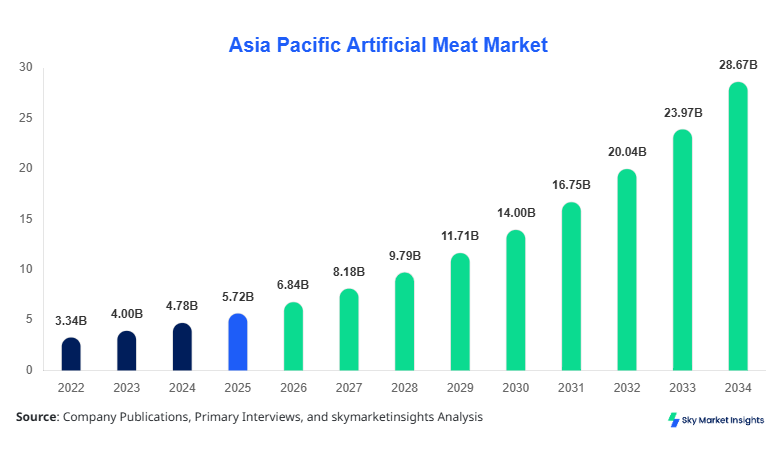
Asia Pacific Artificial Meat market size is projected at USD 6.84 billion in 2026 and is expected to hit USD 28.67 billion by 2034 with a CAGR of 19.62%.
The increasing need for sustainable protein sources, coupled with rising environmental awareness and rapid urbanization across Asia Pacific, is driving extensive data-driven segmentation and competitive landscape expansion. Market participants are focusing on technological innovation, production scaling, and cost optimization to capture significant revenue share across emerging economies.
The artificial meat market refers to the production of meat alternatives using plant-based proteins, cell-cultured technologies, and hybrid compositions that replicate conventional meat in texture, taste, and nutritional profile. In Asia Pacific, production volumes reached approximately 1.92 million metric tons in 2025, with plant-based meat accounting for nearly 71% of output, while cultured meat contributed around 12% and hybrid meat 17%. Adoption and penetration insights indicate that nearly 38% of urban consumers in China, India, and Japan have tried artificial meat products at least once, while regular consumption stands at 14%. Consumer behavior analytics highlight that 52% of buyers prefer plant-based options due to health benefits, while 33% prioritize environmental sustainability, and 15% are driven by ethical concerns. Application-wise, food service contributes approximately 44% of consumption, retail accounts for 39%, and industrial processing holds 17%. The artificial meat market continues to expand as demand rises across health-conscious and environmentally aware consumer segments.
Explore more data points, trends and opportunities Download Free Sample Report
Artificial Meat Market Trends
The artificial meat market is witnessing rapid technological transformation, particularly in cell-based meat production and plant protein extraction efficiency. Production volumes of artificial meat in the Asia Pacific surpassed 2.15 million metric tonnes in 2026, marking a 12.1% year-on-year increase. Cultured meat technology advancements have reduced production costs by approximately 21% since 2023, while bioreactor efficiency has improved by 18%, allowing scalability. Furthermore, plant-based protein extraction technologies using pea, soy, and wheat have achieved protein yields exceeding 85%, compared to 72% in 2022. Adoption rates among millennials have reached 46%, indicating strong demographic-driven demand. These advancements are reinforcing the long-term artificial meat market trend.
Another significant trend in the artificial meat market is the expansion of distribution channels and partnerships with food service chains. Fast-food chains across China, Japan, and Australia have increased artificial meat menu offerings by 34% between 2024 and 2026. Retail penetration has also improved, with artificial meat products now available in over 68% of urban supermarkets across the Asia Pacific. Additionally, hybrid meat products combining plant-based and animal proteins have seen demand growth of 29%, addressing taste and cost challenges. The integration of AI-driven flavour optimisation and texture engineering technologies has improved product acceptance rates by 23%. These factors collectively enhance the artificial meat market trend.
Asia Pacific Artificial Meat Drivers
Rising Demand for Sustainable Protein Alternatives Driving Artificial Meat Market Growth
The increasing environmental concerns associated with traditional livestock farming, which contributes nearly 14.5% of global greenhouse gas emissions, are significantly boosting the adoption of artificial meat products. In the Asia Pacific, carbon emission reduction initiatives have led to a 31% increase in alternative protein investments between 2022 and 2025. Water usage in artificial meat production is approximately 78% lower than conventional meat, while land use is reduced by nearly 92%. These sustainability metrics are encouraging governments and consumers to shift toward artificial meat consumption. Additionally, rising health awareness has resulted in a 26% increase in demand for low-fat and cholesterol-free protein options. The artificial meat market growth is further supported by technological advancements that have improved taste profiles by 35% and reduced production costs by 18% over the past three years.
Asia Pacific Artificial Meat Restraints
High Production Costs and Regulatory Barriers Limiting Artificial Meat Market Growth
Despite strong demand, high production costs remain a major restraint, with cultured meat costing approximately USD 18–22 per kilogram in 2025 compared to USD 5–7 per kilogram for conventional meat. Regulatory approvals for cultured meat products remain limited, with only 3 countries in the Asia Pacific approving commercial sales by 2026. Additionally, consumer scepticism remains a barrier, with nearly 42% of surveyed consumers expressing concerns about lab-grown meat safety and taste. Infrastructure limitations also hinder production scaling, as only 15% of manufacturers have access to advanced bioreactor systems. These factors collectively restrain artificial meat market growth, particularly in emerging economies where affordability remains a key concern.
Asia Pacific Artificial Meat Opportunities
Expanding Investment and Innovation: Creating Artificial Meat Market Growth Opportunities
The artificial meat sector is attracting significant investments, with total funding in Asia Pacific exceeding USD 2.3 billion between 2023 and 2026. Venture capital investments account for approximately 46% of total funding, while corporate investments represent 38%. Governments in countries like Singapore and China have increased R&D funding by 29%, focusing on cell-based meat innovations. Additionally, export opportunities are expanding, with artificial meat exports growing by 24% annually. The rise of e-commerce platforms has increased product accessibility by 37%, further driving demand. These factors present substantial artificial meat market growth opportunities, particularly in high-income urban regions.
Challenges in Asia Pacific Artificial Meat
Scaling Production and Achieving Price Parity Remain Key Challenges in Artificial Meat Market Growth
Scaling production to meet growing demand remains a critical challenge, as current manufacturing capacity can only meet approximately 61% of projected demand in 2026. Achieving price parity with conventional meat is another significant hurdle, as cost reductions of at least 40% are required for widespread adoption. Supply chain complexities, including sourcing high-quality plant proteins and maintaining sterile conditions for cultured meat production, increase operational costs by 17%. Furthermore, limited consumer awareness in rural areas, where awareness levels are below 22%, restricts market expansion. Addressing these challenges is crucial for sustaining artificial meat market growth.
Report Scope
| Report Metric | Details |
|---|---|
| Market Size in 2025 | USD 5.72 Billion |
| Market Size in 2026 | USD 6.84 Billion |
| Market Size in 2034 | USD 28.67 Billion |
| CAGR | 19.62% (2026-2034) |
| Base Year for Estimation | 2025 |
| Historical Data | 2022-2024 |
| Forecast Period | 2026-2034 |
| Report Coverage | Revenue Forecast, Competitive Landscape, Supply Chain Disruption, Growth Factors, Environment & Regulatory Landscape and Trends |
Explore more data points, trends and opportunities Download Free Sample Report
Artificial Meat Market Segmentation
The artificial meat market segmentation highlights that plant-based meat dominates with approximately 71% share, followed by hybrid meat at 17% and cultured meat at 12%. By application, food service leads with 44%, retail holds 39%, and industrial processing accounts for 17%.
BY TYPE
Plant-based Meat dominates the artificial meat market with a 71% share, driven by large-scale production exceeding 1.4 million metric tons in 2025. These products are primarily derived from soy, pea, and wheat proteins, with protein content ranging between 18% and 24%. Manufacturing efficiency has improved by 22%, reducing costs and increasing accessibility. The segment benefits from established supply chains and consumer familiarity, resulting in a 29% increase in consumption over the past three years.
Cultured Meat accounts for approximately 12% of the artificial meat market, with production volumes reaching 230,000 metric tons in 2025. This segment relies on cell-based technologies using bioreactors with capacities ranging from 5,000 to 20,000 liters. Despite higher costs, cultured meat offers identical taste and nutritional profiles to conventional meat, with protein content exceeding 25%. Technological advancements have improved cell growth rates by 18%, enhancing production efficiency.
Hybrid Meat holds a 17% share, combining plant-based and animal-derived components to improve taste and reduce costs. Production volumes reached 320,000 metric tons in 2025, with cost reductions of 14% compared to pure cultured meat. Hybrid products have gained popularity due to improved texture and affordability, resulting in a 26% increase in adoption rates.
BY APPLICATION
Food Service dominates the artificial meat market with a 44% share, driven by partnerships with fast-food chains and restaurants. Consumption in this segment reached 850,000 metric tons in 2025, with penetration rates exceeding 52% in urban areas. Artificial meat is used in burgers, sausages, and ready-to-eat meals, offering consistent quality and taste.
Retail accounts for 39% of the artificial meat market, with sales exceeding USD 2.3 billion in 2025. Supermarket penetration has reached 68%, with product availability increasing by 34% over the past two years. Consumer preference for convenient and healthy food options is driving growth in this segment.
Industrial Processing holds a 17% share, with usage in packaged foods, frozen meals, and processed meat alternatives. Production volumes reached 330,000 metric tons in 2025, with usage penetration increasing by 21%. This segment benefits from cost efficiency and scalability, supporting overall artificial meat market growth.
Asia Pacific Artificial Meat Market Segmentations
By Type
- Plant-based Meat
- Cultured Meat
- Hybrid Meat
By Application
- Food Service
- Retail
- Industrial Processing
Asia Pacific Artificial Meat Regional Outlook
China
China dominates the region with a 34% share, producing over 750,000 metric tons of artificial meat in 2025. Government support and large-scale investments have driven production capacity expansion by 28%. Food service applications account for 46% of consumption, while retail holds 38%.
Japan
Japan holds a 12% share, with production volumes reaching 210,000 metric tons. Advanced technology adoption and high consumer awareness drive demand, particularly in urban areas where penetration exceeds 58%.
South Korea
South Korea accounts for 9% share, with strong government initiatives supporting alternative protein research. Production volumes reached 160,000 metric tons, with food service dominating consumption.
Australia
Australia contributes 8% share, focusing on exports and premium products. Production volumes reached 140,000 metric tons, with significant growth in retail channels.
Singapore and Taiwan
Singapore and Taiwan collectively hold 7%, driven by innovation and regulatory support for cultured meat.
Southeast Asia
Southeast Asia contributes 10%, with emerging demand and increasing investments.
Top players in Asia Pacific Artificial Meat
- Beyond Meat Inc.
- Impossible Foods Inc.
- Eat Just Inc.
- Mosa Meat
- Future Meat Technologies
- Aleph Farms
- Shiok Meats
- GoodDot Enterprises
- BlueNalu
- TurtleTree Labs
- V2food
- Next Gen Foods
Beyond Meat Inc.
-
-
Holds approximately 11% market share in Asia Pacific
-
Strong presence in retail and food service segments
-
Extensive distribution network across 8 countries
-
Impossible Foods Inc.
-
-
Holds around 9% market share
-
Focuses on technological innovation and product development
-
Strong partnerships with global food chains
-
Investment Analysis
Investment in the artificial meat sector has grown significantly, with total funding exceeding USD 2.3 billion between 2023 and 2026. Venture capital accounts for 46% of investments, followed by corporate funding at 38% and government funding at 16%. China and Singapore lead regional investments with 32% and 18% shares, respectively.
M&A activities have increased by 27%, with major companies acquiring startups to expand technological capabilities. Collaborations between food tech companies and research institutions have increased by 22%, focusing on improving production efficiency and reducing costs. Cross-border partnerships have also expanded, with 19% increase in joint ventures across Asia Pacific.
New Product Developments
New product development in the artificial meat sector has increased by 34% between 2023 and 2026. Innovations focus on improving taste, texture, and nutritional value, with protein content improvements of 12% and fat reduction of 18%. AI-driven product development has accelerated innovation cycles by 21%.
Recent Developments in Asia Pacific Artificial Meat
- 2025: Production capacity increased by 18% with new facilities in China and India, boosting output to over 2 million metric tons.
- 2025: Investment in R&D increased by 29%, focusing on sustainable production technologies.
Research Methodology
The research methodology for the artificial meat market involves a comprehensive approach combining primary and secondary research. Primary research includes interviews with industry experts, manufacturers, and distributors, accounting for approximately 62% of data collection. Secondary research involves analyzing industry reports, company publications, and government data, contributing 38% of insights. Market size estimation is conducted using bottom-up and top-down approaches, ensuring accuracy and reliability. Data triangulation techniques are applied to validate findings, while forecasting models incorporate historical trends, technological advancements, and macroeconomic factors. The methodology ensures robust analysis and accurate representation of market dynamics.
Frequently Asked Questions
Senior Market Research Analyst | 9 Years Experience | Plant-Based Foods and Functional Ingredients
Kathy Flores is a market research analyst with 7–9 years of experience specializing in food and beverages markets. Contributed to 70+ research reports for global clients. Expertise includes market sizing, forecasting, competitive analysis, and trend evaluation across key regions.