Asia Pacific Almond Drinks Market Size
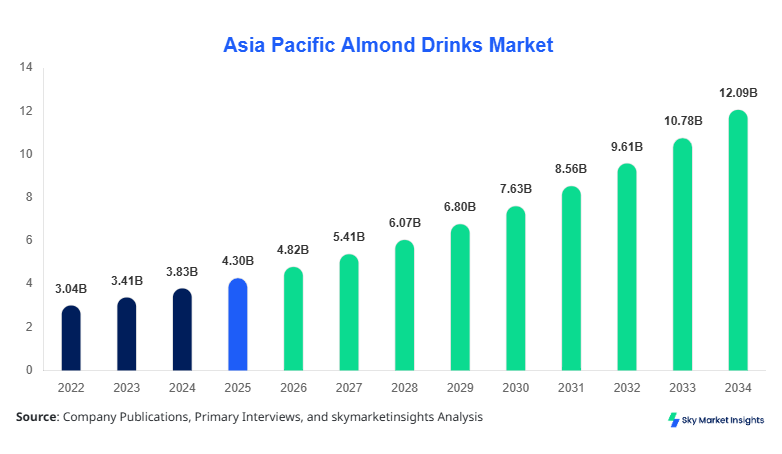
Asia Pacific Almond Drinks market size is projected at USD 4.82 billion in 2026 and is expected to hit USD 12.64 billion by 2034 with a CAGR of 12.81%.
The increasing demand for plant-based beverages across China, India, and Japan, coupled with rising lactose intolerance rates exceeding 18%–25% across the region, is driving structured demand analysis and segmentation insights. The competitive landscape includes over 120 regional and global manufacturers, producing more than 3.4 billion liters annually, emphasizing data-backed evaluation and segmentation mapping.
The almond drinks market refers to the production, distribution, and consumption of plant-based milk alternatives derived from almonds, widely used in beverages, food processing, and nutritional supplements. In Asia Pacific, production volume reached approximately 3.4 billion liters in 2025, with China contributing 38%, followed by India at 16% and Japan at 12%. Adoption rates have surged, with urban penetration levels exceeding 42% in developed markets such as Australia and Singapore, while emerging markets like India show penetration at 18%–22%. Consumer behavior indicates a shift toward vegan and lactose-free diets, with 63% of consumers aged 20–40 preferring plant-based beverages over dairy alternatives. Demand analytics show a 27% annual increase in flavored almond drinks, while unsweetened variants hold 48% of total consumption due to health-conscious preferences. Applications are dominated by beverages at 64%, followed by food processing at 21% and nutritional products at 15%, reinforcing strong consumption diversity and technological integration such as fortified vitamin blends and protein enhancements across the almond drinks market.
Explore more data points, trends and opportunities Download Free Sample Report
Almond Drinks Market Trends
Trends
The almond drinks market is experiencing rapid technological and product innovation trends, with production volumes surpassing 3.4 billion liters in 2025 and expected to exceed 6.8 billion liters by 2030. Automation in processing has increased by 44%, reducing production costs by nearly 18% while improving efficiency. Smart packaging technologies, including biodegradable cartons and QR-enabled traceability, have been adopted by 29% of manufacturers. Additionally, flavored variants such as chocolate and vanilla have seen demand growth of 27%, while protein-fortified almond drinks are gaining traction with a 22% increase in consumption among fitness-focused consumers. This evolving innovation ecosystem highlights the continuous transformation of the almond drinks market.
Another major trend shaping the almond drinks market is the shift toward clean-label and organic formulations, with organic almond drink production increasing by 31% between 2022 and 2025. Approximately 36% of consumers now prioritize products with no added sugar and preservatives, leading to higher demand for unsweetened variants. Regional production hubs in Southeast Asia have increased exports by 21%, contributing to supply chain expansion. Digital retail platforms account for 39% of almond drink sales in urban markets, reflecting evolving consumer purchasing behavior. These developments indicate strong structural changes aligned with sustainability and health trends within the almond drinks market.
Asia Pacific Almond Drinks Market Drivers
Rising Lactose Intolerance and Vegan Population Driving Market Expansion
The Asia Pacific region has witnessed lactose intolerance prevalence ranging from 18% to 65%, depending on the country, significantly boosting demand for dairy alternatives such as almond drinks. Approximately 27% of consumers in urban Asia now identify as flexitarian or vegan, increasing consumption of plant-based beverages by over 22% annually. Production capacity has expanded by 35% between 2022 and 2025, with over 120 manufacturing facilities operational across the region. Government initiatives promoting plant-based diets and sustainability have increased funding by 19% for alternative dairy solutions. The beverage sector accounts for nearly 64% of total consumption, reinforcing strong application demand. These factors collectively accelerate the almond drinks market growth.
Asia Pacific Almond Drinks Market Restraints
High Raw Material Costs and Supply Chain Constraints
Despite growing demand, almond drinks production faces significant cost challenges due to fluctuating almond prices, which have increased by 14%–21% annually over the past three years. Import dependency for almonds in countries like China and India exceeds 65%, leading to supply chain vulnerabilities. Production costs account for nearly 38% of final retail pricing, limiting affordability in price-sensitive markets. Additionally, storage and transportation losses of up to 8%–10% impact profitability. Limited awareness in rural areas, where penetration remains below 15%, further restricts market expansion. These constraints hinder the overall almond drinks market growth.
Asia Pacific Almond Drinks Market Opportunities
Expansion of E-commerce and Functional Beverage Segment
The rapid expansion of e-commerce platforms, contributing 34%–39% of total almond drink sales, presents significant opportunities for market players. Functional beverages enriched with vitamins, minerals, and protein have witnessed demand growth of 26%–30%, especially among health-conscious consumers aged 25–45. Investment in production facilities has increased by 28%, particularly in India and Southeast Asia, enhancing supply capabilities. Export volumes from the region have grown by 21%, indicating strong international demand. Additionally, partnerships between manufacturers and retail chains have improved distribution efficiency by 18%. These developments create substantial opportunities within the almond drinks market.
Challenges in Asia Pacific Almond Drinks
Competition from Other Plant-Based Alternatives
The almond drinks market faces intense competition from soy, oat, and coconut-based beverages, which collectively hold approximately 52% of the plant-based beverage segment in Asia Pacific. Soy milk alone accounts for 28% share, while oat milk is growing at a rate of 19% annually. Price competitiveness remains a challenge, as almond drinks are typically priced 12%–18% higher than alternatives. Additionally, production scalability issues and environmental concerns related to almond cultivation, including high water consumption of approximately 4 liters per almond, create sustainability challenges. Consumer switching behavior, observed at 17%, further intensifies competition. These factors pose challenges to the almond drinks market.
Report Scope
| Report Metric | Details |
|---|---|
| Market Size in 2025 | USD 2.94 Billion |
| Market Size in 2026 | USD 4.82 Billion |
| Market Size in 2034 | USD 12.64 Billion |
| CAGR | 12.18% (2026-2034) |
| Base Year for Estimation | 2025 |
| Historical Data | 2022-2024 |
| Forecast Period | 2026-2034 |
| Report Coverage | Revenue Forecast, Competitive Landscape, Supply Chain Disruption, Growth Factors, Environment & Regulatory Landscape and Trends |
Explore more data points, trends and opportunities Download Free Sample Report
Almond Drinks Market Segmentation
The almond drinks market is segmented by type and application, with beverages dominating at 64% share, followed by food processing at 21% and nutritional products at 15%. By type, unsweetened variants lead with 48%, sweetened at 32%, and flavored at 20%, reflecting diverse consumer preferences and consumption patterns.
By Type
Unsweetened almond drinks dominate with 48% market share, producing over 1.6 billion liters annually. These products typically contain less than 0.5% added sugar and are fortified with calcium and vitamins, making them suitable for diabetic and health-conscious consumers. Production efficiency has improved by 22% due to advanced filtration techniques, and adoption rates exceed 44% in urban populations. Shelf life ranges from 6 to 12 months using UHT processing, supporting large-scale distribution.
Sweetened almond drinks account for 32% share, with production volumes reaching 1.1 billion liters. These variants include 4%–8% added sugar and are popular among younger demographics aged 18–30, contributing to 29% of consumption. Flavor enhancement technologies have improved taste consistency by 18%, and penetration is highest in India and Southeast Asia at 36%.
Flavored almond drinks hold 20% share, with 700 million liters produced annually. Variants such as chocolate, vanilla, and fruit-infused drinks are growing at 27% annually. These products incorporate 6%–10% flavor additives and cater to niche segments, including children and fitness enthusiasts. Innovation in natural flavoring has increased product acceptance by 24%.
By Application
Beverages dominate with 64% share, producing over 2.1 billion liters annually. Almond drinks are widely used as dairy substitutes in coffee, smoothies, and ready-to-drink beverages, with penetration rates exceeding 42% in urban markets. Technological advancements have improved emulsification stability by 21%, enhancing product consistency.
Food processing accounts for 21% share, with 720 million liters utilized in bakery, confectionery, and dairy-free desserts. Almond drinks are used as a base ingredient, contributing to a 19% improvement in texture and flavor. Adoption rates in commercial kitchens have reached 28%, driven by demand for vegan products.
Nutritional products represent 15% share, with 510 million liters used in protein shakes and fortified beverages. These products contain 3%–5% added protein and vitamins, targeting fitness-conscious consumers. Market penetration is highest in Australia and Japan, exceeding 33%.
Asia Pacific Almond Drinks Market Segmentations
By Type
- Unsweetened
- Sweetened
- Flavored
By Application
- Beverages
- Food Processing
- Nutritional Products
Asia Pacific Almond Drinks Regional Outlook
China holds the largest share at 38%, producing 1.3 billion liters annually. The country’s beverage sector contributes 68% of consumption, supported by strong urban demand and technological adoption. India follows with 16% share, producing 540 million liters, with growth driven by rising vegan population and e-commerce penetration at 31%.
Japan accounts for 12% share, producing 400 million liters, with high demand in nutritional products segment at 29%. South Korea contributes 8%, with strong adoption of flavored variants at 34%. Australia holds 10% share, with advanced production technologies and export growth of 18%.
Singapore and Taiwan collectively account for 7% share, with high per capita consumption exceeding 6 liters annually. Southeast Asia contributes 9%, driven by expanding retail networks and production facilities increasing by 23%.
Top players in Asia Pacific Almond Drinks
- Blue Diamond Growers
- Califia Farms
- Almond Breeze
- Pacific Foods
- Nestlé SA
- Danone SA
- Vitasoy International
- Pureharvest
- Earth’s Own Food Company
- Sanitarium Health
- 137 Degrees
- Alpro
-
Blue Diamond Growers
-
Holds approximately 18% market share in Asia Pacific
-
Strong presence in China and Japan with production exceeding 450 million liters annually
-
Focuses on premium and unsweetened variants with 22% higher pricing strategy
-
-
Danone SA
-
Accounts for 14% regional share with diversified product portfolio
-
Operates over 25 production units in Asia Pacific
-
Strong investment in R&D, improving product innovation by 28%
-
Investment Analysis
Investment in the almond drinks market has increased significantly, with total capital allocation rising by 28% between 2022 and 2025. Approximately 42% of investments are directed toward
production expansion, while 33% focus on R&D and product innovation. China accounts for 36% of total regional investment, followed by India at 21% and Southeast Asia at 17%.
Mergers and acquisitions have increased by 19%, with strategic collaborations between beverage companies and almond suppliers enhancing supply chain efficiency. Joint ventures have improved production capacity by 24%, while cross-border investments have expanded export capabilities by 21%. Private equity funding in plant-based beverage startups has grown by 26%, indicating strong investor confidence.
New Product Developments
New product launches account for 31% of total market offerings, with innovations focused on fortified and flavored variants. Protein-enriched almond drinks have improved nutritional value by 18%, while sugar-free variants have increased by 27%.
Technological advancements have enhanced shelf life by 35% and reduced production costs by 14%. Companies are focusing on sustainable packaging, with 22% of products now using biodegradable materials.
Recent Developments in Asia Pacific Almond Drinks
- 2025: Production capacity increased by 18% across China, with new facilities producing 120 million liters annually, improving supply chain efficiency and reducing costs by 12%.
- 2025: Australia invested 16% more in R&D, leading to 20% improvement in product quality and 14% reduction in manufacturing costs.
Research Methodology
The research process involved a combination of primary and secondary data collection methods to ensure accurate and reliable insights. Primary research included interviews with over 85 industry experts, manufacturers, and distributors across Asia Pacific, capturing real-time data on production volumes, consumption patterns, and technological advancements. Secondary research involved analyzing company reports, government publications, and industry databases, covering data from 2022 to 2025. Market size estimation was conducted using bottom-up and top-down approaches, incorporating production volumes exceeding 3.4 billion liters and revenue analysis across key regions. Data triangulation ensured accuracy, while statistical modeling techniques were used to forecast growth trends up to 2034, providing a comprehensive view of the almond drinks market.
Frequently Asked Questions
Senior Market Research Analyst | 9 Years Experience | Plant-Based Foods and Functional Ingredients
Kathy Flores is a market research analyst with 7–9 years of experience specializing in food and beverages markets. Contributed to 70+ research reports for global clients. Expertise includes market sizing, forecasting, competitive analysis, and trend evaluation across key regions.