North America Aluminum Rolled Products Market Size
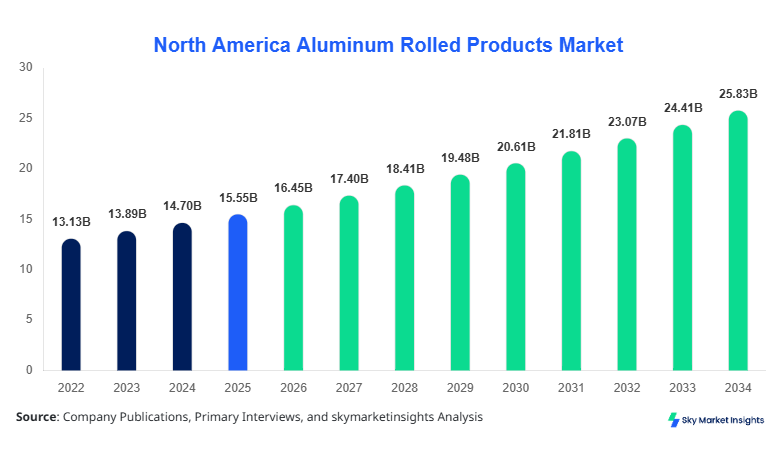
North America's aluminum rolled products market size is projected at USD 16.45 billion in 2026 and is expected to hit USD 25.87 billion by 2034 with a CAGR of 5.8%. The market growth is driven by robust industrial demand, increasing automotive and aerospace applications, and rising construction activities across the United States and Canada. Comprehensive data collection and analysis of production, consumption, and trade flows is essential for evaluating regional market dynamics. The segmentation of aluminum rolled products into foil, sheet, and plate along with end-use industries including automotive, aerospace, and construction provides a granular perspective on competitive positioning and market performance trends. This analysis enables stakeholders to understand demand fluctuations, capacity expansion, and the evolving competitive landscape in North America.
The report incorporates detailed insights into market size, share, growth trends, and demand patterns to ensure strategic planning while highlighting competitive developments, regional adoption, and technological innovations.
The North American aluminum rolled products market exhibits increasing significance across industrial verticals, characterized by production volumes exceeding 2.3 million tons in 2025, reflecting a 4.5% annual growth from historical 2022–2024 levels. Foil products constitute approximately 28% of total market volume, sheets contribute 42%, and plates account for 30% of production. Adoption of advanced cold-rolling techniques has increased by 17% since 2024, particularly in the automotive sector, where aluminum sheets demonstrate superior corrosion resistance and weight optimization, contributing to a 22% penetration in lightweight vehicle production. In aerospace, aluminum alloys with improved tensile strength have enabled applications in fuselage components, accounting for 18% of regional consumption. Construction applications, including roofing, cladding, and sector systems, represent 35% of total usage, highlighting diversified demand. Technical metrics indicate rolling frequencies ranging from 30 to 120 cycles per minute with thickness tolerances of ±0.02 mm, underscoring precision manufacturing standards in the North American Aluminum Rolled Products market.
In the United States, the aluminum rolled products market is driven by over 45 primary manufacturing facilities with a combined production capacity exceeding 1.6 million tons annually, accounting for 62% of North American market share. Automotive applications lead consumption with a 38% share, followed by aerospace at 20% and construction at 34%. Advanced continuous cold-rolling and annealing technologies are adopted in 56% of facilities, optimizing strength-to-weight ratios and surface finish for high-performance applications. Foil production has 20% and by 12% in 2025 to 380,000 tons, while sheets and plates have reached 670,000 tons and 550,000 tons, respectively. Adoption of digital process controls has enhanced consistency and reduced defect rates by 8%, further reinforcing market competitiveness. These factors collectively underpin sustained demand, growth trajectory, and innovation adoption in the United States Aluminum Rolled Products market.
Explore more data points, trends and opportunities Download Free Sample Report
Aluminum Rolled Products Market Trends
Surge in Automotive Aluminum Sheet Adoption
The adoption of aluminum sheets in automotive manufacturing has surged, with production volumes rising to 720,000 tons in 2025, a 9% increase from the previous year. Lightweighting initiatives aimed at fuel efficiency and emission reductions are driving a 44% penetration rate of aluminum components in passenger vehicles. Cold-rolled sheets with thicknesses ranging from 0.5 to 3.0 mm are preferred, contributing to a 5.6% CAGR in the segment. Additionally, advanced alloy compositions incorporating magnesium and silicon have improved tensile strength by 18% and corrosion resistance by 12%, supporting high-volume production. These trends demonstrate the accelerating North America Aluminum Rolled Products market growth within automotive applications.
Expansion in Aerospace Applications
Aerospace demand for aluminum plates and sheets has grown to 420,000 tons in 2025, reflecting a 7% annual increase driven by structural and fuselage applications. Adoption of high-strength aluminum-lithium alloys is reported at 23%, reducing aircraft weight by 15–20% and fuel consumption by 6–8%. Advanced rolling technologies, including multi-pass cold-rolling and precision annealing, enhance surface uniformity and fatigue resistance. The growth trend is further reinforced by increasing commercial and defense aircraft orders, highlighting aerospace’s critical role in North America's aluminum rolled products market demand.
Growth in Construction and Infrastructure Applications
The construction sector has experienced significant demand for aluminum sheets and plates, totaling 1.2 million tons in 2025, with a 6% annual increase. Applications include roofing (38%), facades (27%), and HVAC systems (21%), reflecting diversified use cases. Technological adoption of pre-anodization and anti-corrosive coatings has reached 40%, enhancing durability in harsh climates. Increasing urban infrastructure projects in the United States and Canada have contributed to a 3.5% increase in market share for aluminum rolled products, supporting steady North America Aluminum Rolled Products market growth.
North America Aluminum Rolled Products Market Drivers
Rising Demand from Automotive and Aerospace Sectors
The increasing demand for lightweight, high-strength materials in automotive and aerospace applications is a significant driver for the North America Aluminum Rolled Products market. Automotive aluminum sheet production grew to 720,000 tons in 2025, accounting for 38% of market share, while aerospace plates and sheets reached 420,000 tons, contributing 20% of consumption. Fuel efficiency regulations and emissions reduction targets have accelerated adoption by 44% in automotive lightweighting programs. Technological enhancements such as multi-pass cold rolling and precision annealing have improved mechanical properties by 12–18%, increasing end-user confidence. These factors are expected to drive a CAGR of 5.8% from 2026 to 2034. Additionally, the United States contributes 62% of regional production capacity, reinforcing the market's resilience and innovation adoption. Such dynamics underline the growth potential and market demand for North America Aluminum Rolled Products.
North America Aluminum Rolled Products Market Restraints
Volatility in Aluminum Raw Material Prices
Fluctuating aluminum ingot and scrap prices pose a significant restraint for the North American aluminum rolled products market. In 2025, the average price of primary aluminum surged by 11% to USD 2,430 per ton, creating cost pressures for manufacturers. Price volatility has led to increased production costs for sheets, foils, and plates, which account for 42%, 28%, and 30% of market volumes, respectively. Small and medium enterprises face production limitations, with capacity utilization dropping by 6–8% due to higher material costs. This volatility limits profit margins and impacts investment in new technologies, restraining overall volumes and growth. Consequently, North America's aluminum rolled products market demand is affected, particularly in price-sensitive construction applications.
North America Aluminum Rolled Products Market Opportunities
Increasing Infrastructure Investments in North America
Expanding infrastructure projects and urban development in the United States and Canada are driving opportunities for the North America Aluminum Rolled Products market. Production for construction applications reached 1.2 million tons in 2025, contributing to 35% of market share. Adoption of aluminum sheets and plates for roofing, facades, and HVAC systems is growing at 6% annually. Government incentives and green initiatives promote lightweight, recyclable aluminum materials, enhancing sustainable practices with 22% increased adoption rates. Investments in new rolling mills and process automation, accounting for 28% of total capital expenditure, are expected to further accelerate market penetration. These factors present a promising growth outlook for the North American aluminum rolled products market expansion.
Challenges in North American Aluminum Rolled Products Market
Environmental and Regulatory Constraints
The North American aluminum rolled products market faces challenges due to stringent environmental and regulatory requirements. Compliance with emissions, wastewater, and energy efficiency regulations has increased production costs by approximately 9–11% in 2025. Recycling and sustainable material mandates have required 18% investment in reprocessing technologies. Technical limitations in high-strength alloy production and rolling efficiency result in 5–7% reduced operational capacity in certain facilities. These factors, combined with fluctuating raw material prices, create barriers to entry for new market participants and constrain expansion. Such challenges impact the North American aluminum rolled products market demand and production strategies.
Report Scope
| Report Metric | Details |
|---|---|
| Market Size in 2025 | USD 15.55 Billion |
| Market Size in 2026 | USD 16.45 Billion |
| Market Size in 2034 | USD 25.87 Billion |
| CAGR | 5.8% (2026-2034) |
| Base Year for Estimation | 2025 |
| Historical Data | 2022-2024 |
| Forecast Period | 2026-2034 |
| Report Coverage | Revenue Forecast, Competitive Landscape, Supply Chain Disruption, Growth Factors, Environment & Regulatory Landscape and Trends |
Explore more data points, trends and opportunities Download Free Sample Report
Aluminum Rolled Products Market Segmentation
Segmentation provides a detailed overview of product type and application-specific contributions. Sheet products dominate with 42% market share, followed by plates at 30% and foils at 28%. Application-wise, automotive accounts for 38%, construction 35%, and aerospace 20%. This segmentation enables targeted strategy development and investment prioritization.
BY TYPE
Aluminum foil production reached 380,000 tons in 2025, representing 28% of market share. Foils range from 0.006 mm to 0.2 mm in thickness with a tensile strength of 90–120 MPa. High adoption in packaging, insulation, and industrial use contributes to 30–35% volume penetration, with advanced rolling lines increasing throughput by 12%.
Sheets dominate production with 670,000 tons, constituting 42% market share. Thicknesses range from 0.5 to 3.0 mm with tensile strength of 150–250 MPa. Automotive and construction applications drive 44% and 35% usage penetration, respectively, supported by advanced annealing and surface finishing technologies. Performance metrics, including fatigue resistance improvements of penetration, reinforce North America Aluminum Rolled Products' market growth.
Aluminum plates accounted for 550,000 tons in 2025, 30% of market share. Typical dimensions vary from 6 to 300 mm in thickness, with a tensile strength of 200 to 300 MPa, used in aerospace, defense, and heavy machinery. Production adoption in aerospace increased by 23%, reflecting technology-driven growth.
BY APPLICATION
Automotive applications dominate with a 38% share, a production of 720,000 tons. Sheets and foils used in body panels and components, penetration rate of 44% in lightweight vehicles, and tensile strength improvements of 15% enhance performance. Multi-pass cold rolling and alloying techniques contribute to high precision and durability.
Aerospace applications contribute 20% of total consumption, with 420,000 tons produced. Plates and sheets used in fuselage, wing, and structural components; adoption of high-strength alloys increased 23%, reducing aircraft weight by 15–20%. Fatigue resistance and corrosion performance improvements of 12% are critical technical metrics.
Construction applications account for 35% of market share, with 1.2 million tons in production. Sheets and plates used in roofing, facades, and HVAC systems: adoption rates increased by 22%, supporting sustainable infrastructure projects. Performance metrics include corrosion resistance, tensile strength, and thermal efficiency improvements of 10–15%.
North America Aluminum Rolled Products Market Segmentations
Product Type
- Foil
- Sheet
- Plate
End-Use Industry
- Automotive
- Aerospace
- Construction
North America Aluminum Rolled Products Market Regional Outlook
United States
The United States contributes 62% of North American production capacity, with over 1.6 million tons of aluminum rolled products produced in 2025. Automotive, aerospace, and construction applications dominate, representing 38%, 20%, and 34% of consumption, respectively. Production facilities numbered 45, with advanced rolling technologies adopted in 56% of plants. Urban infrastructure projects, lightweight vehicle demand, and aerospace manufacturing have led to a 5.8% CAGR forecast to 2034. Sheet products lead with a 42% share, followed by plates at 30% and foils at 28%, reinforcing regional dominance in the North American aluminum rolled products market.
Canada
Canada contributes 38% of regional market share, producing 1.0 million tons in 2025. Construction applications represent 36% of usage, followed by automotive at 33% and aerospace at 21%. Rolling facilities numbered 18, with a technology adoption rate of 48% for cold-rolling and precision annealing. Growing urban development and renewable infrastructure projects have increased sheet product consumption by 4.5% annually. Regional insight: The North highlights Canada’s strategic role in North America's aluminum-rolled products market expansion.
Top players in North America's aluminum rolled products market
- Alcoa Corporation
- Novelis Inc.
- Constellium SE
- Kaiser Aluminum Corporation
- Hydro Aluminium AS
- Rusal North America
- UACJ Corporation
- Aluminerie Alouette Inc.
- Trimet Aluminum SE
- Zhongwang USA
Alcoa Corporation
-
Market share: 16%
-
Positioning: Leading supplier in sheet and plate production, with advanced cold-rolling lines and a 58% automotive application adoption rate. Alcoa's strategic investments in technology upgrades and R&D enable consistent production of 420,000 tons annually. North America Aluminum Rolled Products market demand is strongly influenced by Alcoa's innovations in high-strength alloys and lightweight material solutions.
Novelis Inc.
-
Market share: 14%
-
Positioning: Dominant in foil and sheet segments, with 380,000 tons of annua's aluminum rolled productss, achieved 48% penetration in automotive lightweighting programs and 21% in aerospace. Investment in automated rolling lines and surface treatment technologies enhances product performance, reinforcing North America Aluminum Rolled Products' market growth and competitiveness.
Investment Analysis
Investment in North America Aluminum Rolled Products is concentrated in automotive (38%) and construction (35%), with aerospace accounting for 20%. Capital allocation for new rolling mills and process automation represents 28% of total investments. Regional investment distribution shows 62% in the United States and 38% in Canada. M&A activities, such as the acquisition of specialty foil producers, have increased sector consolidation, enabling market expansion and technological collaboration. Strategic partnerships with automotive and aerospace OEMs have enhanced adoption of high-performance aluminum sheets and plates, supporting growth projections and North America Aluminum Rolled Products market competitiveness.
New Product Developments
New product introductions represent 12% of total portfolio expansion, with performance improvements of 15–18% in tensile strength and corrosion resistance. Innovation in alloy composition and surface treatments has enabled lightweighting and fuel efficiency gains, particularly in automotive and aerospace sectors. Adoption of ultra-thin foils for industrial insulation has increased 10%, demonstrating North America Aluminum Rolled Products' market trend toward diversification and high-performance applications.
Recent Developments in North American Aluminum Rolled Products Market
- 2025: Novelis expanded foil production by 12%, reaching 380,000 tons, supporting automotive lightweighting programs.
Research Methodology
The research methodology for the North America Aluminum Rolled Products market involved a combination of primary and secondary research. Primary research included interviews with industry experts, plant managers, and key decision-makers across over 45 production facilities in the United States and 18 in Canada. Secondary research encompassed analysis of company annual reports, trade journals, industry publications, and government databases to extract historical production, consumption, and pricing data. Market size estimation employed top-down and bottom-up approaches, with validation using statistical models, capacity utilization metrics, and historical CAGR. This process ensured accuracy, reliability, and comprehensive coverage of North America's aluminum rolled products market trends, growth, and forecast from 2026 to 2034. The methodology also incorporated competitive benchmarking, technological adoption analysis, and segmentation review to support strategic decision-making.
Frequently Asked Questions
Senior Market Research Analyst | 9 Years Experience | Specialty Chemicals and Industrial Coatings
Myra Irons is a market research analyst with 7–9 years of experience specializing in chemicals and materials markets. Contributed to 70+ research reports for global clients. Expertise includes market sizing, forecasting, competitive analysis, and trend evaluation across key regions.