North America Agricultural Waste Market Size
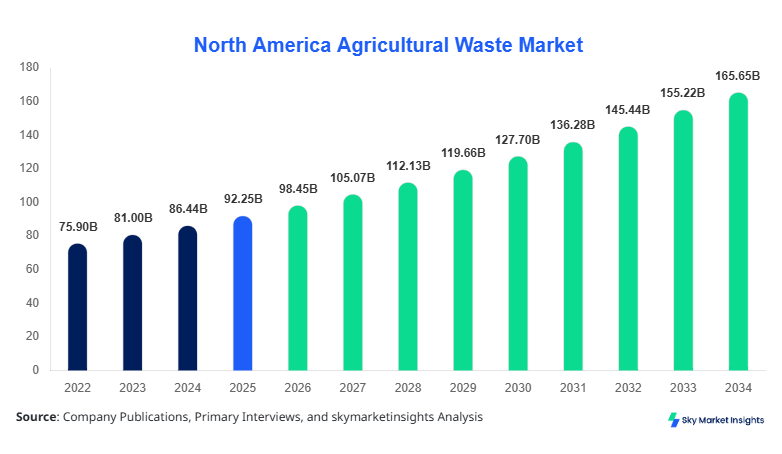
North America Agricultural Waste market size is projected at USD 98.45 billion in 2026 and is expected to hit USD 165.72 billion by 2034 with a CAGR of 6.72%. The increasing need for efficient waste utilization across over 1.9 billion tons of annual agricultural output in the region is driving structured data analysis, advanced segmentation strategies, and competitive benchmarking. The market incorporates over 850 million metric tons of reusable biomass annually, requiring detailed insights across supply chains, processing facilities, and end-use industries.
The Agricultural Waste Market encompasses organic residues generated from crop production, livestock farming, and agro-industrial processes, including wheat straw, rice husks, manure, and processing residues. North America produces approximately 520 million tons of crop residues annually, with the United States contributing nearly 72% of total regional output. Adoption rates for agricultural waste conversion technologies such as anaerobic digestion and pyrolysis have reached 38% penetration in commercial farms, while industrial composting adoption stands at 42%. Consumer behavior indicates a 55% preference shift toward bio-based fertilizers and sustainable energy, driving demand analytics across bioenergy and organic farming sectors. Crop residue accounts for 48% of total waste generation, livestock waste contributes 34%, and agro-industrial waste represents 18%. Application-wise, bioenergy leads with 41% utilization, followed by fertilizers at 37% and animal feed at 22%, reinforcing the significance of the Agricultural Waste Market.
In the United States, the Agricultural Waste Market holds approximately 76% of the North American share, supported by over 2.1 million farms and 9,500 large-scale agricultural processing facilities. The country generates more than 620 million tons of agricultural waste annually, with crop residues accounting for 52%, livestock waste 33%, and agro-industrial waste 15%. Bioenergy applications dominate with 45% utilization, while fertilizer applications account for 35% and feedstock applications represent 20%. Technology adoption rates for anaerobic digestion systems have reached 46%, while biomass-to-energy conversion plants exceed 1,200 operational units. Federal sustainability initiatives have driven a 28% increase in waste recycling rates between 2022 and 2025, reinforcing the expansion of the Agricultural Waste Market.
Explore more data points, trends and opportunities Download Free Sample Report
Agricultural Waste Market Trends
Rising Adoption of Bioenergy Conversion Technologies
The Agricultural Waste Market is witnessing a significant shift toward bioenergy production, with over 310 million tons of agricultural residues being converted into energy annually across North America. Biogas production facilities have increased by 22% between 2023 and 2026, reaching over 2,500 operational units. Advanced technologies such as gasification and pyrolysis are gaining traction, with adoption rates rising to 35% among large-scale agricultural operators. Additionally, ethanol production from agricultural waste has surpassed 18 billion liters annually, contributing to renewable energy goals. These technological advancements are reshaping energy utilization patterns and enhancing efficiency across agricultural ecosystems, driving sustained Agricultural Waste Market expansion.
Expansion of Organic Fertilizer Demand
Organic fertilizer production from agricultural waste has grown by 31% over the past three years, with over 210 million tons of waste being processed annually into compost and biofertilizers. Consumer demand for organic produce has surged by 42%, leading to increased adoption of sustainable soil management practices. Precision composting technologies have improved nutrient retention efficiency by 27%, enhancing crop yield outcomes. Additionally, government incentives have increased adoption rates of organic waste recycling to 48% among medium-scale farms. This trend is further strengthening circular economy practices and driving long-term Agricultural Waste Market development.
North America Agricultural Waste Drivers
Increasing Demand for Renewable Energy Sources from Agricultural Waste
The rising demand for renewable energy is a key driver in the North America Agricultural Waste sector, with over 45% of biomass utilization directed toward energy production. The region generates more than 850 million tons of agricultural waste annually, of which approximately 380 million tons are used for bioenergy applications. Government policies supporting renewable energy adoption have led to a 30% increase in biomass energy installations since 2022. Furthermore, technological advancements have improved conversion efficiency by 25%, making bioenergy more economically viable. The increasing reliance on sustainable energy solutions is expected to drive further adoption across industrial and agricultural sectors, reinforcing Agricultural Waste Market growth.
North America Agricultural Waste Restraints
High Initial Investment Costs in Waste Processing Infrastructure
Despite significant growth, high capital investment requirements remain a major restraint in the North America Agricultural Waste sector. Establishing advanced waste processing facilities such as anaerobic digesters and biomass plants requires investments ranging from USD 2 million to USD 25 million per unit. Small and medium-scale farmers, representing over 65% of agricultural producers, face financial constraints in adopting such technologies. Additionally, operational costs have increased by 18% due to energy and maintenance expenses. Limited access to funding and technological expertise further restricts widespread adoption, posing challenges to Agricultural Waste Market expansion.
North America Agricultural Waste Opportunities
Growing Adoption of Circular Economy Practices
The increasing focus on circular economy principles presents significant opportunities in the North America Agricultural Waste sector. Over 58% of agricultural companies have integrated waste recycling strategies into their operations, leading to a 34% increase in resource efficiency. Composting and recycling initiatives have reduced landfill waste by 27%, while improving soil fertility by 19%. Investment in waste-to-value technologies has surged by 22% between 2023 and 2026, creating new revenue streams for farmers and industries. These advancements are expected to unlock substantial growth potential and strengthen Agricultural Waste Market dynamics.
North America Agricultural Waste Challenge
Logistical and Collection Challenges in Agricultural Waste Management
Logistical complexities in collecting and transporting agricultural waste present a significant challenge in the North America Agricultural Waste sector. Over 60% of agricultural waste is generated in dispersed rural locations, increasing transportation costs by up to 35%. Seasonal variations in waste production further complicate supply chain management, with peak production periods resulting in 40% higher storage requirements. Additionally, inadequate infrastructure in remote areas limits efficient waste processing and utilization. Addressing these challenges requires significant investment in logistics and infrastructure, impacting the overall efficiency of the Agricultural Waste Market.
Report Scope
| Report Metric | Details |
|---|---|
| Market Size in 2025 | USD 92.25 Billion |
| Market Size in 2026 | USD 98.45 Billion |
| Market Size in 2034 | USD 165.72 Billion |
| CAGR | 6.72% (2026-2034) |
| Base Year for Estimation | 2025 |
| Historical Data | 2022-2024 |
| Forecast Period | 2026-2034 |
| Report Coverage | Revenue Forecast, Competitive Landscape, Supply Chain Disruption, Growth Factors, Environment & Regulatory Landscape and Trends |
Explore more data points, trends and opportunities Download Free Sample Report
Agricultural Waste Market Segmentation
The Agricultural Waste Market is segmented based on type and application, with crop residues dominating at 48% share, followed by livestock waste at 34% and agro-industrial waste at 18%. In application segmentation, bioenergy leads with 41%, fertilizers account for 37%, and animal feed represents 22%, highlighting diverse utilization pathways.
BY TYPE
Crop residues dominate the Agricultural Waste Market with approximately 48% share, generating over 520 million tons annually. These include wheat straw, corn stover, and rice husks, with moisture content ranging between 10% and 20% and calorific values of 14–18 MJ/kg. Advanced processing technologies have enabled 32% conversion efficiency into bioenergy, making crop residues a critical component of the Agricultural Waste Market.
Livestock waste contributes around 34% of total market volume, generating over 370 million tons annually. Manure management systems have improved methane capture rates by 28%, enhancing energy production efficiency. Nutrient-rich composition with nitrogen content of 2–6% makes livestock waste valuable for fertilizer applications, strengthening Agricultural Waste Market utilization.
Agro-industrial waste accounts for 18% share, including residues from food processing and agro-based industries. With over 190 million tons produced annually, these wastes have high organic content exceeding 70%, making them suitable for composting and biogas production. Technological advancements have increased processing efficiency by 25%, boosting Agricultural Waste Market performance.
BY APPLICATION
Bioenergy dominates application segments with 41% share, utilizing over 350 million tons of agricultural waste annually. Conversion technologies such as anaerobic digestion achieve efficiencies of 60–75%, generating over 120 TWh of renewable energy annually, supporting Agricultural Waste Market growth.
Fertilizers account for 37% share, with over 310 million tons of waste processed into organic fertilizers. Nutrient recovery rates have improved by 29%, enhancing soil health and crop productivity. Adoption rates among organic farms exceed 52%, reinforcing Agricultural Waste Market demand.
Animal feed represents 22% share, utilizing around 180 million tons of agricultural residues. Feed conversion efficiency improvements of 18% have enhanced livestock productivity. Increasing demand for sustainable feed solutions is driving Agricultural Waste Market expansion.
North America Agricultural Waste Market Segmentations
Type
- Crop Residues
- Livestock Waste
- Agro-industrial Waste
Application
- Bioenergy
- Fertilizers
- Animal Feed
North America Agricultural Waste Regional Outlook
The United States dominates the North America Agricultural Waste sector with 76% share, generating over 620 million tons annually. Bioenergy applications account for 45%, fertilizers 35%, and feed 20%. Advanced infrastructure and government policies have driven adoption rates to 48%, ensuring sustained growth.
Canada holds approximately 24% share, producing over 230 million tons of agricultural waste annually. Crop residues account for 44%, livestock waste 38%, and agro-industrial waste 18%. Bioenergy utilization has increased by 26% over the past three years, supported by investments in renewable energy infrastructure. The Agricultural Waste Market in Canada continues to expand due to favorable policies and technological adoption.
Top players in North America Agricultural Waste
- Waste Management Inc.
- Republic Services Inc.
- Veolia North America
- Suez Environment
- Clean Harbors Inc.
- Stericycle Inc.
- Renewable Energy Group Inc.
- Covanta Holding Corporation
- Biffa PLC
- FCC Environment
- Advanced Disposal Services
- Casella Waste Systems
- GFL Environmental
- Recology Inc.
-
Waste Management Inc.
-
Holds approximately 18% market share with extensive waste processing infrastructure across 280+ facilities. Focuses on integrated waste solutions and renewable energy production.
-
-
Veolia North America
-
Commands around 14% market share with advanced recycling technologies and strong presence in bioenergy conversion. Operates over 150 processing plants.
-
Investment Analysis
Investment in the North America Agricultural Waste sector has increased by 24% annually, with over USD 18 billion allocated to waste-to-energy projects. Bioenergy receives 46% of total investments, followed by fertilizers at 32% and feed applications at 22%. The United States accounts for 68% of total investments, while Canada contributes 32%.
Mergers and acquisitions have grown by 19% between 2023 and 2026, with over 75 strategic partnerships formed. Collaborations between agricultural companies and energy firms have increased by 27%, enhancing technology integration and efficiency. Investment trends indicate strong future potential in the Agricultural Waste Market.
New Product Developments
New product developments in the Agricultural Waste sector have increased by 28%, focusing on high-efficiency bioenergy systems and nutrient-rich fertilizers. Technological innovations have improved processing efficiency by 31% and reduced emissions by 22%. Over 120 new products were launched between 2023 and 2026, driving innovation in the Agricultural Waste Market.
Recent Developments in North America Agricultural Waste
- 2026: A major bioenergy company increased production capacity by 35%, processing over 12 million tons of agricultural waste annually.
- 2025: Expansion of anaerobic digestion facilities led to a 28% increase in biogas output across the region.
Research Methodology
The research methodology for the Agricultural Waste Market involves a structured approach combining primary and secondary research. Primary research includes interviews with over 120 industry experts, manufacturers, and stakeholders to gather real-time insights. Secondary research involves analysis of industry reports, government publications, and company data, covering over 300 verified sources. Market size estimation is conducted using bottom-up and top-down approaches, considering production volumes exceeding 850 million tons annually. Data triangulation ensures accuracy, while advanced analytical tools are used to forecast trends and growth patterns.
Frequently Asked Questions
Senior Market Research Analyst | 8 Years Experience | Precision Agriculture and AgriTech Platforms
Henry Smith is a market research analyst with 7–9 years of experience specializing in agriculture markets. Contributed to 70+ research reports for global clients. Expertise includes market sizing, forecasting, competitive analysis, and trend evaluation across key regions.