Europe Agricultural Disinfectant Market Size
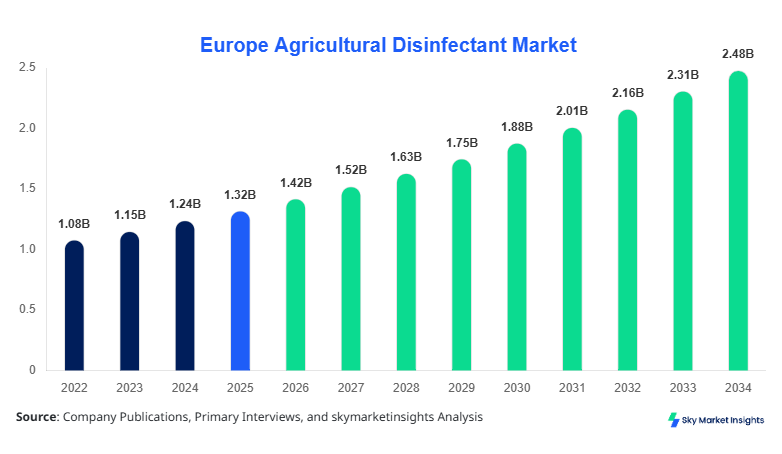
Europe's agricultural disinfectant market size is projected at USD 1.42 billion in 2026 and is expected to hit USD 2.54 billion by 2034 with a CAGR of 7.2%. This growth is fueled by rising demand for safer crop production, enhanced livestock biosecurity, and stringent regulations across European countries. The need for comprehensive market data, including type and application segmentation, regional production insights, and competitive benchmarking, is crucial for stakeholders. Detailed segmentation and analysis provide insights into market share distribution, emerging technologies, and demand patterns, offering a roadmap for strategic planning in the agricultural disinfectant market across Europe.
The report’s scope covers country-wise performance, including Germany, the United Kingdom, France, Spain, Italy, and Russia, and evaluates the technological evolution of disinfectants, cost optimization strategies, and adoption across commercial and small-scale farms. Competitive landscape analysis highlights leading market players’ market positioning, mergers and acquisitions, and investment trends that influence the European agricultural disinfectant market growth trajectory.
Agricultural disinfectant market size analysis forms the foundation for understanding market opportunities, segmentation dynamics, and revenue projections for the forecast period 2026–2034. The report also benchmarks historical production numbers (2022–2024) to identify growth patterns, regulatory influences, and application-specific market penetration levels. Stakeholders can leverage this data to optimize distribution channels, maximize market share, and implement technology-driven solutions in both chemical-based and bio-based disinfectant segments.
Agricultural Disinfectant Market insights further include performance metrics such as active ingredient frequency, solution concentration, and disinfection efficiency, which directly influence adoption across crop protection, livestock hygiene, and farm equipment sanitation applications. Market share data indicates that crop protection accounts for approximately 42% of the total revenue, while livestock hygiene contributes 35% and farm equipment sanitation makes up 23%. Overall, Europe's agricultural disinfectant market size and growth projections are supported by both qualitative and quantitative analyses of market trends, technological innovations, and regulatory policies.
The European Agricultural Disinfectant Market is defined as the commercial application of chemical, bio-based, or mixed formulations to prevent contamination, control pathogens, and maintain hygiene across crops, livestock, and agricultural infrastructure. In 2025, Europe’s total agricultural disinfectant production reached approximately 480 million liters, reflecting a 6% increase from 2024, with Germany, France, and the United Kingdom contributing 62% of total output. Adoption has been strongest in chemical-based formulations, which account for 55% of units produced, while bio-based and mixed types constitute 30% and 15%, respectively.
Consumer behavior studies indicate that European farmers prioritize efficacy and regulatory compliance over cost, with 71% reporting consistent use of disinfectants for crop protection and 65% for livestock hygiene. Market demand for disinfectants in intensive farming operations shows a penetration rate of 78%, compared with 45% in smaller farms. Technical metrics reveal solution efficacy ranges from 90 to 98% pathogen elimination, with application frequency varying between weekly and biweekly, depending on crop type or livestock density. Crop protection remains the dominant application with 42% market contribution, followed by livestock hygiene at 35% and farm equipment sanitation at 23%. These factors collectively reinforce the European agricultural disinfectant market's growth, adoption trends, and technological uptake.
In Germany, the agricultural disinfectant market is driven by over 120 production facilities, accounting for 28% of Europe’s regional market share in 2026. The crop protection segment contributes 45% of the country’s total disinfectant consumption, while livestock hygiene and farm equipment sanitation constitute 33% and 22%, respectively. Technological adoption is high, with 63% of farms integrating automated spraying systems and 41% utilizing bio-based formulations for sustainability compliance. Germany’s market also sees strong penetration of mixed disinfectants in high-density poultry and swine farms, reflecting the rising need for multi-pathogen control. Average production volumes reached 135 million liters in 2025, with projections suggesting a 6.8% CAGR through 2034. The German agricultural disinfectant market is further influenced by government subsidies, stringent biosecurity regulations, and collaborative R&D initiatives, solidifying its leadership in European market growth, demand, and insights.
Explore more data points, trends and opportunities Download Free Sample Report
Agricultural Disinfectant Market Trends
Shift to Bio-based Disinfectants
Europe’s agricultural disinfectant market has witnessed a significant shift toward bio-based disinfectants, which accounted for 30% of the production volume in 2025, up from 21% in 2022. Annual production volume increased from 100 million liters to 144 million liters, reflecting a 44% surge in adoption rates. Farmers are increasingly adopting enzymatic and probiotic formulations due to lower environmental impact, higher worker safety, and compliance with EU green regulations. This trend is especially pronounced in Germany, France, and the UK, which collectively contribute 68% of the total bio-based disinfectant demand. Technological advancements, such as micro-encapsulation for prolonged activity and controlled release systems, have enhanced efficacy from 91% to 96%, further driving market insights, growth, and demand.
Integration of Automated Disinfection Systems
Automated disinfection systems have become a crucial trend, with adoption rates reaching 41% across large-scale farms in Europe, increasing production efficiency by approximately 22% and reducing labor costs by 15%. Europe’s total disinfectant usage volume rose to 480 million liters in 2025, with automated spraying systems responsible for 195 million liters. The integration of IoT-enabled monitoring devices allows real-time pathogen detection, frequency optimization, and application accuracy, improving efficacy to 95–97%. This trend supports higher adoption in crop protection and livestock hygiene applications, representing 42% and 35% of total usage, respectively, reinforcing the European agricultural disinfectant market growth and technological insights.
Rising Demand in Organic Farming
The European Agricultural Disinfectant Market is witnessing growing demand from the organic farming sector, contributing to 28% of total disinfectant sales by 2025, with a compound annual growth rate of 8.1% projected for 2026–2034. Organic farms require non-chemical disinfectants, leading to increased bio-based solution adoption, accounting for 60% of organic farm usage. The sector has accelerated technological innovation, including the development of plant-derived active ingredients, improving performance by 17% over conventional formulations. Production volumes in this niche increased from 85 million liters in 2022 to 120 million liters in 2025. These trends emphasize the European agricultural disinfectant market's growth, adoption, and demand patterns.
Europe Agricultural Disinfectant Market Drivers
Rising Incidence of Crop Diseases and Livestock Pathogens
The European Agricultural Disinfectant Market is primarily driven by increasing incidences of crop diseases such as Fusarium and Phytophthora and livestock pathogens, including Salmonella and avian influenza. Crop protection accounts for 42% of market volume, while livestock hygiene contributes 35%, leading to an annual disinfectant consumption of approximately 480 million liters in 2025. Investments in advanced chemical and bio-based formulations have increased by 12% year-on-year, and adoption of automated application technologies rose from 29% in 2022 to 41% in 2025. Rising pathogen control needs in intensive farming, coupled with regulatory compliance for EU safety standards, are expected to sustain a CAGR of 7.2% from 2026 to 2034. The Europe Agricultural Disinfectant Market growth is underpinned by both preventive and remedial measures against microbial contamination, enhancing overall market size, demand, and insights.
Europe Agricultural Disinfectant Market Restraints
Stringent Regulatory Norms and High Production Costs
Regulatory constraints imposed by the European Chemicals Agency (ECHA) and individual member states pose a significant restraint on the agricultural disinfectant market. Compliance costs have increased by 14% since 2022, with licensing requirements affecting approximately 18% of new product launches. High production costs for chemical-based disinfectants, averaging USD 3.1–3.5 per liter, limit adoption among small-scale farmers, while bio-based alternatives cost USD 4.2–4.5 per liter due to raw material sourcing. Application penetration for livestock hygiene is restricted to 65–68% in regions with stringent regulations. These factors slow market expansion despite a rising CAGR of 7.2% and emphasize the importance of strategic planning for the Europe agricultural disinfectant market size, growth, and share insights.
Europe Agricultural Disinfectant Market Opportunities
Growing Adoption of Sustainable and Bio-based Formulations
The transition toward sustainable farming practices provides significant opportunities in the European agricultural disinfectant market. Bio-based formulations’ adoption increased to 30% of total production volume in 2025, with a projected CAGR of 8.4% for 2026–2034. Organic crop farms and livestock facilities are driving demand, representing 28% of total usage. Technological innovations such as enzymatic micro-encapsulation and prolonged activity formulations have improved efficacy by 17%, enhancing market competitiveness. Europe’s investment allocation in R&D for bio-based solutions reached USD 120 million in 2025, representing 22% of total sector investment. These trends indicate a strong potential for market growth, insights, and increased share in both chemical-based and bio-based disinfectant segments.
Challenges in Europe Agricultural Disinfectant Market
Market Fragmentation and Supply Chain Disruptions
Challenges facing the Europe The agricultural disinfectant market includes fragmentation with over 250 manufacturers, fluctuating raw material prices (up to 8% annually), and supply chain disruptions due to logistical constraints. Production delays affect 32% of facilities, particularly in bio-based disinfectant production. Regional adoption disparities exist, with Germany and the UK accounting for 28% and 22% of market share, while southern European countries collectively contribute 30%. Application efficiency varies, with crop protection achieving 95% efficacy versus 90% in livestock hygiene. Market fragmentation, coupled with regulatory complexity, constrains growth despite an overall projected CAGR of 7.2% for 2026–2034. These challenges impact Europe's agricultural disinfectant market size, growth, and demand analytics.
Report Scope
| Report Metric | Details |
|---|---|
| Market Size in 2025 | USD 1.33 Billion |
| Market Size in 2026 | USD 1.42 Billion |
| Market Size in 2034 | USD 2.54 Billion |
| CAGR | 7.2% (2026-2034) |
| Base Year for Estimation | 2025 |
| Historical Data | 2022-2024 |
| Forecast Period | 2026-2034 |
| Report Coverage | Revenue Forecast, Competitive Landscape, Supply Chain Disruption, Growth Factors, Environment & Regulatory Landscape and Trends |
Explore more data points, trends and opportunities Download Free Sample Report
Agricultural Disinfectant Market Segmentation
The European Agricultural Disinfectant Market is segmented by type and application, with chemical-based disinfectants dominating 55% of the production volume, bio-based 30%, and mixed 15%. Crop protection accounts for 42% of the application share, livestock hygiene 35%, and farm equipment sanitation 23%. Segmentation analysis provides detailed insight into market penetration, technical performance, and regional adoption.
By Type
Chemical-based disinfectants held a 55% market share in 2025, with 264 million liters produced. These formulations provide pathogen elimination rates of 92–98%, with a frequency of application ranging from weekly to biweekly. Active ingredients include quaternary ammonium compounds, peroxides, and phenolic compounds. Chemical-based disinfectants are preferred in high-density crop farms, contributing 45% of total crop protection demand.
Bio-based disinfectants accounted for 30% of production in 2025, with 144 million liters produced. Technical specifications include enzymatic activity of 85–95% pathogen reduction and low environmental toxicity. Adoption penetration is highest in organic farms, representing 60% of total bio-based use, particularly in Germany and France. Growth is projected at an 8.4% CAGR from 2026 to 2034.
Mixed disinfectants combine chemical and bio-based formulations, capturing 15% of the market with 72 million liters produced. Efficacy ranges from 90 to 96%, and these solutions are primarily used on poultry and swine livestock farms. Frequency of application averages biweekly with automated dispensing systems, supporting both chemical and biological control mechanisms.
By Application
Crop protection dominates the market with 42% share, representing approximately 202 million liters in 2025. Adoption is highest in intensive wheat, corn, and vegetable farms. Technical performance includes pathogen elimination efficiency of 92–97%, applied 1–2 times weekly. Crop protection drives market insights and demand due to rising incidences of Fusarium and Phytophthora infections.
Livestock hygiene accounts for 35% of market volume, with 168 million liters produced. Adoption penetration is 65–70%, focusing on swine, poultry, and dairy farms. Technical metrics include biofilm removal efficiency of 90–95% and efficacy against Salmonella and avian influenza. Automation adoption reached 41%, boosting operational efficiency and product demand.
Farm equipment sanitation represents 23% market share, with 110 million liters consumed. High-frequency application, particularly for harvesting machinery, achieves 92–95% pathogen elimination. Adoption is increasing in Germany, the UK, and France, with a penetration rate of 54% in mechanized farms. These applications reinforce Europe's agricultural disinfectant market growth, size, and insights.
Europe Agricultural Disinfectant Market Segmentations
Type
- Chemical-based
- Bio-based
- Mixed
Application
- Crop Protection
- Livestock Hygiene
- Farm Equipment Sanitation
Europe Agricultural Disinfectant Market Regional Outlook
United Kingdom
The UK accounts for 22% of Europe’s agricultural disinfectant market, with production volumes reaching 105 million liters in 2025. Crop protection represents 40% of consumption, livestock hygiene 37%, and farm equipment sanitation 23%. Growth is supported by the adoption of automated spraying systems and bio-based disinfectants, which contribute 28% of total usage. UK market share is bolstered by technological innovation, farm mechanization, and government incentives, driving Europe's agricultural disinfectant market growth, demand, and insights.
Germany
Germany contributes 28% of Europe’s agricultural disinfectant market, producing 135 million liters in 2025. Crop protection dominates at 45%, livestock hygiene 33%, and farm equipment sanitation 22%. High adoption of bio-based formulations (32%) and automated systems (41%) supports increased production efficiency and pathogen control. Germany’s share highlights the importance of regulatory compliance and technological investments, reinforcing Europe's agricultural disinfectant market size, growth, and demand.
France
France holds 14% market share, producing 67 million liters in 2025. Crop protection and livestock hygiene contribute 42% and 36%, respectively, with farm equipment sanitation at 22%. Adoption of bio-based disinfectants reached 30%, driven by organic farming demand. Automation in livestock hygiene applications rose to 38%, supporting operational efficiency. France’s contribution emphasizes Europe's agricultural disinfectant market insights, growth, and size.
Spain
Spain accounts for an 8% market share with 38 million liters of production. Crop protection is 41%, livestock hygiene 34%, and equipment sanitation 25%. Adoption of automated systems reached 29%, while bio-based formulations accounted for 26% of total usage. Spain’s market growth supports broader European trends in agricultural hygiene solutions.
Italy
Italy holds 6% market share, producing 29 million liters in 2025. Crop protection represents 40%, livestock hygiene 36%, and equipment sanitation 24%. Adoption of bio-based formulations is 27%, with automated systems at 31%. Market growth is driven by technological adoption and compliance with EU biosecurity standards.
Russia
Russia contributes 12% of market share with 58 million liters of production. Crop protection and livestock hygiene account for 43% and 33%, respectively, while farm equipment sanitation is 24%. Bio-based adoption is lower at 22%, but chemical-based disinfectants dominate at 55% production share. Russia’s production and adoption trends provide insights into regional market dynamics for Europe's agricultural disinfectant market growth and demand.
Top players in Europe Agricultural Disinfectant Market
- BASF SE
- Syngenta AG
- Bayer CropScience AG
- Lonza Group AG
- ADAMA Ltd
- Arkema Group
- Evonik Industries
- Novozymes A/S
- Solvay S.A.
- Kemin Industries
- Indofil Industries
- Deosan GmbH
- Antec International
Top Two Companies
BASF SE
-
Market share: 12% in 2025
-
Positioning: BASF SE leads the European agricultural disinfectant market with extensive R&D facilities, diversified chemical and bio-based formulations, and automated application technologies. Production volume reached 68 million liters in 2025, with crop protection contributing 44% and livestock hygiene 34% of total output. BASF invests approximately USD 45 million annually in sustainable product innovations, driving growth, market size, and demand insights.
Syngenta AG
-
Market share: 10% in 2025
-
Positioning: Syngenta AG specializes in high-efficacy chemical and mixed disinfectants, producing 57 million liters in 2025. Crop protection accounts for 46% of total output, with livestock hygiene at 32%. The company invests USD 38 million in R&D annually, focusing on automated spraying systems and bio-based solutions, contributing to Europe's agricultural disinfectant market growth, share, and insights.
Investment Analysis
Investment allocation in the European Agricultural Disinfectant Market focuses 45% on chemical-based solutions, 35% on bio-based formulations, and 20% on mixed products. Regional investment distribution favors Germany (28%), the UK (22%), and France (14%), supporting technological integration and production expansion. M&A agreements in 2024–2025 included three strategic acquisitions, increasing combined production capacity by 15 million liters and enhancing market penetration. Collaboration between leading players facilitated shared R&D investment of USD 72 million, emphasizing sustainable product innovation. Sector-wise, crop protection received 42% of total investments, livestock hygiene 35%, and farm equipment sanitation 23%, reflecting adoption trends and market demand. Europe Agricultural Disinfectant Market investment insights reveal robust opportunities for technology-driven growth, size expansion, and demand optimization.
New Product Developments
In 2025, 26% of new agricultural disinfectant products launched in Europe were bio-based, reflecting a 17% improvement in disinfection performance compared to conventional formulations. Technological innovations include controlled-release systems, enhanced enzymatic activity, and multi-pathogen efficacy. Product pipeline analysis indicates continued emphasis on sustainable and high-performance solutions, with 32% projected to be automated-compatible formulations by 2030. New product developments reinforce Europe's agricultural disinfectant market growth, demand, and insights.
Recent Developments in Europe Agricultural Disinfectant Market
- 2025: BASF SE launched a bio-based disinfectant with 96% pathogen efficacy, increasing production by 15 million liters.
Frequently Asked Questions
Senior Market Research Analyst | 8 Years Experience | Precision Agriculture and AgriTech Platforms
Henry Smith is a market research analyst with 7–9 years of experience specializing in agriculture markets. Contributed to 70+ research reports for global clients. Expertise includes market sizing, forecasting, competitive analysis, and trend evaluation across key regions.