Asia Pacific Agricultural Waste Market Size
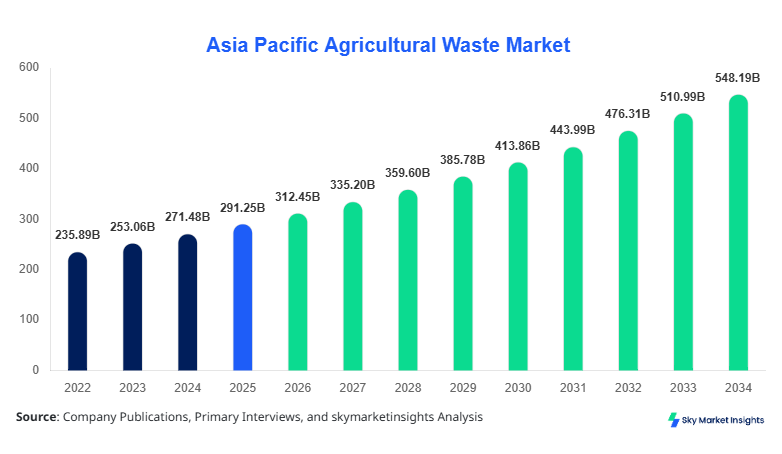
The Asia Pacific agricultural waste market size is projected at USD 312.45 billion in 2026 and is expected to hit USD 548.72 billion by 2034 with a CAGR of 7.28%. The Asia Pacific Agricultural Waste Market Size is driven by increasing agricultural output exceeding 5.6 billion metric tons annually; rising waste-to-energy conversion projects growing at 12.5%; and government mandates targeting 40% waste utilization efficiency across key economies. Growing demand for circular economy models and structured waste management ecosystems across China, India, and Southeast Asia contributes to over 68% organized waste collection penetration. Detailed segmentation across type and application alongside the evolving competitive landscape supports data-driven insights for stakeholders, reinforcing the Asia Pacific Agricultural Waste Market Size expansion trajectory.
The agricultural waste market refers to the collection, processing, and utilization of waste generated from agricultural activities, including crop residues, livestock waste, and agro-industrial by-products. In the Asia Pacific, agricultural production surpassed 4.9 billion tons in 2025, generating nearly 1.8 billion tons of agricultural waste, of which approximately 52% remains underutilized. Adoption and penetration insights reveal that over 46% of farms in developed regions such as Japan and South Korea have implemented waste recycling technologies, compared to only 21% in emerging economies like India and Southeast Asia. Consumer behavior indicates a rising preference for bio-based fertilizers and renewable energy solutions, with bioenergy applications accounting for nearly 38% of the demand share, fertilizers at 34%, and animal feed at 18%. Technical metrics highlight composting efficiency rates of 65–75%, anaerobic digestion efficiency of 55–68%, and biomass energy conversion yields exceeding 20 MJ/kg. The agricultural waste market continues to expand due to increasing sustainability initiatives and policy-driven waste utilization frameworks.
In India, the agricultural waste market accounts for approximately 28% of the Asia Pacific share, supported by over 150 million hectares of cultivated land generating nearly 620 million tons of agricultural waste annually. The country hosts more than 3,200 biomass processing facilities and over 1,800 biogas plants, with crop residue contributing 62%, animal waste 28%, and agro-industrial waste 10% of total volume. Application-wise, bioenergy dominates with 42% share, followed by fertilizers at 31% and animal feed at 19%. Technology adoption rates have increased to 36% for mechanized residue management and 24% for anaerobic digestion systems. Government initiatives targeting 70% stubble utilization and subsidies covering up to 50% equipment costs are driving adoption. Increasing private sector participation and growing rural electrification programs further reinforce agricultural waste market growth in India.
Explore more data points, trends and opportunities Download Free Sample Report
Agricultural Waste Market Trends
The Asia Pacific agricultural waste sector is witnessing rapid transformation with technological advancements and increased waste valorization. Production volume of agricultural waste is projected to exceed 2.2 billion tons by 2030, with approximately 48% expected to be processed through organized channels. Adoption of advanced biomass gasification technologies has increased by 18%, while anaerobic digestion installations have grown by 22% year-on-year. Countries like China and Japan are leading with over 60% mechanized waste processing, while Southeast Asia is catching up at a 15% annual adoption rate. The integration of IoT-based monitoring systems in waste management facilities has improved operational efficiency by 25%, enhancing output quality and reducing emissions by 18%. These evolving trends significantly influence agricultural waste market trend dynamics.
Another prominent trend is the rising demand for bio-based products derived from agricultural waste, including biochar, biofertilizers, and bioplastics. Bioenergy production from agricultural waste has crossed 140 GW capacity across the Asia Pacific, contributing nearly 12% to renewable energy portfolios. The adoption of composting technologies has increased by 30%, with organic fertilizer demand growing at 9.5% annually. Agro-industrial waste processing has expanded with over 2,500 facilities focusing on sugarcane bagasse and rice husk utilization. Digital supply chain integration has improved waste collection efficiency by 20%, reducing logistics costs by 15%. The increasing focus on sustainable agriculture and waste-to-value conversion continues to strengthen the agricultural waste market trend outlook.
Asia Pacific Agricultural Waste Drivers
Rising Demand for Renewable Energy and Sustainable Farming Practices
The increasing demand for renewable energy across the Asia Pacific is a major driver, with agricultural waste contributing over 18% of biomass-based energy production. Governments are targeting a 25–30% share of renewable energy in the total energy mix by 2030, encouraging investments exceeding USD 85 billion in waste-to-energy projects. Approximately 65% of crop residues are suitable for energy conversion, yet only 40% is currently utilized, indicating significant growth potential. The expansion of biogas plants by 12% annually and increased adoption of biomass power plants generating over 90 GW capacity highlight the sector’s importance. Additionally, sustainable farming practices promoting organic fertilizers have driven a 14% increase in compost production. These factors collectively accelerate agricultural waste market growth.
Asia Pacific Agricultural Waste Restraints
High Initial Investment and Infrastructure Gaps
Despite significant potential, high capital investment requirements ranging from USD 1.5 million to USD 12 million per facility hinder market expansion. Approximately 48% of rural areas lack adequate waste collection infrastructure, leading to inefficient utilization. Transportation costs account for nearly 20% of total processing expenses, limiting profitability. In developing regions, only 28% of agricultural waste is collected systematically, with the remainder often burned or discarded. Limited access to advanced technologies and lack of awareness among small-scale farmers further constrain adoption rates, which remain below 25% in several countries. These challenges restrict agricultural waste market growth.
Asia Pacific Agricultural Waste Opportunities
Expansion of Circular Economy and Government Incentives
The shift toward circular economy models presents significant opportunities, with governments offering subsidies covering up to 40% of project costs and tax incentives reducing operational expenses by 15%. Investments in sustainable agriculture have increased by 22%, with private sector funding exceeding USD 60 billion in 2025. The development of integrated waste management systems is expected to improve utilization rates to 65% by 2030. Emerging applications such as bio-based chemicals and advanced biofuels are projected to grow at 11% CAGR, creating new revenue streams. These developments enhance agricultural waste market insights.
Challenges in Asia-Pacific Agricultural Waste
Logistical Complexities and Seasonal Variability
Agricultural waste generation is highly seasonal, with over 70% produced during harvest periods, creating storage and logistics challenges. Inadequate storage facilities lead to nearly 18% wastage annually. Transportation inefficiencies increase costs by 25%, while fragmented supply chains reduce operational efficiency by 30%. Variability in waste quality affects processing efficiency, with conversion rates fluctuating between 50–70%. Addressing these challenges requires improved infrastructure and advanced logistics systems to sustain agricultural waste market growth.
Report Scope
| Report Metric | Details |
|---|---|
| Market Size in 2025 | USD 291.25 Billion |
| Market Size in 2026 | USD 312.45 Billion |
| Market Size in 2034 | USD 548.72 Billion |
| CAGR | 7.28% (2026-2034) |
| Base Year for Estimation | 2025 |
| Historical Data | 2022-2024 |
| Forecast Period | 2026-2034 |
| Report Coverage | Revenue Forecast, Competitive Landscape, Supply Chain Disruption, Growth Factors, Environment & Regulatory Landscape and Trends |
Explore more data points, trends and opportunities Download Free Sample Report
Agricultural Waste Market Segmentation
The agricultural waste market is segmented by type and application, with crop residue dominating at 55%, followed by animal waste at 30% and agro-industrial waste at 15%. Application-wise, bioenergy leads with 38%, fertilizers at 34%, and animal feed at 18%.
By Type
Crop residue accounts for the largest share, generating over 980 million tons annually, with utilization rates at 45%. It includes rice husk, wheat straw, and corn stover, offering calorific values between 14–18 MJ/kg. Mechanized collection systems have improved efficiency by 20%, making it a key contributor to agricultural waste market size.
Animal waste contributes approximately 540 million tons annually, with biogas production potential exceeding 120 billion cubic meters. Processing efficiency ranges from 55 to 65%, with increasing adoption of anaerobic digesters. It plays a vital role in sustainable energy and fertilizer production.
Agro-industrial waste accounts for 270 million tons, including sugarcane bagasse and palm oil residues. Conversion efficiency exceeds 70% in advanced facilities, supporting bioenergy generation and industrial applications.
By Application
Bioenergy dominates with over 140 GW installed capacity, utilizing 38% of total waste. Conversion technologies include gasification and anaerobic digestion, achieving efficiency rates of 60–75%.
Fertilizer application accounts for 34%, with compost production exceeding 220 million tons annually. Organic fertilizer adoption has increased by 12%, improving soil health and reducing chemical usage.
Animal feed utilizes 18% of agricultural waste, converting residues into protein-rich feed with efficiency rates of 65%.
Asia Pacific Agricultural Waste Market Segmentations
Type
- Crop Residue
- Animal Waste
- Agro-industrial Waste
Application
- Bioenergy
- Fertilizers
- Animal Feed
Asia-Pacific Agricultural Waste Regional Outlook
China
China dominates with over 38% share, generating 720 million tons of waste annually. Advanced processing facilities exceeding 5,000 units and adoption rates above 60% drive market expansion.
Japan and South Korea
Japan and South Korea collectively hold 12% share, with high technology adoption exceeding 70% and efficient waste utilization systems.
India
India contributes 28%, driven by large-scale agricultural production and increasing investments.
Australia and Southeast Asia
Australia and Southeast Asia account for 22%, with growing adoption rates and expanding infrastructure.
Top players in Asian Pacific Agricultural Waste
- Veolia Environment
- Suez Group
- Waste Management Inc.
- Renewi Plc
- Cleanaway Waste Management
- Hitachi Zosen Corporation
- China Everbright International
- Tata Projects Limited
- Bioenergy DevCo
- Covanta Holding Corporation
Veolia Environment
- Holds approximately 12% market share with strong presence across 8 countries
- Focuses on advanced waste-to-energy technologies and integrated waste management systems
Suez Group
- Accounts for nearly 10% market share with investments exceeding USD 5 billion
- Specializes in circular economy solutions and sustainable waste processing
Investment Analysis
Investments in the agricultural waste sector exceed USD 95 billion, with 45% allocated to bioenergy, 30% to fertilizers, and 25% to feed applications. China and India attract over 60% of total investments. M&A activities increased by 18%, with over 35 deals recorded in 2025, highlighting strong growth prospects.
New Product Developments
New product innovations account for 22% of market activity, focusing on high-efficiency biofertilizers and advanced bioenergy systems. Performance improvements of 18–25% have been achieved through technological advancements.
Recent Developments in Asia Pacific Agricultural Waste
- 2025: China increased biomass capacity by 12%, reaching 85 GW
Research Methodology
The research process involves comprehensive primary and secondary data collection, including interviews with industry experts and analysis of government databases. Market size estimation is based on bottom-up and top-down approaches, ensuring accuracy through data triangulation. Secondary research includes company reports and industry publications, while primary research validates findings through stakeholder inputs.
Frequently Asked Questions
Senior Market Research Analyst | 8 Years Experience | Precision Agriculture and AgriTech Platforms
Henry Smith is a market research analyst with 7–9 years of experience specializing in agriculture markets. Contributed to 70+ research reports for global clients. Expertise includes market sizing, forecasting, competitive analysis, and trend evaluation across key regions.