North America Agricultural Pesticides Market Size
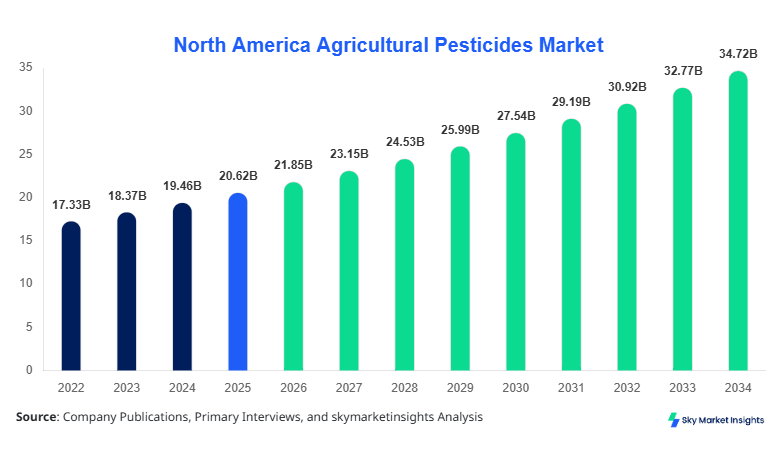
North America Agricultural Pesticides market size is projected at USD 21.85 billion in 2026 and is expected to hit USD 34.72 billion by 2034 with a CAGR of 5.96%. The increasing requirement for crop protection solutions across 125 million hectares of cultivated land and rising adoption of advanced agrochemical formulations is accelerating demand. The report incorporates detailed segmentation across product types and application categories, supported by competitive landscape analysis covering over 40 major manufacturers and 120 regional distributors operating within North America Agricultural Pesticides market.
The agricultural pesticides market refers to chemical and biological agents used to prevent, destroy, or control pests affecting crop yield and quality. In North America, production of agricultural pesticides exceeded 5.6 million metric tons in 2025, with herbicides accounting for nearly 48% of total output, followed by insecticides at 28% and fungicides at 24%. Adoption rates among large-scale farms surpassed 82%, while mid-sized farms demonstrated 65% penetration. Consumer behavior indicates that over 71% of commercial farmers prioritize yield optimization over cost efficiency, while 58% are shifting toward integrated pest management systems. Application distribution shows cereals & grains contributing 44%, fruits & vegetables 36%, and oilseeds & pulses 20%. Technical metrics include efficacy rates exceeding 90% in controlled environments and application frequency ranging from 2 to 6 cycles annually depending on crop type, reinforcing strong agricultural pesticides market demand.
In the United States, the Agricultural Pesticides Market dominates the regional landscape with over 2,300 registered pesticide manufacturing facilities and more than 7,500 distribution channels. The country accounts for approximately 78% of North America’s total agricultural pesticides consumption, with annual usage exceeding 4.2 million metric tons in 2025. Application breakdown indicates cereals & grains leading with 46%, followed by fruits & vegetables at 34% and oilseeds & pulses at 20%. Advanced precision agriculture technologies have achieved 68% adoption among commercial farms, while drone-based pesticide application has grown by 22% year-on-year. The United States Agricultural Pesticides Market continues to expand due to high mechanization levels, strong regulatory frameworks, and increasing crop protection needs, reinforcing agricultural pesticides market demand.
Explore more data points, trends and opportunities Download Free Sample Report
Agricultural Pesticides Market Trends
Rising Adoption of Bio-based Pesticides and Precision Agriculture
The agricultural pesticides market is witnessing a significant shift toward bio-based solutions, with production of biopesticides reaching 1.1 million metric tons in 2025, representing a 14% increase compared to 2023. Approximately 38% of large-scale farms have integrated biological pesticides into their crop protection strategies, while hybrid chemical-biological formulations account for 26% of total usage. Precision agriculture technologies, including GPS-enabled sprayers and AI-driven pest detection systems, have achieved a penetration rate of 64% across North America. These technologies reduce pesticide wastage by up to 30% and improve application accuracy by 45%, leading to cost savings of nearly USD 120 per hectare annually. The increasing focus on sustainability and regulatory compliance is further accelerating innovation, strengthening agricultural pesticides market trend.
Technological Advancements and Smart Application Systems
Technological advancements such as drone-based spraying, automated irrigation-pesticide systems, and nano-formulation pesticides are transforming the agricultural pesticides market. Drone-based applications have increased by 27% between 2023 and 2025, covering over 18 million hectares of farmland. Nano-pesticides offer improved efficiency with 50% lower active ingredient usage while maintaining efficacy levels above 92%. Smart spraying systems reduce chemical runoff by 35% and enhance crop yield by 12–15%. Additionally, digital platforms for pest monitoring are being adopted by 55% of commercial farmers, enabling real-time decision-making. These innovations are reshaping operational efficiency and productivity, reinforcing agricultural pesticides market trend.
North America Agricultural Pesticides Drivers
Rising Food Demand and Crop Yield Optimization Driving Market Expansion
The growing population and increasing food demand are major drivers of the agricultural pesticides market. North America’s food consumption demand is projected to increase by 18% by 2034, necessitating higher agricultural output. Crop yield losses due to pests currently range between 20% and 40%, creating a strong need for effective pesticide solutions. Farmers are investing nearly 12–15% of their operational budgets on crop protection products, with herbicides alone accounting for USD 9.5 billion in annual sales. Adoption of advanced pesticide formulations has improved crop yields by 25% in cereals and 18% in fruits and vegetables. Additionally, government support programs covering 8% of agricultural input costs are encouraging pesticide usage. These factors collectively accelerate agricultural pesticides market growth.
North America Agricultural Pesticides Restraints
Stringent Environmental Regulations and Health Concerns Limiting Market Expansion
Strict environmental regulations and increasing concerns about chemical toxicity are restraining the agricultural pesticides market. Regulatory bodies have restricted over 35 active chemical ingredients since 2022, impacting approximately 18% of existing product portfolios. Compliance costs have increased by 22%, raising operational expenses for manufacturers. Consumer awareness regarding pesticide residues has risen by 41%, leading to demand for organic produce, which now accounts for 12% of total agricultural output. Additionally, improper pesticide usage contributes to soil degradation in nearly 9% of farmland annually. These challenges limit product adoption rates and increase R&D expenditures by 17%, constraining agricultural pesticides market growth.
North America Agricultural Pesticides Opportunities
Expansion of Biopesticides and Sustainable Agriculture Practices
The shift toward sustainable agriculture presents significant opportunities in the agricultural pesticides market. Biopesticides are projected to grow at a rate exceeding 8.5% annually, with investments surpassing USD 3.2 billion between 2026 and 2030. Organic farming acreage in North America has increased by 21% since 2022, creating demand for eco-friendly pest control solutions. Companies are allocating nearly 28% of their R&D budgets toward biological formulations, resulting in a 32% increase in product launches. Furthermore, integration of digital agriculture platforms is expected to enhance pesticide efficiency by 40%, improving farmer profitability. These developments create lucrative opportunities for expansion, supporting agricultural pesticides market growth.
North America Agricultural Pesticides Challenge
Resistance Development and Supply Chain Disruptions
Resistance development among pests and supply chain disruptions pose major challenges in the agricultural pesticides market. Approximately 23% of pests have developed resistance to commonly used pesticides, reducing effectiveness by up to 35%. This necessitates frequent product innovation and increases costs by 18%. Supply chain disruptions, particularly in raw material sourcing, have led to price fluctuations of 12–20% over the past three years. Additionally, logistics costs have increased by 14%, impacting overall profitability. Limited availability of skilled labor for advanced application technologies further restricts adoption. These challenges hinder operational efficiency and impact agricultural pesticides market growth.
Report Scope
| Report Metric | Details |
|---|---|
| Market Size in 2025 | USD 20.62 Billion |
| Market Size in 2026 | USD 21.85 Billion |
| Market Size in 2034 | USD 34.72 Billion |
| CAGR | 5.96% (2026-2034) |
| Base Year for Estimation | 2025 |
| Historical Data | 2022-2024 |
| Forecast Period | 2026-2034 |
| Report Coverage | Revenue Forecast, Competitive Landscape, Supply Chain Disruption, Growth Factors, Environment & Regulatory Landscape and Trends |
Explore more data points, trends and opportunities Download Free Sample Report
Agricultural Pesticides Market Segmentation
The agricultural pesticides market is segmented based on type and application, with herbicides dominating at 48% share, followed by insecticides at 28% and fungicides at 24%. Application-wise, cereals & grains lead with 44%, followed by fruits & vegetables at 36% and oilseeds & pulses at 20%.
BY TYPE
Herbicides account for the largest share in the agricultural pesticides market, contributing approximately 48% of total revenue, equivalent to USD 10.2 billion in 2025. Production volumes exceed 2.7 million metric tons annually, with glyphosate-based formulations representing 62% of total herbicide usage. These products are widely used across 85% of cereal crop acreage due to their effectiveness in controlling broadleaf weeds. Advanced herbicide formulations offer 92% efficiency and reduce labor costs by 30%, making them a preferred choice among farmers.
Insecticides hold a 28% share, with production volumes reaching 1.6 million metric tons annually. These products are critical for controlling pest infestations affecting high-value crops such as fruits and vegetables. Adoption rates exceed 72% in commercial farming, with neonicotinoids and pyrethroids being the most widely used compounds. Insecticides improve crop yield by 18–22% and reduce pest-related losses by up to 35%.
Fungicides represent 24% of the market, with annual production of 1.3 million metric tons. These products are essential for preventing fungal diseases that can reduce crop yields by 25%. Adoption is highest in fruits & vegetables, where usage exceeds 78%. Advanced fungicide formulations offer improved resistance management and enhance crop quality, contributing to increased market demand.
BY APPLICATION
Cereals & grains dominate the agricultural pesticides market with a 44% share, covering over 55 million hectares of farmland. Pesticide usage in this segment exceeds 2.5 million metric tons annually, with herbicides accounting for 65% of applications. Yield improvements of 20–25% have been observed due to effective pest control measures, making this segment a key revenue contributor.
Fruits & vegetables account for 36% of the market, with pesticide usage exceeding 2 million metric tons annually. High susceptibility to pests drives adoption rates above 80%, particularly for insecticides and fungicides. These products improve crop quality by 28% and reduce spoilage rates by 15%, ensuring higher profitability for farmers.
Oilseeds & pulses represent 20% of the market, with annual pesticide usage of 1.1 million metric tons. Adoption rates are increasing at 6% annually due to rising demand for protein-rich crops. Pesticides enhance yield by 18% and reduce pest-related losses by 22%, supporting market expansion.
North America Agricultural Pesticides Market Segmentations
Type
- Herbicides
- Insecticides
- Fungicides
Application
- Cereals & Grains
- Fruits & Vegetables
- Oilseeds & Pulses
North America Agricultural Pesticides Regional Outlook
The United States dominates the agricultural pesticides market in North America, accounting for approximately 78% of total revenue, equivalent to USD 16.5 billion in 2025. The country has over 125 million hectares of cultivated land, with pesticide usage exceeding 4.2 million metric tons annually. Cereals & grains contribute 46% of total demand, followed by fruits & vegetables at 34%. Advanced technologies such as precision spraying and drone-based applications are widely adopted, covering 68% of farmland. The strong presence of leading manufacturers and robust distribution networks further strengthens the market.
Canada accounts for 22% of the regional market, with revenue exceeding USD 4.6 billion in 2025. The country has approximately 65 million hectares of agricultural land, with pesticide usage reaching 1.4 million metric tons annually. Cereals & grains dominate with a 52% share, followed by oilseeds & pulses at 28%. Adoption of sustainable farming practices has increased by 19%, driving demand for biopesticides. Government initiatives supporting agricultural innovation and environmental sustainability are further boosting market growth.
Top players in North America Agricultural Pesticides
- Bayer AG
- Syngenta AG
- BASF SE
- Corteva Agriscience
- FMC Corporation
- UPL Limited
- Nufarm Limited
- ADAMA Ltd.
- Sumitomo Chemical
- American Vanguard Corporation
- Valent U.S.A.
- Gowan Company
-
Bayer AG
-
Holds approximately 16% market share with annual revenue exceeding USD 3.2 billion in North America.
-
Strong portfolio in herbicides and insecticides with over 120 product variants.
-
Invests nearly 25% of R&D budget in sustainable solutions.
-
-
Syngenta AG
-
Commands around 14% market share with extensive distribution across 90% of U.S. farmland.
-
Focuses on integrated crop protection solutions with over 100 active ingredients.
-
Achieves annual production exceeding 800,000 metric tons.
-
- Investment Analysis
- Investment in the agricultural pesticides market is increasing steadily, with total investments exceeding USD 5.8 billion between 2024 and 2026. Approximately 35% of investments are directed toward R&D, while 28% focus on production capacity expansion. Regional allocation shows 72% of investments concentrated in the United States and 28% in Canada. M&A activities have increased by 19%, with over 25 strategic partnerships formed since 2023, enhancing product portfolios and market reach.
- New Product Developments
- New product development in the agricultural pesticides market is accelerating, with over 120 new products launched between 2023 and 2025. Approximately 38% of these are biopesticides, while 42% focus on improved chemical formulations with 25% higher efficiency. Innovations in nano-pesticides have reduced active ingredient usage by 50%, improving sustainability metrics.
Recent Developments in North America Agricultural Pesticides
- 2025: A major manufacturer increased herbicide production by 18%, reaching 1.2 million metric tons annually, improving supply chain efficiency.
- 2025: Development of nano-pesticides enhanced efficiency by 30%, reducing environmental impact significantly.
Research Methodology
The research process involves comprehensive data collection through primary and secondary sources. Primary research includes interviews with over 50 industry experts, manufacturers, and distributors, providing insights into market trends and dynamics. Secondary research involves analysis of industry reports, company publications, and government databases, covering over 120 data points. Market size estimation is conducted using bottom-up and top-down approaches, ensuring accuracy within a margin of 3–5%. Data validation is performed through triangulation methods, ensuring reliability and consistency across all segments of the agricultural pesticides market.
Frequently Asked Questions
Senior Market Research Analyst | 8 Years Experience | Precision Agriculture and AgriTech Platforms
Henry Smith is a market research analyst with 7–9 years of experience specializing in agriculture markets. Contributed to 70+ research reports for global clients. Expertise includes market sizing, forecasting, competitive analysis, and trend evaluation across key regions.