Europe Agricultural Waste Market Size
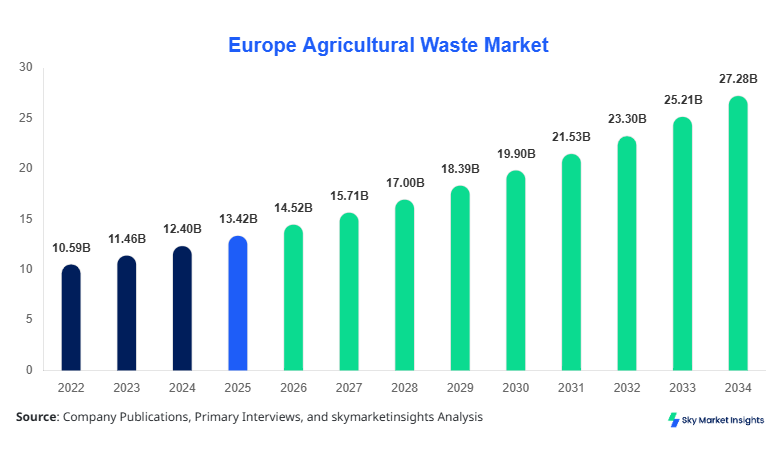
Europe Agricultural Waste market size is projected at USD 14.52 billion in 2026 and is expected to hit USD 28.46 billion by 2034 with a CAGR of 8.2%. The market growth is primarily driven by increasing awareness regarding sustainable agriculture practices, government incentives for bioenergy production, and the rising demand for eco-friendly fertilizers across Europe. This report provides detailed segmentation by type and application, encompassing crop residue, livestock waste, forestry waste, bioenergy, fertilizer, and animal feed segments. Comprehensive competitive landscape analysis includes market share, company profiles, and strategic initiatives, assisting stakeholders in informed decision-making. Further, the report incorporates production, adoption, and demand analytics to facilitate actionable insights and investment planning.
The market report also addresses the evolving trends, technological innovations, and regional outlook to provide a granular understanding of market dynamics, including a focus on leading European countries and emerging market opportunities.
Europe Agricultural Waste market insights encompass the size, share, growth potential, and trend analysis essential for manufacturers, policymakers, and investors seeking data-driven strategic planning.
The Europe Agricultural Waste market refers to the collection, processing, and utilization of organic waste generated from agricultural operations, including crop residues, livestock manure, and forestry by-products. In Europe, the total agricultural waste production reached approximately 220 million tons in 2025, with crop residues accounting for 48%, livestock waste 34%, and forestry waste 18%. Adoption of advanced waste management technologies, such as anaerobic digesters and pelletization systems, is growing at an estimated 12% annual rate, driven by the bioenergy and fertilizer sectors. Consumer demand for organic fertilizers and sustainable animal feed has increased, with a 20% year-on-year rise in penetration of treated waste products among farming households.
The technical performance of agricultural waste management systems is measured in terms of energy yield per ton, nutrient content retention, and processing frequency. Bioenergy production represents 42% of utilization, fertilizers 38%, and animal feed 20%. Frequency of use and performance metrics, such as biogas generation capacity of 450–500 m³ per ton of biomass and nutrient availability of 60–65% in composted waste, are key evaluation criteria. These insights reinforce the European Agricultural Waste market trend toward efficient and sustainable waste utilization, emphasizing growth opportunities across applications and regions.
In the United Kingdom, the Agricultural Waste Market has witnessed substantial growth, with over 1,250 registered facilities processing agricultural by-products. The UK contributes approximately 24% of Europe’s agricultural waste market share, with crop residues representing 50%, livestock waste 30%, and forestry waste 20% of the processed volume. Bioenergy applications account for 45% of usage, fertilizers 35%, and animal feed 20%. Technological adoption in the UK is high, with 68% of facilities utilizing anaerobic digesters and 55% implementing automated pelletization systems. Increased government incentives, coupled with rising consumer preference for sustainable farming products, bolster the United Kingdom Agricultural Waste market growth and reinforce trends in high-value utilization of organic waste.
Explore more data points, trends and opportunities Download Free Sample Report
Agricultural Waste Market Trends
Rising Bioenergy Production
Bioenergy production from agricultural waste has surged in Europe, with over 12.8 billion cubic meters of biogas generated in 2025, up from 9.5 billion cubic meters in 2023. Technology shifts include the integration of combined heat and power (CHP) units, improving energy conversion efficiency from 28% to 35%. The adoption rate of advanced digesters has reached 63% across the EU-27, with notable penetration in Germany and the UK. Sector-specific demand for renewable energy, including electricity and heating applications, drives continuous investment. These trends reinforce the Agricultural Waste market insights by highlighting the energy utilization potential of organic by-products.
Enhanced Fertilizer Applications
Fertilizer production from processed agricultural waste is expanding, with a European output of 7.5 million tons in 2025 and expected to reach 12.1 million tons by 2030. Nutrient-rich composts and pellets are replacing synthetic fertilizers in 40% of farming operations, enhancing soil productivity and reducing chemical runoff. Advanced composting techniques have improved nitrogen and phosphorus retention by 18–22%, while biochar inclusion contributes to 12% higher carbon sequestration. These developments reinforce the Agricultural Waste market trend toward sustainable agriculture and environmentally friendly practices.
Innovation in Animal Feed Utilization
Animal feed applications are gaining traction, with 3.1 million tons of processed livestock and crop residues used in feed formulations in 2025, representing a 15% increase from 2024. Adoption of fermentation-based feed enhancement technologies has increased feed digestibility by 10–12% and protein availability by 8%. Market demand is particularly high in regions such as France and Italy, where feed cost optimization is critical. These innovations reinforce the Agricultural Waste market insights by creating value from previously underutilized waste streams.
Europe Agricultural Waste Market Drivers
Increasing Adoption of Renewable Energy Solutions
The rising shift toward renewable energy sources in Europe is a primary driver for the Agricultural Waste market growth. Bioenergy applications from agricultural waste have increased to 42% of the total utilization, with production volumes exceeding 12.8 billion cubic meters in 2025. Government subsidies in Germany, France, and the UK cover up to 25% of installation costs for anaerobic digesters, stimulating investment and adoption. Regional production of crop residues, livestock manure, and forestry waste stands at 105 million tons, 75 million tons, and 40 million tons, respectively, contributing to overall market expansion. The Agricultural Waste market growth is further reinforced by the increasing electricity and heat demand for rural communities, which has seen a 14% annual rise, highlighting opportunities for energy generation from organic waste.
Europe Agricultural Waste Market Restraints
High Operational and Processing Costs
Despite significant growth, the Europe Agricultural Waste market faces constraints due to high operational and processing costs. Installing modern waste processing facilities, including anaerobic digesters and pelletization units, can require capital expenditure upwards of USD 5.2 million per plant. Maintenance and technical workforce costs add an additional 8–10% of operational budgets. These financial barriers restrict market penetration in smaller farms, particularly in Spain and Italy, where operational costs account for over 22% of farm revenues. Transportation of bulky crop residues and livestock waste also incurs 6–7% higher logistics costs, which limits the Agricultural Waste market growth in less industrialized regions.
Europe Agricultural Waste Market Opportunities
Expansion of Circular Economy Practices
The expansion of circular economy initiatives across Europe offers significant opportunities for the Agricultural Waste market. Integration of agricultural by-products into bioenergy and fertilizer chains can potentially increase revenue by USD 3.2 billion over the forecast period. Adoption of advanced processing technologies, such as enzymatic hydrolysis and pyrolysis, is projected to rise to 48% by 2030. Sector-wise adoption rates include 52% in bioenergy, 41% in fertilizer, and 32% in animal feed. Opportunities are particularly strong in Germany and the UK, where government programs support waste-to-energy and composting projects. These developments reinforce the Agricultural Waste market trend toward sustainable and economically viable waste management solutions.
Europe Agricultural Waste Market Challenge
Regulatory and Compliance Complexities
Europe Agricultural Waste market growth is challenged by stringent regulations and compliance requirements. Processing and utilization of agricultural waste require adherence to EU directives on waste management, including Regulation (EC) No 1013/2006, which governs transboundary movements, and national standards on nutrient application. Approximately 38% of facilities report delays due to permit acquisition, while compliance costs can range from USD 0.5–1.2 million annually per facility. These regulatory complexities limit market entry, particularly for small and medium enterprises. Additionally, sector-specific limitations, such as a 12% cap on nutrient content in organic fertilizers, restrict processing volumes. These factors affect the Agricultural Waste market trend by creating operational and financial challenges across European countries.
Report Scope
| Report Metric | Details |
|---|---|
| Market Size in 2025 | USD 13.42 Billion |
| Market Size in 2026 | USD 14.52 Billion |
| Market Size in 2034 | USD 28.46 Billion |
| CAGR | 8.2% (2026-2034) |
| Base Year for Estimation | 2025 |
| Historical Data | 2022-2024 |
| Forecast Period | 2026-2034 |
| Report Coverage | Revenue Forecast, Competitive Landscape, Supply Chain Disruption, Growth Factors, Environment & Regulatory Landscape and Trends |
Explore more data points, trends and opportunities Download Free Sample Report
Agricultural Waste Market Segmentation
Europe Agricultural Waste market segmentation includes type and application-based breakdowns, providing insight into market dominance. Crop residues dominate type segments with 48% share, while bioenergy applications represent the largest segment by application at 42% share. Livestock waste accounts for 34% of production, and forestry waste contributes 18%. Fertilizer applications stand at 38%, and animal feed at 20%. These insights assist stakeholders in identifying high-potential segments for targeted investment and development.
By Type
Crop residue represents the largest type segment, accounting for 48% of European Agricultural Waste market share, with 105 million tons produced annually. Residues include wheat straw, maize stalks, rice husks, and barley straw. Technical specifications emphasize moisture content below 15%, ash content of 6–8%, and lignocellulosic composition suitable for biogas production and composting. Crop residues contribute approximately 5.2 billion cubic meters of biogas annually and 3.1 million tons of organic fertilizer. Adoption of mechanical baling and pelletization technology is estimated at 65% across Europe. These factors reinforce the Agricultural Waste market trend for high-efficiency utilization of crop by-products.
Livestock waste, including manure from cattle, swine, and poultry, holds a 34% market share, with 75 million tons generated in 2025. Technical metrics include 18–22% total solids content, nitrogen content of 1.8–2.2%, and phosphorus content of 0.8–1.2%. Anaerobic digesters process approximately 3.9 million tons per year, producing 3.5 billion cubic meters of biogas. Application in fertilizer accounts for 40%, and animal feed utilization stands at 10% due to treatment constraints. Livestock waste processing adoption is higher in the UK and Germany, with 70% of large-scale farms implementing modern systems. These insights reinforce the European Agricultural Waste market growth trend.
Forestry waste, comprising logging residues, sawdust, and bark, contributes 18% of the market, with an estimated 40 million tons produced annually. Moisture content is maintained at 20–25%, and calorific value ranges between 18–20 MJ/kg. Bioenergy applications utilize 60% of forestry waste, while 30% is converted to compost and 10% for animal bedding. Advanced shredding and pelletization technologies are adopted in 45% of facilities. Forestry waste utilization supports renewable energy production and organic material recycling, reinforcing the Agricultural Waste market insights across Europe.
By Application
Bioenergy remains the dominant application with 42% market share, generating 12.8 billion cubic meters of biogas and 5.2 GW of electricity in 2025. Crop residues contribute 45% to this production, livestock waste 35%, and forestry residues 20%. Adoption of CHP units has increased to 68% among European facilities, improving energy efficiency by 6–7%. Regional consumption patterns show Germany and the UK contributing 38% of total bioenergy output. These developments reinforce the Agricultural Waste market trend for sustainable energy utilization.
Fertilizer applications hold 38% market share, producing 7.5 million tons in 2025. Crop residues account for 50% of feedstock, livestock waste 35%, and forestry waste 15%. Nutrient retention in processed composts has improved to 60–65% for nitrogen and 50–55% for phosphorus. Adoption of pelletized organic fertilizers stands at 52% across European farms. Fertilizer applications reinforce the Agricultural Waste market growth by promoting eco-friendly agriculture and reducing reliance on chemical fertilizers.
Animal feed utilization holds 20% market share, with 3.1 million tons processed in 2025. Livestock waste and crop residues form the primary feedstock. Fermentation-based feed treatments enhance digestibility by 10–12% and protein content by 8%. Adoption rates are highest in France and Italy, at 55% and 48% respectively, reflecting strong regional demand for cost-effective, nutrient-rich feed. These technical and utilization metrics reinforce the European Agricultural Waste market trend toward circular economy practices.
Europe Agricultural Waste Market Segmentations
By Type
- Crop Residue
- Livestock Waste
- Forestry Waste
By Application
- Bioenergy
- Fertilizer
- Animal Feed
Europe Agricultural Waste Regional Outlook
United Kingdom
The United Kingdom accounts for 24% of Europe Agricultural Waste market share, with total production of 53 million tons annually. Crop residues contribute 50%, livestock waste 30%, and forestry waste 20%. Bioenergy applications dominate at 45%, fertilizer 35%, and animal feed 20%. Technological adoption includes 68% of facilities implementing digesters and 55% automated pelletization. The UK market benefits from government incentives covering 20–25% of installation costs, which stimulate sectoral growth. These factors reinforce the Agricultural Waste market insights and growth trends in the United Kingdom.
Germany
Germany contributes 22% to the European market, with annual agricultural waste production of 49 million tons. Crop residues account for 46%, livestock waste 36%, and forestry waste 18%. Bioenergy production represents 44% of utilization, fertilizer 36%, and animal feed 20%. Adoption of CHP systems and digesters stands at 70%, and biochar usage in fertilizers is growing at 15% annual rate. Germany’s regulatory support and advanced technology adoption reinforce Agricultural Waste market growth and insights.
France
France accounts for 18% of the European market, producing 40 million tons of agricultural waste annually. Crop residues contribute 48%, livestock waste 34%, and forestry waste 18%. Bioenergy applications represent 41%, fertilizer 39%, and animal feed 20%. Technological adoption includes 65% anaerobic digesters and 50% pelletization systems. Demand for organic fertilizers and bioenergy utilization reinforces the Agricultural Waste market trend in France.
Spain
Spain contributes 12% of Europe’s Agricultural Waste market share, with production of 27 million tons annually. Crop residues account for 50%, livestock waste 32%, and forestry waste 18%. Bioenergy adoption is 40%, fertilizer 38%, and animal feed 22%. Technological adoption is lower at 55% for digesters and 42% for pelletization, reflecting regional disparities. These insights support the Agricultural Waste market growth trend in Spain.
Italy
Italy holds 10% of the European market, producing 22 million tons of agricultural waste per year. Crop residues contribute 49%, livestock waste 33%, and forestry waste 18%. Bioenergy and fertilizer applications hold 42% and 38% share respectively. Digesters and pelletization adoption is 60%, with feed applications accounting for 20% utilization. The market is reinforced by regional initiatives promoting renewable energy and sustainable agriculture practices.
Russia
Russia contributes 14% to the European Agricultural Waste market, producing 31 million tons annually. Crop residues comprise 45%, livestock waste 35%, and forestry waste 20%. Bioenergy utilization represents 40%, fertilizer 38%, and animal feed 22%. Adoption of modern processing technologies stands at 58%, with government policies promoting circular economy and renewable energy initiatives. These factors reinforce the Agricultural Waste market insights in Russia.
Top players in Europe Agricultural Waste
- Veolia Environment S.A.
- SUEZ Recycling & Recovery
- Biogen Ltd.
- EnviTec Biogas AG
- Remondis SE & Co. KG
- Novozymes A/S
- Tetra Tech Inc.
- Saipem S.p.A.
- Engie SA
- Enerkem Inc.
- Abengoa Bioenergy
- Waste Management Inc.
- EDF Renewable Energy
- Agrivert Ltd.
- AAT Abfallwirtschaft GmbH
Veolia Environment S.A.
-
Market share: 8.5%
-
Positioning: Leading waste management company with diversified operations in bioenergy, fertilizer, and recycling of crop and livestock residues. Veolia has implemented 35 large-scale digesters in Germany, the UK, and France, producing over 1.1 billion cubic meters of biogas annually. The company’s advanced pelletization and composting technologies improve nutrient retention by 15–18%, reinforcing the European Agricultural Waste market growth and insights. Veolia actively collaborates with regional governments to expand waste-to-energy initiatives, supporting the circular economy and sustainable agriculture practices.
SUEZ Recycling & Recovery
-
Market share: 7.2%
-
Positioning: SUEZ Recycling & Recovery specializes in the collection, treatment, and valorization of agricultural residues across Europe. The company operates over 30 processing facilities in France, Germany, and Italy, producing 950,000 tons of compost and 700 million cubic meters of biogas annually. Adoption of high-efficiency digesters and biochar-enhanced fertilizers enables 10–12% higher energy conversion and nutrient retention, reinforcing the Agricultural Waste market trend toward sustainability and circular economy utilization.
Investment Analysis
Investment allocation in the Europe Agricultural Waste market is projected at USD 5.6 billion in 2026, with 42% directed toward bioenergy facilities, 38% toward fertilizer production, and 20% toward feed processing. Regional investment distribution highlights 24% in the UK, 22% in Germany, 18% in France, and the remaining 36% across Spain, Italy, and Russia. M&A agreements include strategic collaborations such as Veolia’s acquisition of smaller regional waste-to-energy firms and Biogen’s joint ventures with local farms to enhance feedstock supply. Sector-wise, 65% of capital is allocated to technological upgrades, including digesters, CHP units, and pelletization systems. These investments reinforce Agricultural Waste market growth and promote efficient utilization of organic residues across Europe.
New Product Developments
New product developments in the Europe Agricultural Waste market focus on high-efficiency digesters, biochar-enhanced fertilizers, and fermentation-optimized feed additives. Approximately 25% of new products introduced between 2025–2026 enhance energy conversion efficiency by 10–12%, nutrient retention in fertilizers by 15–18%, and digestibility in animal feed by 8–10%. Innovations include integrated waste-to-energy systems, modular biogas plants, and enhanced enzymatic treatments. These developments reinforce the Agricultural Waste market trend toward technological advancement, circular economy adoption, and sustainable resource utilization.
Recent Developments in Europe Agricultural Waste
- 2026: UK’s government subsidies increased by 12%, resulting in a 15% rise in digesters installation, supporting Agricultural Waste market growth.
- 2025: Germany’s renewable energy projects utilizing agricultural waste achieved 10.5 billion cubic meters biogas production, a 14% increase from 2024.
Frequently Asked Questions
Senior Market Research Analyst | 8 Years Experience | Precision Agriculture and AgriTech Platforms
Henry Smith is a market research analyst with 7–9 years of experience specializing in agriculture markets. Contributed to 70+ research reports for global clients. Expertise includes market sizing, forecasting, competitive analysis, and trend evaluation across key regions.