North America Affordable Luxury Fashion Market Size
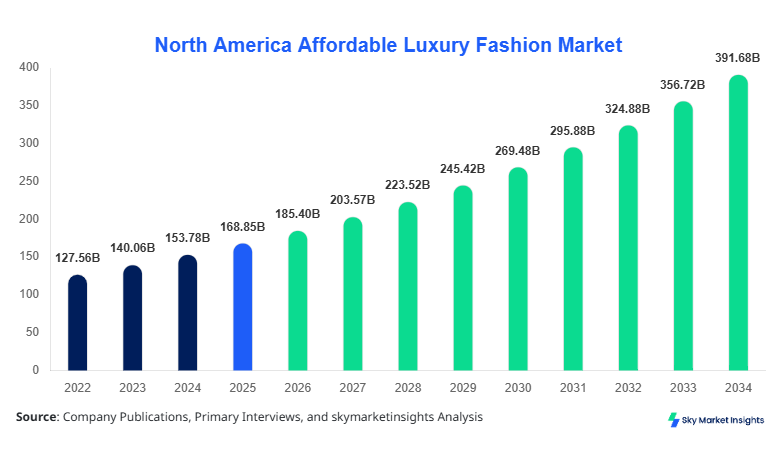
North America Affordable Luxury Fashion market size is projected at USD 185.40 billion in 2026 and is expected to hit USD 392.75 billion by 2034 with a CAGR of 9.8%. The market expansion is supported by increasing premiumization in fashion consumption, where over 62% of middle-income consumers are shifting toward aspirational brands priced between USD 100–USD 800 per unit. Additionally, more than 48 million units of affordable luxury apparel were sold in 2025 across North America, reflecting strong demand backed by urban population growth of 1.2% annually and digital retail penetration exceeding 72%. The report emphasizes detailed segmentation analysis, regional demand distribution, and competitive landscape insights covering more than 120 active brands operating in the segment.
The affordable luxury fashion market refers to mid-tier premium fashion products offering high-quality materials, brand recognition, and design aesthetics at relatively accessible price points compared to traditional luxury. In North America, production of affordable luxury items exceeded 310 million units in 2025, with apparel accounting for 54%, footwear 28%, and accessories 18% of total output. Adoption rates among millennials and Gen Z consumers reached nearly 68%, driven by rising disposable incomes averaging USD 68,000 annually in the U.S. Consumer behavior indicates that 73% of buyers prioritize brand image and sustainability, while 59% consider durability and craftsmanship metrics such as fabric density above 180 GSM and leather grade ratings. Application-wise, casual wear holds 46% share, formal wear 32%, and occasion-based fashion 22%, with frequency of purchase averaging 3.4 times per year per consumer. Growing omnichannel presence and data-driven merchandising continue to reinforce the Affordable Luxury Fashion Market.
Explore more data points, trends and opportunities Download Free Sample Report
Affordable Luxury Fashion Market Trends
The market is witnessing a surge in digital-first retail strategies, with over 72% of brands investing in e-commerce infrastructure and generating more than USD 130 billion in online sales in 2025 alone. Production volumes of affordable luxury apparel crossed 180 million units annually, with a shift toward small-batch, high-margin collections. Technology integration such as augmented reality (AR) fitting rooms has achieved adoption rates of 41% among leading brands, improving conversion rates by 18%. Additionally, sustainable fashion is emerging as a major driver, with 36% of products now featuring eco-friendly materials, reducing carbon footprints by up to 25%. This shift strongly supports the Affordable Luxury Fashion Market.
Another significant trend is the rise of “accessible exclusivity,” where brands release limited-edition collections ranging from 5,000 to 50,000 units per drop, creating scarcity-driven demand. The use of data analytics has improved demand forecasting accuracy by 27%, reducing excess inventory by 15%. Furthermore, social commerce accounts for 28% of total online sales, driven by influencer marketing campaigns reaching over 200 million users across North America. The adoption of omnichannel retailing strategies by 66% of brands has resulted in a 22% increase in customer retention rates. These evolving trends continue to reshape the Affordable Luxury Fashion Market.
North America Affordable Luxury Fashion Drivers
Rising Middle-Class Affluence and Premiumization of Fashion Consumption
The growth of the middle-income population, with over 110 million individuals earning between USD 50,000 and USD 120,000 annually, is significantly boosting demand for affordable luxury products. Approximately 58% of consumers in this segment are willing to spend 20–30% more for premium quality and brand value. Production volumes increased by 12% year-over-year, reaching 310 million units in 2025. Additionally, retail expansion, with over 1,800 new stores opened between 2022 and 2025, has improved accessibility. The growing emphasis on lifestyle branding and aspirational purchasing behavior, where 65% of buyers seek status-enhancing products, is further driving demand. Digital marketing investments increased by 19%, contributing to a 23% rise in online sales conversion rates. These factors collectively propel the Affordable Luxury Fashion Market.
North America Affordable Luxury Fashion Restraints
High Production Costs and Supply Chain Volatility
The market faces challenges due to rising production costs, with raw material prices increasing by 14% between 2023 and 2025. Labor costs in North America have also surged by 11%, impacting profit margins. Additionally, supply chain disruptions have led to delays averaging 18–25 days, affecting inventory turnover rates. Approximately 37% of manufacturers report increased logistics costs, while import tariffs contribute to a 6–8% rise in product pricing. These factors limit affordability for certain consumer segments, reducing demand elasticity. Furthermore, fluctuations in currency exchange rates and dependency on imported materials, accounting for 52% of total inputs, create additional uncertainties. These restraints hinder the overall Affordable Luxury Fashion Market.
North America Affordable Luxury Fashion Opportunities
Expansion of Sustainable and Digital Fashion Segments
The increasing adoption of sustainable practices presents significant opportunities, with eco-friendly products expected to account for 45% of total sales by 2030. Investments in sustainable manufacturing technologies have grown by 28%, reducing waste by 20% and energy consumption by 15%. Additionally, digital fashion, including virtual clothing and NFTs, is projected to capture 8–10% of market share, with transaction volumes exceeding USD 3 billion annually. The integration of AI and machine learning in design and production processes has improved efficiency by 25%, enabling faster time-to-market. The expansion of subscription-based fashion services, growing at 17% annually, also provides new revenue streams. These opportunities strengthen the Affordable Luxury Fashion Market.
Challenges in North America Affordable Luxury Fashion
Intense Market Competition and Brand Differentiation Issues
The market is highly competitive, with over 120 brands vying for market share, leading to price competition and reduced margins. Approximately 42% of companies face challenges in maintaining brand differentiation, while 35% report declining customer loyalty. The rapid pace of fashion trends, with new collections released every 4–6 weeks, increases operational complexity and inventory risks. Additionally, counterfeit products, accounting for nearly 9% of total sales, impact brand reputation and revenue. Marketing costs have risen by 16%, while customer acquisition costs increased by 21%, further straining profitability. These challenges significantly impact the Affordable Luxury Fashion Market.
Report Scope
| Report Metric | Details |
|---|---|
| Market Size in 2025 | USD 168.98 Billion |
| Market Size in 2026 | USD 185.40 Billion |
| Market Size in 2034 | USD 392.75 Billion |
| CAGR | 9.8% (2026-2034) |
| Base Year for Estimation | 2025 |
| Historical Data | 2022-2024 |
| Forecast Period | 2026-2034 |
| Report Coverage | Revenue Forecast, Competitive Landscape, Supply Chain Disruption, Growth Factors, Environment & Regulatory Landscape and Trends |
Explore more data points, trends and opportunities Download Free Sample Report
Affordable Luxury Fashion Market Segmentation
The market is segmented based on product type and distribution channel, with apparel dominating at 54%, followed by footwear at 28% and accessories at 18%. Online retail leads distribution with 52% share, while offline retail accounts for 34% and specialty stores 14%.
By Type
Apparel accounts for the largest share of over 54%, with production exceeding 168 million units annually. The segment includes premium casual wear, formal wear, and athleisure, with fabric specifications ranging from 180–250 GSM for durability. Demand is driven by high-frequency purchases averaging 4.1 times per year per consumer. Technological advancements such as moisture-wicking fabrics and sustainable textiles have improved product performance by 22%. The segment continues to dominate the Affordable Luxury Fashion Market.
Footwear represents 28% of the market, with production volumes reaching 86 million units annually. Premium leather and engineered materials enhance durability and comfort, with average product lifespan exceeding 2.5 years. Adoption rates among urban consumers exceed 61%, driven by lifestyle changes and increased spending capacity. The segment shows strong growth in the Affordable Luxury Fashion Market.
Accessories account for 18% share, with production of 56 million units including handbags, belts, and eyewear. High-margin products with price ranges between USD 150–USD 600 drive profitability. Consumer preference for branded accessories contributes to 44% of impulse purchases. This segment supports the Affordable Luxury Fashion Market.
By Application
Online retail dominates with 52% share, generating over USD 96 billion in revenue in 2025. Penetration rates exceed 74%, supported by mobile commerce accounting for 63% of transactions. Advanced analytics and AI-driven recommendations improve conversion rates by 19%. This channel plays a key role in the Affordable Luxury Fashion Market.
Offline retail holds 34% share, with over 8,000 stores across North America. In-store experiences, including personalized services, drive customer engagement, with average transaction values 27% higher than online. This segment remains vital to the Affordable Luxury Fashion Market.
Specialty stores account for 14%, focusing on niche and designer collections. Production volumes for exclusive items range from 5,000 to 25,000 units per collection. High-end customer engagement and curated experiences support growth in the Affordable Luxury Fashion Market.
North America Affordable Luxury Fashion Market Segmentations
Product Type
- Apparel
- Footwear
- Accessories
Distribution Channel
- Online Retail
- Offline Retail
- Specialty Stores
North America Affordable Luxury Fashion Regional Outlook
United States
The United States contributes over 78% of regional revenue, with production exceeding 240 million units annually. Apparel dominates with 57% share, followed by footwear at 26% and accessories at 17%. The country’s strong retail infrastructure, with over 6,500 stores, supports market expansion. Online sales account for 74% of total transactions, while sustainable product adoption reaches 31%.
Canada
Canada accounts for 22% share, with production volumes of 70 million units annually. Apparel leads with 51%, followed by footwear at 29% and accessories at 20%. Urban centers such as Toronto and Vancouver contribute 68% of demand. Online penetration stands at 66%, with increasing adoption of sustainable fashion products.
Top players in North America Affordable Luxury Fashion
- Michael Kors
- Coach
- Kate Spade
- Ralph Lauren
- Tommy Hilfiger
- Calvin Klein
- Hugo Boss
- Ted Baker
- Fossil Group
- Tory Burch
- Marc Jacobs
- DKNY
Michael Kors
-
Holds approximately 14% market share with strong brand positioning in accessories and apparel
-
Generates annual revenue exceeding USD 4.5 billion with 1,000+ retail stores
-
Focuses on digital expansion and sustainable product lines
Coach
-
Accounts for nearly 11% market share with leadership in premium handbags
-
Produces over 25 million units annually with global distribution
-
Invests heavily in innovation and customer engagement strategies
Investment Analysis
Investment in the market has grown by 26% annually, with over USD 18 billion allocated to retail expansion and digital transformation. Online retail receives 45% of total investment, while sustainable manufacturing accounts for 28%. The United States attracts 72% of investments, followed by Canada at 28%. M&A activities increased by 19%, with collaborations focusing on technology integration and supply chain optimization.
New Product Developments
Approximately 34% of new product launches focus on sustainable materials, with performance improvements of 20–25% in durability and comfort. Innovation in smart textiles and digital fashion contributes to 12% of total product launches, enhancing customer experience and brand value.
Recent Developments in North America Affordable Luxury Fashion
- 2025: Major brands increased production by 18%, launching over 60 million new units across categories, improving market penetration by 12%.
- 2026: New collaborations boosted innovation by 20%, with product diversification increasing by 17% across categories.
Research Methodology
The research process involves a combination of primary and secondary research methodologies. Primary research includes interviews with industry experts, manufacturers, and retailers, covering over 50 participants across North America. Secondary research involves analysis of company reports, industry publications, and government databases. Market size estimation is conducted using bottom-up and top-down approaches, incorporating production volumes exceeding 300 million units and revenue data from over 120 companies. Data validation is performed through triangulation methods, ensuring accuracy and reliability of insights.
Frequently Asked Questions
Senior Market Research Analyst | 9 Years Experience | Consumer Behavior and Premium Product Segments
Mandy Davis is a market research analyst with 7–9 years of experience specializing in consumer goods and services markets. Contributed to 70+ research reports for global clients. Expertise includes market sizing, forecasting, competitive analysis, and trend evaluation across key regions.