Europe Affordable Luxury Fashion Market Size
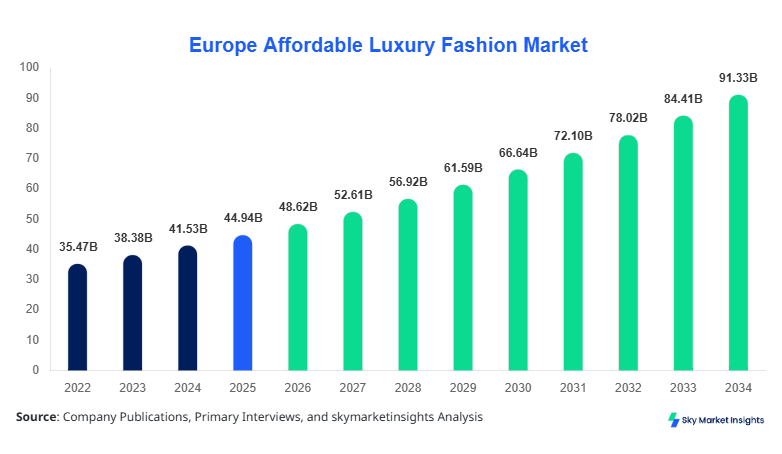
Europe Affordable Luxury Fashion market size is projected at USD 48.62 billion in 2026 and is expected to hit USD 91.44 billion by 2034 with a CAGR of 8.2%.
The market expansion is supported by rising consumer expenditure on aspirational fashion products, increasing digital retail penetration, and strong premiumization across mid-income households in Europe. Growing investments in omnichannel retailing, supply chain optimization, and fast-cycle product launches are further enhancing the competitive environment. The market evaluation includes detailed segmentation analysis, country-level revenue contribution, consumption analytics, import-export trends, and assessment of leading brands operating across the regional affordable premium apparel ecosystem.
The affordable luxury fashion industry refers to premium-designed apparel, footwear, and accessories offered at comparatively accessible pricing compared to traditional luxury brands. In Europe, more than 1.28 billion affordable premium fashion units were sold in 2025, supported by rising urban consumers and fashion-conscious millennials. The United Kingdom, Germany, and France collectively contributed over 58% of total regional revenue generation. Adoption and penetration levels have accelerated substantially due to online retail channels accounting for 37.4% of total sales transactions during 2025, compared with 29.1% in 2022. Consumer demand remains concentrated among the 25–44 age group, representing approximately 61% of total purchases, while female consumers contributed nearly 68% of category consumption volume.
Consumer behavior analytics indicate that nearly 54% of European consumers prioritize affordability combined with brand exclusivity, while 46% focus on sustainability certifications and ethical sourcing. Approximately 41% of online shoppers purchase affordable premium apparel at least four times annually, and average transaction values increased from USD 128 in 2023 to USD 149 in 2025. Apparel accounted for 49% of total application share, followed by accessories at 31% and footwear at 20%. Technical metrics such as inventory turnover ratios averaged 5.8x annually across major retailers, while digital conversion rates exceeded 3.9% among leading e-commerce operators. Rising omnichannel engagement and personalized marketing continue strengthening the Europe Affordable Luxury Fashion market.
Explore more data points, trends and opportunities Download Free Sample Report
Affordable Luxury Fashion Market Trends
Expansion of Sustainable and Digital-First Collections
Sustainability-focused production and digital-first retail models are becoming major operational priorities across the European fashion ecosystem. In 2025, more than 386 million sustainable affordable luxury apparel units were produced across Europe, representing nearly 30% of total market production. Brands increasingly incorporated recycled polyester, vegan leather, and organic cotton into product portfolios, with eco-friendly product launches increasing by 27% year-over-year. Approximately 44% of consumers in France and Germany preferred environmentally certified premium fashion products, while carbon-neutral manufacturing initiatives expanded by 19% across major retailers. Digital product passports and blockchain-enabled traceability solutions were implemented by nearly 14% of leading premium brands to improve supply chain transparency. This shift toward sustainability and digital engagement continues strengthening the Affordable Luxury Fashion Market.
AI-driven personalization technologies also transformed retail operations during 2025. More than 52% of premium fashion retailers deployed recommendation engines and predictive analytics systems to improve customer retention and optimize pricing strategies. Virtual fitting tools improved online conversion rates by 16%, while augmented reality shopping applications increased customer engagement duration by 22%. Subscription-based styling services and influencer-driven collections generated strong traction among consumers aged 18–35 years. Cross-border online fashion transactions increased by 21%, particularly between the UK, Germany, and Spain, reinforcing evolving digital commerce trends within the Affordable Luxury Fashion Market.
Rising Popularity of Limited Edition and Capsule Collections
European fashion brands increasingly launched limited-edition and capsule collections to drive exclusivity while maintaining accessible pricing structures. In 2025, approximately 18% of premium affordable product launches involved influencer collaborations, celebrity partnerships, or designer-led capsule series. Production volumes for limited-run collections exceeded 94 million units, with sell-through rates averaging 79% within the first 60 days of launch. Brands operating in Italy and France experienced particularly strong demand for seasonal capsule collections focused on minimalist and heritage-inspired aesthetics.
The trend is also supported by social media marketing expansion, where Instagram and TikTok influenced nearly 63% of consumer purchase decisions in the 18–30 age category. Luxury-inspired footwear collections recorded annual demand expansion of 14%, while premium accessories collaborations witnessed sales growth exceeding 17%. Retailers increasingly adopted data-driven design processes, reducing product development cycles from 10 months to approximately 6 months. Furthermore, localized manufacturing capabilities across Spain and Italy improved responsiveness to fast-changing consumer preferences. Strong engagement with limited-edition product strategies continues supporting the Affordable Luxury Fashion Market.
Europe Affordable Luxury Fashion Drivers
Increasing Middle-Class Aspirational Spending and Premiumization
Rising disposable income among middle-income households across Europe remains one of the primary growth catalysts for premium affordable fashion products. Household expenditure on aspirational lifestyle categories increased by approximately 11.6% between 2022 and 2025, while premium fashion purchases among consumers earning USD 45,000–90,000 annually expanded by 19%. More than 62% of millennials indicated preference for affordable premium brands over traditional fast-fashion products due to higher perceived quality, exclusivity, and durability. Urban populations across Germany, the United Kingdom, and France generated nearly 71% of regional consumption volume due to stronger fashion awareness and higher spending capacity.
Digital retail infrastructure further accelerated category expansion. Nearly 74% of European consumers researched products online before purchasing, while omnichannel consumers spent approximately 28% more annually compared to single-channel shoppers. Seasonal product launches, loyalty programs, and flexible financing options improved accessibility for aspirational buyers. Additionally, the availability of premium products within price ranges between USD 80 and USD 450 significantly broadened consumer penetration. Increasing premiumization of mid-tier fashion products continues supporting the Affordable Luxury Fashion Market.
Europe Affordable Luxury Fashion Restraints
Supply Chain Volatility and Rising Production Costs
Despite strong demand fundamentals, the market continues facing pressure from rising manufacturing and logistics expenses. European textile production costs increased by approximately 13% during 2024–2025 due to energy price inflation and higher labor wages. Transportation costs across major fashion import corridors rose by 16%, impacting profit margins for brands operating with seasonal collections and limited inventory cycles. Nearly 39% of retailers reported inventory imbalance challenges due to fluctuating raw material availability and delayed international shipments.
The cost of sustainable raw materials also remains significantly higher than conventional alternatives. Organic cotton prices exceeded conventional cotton costs by nearly 24%, while vegan leather materials recorded price increases of 18% during 2025. Smaller brands operating within the affordable premium segment struggled to maintain profitability while balancing sustainability commitments and competitive pricing structures. Additionally, counterfeit fashion products represented an estimated 7% revenue loss across online platforms, particularly in Eastern Europe and Russia. These operational and pricing constraints continue limiting Affordable Luxury Fashion Market expansion.
Europe Affordable Luxury Fashion Opportunities
Expansion of Omnichannel Retail and Resale Fashion Platforms
The increasing integration of omnichannel retail ecosystems presents substantial opportunities for premium affordable fashion brands across Europe. Approximately 68% of European consumers preferred combining online browsing with in-store purchasing during 2025, creating strong demand for integrated shopping experiences. Investment in digital commerce infrastructure exceeded USD 4.8 billion across European premium fashion retailers between 2023 and 2025. Click-and-collect services increased by 26%, while same-day delivery adoption expanded by 18% among urban consumers.
The resale and circular fashion segment also emerged as a high-potential revenue stream. Premium resale transactions increased by 31% annually across Europe, with France and the United Kingdom accounting for nearly 49% of second-hand premium fashion activity. Luxury rental platforms recorded customer base expansion of 22%, particularly among consumers aged 20–35 years seeking cost-efficient access to designer-inspired collections. Brands integrating certified resale channels and buyback programs improved customer retention rates by nearly 14%. These evolving retail models continue creating new opportunities for the Affordable Luxury Fashion Market.
Europe Affordable Luxury Fashion Challenge
Intense Competitive Pressure and Rapid Trend Cycles
The European affordable premium fashion ecosystem remains highly competitive due to the presence of global fast-fashion operators, luxury houses, and digitally native brands. More than 1,500 mid-tier premium fashion labels actively compete across the region, resulting in substantial pricing pressure and reduced product differentiation. Seasonal markdowns averaged 22% during 2025, particularly in footwear and accessories categories. Approximately 41% of retailers experienced excess inventory challenges due to rapidly shifting consumer preferences and unpredictable trend cycles.
Shortened product life cycles also create operational complexities. Product development timelines decreased from 12 months to nearly 5–6 months among leading retailers, requiring continuous design innovation and faster manufacturing turnaround. Social media-driven trends accelerate consumer expectation changes, with nearly 58% of consumers demanding new product launches every quarter. Additionally, maintaining exclusivity while preserving affordability remains a difficult balance for many brands. Limited availability strategies improve perceived brand value but often increase supply chain risks and stockout frequency. These competitive and operational challenges continue impacting the Affordable Luxury Fashion Market.
Report Scope
| Report Metric | Details |
|---|---|
| Market Size in 2025 | USD 44.94 Billion |
| Market Size in 2026 | USD 48.62 Billion |
| Market Size in 2034 | USD 91.44 Billion |
| CAGR | 8.2% (2026-2034) |
| Base Year for Estimation | 2025 |
| Historical Data | 2022-2024 |
| Forecast Period | 2026-2034 |
| Report Coverage | Revenue Forecast, Competitive Landscape, Supply Chain Disruption, Growth Factors, Environment & Regulatory Landscape and Trends |
Explore more data points, trends and opportunities Download Free Sample Report
Affordable Luxury Fashion Market Segmentation
The European market is segmented based on product type and distribution channel. Apparel remained the dominant segment with approximately 49% market contribution in 2025, followed by accessories at 31% and footwear at 20%. By distribution channel, online retail accounted for 37.4% of revenue share, while specialty stores contributed 34% and department stores represented 28.6%. Strong premium consumer penetration and rapid e-commerce adoption continue driving segment-level diversification
BY TYPE
Apparel remained the largest product category across Europe, accounting for nearly USD 23.7 billion in revenue during 2025. More than 610 million premium apparel units were sold across regional markets, with jackets, dresses, knitwear, and tailored casualwear representing the highest demand categories. Technical improvements such as moisture-control fabrics, wrinkle-resistant materials, and sustainable fibers gained substantial popularity. Female consumers contributed approximately 64% of apparel segment purchases, while online sales penetration exceeded 39%. Germany and the United Kingdom collectively represented 46% of apparel demand. Product customization, rapid seasonal turnover, and celebrity-endorsed collections continue supporting segment expansion.
Footwear represented approximately 20% of total market contribution and exceeded 248 million units sold in 2025. Premium sneakers, formal shoes, and hybrid comfort footwear experienced strong adoption among urban consumers. Smart cushioning systems, lightweight polymer materials, and recycled rubber soles improved product performance and sustainability metrics. Nearly 48% of premium footwear purchases originated from consumers aged 20–39 years. Italy maintained strong production leadership with more than 71 million premium footwear units manufactured annually. Omnichannel distribution and influencer marketing remain key growth drivers for footwear sales.
Accessories generated approximately USD 14.6 billion in revenue during 2025 and represented one of the fastest-growing product categories. Handbags, belts, scarves, jewelry, and eyewear accounted for the majority of product demand. Limited-edition accessories launches increased by 18%, while sustainable leather alternatives gained 21% adoption growth across France and Spain. More than 410 million accessories units were distributed throughout Europe during 2025. Technical improvements in lightweight materials and RFID-enabled authentication systems enhanced premium positioning. Strong gifting demand and cross-category styling trends continue supporting accessories expansion.
BY APPLICATION
Online retail emerged as the fastest-growing distribution channel, accounting for approximately 37.4% of total market transactions during 2025. More than 472 million fashion products were sold through digital platforms across Europe. Mobile commerce represented nearly 61% of online transactions, while AI-based recommendation systems improved customer conversion rates by 16%. Subscription-based fashion services and virtual styling platforms also expanded rapidly among younger consumers. Average online order values increased to USD 156 in 2025 compared with USD 132 in 2022. Free returns, personalized recommendations, and influencer marketing continue strengthening online retail adoption.
Specialty stores accounted for nearly 34% of market contribution due to strong consumer preference for premium in-store experiences. Approximately 11,000 specialty fashion outlets actively operated across Europe in 2025, with the highest concentration in the United Kingdom, Italy, and France. In-store personalization services, luxury-inspired interior designs, and exclusive collection launches improved customer engagement metrics by 19%. Nearly 53% of premium consumers preferred trying products physically before purchase, particularly for footwear and accessories. RFID inventory systems and digital fitting rooms were increasingly adopted to improve operational efficiency.
Department stores contributed approximately 28.6% of regional revenue generation and remained important for multi-brand premium product accessibility. More than 2,300 department stores across Europe offered affordable luxury collections in 2025. Seasonal promotions and premium private-label offerings improved foot traffic by 12% annually. Department store consumers demonstrated average annual spending of USD 620 per customer, particularly in Germany and Spain. Collaborative launches between department stores and premium designers also improved exclusivity and brand visibility. Integrated loyalty programs and omnichannel fulfillment continue supporting department store competitiveness.
Europe Affordable Luxury Fashion Market Segmentations
Product Type
- Apparel
- Footwear
- Accessories
Distribution Channel
- Online Retail
- Specialty Stores
- Department Stores
Europe Affordable Luxury Fashion Regional Outlook
United Kingdom
The United Kingdom remained the leading contributor to the European market, accounting for nearly 29.7% of regional revenue during 2025. More than 670 premium affordable fashion companies actively operated within the country, supported by strong retail infrastructure and digital commerce adoption. Apparel dominated with 51% of product sales, while online retail penetration exceeded 43%. London represented approximately 38% of national premium fashion consumption due to high disposable income and strong international tourism activity. Sustainable fashion collections accounted for 24% of total new product launches.
Consumer spending on aspirational fashion products exceeded USD 11.9 billion in 2025, supported by rising millennial and Gen Z purchasing power. Mobile commerce transactions increased by 18%, while influencer-led campaigns contributed nearly 34% of digital customer acquisition. The expansion of resale fashion platforms and subscription styling services further improved market penetration across urban regions.
Germany
Germany accounted for approximately 21% of total regional market revenue during 2025, supported by strong domestic consumption and advanced manufacturing capabilities. More than 310 million premium fashion units were sold annually, with apparel contributing 47% of total sales. Sustainable products represented 29% of purchases among consumers aged 25–40 years. Berlin, Munich, and Hamburg emerged as major consumption centers due to higher urban purchasing capacity.
German consumers demonstrated strong preference for quality-focused products, with average annual spending on premium affordable fashion exceeding USD 540 per consumer. Online transactions represented 36% of total purchases, while specialty stores remained highly influential for footwear and accessories sales. Investments in AI-driven retail analytics and inventory management systems expanded significantly across major retailers.
France
France contributed approximately 17% of regional revenue generation and remained a major fashion innovation hub. More than 240 million premium fashion products were distributed across the country during 2025. Paris accounted for nearly 42% of domestic premium fashion spending due to tourism, luxury culture influence, and high-income consumers. Accessories represented 34% of total category demand, particularly handbags and jewelry.
Digital commerce adoption expanded rapidly, with mobile-based fashion purchases increasing by 22% annually. Sustainable materials were integrated into approximately 31% of new collections launched by French retailers. Influencer collaborations and limited-edition capsule launches remained highly effective in attracting younger consumers across urban regions.
Spain
Spain represented approximately 11% of the European market and benefited from strong textile manufacturing infrastructure and tourism-driven retail activity. More than 146 million premium apparel and accessories units were sold during 2025. Barcelona and Madrid accounted for nearly 57% of national demand due to strong urban retail concentration and tourist spending.
Fast product development cycles and localized manufacturing enabled Spanish brands to reduce lead times by nearly 21%. Online retail penetration reached 34%, while specialty stores contributed approximately 37% of national revenue. Sustainable cotton usage increased by 19% among domestic manufacturers, supporting environmentally conscious consumer demand.
Italy
Italy accounted for nearly 13% of regional market revenue and maintained leadership in premium footwear and leather accessories production. More than 71 million premium footwear units were manufactured in 2025, representing approximately 29% of European premium footwear production. Milan remained a dominant fashion innovation hub, attracting international collaborations and investment.
Italian consumers demonstrated strong preference for craftsmanship-focused products, particularly handbags and tailored apparel. Accessories contributed nearly 36% of national market revenue, while sustainable leather alternatives experienced adoption growth of 17%. Export-oriented production and strong luxury-fashion influence continued strengthening Italy’s market position.
Russia
Russia represented approximately 8% of the regional market and experienced increasing demand for accessible premium apparel among urban consumers. Moscow and Saint Petersburg accounted for nearly 61% of national consumption. More than 112 million affordable premium fashion products were sold across the country during 2025.
Digital retail channels expanded significantly, with e-commerce transactions increasing by 24% year-over-year. Imported premium fashion products represented nearly 48% of total category sales. Despite economic uncertainties, aspirational purchasing behavior and rising demand for premium accessories continued supporting market expansion across major metropolitan regions.
Top players in Europe Affordable Luxury Fashion
- Michael Kors
- Coach
- Ted Baker
- Hugo Boss
- Furla
- Longchamp
- Marc Jacobs
- Armani Exchange
- Guess
- Liu Jo
- Massimo Dutti
- Pinko
- Maje
- Sandro
- Twinset
Michael Kors
-
Michael Kors accounted for approximately 8.6% of the regional premium affordable fashion sector during 2025.
-
The company maintained strong positioning through handbags, footwear, and premium accessories across more than 720 European retail locations.
-
Digital sales represented nearly 39% of company revenue in Europe.
-
Sustainability-focused collections increased by 22% annually.
-
Strategic collaborations and influencer-led campaigns strengthened penetration among consumers aged 20–40 years.
-
Strong omnichannel operations and premium brand perception continue enhancing competitive positioning.
Hugo Boss
-
Hugo Boss represented approximately 6.9% of the European market during 2025.
-
The company maintained strong leadership in premium apparel and menswear segments across Germany, France, and the United Kingdom.
-
More than 31% of product launches incorporated sustainable materials and low-carbon manufacturing practices.
-
Online retail contributed approximately 34% of regional sales revenue.
-
AI-enabled customer analytics and personalization technologies improved digital conversion rates by nearly 15%.
-
Expansion into affordable premium casualwear continues improving consumer reach and brand competitiveness.
Investment Analysis
European investment activity within premium affordable fashion expanded substantially between 2023 and 2025, with total sector investments exceeding USD 9.4 billion. Approximately 38% of investments were allocated toward digital commerce infrastructure, while 27% targeted sustainable manufacturing technologies and recyclable materials development. The United Kingdom attracted nearly 32% of total regional investments due to strong retail digitization and high consumer spending. Germany accounted for approximately 21%, supported by automation investments and smart inventory systems.
Mergers, acquisitions, and collaboration agreements also accelerated throughout the industry. Nearly 41 strategic partnerships were announced between 2023 and 2025 involving sustainable textile manufacturers, fashion technology providers, and omnichannel retail operators. Approximately 18% of premium brands entered collaboration agreements with resale platforms to strengthen circular economy participation. Investments in AI-powered personalization and demand forecasting technologies increased by 24%, while warehouse automation projects expanded by 16%. Private equity firms also increased exposure to digitally native premium brands targeting Gen Z consumers.
Cross-border partnerships between Italian manufacturers and British digital retailers improved supply chain responsiveness and shortened product launch timelines by approximately 19%. French fashion houses increasingly collaborated with technology startups focused on virtual try-on and blockchain authentication systems. These investment activities continue supporting long-term market modernization and operational scalability across Europe.
New Product Developments
Product innovation remained highly active across Europe during 2025, with approximately 29% of new launches focused on sustainable and technology-enhanced collections. Smart fabrics with moisture regulation, anti-wrinkle properties, and lightweight durability features improved product performance by nearly 18%. Vegan leather usage increased by 21%, while recycled polyester integration expanded across premium apparel and accessories categories.
Fashion brands also accelerated limited-edition product development strategies. Nearly 17% of all launches involved capsule collaborations with influencers or independent designers. AI-assisted design technologies reduced sample production costs by 13% and shortened development cycles significantly. Additionally, personalized customization options such as monogramming and virtual styling tools improved customer engagement metrics by nearly 20%, supporting stronger premium consumer retention.
Recent Developments in Europe Affordable Luxury Fashion
- 2025: Michael Kors expanded sustainable handbag production by 18%, introducing recycled material collections across more than 320 European stores. The initiative reduced virgin plastic usage by approximately 27% and strengthened eco-conscious consumer engagement.
- 2025: Hugo Boss increased digital commerce investments by 22%, implementing AI-powered recommendation systems across major European markets. Online conversion rates improved by nearly 15%, while mobile transaction volumes increased by 19%.
Research Methodology
The research methodology for the Europe affordable premium fashion industry combined extensive primary and secondary research approaches to ensure accurate market forecasting and competitive benchmarking. The research process included analysis of regional retail databases, trade associations, government import-export statistics, annual reports, and premium fashion company disclosures from 2022 to 2025. More than 65 primary interviews were conducted with executives, retail distributors, supply chain managers, fashion consultants, and e-commerce platform operators across the United Kingdom, Germany, France, Spain, Italy, and Russia.
Secondary research involved assessment of consumer expenditure trends, demographic purchasing behavior, online retail penetration metrics, sustainability adoption rates, and fashion production statistics. Market size estimation utilized bottom-up and top-down analytical frameworks integrating unit sales volume, pricing trends, and country-level revenue contribution analysis. Forecast models incorporated macroeconomic indicators, inflation trends, digital retail expansion, and consumer premiumization patterns. Data triangulation and validation techniques were applied to minimize forecasting deviations and improve statistical accuracy. Competitive landscape analysis further evaluated company positioning, innovation strategies, investment activity, and omnichannel adoption to provide a comprehensive assessment of the European market ecosystem.
Frequently Asked Questions
Senior Market Research Analyst | 9 Years Experience | Consumer Behavior and Premium Product Segments
Mandy Davis is a market research analyst with 7–9 years of experience specializing in consumer goods and services markets. Contributed to 70+ research reports for global clients. Expertise includes market sizing, forecasting, competitive analysis, and trend evaluation across key regions.