Europe Agate Jewelry Market Size
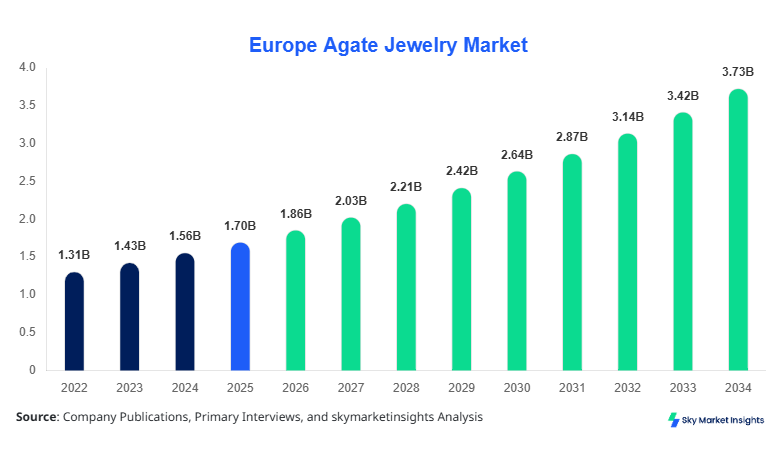
Europe Agate Jewelry market size is projected at USD 1.86 billion in 2026 and is expected to hit USD 3.74 billion by 2034 with a CAGR of 9.1%.
The expansion of gemstone-based fashion accessories across Europe is accelerating due to increasing consumer preference for semi-precious gemstone ornaments, rising disposable income, and expanding luxury retail infrastructure. More than 142 million units of gemstone jewelry products are expected to be traded across Europe in 2026, while online jewelry purchases are forecast to contribute over 38% of total revenue generation. The market assessment includes extensive segmentation analysis, regional production evaluation, pricing analytics, and competitive landscape benchmarking across premium and mid-range jewelry categories.
The agate jewelry industry refers to the production, processing, distribution, and retailing of ornaments manufactured using natural and treated agate gemstones integrated into rings, necklaces, bracelets, pendants, earrings, and decorative accessories. Europe imported approximately 28,400 metric tons of semi-precious gemstone materials in 2025, of which agate stones accounted for nearly 14.8% of the total gemstone trade volume. Agate jewelry adoption across Europe has increased substantially due to rising demand for personalized accessories and handcrafted gemstone products. Consumer penetration among millennials and Gen Z buyers reached 41% in 2025, compared with 33% in 2022. Luxury and premium jewelry applications contributed approximately 46% of overall consumption, while fashion and lifestyle accessories represented 39%.
Consumer behavior analytics indicate that nearly 58% of European consumers prefer gemstone jewelry products featuring natural stones over synthetic alternatives. Online customization orders increased by 27% during 2025, particularly in Germany, France, and the United Kingdom. Bracelet applications represented 29% of unit sales, rings accounted for 34%, and necklaces held approximately 25% share. Average gemstone hardness levels used in agate jewelry range between 6.5 and 7 on the Mohs scale, ensuring durability and long-term ornament performance. Multi-layer electroplating technologies and AI-driven gemstone cutting solutions improved manufacturing precision by 18% across European production facilities. Growing preference for artisanal ornaments and ethically sourced gemstones continues to strengthen the Europe Agate Jewelry market.
Explore more data points, trends and opportunities Download Free Sample Report
Agate Jewelry Market Trends
Rising Demand for Sustainable and Handcrafted Jewelry
European consumers are increasingly favoring sustainably sourced gemstone accessories and handcrafted jewelry products. More than 47% of luxury jewelry consumers in Europe indicated preference for ethically sourced gemstones during 2025, compared with 35% in 2022. The demand for handmade agate necklaces and bracelets increased by 29% across France, Italy, and Germany due to growing awareness regarding artisanal craftsmanship. Nearly 12.6 million handcrafted agate jewelry units were produced across Europe during 2025. Manufacturers are adopting low-carbon gemstone processing technologies that reduced production waste by approximately 16%. Independent jewelry studios and boutique gemstone workshops accounted for nearly 21% of total agate jewelry output in Europe. Growing sustainability certifications and eco-conscious production methods are accelerating the Europe Agate Jewelry market.
Expansion of Online Retail and Personalized Jewelry Platforms
Digital transformation within the jewelry industry has significantly influenced consumer purchasing behavior. Online gemstone jewelry transactions across Europe increased by 33% between 2023 and 2025, while mobile-based purchases contributed nearly 61% of total online sales. More than 8,400 digital jewelry retailers now operate throughout Europe, offering AI-based customization tools and virtual gemstone visualization technologies. Personalized agate jewelry orders rose by 31%, particularly among consumers aged between 20 and 38 years. Subscription-based luxury jewelry platforms expanded by 17% annually, while augmented reality product visualization tools improved customer engagement by 22%. Online-exclusive gemstone collections generated nearly USD 420 million in regional revenue during 2025. Strong digital retail penetration continues to enhance the Europe Agate Jewelry market.
Technological Integration in Gemstone Processing
Jewelry manufacturers across Europe are increasingly investing in automated gemstone cutting, laser polishing, and precision engraving systems. More than 48% of large-scale gemstone processing units implemented AI-assisted gemstone classification systems during 2025. Advanced CNC gemstone cutting equipment improved production efficiency by 26% while reducing raw stone wastage by approximately 14%. Germany and Italy together accounted for nearly 44% of Europe’s gemstone processing equipment investments. High-definition gemstone imaging technologies improved quality inspection accuracy by 32%, particularly within luxury agate jewelry manufacturing. Integration of blockchain-based gemstone traceability systems also increased by 18% among premium jewelry brands. Continuous modernization of gemstone processing infrastructure is strengthening the Europe Agate Jewelry market.
Europe Agate Jewelry Drivers
Increasing Consumer Preference for Semi-Precious Gemstone Accessories
Growing consumer interest in semi-precious gemstones is one of the primary factors driving market expansion across Europe. Approximately 63% of fashion-oriented consumers purchased gemstone-based accessories at least once during 2025, while luxury gemstone jewelry purchases increased by 21% compared with 2023. More than 74 million units of gemstone jewelry were sold through organized retail channels across Europe during 2025. Agate stones are increasingly preferred due to their affordability, natural appearance, and wide color variations. Premium gemstone jewelry collections featuring agate stones generated nearly USD 780 million in sales during 2025. Consumer expenditure on fashion accessories across Europe exceeded USD 52 billion annually, with gemstone-based products accounting for nearly 11% of the total segment. Social media-driven fashion trends and celebrity endorsements further accelerated product visibility, especially among consumers aged between 18 and 40 years. Rising penetration of personalized and handcrafted accessories continues to reinforce Europe Agate Jewelry market expansion.
Europe Agate Jewelry Restraints
Volatility in Raw Gemstone Prices and Supply Chain Constraints
Fluctuations in raw agate stone pricing and international gemstone supply disruptions are limiting consistent production growth across Europe. Raw gemstone procurement costs increased by approximately 18% between 2023 and 2025 due to mining restrictions and international transportation expenses. More than 39% of European jewelry manufacturers reported delays in gemstone deliveries during 2025, particularly from Asia-Pacific suppliers. Import dependency remains high, with Europe sourcing nearly 68% of its agate gemstone materials from external markets. Currency fluctuations and increasing logistics costs contributed to a 12% rise in overall jewelry manufacturing expenses. Smaller artisanal producers faced raw material shortages that reduced output volumes by nearly 9% in certain regions. Environmental regulations regarding gemstone extraction and international trade compliance also created additional operational complexities. These supply-side challenges continue to restrict Europe Agate Jewelry market expansion.
Europe Agate Jewelry Opportunities
Growth of Premium Customization and Digital Jewelry Platforms
The rapid rise of personalized luxury accessories presents substantial opportunities for jewelry manufacturers and online retailers. Nearly 54% of European jewelry buyers expressed willingness to pay premium prices for customized gemstone ornaments in 2025. AI-driven jewelry configuration systems improved consumer conversion rates by 24% across online retail platforms. Demand for engraved agate pendants, birthstone rings, and personalized gemstone bracelets increased by 28% during the last two years. Digital jewelry sales across Europe are projected to exceed 46 million units annually by 2030. More than 3,200 jewelry startups entered the online customization segment during 2025 alone. Virtual try-on technologies enhanced consumer retention rates by 19%, while premium subscription-based jewelry collections expanded by 15% annually. The increasing popularity of bespoke luxury accessories and digital-first retail infrastructure creates significant growth potential for the Europe Agate Jewelry market.
Challenges in Europe Agate Jewelry
Counterfeit Gemstones and Intense Competitive Pricing Pressure
The growing circulation of imitation gemstones and low-cost synthetic jewelry products remains a major challenge across Europe. Approximately 17% of online gemstone accessory listings were identified as counterfeit or low-grade imitations during 2025. Counterfeit gemstone products reduced profit margins for premium jewelry brands by nearly 11%. Intense competition among regional and international jewelry retailers has also increased pricing pressure across mid-range product categories. More than 43% of small jewelry manufacturers experienced declining average selling prices due to aggressive online discounting. Synthetic gemstone alternatives, which are priced nearly 35% lower than natural agate stones, are increasingly attracting budget-conscious consumers. Quality verification challenges and lack of standardized gemstone certification frameworks further complicate consumer trust. Rising operational expenses and inflationary retail conditions continue to create profitability concerns for manufacturers operating within the Europe Agate Jewelry market.
Report Scope
| Report Metric | Details |
|---|---|
| Market Size in 2025 | USD 1.70 Billion |
| Market Size in 2026 | USD 1.86 Billion |
| Market Size in 2034 | USD 3.74 Billion |
| CAGR | 9.1% (2026-2034) |
| Base Year for Estimation | 2025 |
| Historical Data | 2022-2024 |
| Forecast Period | 2026-2034 |
| Report Coverage | Revenue Forecast, Competitive Landscape, Supply Chain Disruption, Growth Factors, Environment & Regulatory Landscape and Trends |
Explore more data points, trends and opportunities Download Free Sample Report
Agate Jewelry Market Segmentation
The Europe agate jewelry industry is segmented by product type and distribution channel. Rings dominated the product category with approximately 34% market contribution in 2025 due to higher consumer preference for gemstone engagement and fashion rings. Online retail represented nearly 38% of overall distribution owing to rapid e-commerce penetration and increasing smartphone-based jewelry purchases. Luxury boutiques accounted for 27% share, while specialty stores contributed 35% of total sales.
BY TYPE
Rings represented the largest segment within the European agate jewelry industry, accounting for approximately 34% of total sales during 2025. More than 48 million agate rings were produced across Europe, particularly in Italy, the United Kingdom, and Germany. Demand for gemstone engagement rings and fashion rings increased by 23% due to rising consumer preference for customized accessories. Average ring gemstone dimensions ranged between 6 mm and 12 mm, while premium handcrafted collections generated nearly USD 540 million in revenue. Laser engraving and CAD-assisted jewelry manufacturing technologies improved production efficiency by 21%. Rings featuring dual-tone metal combinations and polished agate gemstones accounted for 42% of premium ring demand. Consumer preference for minimalist gemstone designs further accelerated unit sales among millennials and Gen Z populations.
Necklaces accounted for nearly 25% of the European market due to increasing demand for statement jewelry and luxury gemstone pendants. More than 35 million agate necklaces were sold during 2025 across retail and online platforms. Multi-layer gemstone necklaces experienced 18% annual sales expansion, particularly within premium fashion categories. Average necklace chain lengths ranged between 18 and 30 inches, while handcrafted gemstone pendants represented 31% of total necklace revenue. Germany and France together contributed nearly 39% of Europe’s agate necklace consumption. Technological advancements in gemstone polishing and color enhancement improved product aesthetics by 27%, leading to higher consumer retention and repeat purchases.
Bracelets contributed approximately 29% of regional sales volume due to strong demand for casual gemstone accessories and wellness-inspired jewelry products. Nearly 41 million agate bracelets were manufactured across Europe during 2025. Stretch bracelets and beaded gemstone accessories accounted for 46% of total bracelet unit sales. Wellness-focused gemstone products promoting meditation and holistic lifestyle applications expanded by 22% annually. Italy and Spain emerged as key production hubs, contributing over 37% of bracelet manufacturing volume. Advanced electroplating techniques improved corrosion resistance by 18%, enhancing product durability and customer satisfaction across premium jewelry collections.
BY APPLICATION
Online Retail emerged as the dominant distribution channel, accounting for approximately 38% of Europe’s agate jewelry sales during 2025. More than 54 million gemstone jewelry products were sold through e-commerce platforms. Mobile commerce transactions contributed nearly 61% of online sales value, while social media-driven jewelry campaigns increased customer engagement by 28%. Virtual try-on applications and AI-powered customization tools improved purchase conversion rates by 24%. Average online order values for premium agate jewelry products ranged between USD 85 and USD 240. Germany, the United Kingdom, and France together accounted for over 58% of Europe’s online gemstone jewelry transactions. Subscription-based luxury jewelry services also expanded significantly, supporting stronger digital consumer retention.
Specialty Stores accounted for approximately 35% of total market revenue due to strong consumer preference for in-store gemstone verification and personalized customer interaction. Europe operated more than 8,900 gemstone-focused specialty jewelry outlets during 2025. Premium gemstone collections displayed in specialty stores generated nearly USD 690 million in annual revenue. In-store gemstone customization requests increased by 17%, particularly for rings and pendants. Specialty retailers invested heavily in gemstone certification systems and digital inventory management technologies to improve operational efficiency and customer trust. France and Italy together represented nearly 41% of specialty jewelry retail activity within Europe.
Luxury Boutiques contributed approximately 27% of market revenue and remain critical for premium agate jewelry sales across high-income consumer groups. More than 2,700 luxury jewelry boutiques operated across Europe during 2025. Premium gemstone accessories priced above USD 400 accounted for 52% of boutique revenue generation. The United Kingdom and Italy represented nearly 49% of luxury boutique sales due to strong luxury fashion ecosystems. Boutique-exclusive gemstone collections featuring limited-edition agate stones expanded by 19% annually. Integration of blockchain-based gemstone authenticity tracking improved premium consumer confidence by 16%, supporting long-term luxury jewelry sales growth.
Europe Agate Jewelry Market Segmentations
Product Type
- Rings
- Necklaces
- Bracelets
Distribution Channel
- Online Retail
- Specialty Stores
- Luxury Boutiques
Europe Agate Jewelry Regional Outlook
United Kingdom
The United Kingdom accounted for nearly 31% of Europe’s agate jewelry revenue during 2025, making it the largest regional contributor. More than 21 million gemstone jewelry units were sold across the country, supported by a strong luxury retail sector and rapidly expanding online commerce ecosystem. Rings represented approximately 36% of total sales, while necklaces and bracelets contributed 28% and 24% respectively. The country operates over 1,950 gemstone jewelry manufacturers and specialty retailers. Online transactions accounted for 44% of total sales volume. Consumer spending on luxury accessories exceeded USD 7.2 billion annually, while sustainable gemstone collections expanded by 22%. London remained the dominant jewelry retail hub, accounting for nearly 41% of national premium jewelry transactions.
Germany
Germany represented approximately 22% of Europe’s market revenue due to advanced gemstone processing infrastructure and strong e-commerce penetration. More than 17 million agate jewelry products were traded within Germany during 2025. Online retail channels contributed nearly 42% of total sales. Germany invested heavily in automated gemstone cutting technologies, accounting for approximately 24% of Europe’s gemstone processing equipment expenditure. Necklace applications dominated premium luxury categories, while bracelets gained popularity among younger consumers. Sustainable gemstone certifications increased by 18% annually. Munich and Berlin emerged as key retail centers supporting premium gemstone fashion collections.
France
France contributed nearly 16% of total European agate jewelry consumption in 2025. The country produced approximately 11 million premium gemstone jewelry units, with luxury boutiques accounting for nearly 39% of national revenue generation. Paris remained a major luxury fashion hub driving premium gemstone demand. French consumers increasingly preferred handcrafted and designer gemstone collections, resulting in a 26% rise in artisanal jewelry purchases. Customized gemstone necklaces and pendants gained strong popularity among consumers aged between 25 and 45 years. France also accounted for approximately 19% of Europe’s sustainable jewelry certifications.
Spain
Spain accounted for approximately 11% of Europe’s agate jewelry revenue in 2025, supported by strong tourism-driven luxury accessory demand. More than 8.4 million gemstone jewelry products were sold across Spain during the year. Bracelet applications represented nearly 33% of domestic consumption due to strong preference for casual gemstone fashion products. Barcelona and Madrid emerged as major jewelry retail centers, accounting for nearly 57% of premium jewelry sales. Online gemstone jewelry purchases increased by 21% during 2025. Artisanal gemstone production and handcrafted bracelet exports also expanded substantially.
Italy
Italy contributed nearly 14% of Europe’s revenue due to its established luxury jewelry manufacturing industry and global fashion influence. The country produced approximately 13.7 million agate jewelry products during 2025. Luxury boutiques contributed over 43% of total sales value, while handcrafted gemstone collections accounted for 31% of premium jewelry demand. Italy invested heavily in advanced gemstone polishing technologies that improved finishing precision by 28%. Milan and Florence remained major luxury jewelry hubs attracting high-value international consumers. Premium gemstone exports increased by 17% between 2023 and 2025.
Russia
Russia accounted for approximately 6% of Europe’s agate jewelry consumption due to growing domestic gemstone demand and expanding regional retail infrastructure. More than 5 million gemstone jewelry units were sold across Russia during 2025. Rings represented approximately 38% of total consumption due to increasing wedding and engagement jewelry demand. Domestic gemstone processing capacity expanded by 14% annually, while online jewelry purchases increased by 19%. Moscow remained the primary luxury jewelry retail center contributing nearly 46% of national premium jewelry sales. Rising urban disposable income continues to support gradual market expansion.
Top players in Europe: Agate Jewelry
- Tiffany & Co.
- Pandora Jewelry
- Swarovski AG
- Thomas Sabo
- Bulgari
- Cartier
- Harry Winston
- Chopard
- David Yurman
- Boucheron
- Mikimoto
- Pomellato
- Graff Diamonds
- Piaget
- Van Cleef & Arpels
Tiffany & Co.
-
Holds approximately 8.7% of the regional premium gemstone jewellery share.
-
Strong positioning in luxury gemstone rings and personalised jewellery collections.
-
Operates extensive luxury boutique infrastructure across Europe.
-
Invested significantly in sustainable gemstone sourcing and blockchain traceability technologies.
Tiffany & Co. continues to strengthen its European luxury jewellery presence through premium gemstone collections and high-end personalised accessories. The company expanded its gemstone customisation services by 24% during 2025 and increased boutique modernisation investments across London, Paris, and Milan. Agate gemstone collections targeting younger luxury consumers contributed significantly to revenue diversification. The company also introduced advanced gemstone traceability systems, improving premium consumer trust levels by approximately 18%.
Pandora Jewelry
-
Accounts for approximately a 7.1% share within Europe’s mid-range gemstone jewellery segment.
-
Strong positioning in affordable personalised gemstone bracelets and necklaces.
-
Operates extensive online retail and speciality store distribution channels.
-
Expanded sustainable recycled metal utilisation by 29%.
Pandora Jewellery remains a major player in Europe due to strong brand visibility and extensive digital commerce infrastructure. The company sold more than 16 million gemstone jewellery products across Europe during 2025. Personalised bracelet collections and modular gemstone accessories generated strong consumer traction among younger demographics. Online transactions contributed nearly 48% of the company’s European sales revenue. Pandora also expanded sustainable manufacturing initiatives and low-carbon production technologies across multiple European facilities.
Investment Analysis
Investment activity within Europe’s agate jewellery industry increased significantly during 2025 due to rising luxury accessory demand and expanding digital retail infrastructure. More than USD 620 million was allocated toward gemstone processing modernisation, online jewellery retail platforms, and sustainable sourcing initiatives. Approximately 36% of investments were directed toward AI-driven customisation technologies and digital jewellery visualisation systems. Luxury boutiques attracted nearly 28% of total investment inflows, while speciality retail modernisation projects accounted for 19%. Germany, the United Kingdom, and Italy together contributed over 61% of total industry investment allocation.
Cross-border mergers and acquisitions increased substantially within the European jewellery industry. More than 34 strategic collaborations were recorded during 2025 involving gemstone suppliers, luxury retailers, and digital commerce platforms. Premium jewellery companies increasingly acquired artisanal gemstone workshops to strengthen handcrafted product portfolios. Online jewellery platforms also partnered with AI technology providers to improve personalised product recommendations and customer engagement rates. Sustainable gemstone sourcing agreements expanded by 23%, while blockchain-based gemstone verification partnerships increased by 17%.
Investors are increasingly prioritising sustainable luxury brands and direct-to-consumer gemstone jewellery businesses. Venture capital funding within digital jewellery startups increased by approximately 21% during 2025. Italy and France attracted substantial investments in luxury gemstone craftsmanship facilities and export-orientated premium jewellery manufacturing. Expansion of omnichannel jewellery retail strategies and growing premium consumer demand are expected to sustain long-term investment momentum across Europe’s gemstone jewellery sector.
New Product Developments
Jewellery manufacturers across Europe introduced a wide range of innovative agate gemstone collections during 2025. Approximately 31% of newly launched gemstone accessories featured personalised engraving capabilities and AI-assisted customisation tools. Premium agate necklaces and bracelets utilising recycled metals and ethically sourced gemstones increased by 26%. Advanced gemstone polishing technologies improved product brilliance and surface durability by nearly 18%, enhancing overall premium product appeal.
Luxury jewellery brands increasingly launched limited-edition gemstone collections targeting younger consumers and fashion-conscious buyers. More than 14 million new gemstone jewellery units featuring multi-colour agate combinations entered the European market during 2025. Smart packaging integration and blockchain-based gemstone authentication systems improved customer trust and product traceability. Online-exclusive gemstone collections also generated strong traction across digital commerce channels, particularly in Germany and the United Kingdom.
Recent Developments in Europe Agate Jewelry
- 2025: Pandora Jewelry expanded its sustainable gemstone jewelry manufacturing operations across Europe, increasing recycled metal usage by 29% and boosting gemstone bracelet production capacity by approximately 18%. The company also introduced AI-driven personalization tools across its online retail platforms, resulting in nearly 22% higher consumer engagement rates and substantial growth in customized gemstone accessory orders throughout the United Kingdom and Germany.
- 2025: Tiffany & Co. launched a premium agate gemstone collection targeting luxury consumers across France, Italy, and the United Kingdom. The launch increased regional gemstone necklace sales by nearly 16% and strengthened premium retail positioning. The company also invested in blockchain gemstone traceability systems that improved product authentication efficiency by approximately 19%.
Research Methodology
The research methodology for the Europe agate jewelry industry involved a combination of primary research, secondary research, and quantitative market estimation models. The research process included extensive evaluation of gemstone jewelry production statistics, luxury accessory trade data, retail pricing structures, and consumer purchasing behavior across major European countries. Primary research involved interviews with gemstone suppliers, jewelry manufacturers, luxury retailers, and online commerce operators. More than 120 industry participants contributed operational insights regarding production capacity, consumer demand patterns, pricing dynamics, and technological developments.
Secondary research included analysis of jewelry trade publications, luxury fashion databases, import-export statistics, gemstone processing reports, government trade records, and company financial disclosures. Market size estimation was conducted using bottom-up and top-down analytical approaches incorporating unit shipment analysis, pricing trends, regional consumption patterns, and retail revenue assessment. Statistical modeling techniques were used to evaluate future demand patterns, technology adoption rates, and investment activity across Europe’s gemstone jewelry sector. Forecasting models also considered macroeconomic indicators, luxury spending trends, e-commerce penetration, and demographic consumption behavior to ensure accurate long-term industry assessment.
Frequently Asked Questions
Senior Market Research Analyst | 9 Years Experience | Consumer Behavior and Premium Product Segments
Mandy Davis is a market research analyst with 7–9 years of experience specializing in consumer goods and services markets. Contributed to 70+ research reports for global clients. Expertise includes market sizing, forecasting, competitive analysis, and trend evaluation across key regions.