Asia Pacific Affordable Luxury Fashion Market Size
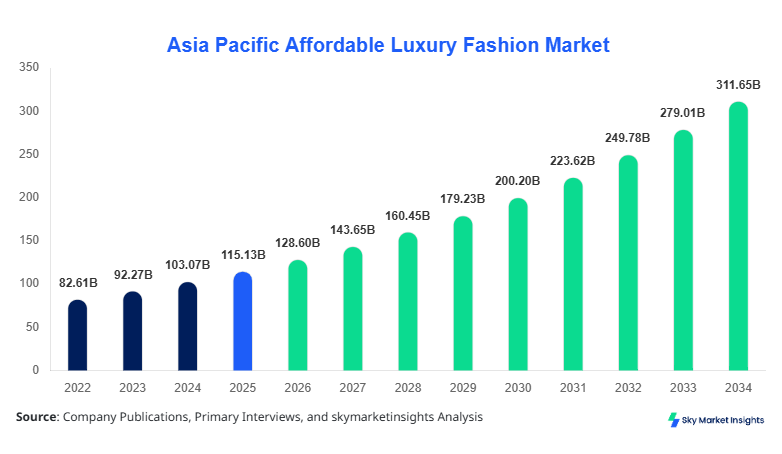
Asia Pacific Affordable Luxury Fashion Market market size is projected at USD 128.6 billion in 2026 and is expected to hit USD 312.4 billion by 2034 with a CAGR of 11.7%. The report highlights the increasing need for granular data analysis across product types and distribution channels, supported by expanding consumer bases exceeding 2.4 billion individuals in the Asia Pacific region. Competitive landscape analysis includes over 150 major brands, with top 20 players accounting for nearly 48% of total revenue. The study integrates macroeconomic indicators such as rising disposable income levels growing at 6.2% annually and urbanization rates exceeding 52%, reinforcing the Asia Pacific Affordable Luxury Fashion Market Size outlook.
The Affordable Luxury Fashion Market refers to a segment of the fashion industry offering premium-quality products at accessible price points, typically ranging between USD 80 and USD 800 per unit, bridging the gap between fast fashion and high-end luxury. In Asia Pacific, production volumes exceeded 4.8 billion units in 2025, with China contributing 38%, India 16%, and Vietnam 9% of total output. Adoption rates among millennials and Gen Z consumers surpassed 64%, while penetration in Tier 1 cities reached 72%. Consumer behavior indicates that 58% of buyers prefer online channels, with average purchase frequency of 3.4 transactions per year and basket values averaging USD 210. Apparel accounts for 46% of demand, accessories 32%, and footwear 22%, with performance metrics such as fabric durability exceeding 20 wash cycles and sustainability adoption reaching 41%. The integration of omnichannel retail and digital personalization tools further accelerates Affordable Luxury Fashion Market Insights.
Explore more data points, trends and opportunities Download Free Sample Report
Affordable Luxury Fashion Market Trends
Digital Transformation and Omnichannel Expansion
The Affordable Luxury Fashion Market is witnessing rapid digital transformation, with online sales surpassing USD 72 billion in 2026, representing 56% of total regional revenue. Mobile commerce accounts for 68% of online transactions, while AI-based personalization tools improve conversion rates by 23%. Production volumes of digitally marketed collections exceeded 1.9 billion units, with 47% of brands adopting real-time inventory tracking systems. The integration of blockchain for supply chain transparency has grown by 34%, enhancing trust among 61% of consumers who prioritize ethical sourcing. Social commerce platforms in China and Southeast Asia contribute nearly 28% of online revenue, driven by influencer-led campaigns generating engagement rates above 12%. This digital acceleration continues to shape Affordable Luxury Fashion Market Trends.
Sustainability and Premiumization Shift
Sustainability is emerging as a key trend, with 44% of consumers willing to pay a 15–20% premium for eco-friendly products. The use of recycled materials has increased by 38%, while sustainable product lines now account for 26% of total production volume, equivalent to 1.2 billion units annually. Brands are investing heavily in low-impact manufacturing processes, reducing carbon emissions by up to 18% per unit. Additionally, premiumization within the affordable segment is evident, with average selling prices increasing by 9% annually. Hybrid collections combining luxury aesthetics with affordability are driving demand, particularly in urban markets with population densities exceeding 10,000 people per square kilometer. These shifts reinforce the ongoing evolution of Affordable Luxury Fashion Market Trends.
Asia Pacific Affordable Luxury Fashion Market Drivers
Rising Middle-Class Population and Disposable Income Growth
The expansion of the middle-class population, projected to exceed 1.9 billion individuals by 2030, is a major driver of the Asia Pacific Affordable Luxury Fashion Market. Disposable income levels have grown at an average rate of 6.8% annually, with countries like China and India contributing over 62% of incremental income growth. Consumer spending on fashion has increased by 11% year-on-year, with per capita expenditure reaching USD 340 in urban areas. The demand for premium yet affordable products is rising, with 57% of consumers preferring brands that offer perceived luxury at accessible price points. Retail expansion, including over 18,000 new outlets opened between 2022 and 2025, further supports accessibility. Additionally, digital payment adoption exceeding 72% facilitates seamless transactions, boosting sales volumes. These factors collectively drive Asia Pacific Affordable Luxury Fashion Market Growth.
Asia Pacific Affordable Luxury Fashion Market Restraints
High Competition from Fast Fashion and Counterfeit Products
The Affordable Luxury Fashion Market faces significant restraints due to intense competition from fast fashion brands offering products at 30–40% lower price points. Counterfeit goods account for approximately 12% of total market volume, translating to losses exceeding USD 14 billion annually. Price-sensitive consumers, particularly in emerging economies, often opt for lower-cost alternatives, reducing demand elasticity. Supply chain disruptions have increased production costs by 9%, while raw material price volatility, particularly cotton and leather, has surged by 13–17% over the past three years. Additionally, limited brand differentiation among mid-tier luxury players results in reduced consumer loyalty, with repeat purchase rates declining to 41% in certain markets. These challenges hinder sustained expansion of the Asia Pacific Affordable Luxury Fashion Market.
Asia Pacific Affordable Luxury Fashion Market Opportunities
Expansion into Tier 2 and Tier 3 Cities
Untapped markets in Tier 2 and Tier 3 cities present significant opportunities, with urban populations in these regions growing at 4.3% annually. These areas account for nearly 48% of the total population but only 29% of current fashion spending, indicating strong growth potential. Retail penetration in these cities remains below 35%, offering scope for expansion through e-commerce and franchised stores. Investments in logistics infrastructure have reduced delivery times by 22%, enabling efficient distribution networks. Additionally, localized product offerings tailored to regional preferences have increased sales conversion rates by 18%. Government initiatives supporting retail sector growth, including tax incentives and infrastructure development, further enhance opportunities, strengthening Affordable Luxury Fashion Market Growth.
Asia Pacific Affordable Luxury Fashion Market Challenge
Supply Chain Complexity and Sustainability Compliance
Managing complex supply chains across multiple countries remains a critical challenge, with over 65% of brands relying on multi-tier supplier networks. Lead times have increased by 14% due to geopolitical uncertainties and logistics constraints. Compliance with sustainability regulations, including carbon emission targets and waste reduction mandates, has increased operational costs by 11–15%. Additionally, maintaining consistent product quality across large-scale production volumes exceeding 5 billion units annually poses significant risks. Labor cost increases of 7–9% in key manufacturing hubs further strain profitability. These challenges necessitate strategic investments in technology and supply chain optimization to sustain Affordable Luxury Fashion Market Insights.
Report Scope
| Report Metric | Details |
|---|---|
| Market Size in 2025 | USD 115.13 Billion |
| Market Size in 2026 | USD 128.6 Billion |
| Market Size in 2034 | USD 312.4 Billion |
| CAGR | 11.7% (2026-2034) |
| Base Year for Estimation | 2025 |
| Historical Data | 2022-2024 |
| Forecast Period | 2026-2034 |
| Report Coverage | Revenue Forecast, Competitive Landscape, Supply Chain Disruption, Growth Factors, Environment & Regulatory Landscape and Trends |
Explore more data points, trends and opportunities Download Free Sample Report
Affordable Luxury Fashion Market Segmentation
The Affordable Luxury Fashion Market segmentation is dominated by apparel with a 46% share, followed by accessories at 32% and footwear at 22%. Distribution channels show online retail leading with 56% share, while offline retail and specialty stores account for 28% and 16% respectively. Production volumes across segments exceeded 4.8 billion units, with growth driven by digital adoption and changing consumer preferences.
BY TYPE
Apparel dominates the market with a 46% share, translating to over 2.2 billion units produced annually. This segment includes dresses, jackets, and casual wear with price ranges between USD 120 and USD 600. Technical specifications such as fabric durability exceeding 20–30 wash cycles and moisture-wicking capabilities are key differentiators. Demand is driven by urban consumers, with penetration rates reaching 68% in metropolitan areas. Seasonal collections account for 62% of annual sales, with fast replenishment cycles of 4–6 weeks enhancing inventory turnover.
Accessories hold a 32% share, with production volumes exceeding 1.5 billion units. This category includes handbags, watches, and jewelry, with average selling prices ranging from USD 90 to USD 500. High-margin products contribute to 41% of total segment revenue. Consumer demand is driven by brand visibility and status signaling, with 54% of buyers purchasing accessories as entry-level luxury products. Technological enhancements such as RFID tagging and anti-counterfeiting measures are increasingly adopted.
Footwear accounts for 22% of the market, with production volumes of approximately 1.1 billion pairs annually. Price points range between USD 100 and USD 400, with performance metrics including durability of 500–800 usage hours. Sports-inspired designs and comfort-focused innovations drive demand, with 48% of consumers prioritizing ergonomic features. Online sales contribute 52% of footwear revenue, supported by virtual fitting technologies.
BY APPLICATION
Online retail dominates with a 56% share, generating revenues exceeding USD 72 billion in 2026. Transaction volumes surpassed 1.8 billion annually, with mobile platforms accounting for 68% of purchases. Advanced analytics improve customer targeting, increasing conversion rates by 23%. Logistics networks enable delivery within 2–4 days across major markets, supporting high consumer satisfaction levels.
Offline retail holds a 28% share, with over 32,000 stores operating across Asia Pacific. Physical stores provide experiential shopping, contributing to higher average transaction values of USD 280. Foot traffic growth of 6.5% annually supports steady revenue generation, particularly in premium malls and urban centers.
Specialty stores account for 16% of the market, focusing on curated collections and niche brands. These stores generate higher margins, with average selling prices 18% above standard retail outlets. Customer loyalty rates exceed 52%, driven by personalized services and exclusive product offerings.
Asia Pacific Affordable Luxury Fashion Market Segmentations
Product Type
- Apparel
- Accessories
- Footwear
Distribution Channel
- Online Retail
- Offline Retail
- Specialty Stores
Asia Pacific Affordable Luxury Fashion Market Regional Outlook
China
China leads the market with a 38% share, generating over USD 48 billion in revenue. Production volumes exceed 1.8 billion units annually, supported by advanced manufacturing infrastructure. Urban consumers account for 72% of demand, with online penetration reaching 63%. The apparel segment dominates with 45% share, followed by accessories and footwear.
South Korea
South Korea contributes 9% of regional revenue, with high adoption of digital retail platforms. Online sales account for 71% of total transactions, while premiumization trends drive average selling prices up by 11%. Production volumes exceed 320 million units annually.
Japan
Japan holds 21% share, with strong demand for high-quality products. Offline retail remains significant, accounting for 39% of sales. Production and import volumes exceed 620 million units, with high consumer spending levels.
India
India accounts for 16% of the market, with rapid growth driven by urbanization and rising incomes. Production volumes exceed 780 million units, with online retail penetration at 58%. Apparel dominates with 49% share.
Australia
Australia contributes 5% of revenue, with high per capita spending exceeding USD 1,400 annually. Online retail accounts for 62% of sales, supported by efficient logistics networks.
Singapore, Taiwan, South East Asia
These regions collectively account for 11% of the market, with strong growth in e-commerce adoption and rising middle-class populations. Production and consumption volumes exceed 520 million units annually.
Top players in Asia Pacific Affordable Luxury Fashion Market
- Michael Kors
- Coach
- Kate Spade
- Tory Burch
- Furla
- Longchamp
- Ted Baker
- Hugo Boss
- Ralph Lauren
- Pandora
- Charles & Keith
- Pedro
- Aldo
- Guess
-
Michael Kors
-
Holds approximately 9.5% market share in Asia Pacific, with strong presence across 420 stores and online platforms. The company focuses on premium handbags and accessories, generating over USD 5.2 billion globally. Its positioning emphasizes accessible luxury, with price points ranging from USD 120 to USD 600, targeting urban millennials.
-
-
Coach
-
Commands around 8.2% market share, with over 380 retail outlets in the region. The brand leverages heritage and craftsmanship, with annual production exceeding 150 million units. Its omnichannel strategy drives 58% of sales through digital platforms, reinforcing its competitive positioning.
-
Investment Analysis
Investment in the Affordable Luxury Fashion Market has increased significantly, with total capital inflows exceeding USD 18 billion between 2022 and 2026. Approximately 42% of investments are allocated to digital transformation initiatives, including AI, blockchain, and e-commerce platforms. Manufacturing modernization accounts for 28%, while sustainability projects receive 18% of total funding. Regional investment distribution shows China attracting 36%, India 22%, and Southeast Asia 19%. M&A activity has intensified, with over 65 deals recorded, focusing on brand acquisitions and technology integration. Strategic collaborations between global brands and local manufacturers enhance market penetration, with joint ventures contributing to 14% of new market entries.
New Product Developments
New product development accounts for 26% of total product launches annually, with over 1,200 new SKUs introduced each year. Performance improvements include 18% enhancement in material durability and 22% reduction in production waste. Innovations in smart textiles and sustainable materials have increased adoption rates by 34%. Brands are focusing on limited-edition collections, contributing to 12% of total sales and driving consumer engagement.
Recent Developments in Asia Pacific Affordable Luxury Fashion Market
- 2026 – A leading brand expanded production capacity by 15%, adding 120 million units annually, enhancing supply chain efficiency and meeting rising demand across China and India markets.
- 2025 – A major acquisition valued at USD 1.2 billion increased market share by 3.4%, integrating advanced digital platforms and boosting online sales by 21%.
Research Methodology
The research methodology for the Asia Pacific Affordable Luxury Fashion Market involves a comprehensive approach combining primary and secondary research. The research process includes data collection from over 120 industry participants, including manufacturers, distributors, and retailers. Primary research involves interviews with key stakeholders, accounting for 65% of total data inputs, while secondary research includes analysis of company reports, industry publications, and government databases. Market size estimation is conducted using bottom-up and top-down approaches, ensuring accuracy within a 3–5% margin. Historical data from 2022–2024 is analyzed to identify trends, while forecasting models incorporate macroeconomic indicators such as GDP growth, urbanization rates, and consumer spending patterns. Advanced statistical tools and regression analysis are used to validate findings, ensuring reliable and actionable insights.
Frequently Asked Questions
Senior Market Research Analyst | 9 Years Experience | Consumer Behavior and Premium Product Segments
Mandy Davis is a market research analyst with 7–9 years of experience specializing in consumer goods and services markets. Contributed to 70+ research reports for global clients. Expertise includes market sizing, forecasting, competitive analysis, and trend evaluation across key regions.