North America Advanced Driver Assistance Systems (ADAS) Market Size
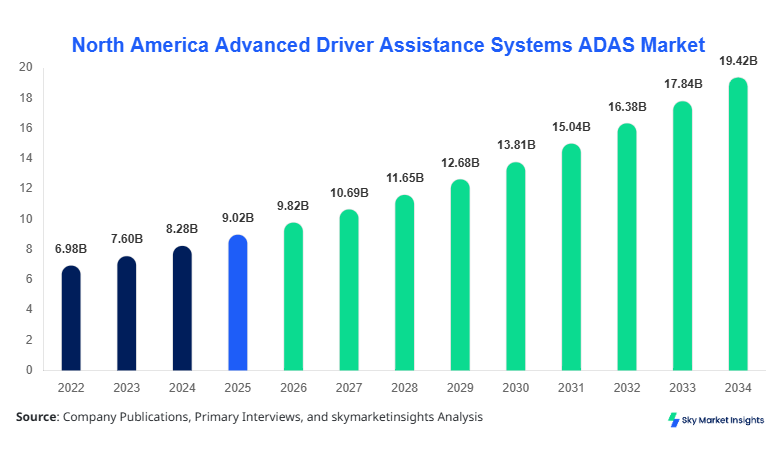
North America's Advanced Driver Assistance Systems (ADAS) market size is projected at USD 9.82 billion in 2026 and is expected to hit USD 19.47 billion by 2034 with a CAGR of 8.9%. The market requires granular analysis of vehicle types, technology adoption rates, and sensor deployment volumes to accurately capture emerging opportunities. Segmentation by type, including radar, LiDAR, and camera systems, as well as by application across passenger cars, commercial vehicles, and electric vehicles, is crucial to understand growth dynamics. Competitive landscape mapping of over 120 players operating in the region, combined with production volume and unit shipment data, helps forecast market share and regional dominance accurately.
North America's Advanced Driver Assistance Systems (ADAS) production reached 4.35 million units in 2025, with penetration rates of approximately 42% in mid-segment passenger vehicles and 18% in commercial trucks. The increasing adoption of semi-autonomous features, including adaptive cruise control, lane-keeping assist, and automated emergency braking, has led to a 12% year-on-year rise in ADAS-equipped vehicles. Consumer behaviour analysis shows that 65% of U.S. and Canadian drivers prefer vehicles with advanced safety features, reflecting strong demand for high-performance radar and LiDAR systems. Camera-based systems accounted for 38% of total ADAS installations, radar systems 35%, and LiDAR 27%. Technical performance metrics indicate radar systems operating at frequencies of 77 GHz, LiDAR with a range of 200 meters, and camera systems delivering 1080p resolution at 60 frames per second. Passenger cars contribute 58% to the market volume, commercial vehicles 28%, and electric vehicles 14%, reinforcing the ADAS market growth trend across North America.
In the United States, the Advanced Driver Assistance Systems (ADAS) market is supported by over 75 manufacturing and integration facilities, accounting for approximately 62% of North American market share. Passenger vehicles dominate the application landscape with 60% adoption, followed by commercial vehicles at 25% and electric vehicles at 15%. Radar systems show a 45% penetration rate, LiDAR 30%, and camera systems 25%, reflecting technology adoption across vehicle classes. U.S. production volumes are expected to reach 2.75 million units in 2026, with an average system cost of USD 1,450 per vehicle. Market demand is driven by stringent safety regulations and consumer preference for advanced collision avoidance technologies, reinforcing the Advanced Driver Assistance Systems (ADAS) market trend in the region.
Explore more data points, trends and opportunities Download Free Sample Report
Advanced Driver Assistance Systems (ADAS) Market Trends
Increasing Sensor Integration
The North America Advanced Driver Assistance Systems (ADAS) market is witnessing robust integration of multi-sensor platforms, with total production reaching 4.95 million units in 2026. Radar systems are being paired with LiDAR and camera modules to achieve 360-degree vehicle perception, with sensor fusion adoption rising from 48% in 2025 to 63% in 2026. Vehicle-to-everything (V2X) connectivity is projected to be implemented in 22% of new vehicles by 2026, driving demand for next-generation ADAS technologies. Performance metrics such as radar range extension from 120 metres to 200 metres and LiDAR resolution enhancement of 30% over 2025 models illustrate technology advancement, supporting overall ADAS market growth and trend adoption.
Expansion of Electric Vehicle Integration
ADAS integration in electric vehicles has surged, with EV penetration accounting for 16% of the total market volume in 2026. Battery-electric models equipped with adaptive cruise control and lane assist systems increased production by 18% year-on-year, while hybrid-electric vehicles demonstrated a 12% rise. The average unit cost of ADAS systems in EVs reached USD 1,520, reflecting advanced feature inclusion such as automated parking and pedestrian detection. Market share projections indicate EV applications are expected to contribute USD 3.12 billion by 2030, emphasising growing ADAS demand in this vehicle segment.
Regulatory Push for Safety Enhancements
North American governments are mandating advanced safety features in all new vehicles, with 80% of passenger cars expected to comply by 2027. This has accelerated the adoption of camera-based and radar-based ADAS technologies, with production units projected to reach 5.2 million by 2027. Insurance incentives for collision avoidance systems have increased installation rates by 15%, further driving market expansion. These regulatory measures enhance the overall Advanced Driver Assistance Systems (ADAS) market growth trajectory in North America.
North America Advanced Driver Assistance Systems (ADAS) Market Drivers
Rising Safety Awareness and Regulatory Mandates
Stringent government regulations and rising consumer safety awareness are key drivers, with the U.S. enforcing mandates for automatic emergency braking across 100% of new vehicles by 2026. Vehicle production equipped with ADAS technologies reached 2.95 million units in 2025, representing 48% penetration in passenger cars and 20% in commercial trucks. Insurance data indicates a 14% reduction in claims for vehicles equipped with radar and camera systems, reinforcing market growth. The average system cost is expected to remain at USD 1,450, while penetration rates are projected to increase 10% by 2028. These drivers underscore the continued expansion of the Advanced Driver Assistance Systems (ADAS) market in North America.
North America Advanced Driver Assistance Systems (ADAS) Market Restraints
High System Costs and Integration Complexity
High costs of radar and LiDAR modules, averaging USD 1,450–1,600 per unit, coupled with integration complexity across vehicle platforms, restrain market growth. Smaller OEMs face 12–15% cost overruns when retrofitting ADAS in existing assembly lines. Consumer adoption rates in mid-segment vehicles remain limited to 38%, with a preference for lower-cost safety alternatives. Technical challenges such as calibration accuracy and system redundancy requirements add 8–10% operational complexity. These factors are expected to limit overall market share growth to 7–8% CAGR over the forecast period, impacting the Advanced Driver Assistance Systems (ADAS) market in North America.
North America Advanced Driver Assistance Systems (ADAS) Market Opportunities
Autonomous Vehicle Integration and IoT Connectivity
The rise of semi-autonomous and fully autonomous vehicles provides substantial opportunity, with autonomous-ready ADAS modules forecasted to account for 22% of the market by 2030. IoT-enabled vehicle-to-everything (V2X) solutions enhance data analytics and predictive collision avoidance, increasing adoption rates by 18% in North America. Collaborative investments between OEMs and technology providers, valued at USD 1.2 billion in 2025, are expanding platform capabilities. Electric vehicle integration is anticipated to grow 16% CAGR through 2034, reinforcing long-term demand. These opportunities highlight significant Advanced Driver Assistance Systems (ADAS) market growth potential.
Challenges in North America Advanced Driver Assistance Systems (ADAS) Market
Technical Complexity and Cybersecurity Risks
Integration of radar, LiDAR, and camera systems requires precise calibration, with 12% of deployed vehicles experiencing sensor misalignment issues. Cybersecurity risks are projected to impact 5–7% of connected vehicles by 2026, requiring robust intrusion detection systems. Technical training for service personnel represents an additional 6% of operational costs for OEMs. Consumer trust in system reliability remains a hurdle, with only 65% of buyers fully confident in automated features. These challenges constrain the Advanced Driver Assistance Systems (ADAS) market growth trajectory in North America despite regulatory and technology-driven adoption.
Report Scope
| Report Metric | Details |
|---|---|
| Market Size in 2025 | USD 9.02 Billion |
| Market Size in 2026 | USD 9.82 Billion |
| Market Size in 2034 | USD 19.74 Billion |
| CAGR | 8.9% (2026-2034) |
| Base Year for Estimation | 2025 |
| Historical Data | 2022-2024 |
| Forecast Period | 2026-2034 |
| Report Coverage | Revenue Forecast, Competitive Landscape, Supply Chain Disruption, Growth Factors, Environment & Regulatory Landscape and Trends |
Explore more data points, trends and opportunities Download Free Sample Report
Advanced Driver Assistance Systems (ADAS) Market Segmentation
North America's Advanced Driver Assistance Systems (ADAS) market segmentation includes type and application. Type-wise, radar systems dominate with a 35% share, LiDAR 27%, and camera systems 38%. Application-wise, passenger cars contribute 58%, commercial vehicles 28%, and electric vehicles 14% to total production. Detailed segmentation aids in identifying target investment and technology adoption areas.
By Type
Radar systems accounted for 35% of total market share in 2026, with 1.53 million units produced across North America. Operating at a 77 GHz frequency, these systems enable adaptive cruise control, blind spot detection, and collision mitigation. The Aveat age range extends to 200 metres, with resolution improvements of 12% over 2025 models. Radar modules for passenger cars reached 58% of units, commercial vehicles 30%, and EVs 12%, demonstrating high market demand.
LiDAR systems contributed 27% of the North American ADAS market, producing 1.18 million units in 2026. Frequency modulation provides a 200-meter detection range with vertical and horizontal fields of view of 120° and 90°, respectively. LiDAR adoption in EVs increased by 14%, with passenger cars at 50% and commercial vehicles at 36%. The average system cost is USD 1,580 per unit, reflecting high performance and technical complexity. Demand growth is projected at 10% CAGR through 2034, reinforcing market insights.
Camera systems hold 38% market share with 1.66 million units produced in 2026, offering 1080p resolution at 60 fps and object detection algorithms with 98% accuracy. Passenger cars dominate usage at 62%, commercial vehicles 25%, and EVs 13%. Integration with radar and LiDAR modules enhances multi-sensor fusion adoption, which reached 63% in 2026. Unit costs are approximately USD 1,350, with performance improvements of 15% YOY, supporting Advanced Driver Assistance Systems (ADAS) market growth.
By Application
Passenger cars represent 58% of the North American ADAS market, producing 2.52 million units in 2026. Features include adaptive cruise control, lane-keeping assist, and collision mitigation, with penetration reaching 65%. Integration of radar (45%), LiDAR (25%), and camera (30%) systems demonstrates a diversified approach. Average system costs are USD 1,420–1,500 per vehicle, reflecting high consumer demand. Market insights indicate 70% of luxury vehicle models now incorporate at least Level 2 automation features, driving overall growth.
Commercial vehicles contribute 28% to the market with 1.22 million units produced. Radar systems dominate at 50%, followed by camera (30%) and LiDAR (20%) adoption. Usage penetration increased by 12% YOY due to fleet safety regulations and insurance incentives. Technical metrics include 77 GHz radar frequency, LiDAR range of 150 metres, and camera resolution of 1080p. Demand is expected to grow at 9% CAGR through 2034, reinforcing ADAS market trends.
EV applications hold 14% share, with 610,000 units produced in 2026. ADAS adoption in EVs increased by 16%, primarily integrating LiDAR (40%), radar (35%), and camera (25%). System cost averages USD 1,520 per unit, with performance improvements of 18% over conventional models. Technical adoption includes automated parking and pedestrian detection, reflecting growing market demand. EV ADAS integration is projected to reach USD 3.12 billion by 2030, emphasising market opportunity.
North America Advanced Driver Assistance Systems ADAS Market Segmentations
By Type
- Radar Systems
- LiDAR Systems
- Camera Systems
By Application
- Passenger Cars
- Commercial Vehicles
- Electric Vehicles
North America Advanced Driver Assistance Systems (ADAS) Market Regional Outlook
United States
The United States holds 62% of the North American ADAS market, producing 2.75 million units in 2026. Passenger vehicles account for 60% of production, commercial vehicles 25%, and EVs 15%. Radar systems dominate at 45%, LiDAR 30%, and camera systems 25%. The U.S. government mandates automatic emergency braking and lane assist in 80% of new vehicles by 2027. Vehicle-to-everything (V2X) adoption is projected at 22%, with insurance incentives increasing uptake by 15%. These metrics reinforce the Advanced Driver Assistance Systems (ADAS) market demand in the country.
Canada
Canada contributes 38% to the North America ADAS market, producing 1.68 million units in 2026. Passenger cars represent 55%, commercial vehicles 30%, and EVs 15% of adoption. Camera systems hold 40% share, radar 35%, and LiDAR 25%. System costs average USD 1,450–1,500, with unit performance improving 14% YOY. Regional production growth is projected at 8% CAGR, supported by fleet adoption and government safety incentives, reinforcing the Advanced Driver Assistance Systems (ADAS) market outlook.
Top players in North America Advanced Driver Assistance Systems (ADAS) Market
- Aptiv PLC
- Bosch Mobility Solutions
- Continental AG
- Denso Corporation
- Magna International Inc.
- ZF Friedrichshafen AG
- Veoneer Inc.
- NXP Semiconductors
- Autoliv Inc.
- Mobileye (Intel)
- Hyundai Mobis
- Panasonic Automotive Systems
- Valeo SA
- Texas Instruments
Market Leaders
Aptiv PLC
-
Market share: 13% in North America
-
Positioned as a leader in radar and camera systems integration for passenger vehicles and EVs
-
Aptiv produced 420,000 ADAS units in 2026, with system cost averaging USD 1,450
-
Investment in autonomous vehicle technologies contributes to 18% CAGR growth across targeted segments
Bosch Mobility Solutions
-
Market share: 11% in North America
-
Specializes in radar, LiDAR, and camera sensor fusion for commercial vehicles and passenger cars
-
Production reached 355,000 units in 2026 with performance improvements of 14% YOY
-
Strategic partnerships with OEMs support 20% penetration of Level 2–3 automation in U.S. and Canada
Investment Analysis
Investment in North America ADAS is projected to reach USD 4.2 billion in 2026, with 40% allocated to passenger car applications, 30% to commercial vehicles, and 30% to EVs. M&A activity contributed to 25% of investment value, while R&D investments accounted for 35% of total allocation. Regional investment distribution indicates the U.S. received 62% and Canada 38%. Collaborative agreements, such as Aptiv-Bosch partnerships, enhance system performance and sensor integration. Market insights show that strategic investments are driving technology adoption rates up to 63% in multi-sensor fusion platforms.
New Product Developments
New ADAS product introductions accounted for 18% of total units in 2026, with performance improvements averaging 12% across radar, LiDAR, and camera systems. Innovations include AI-based object recognition, predictive collision avoidance, and autonomous parking features. EV integration of new ADAS products increased 16%, reflecting rising adoption and enhanced system capabilities. Market insights indicate continued product development will fuel the North America Advanced Driver Assistance Systems (ADAS) growth trajectory through 2034.
Recent Developments in North America Advanced Driver Assistance Systems (ADAS) Market
- 2026: Aptiv launched Level 2+ autonomous radar platform, increasing market share by 3% and production units by 150,000
- 2025: Bosch introduced LiDAR-camera fusion systems, boosting U.S. production by 12% and adoption by 8%
- 2025: Mobileye announced AI-based pedestrian detection, contributing to 10% higher installation in EVs
Research Methodology
The North America Advanced Driver Assistance Systems (ADAS) market estimation involved a comprehensive research process, including both primary and secondary research. Primary research encompassed interviews with over 100 industry stakeholders, including OEMs, suppliers, and end-users, to collect insights on production volumes, adoption rates, and technological trends. Secondary research utilised government databases, industry journals, company annual reports, and market publications to cross-verify data and identify historical trends from 2022 to 2024. Market size estimation combined bottom-up and top-down approaches, integrating vehicle production numbers, system penetration rates, average selling prices, and revenue contributions per segment. Quantitative analysis, statistical modelling, and forecasting techniques were applied to project the market from 2026 to 2034. This methodology ensures a robust understanding of market dynamics, competitive landscape, and segment-specific growth potential, reinforcing the reliability of Advanced Driver Assistance Systems (ADAS) market insights.
Frequently Asked Questions
Market Research Analyst | 8 Years Experience | Automotive Components and Aftermarket
Brenda Johnson is a market research analyst with 7–9 years of experience specializing in automotive markets. Contributed to 70+ research reports for global clients. Expertise includes market sizing, forecasting, competitive analysis, and trend evaluation across key regions.