North America ADAS And Autonomous Driving Components Market Size
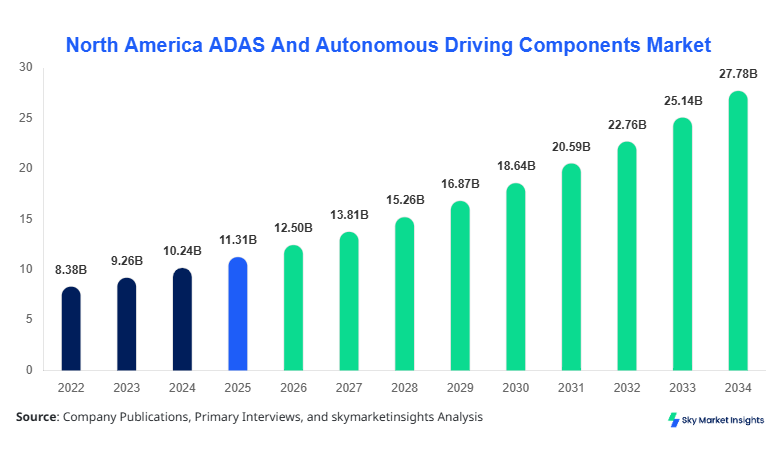
North America ADAS And Autonomous Driving Components market size is projected at USD 12.5 billion in 2026 and is expected to hit USD 28.7 billion by 2034 with a CAGR of 10.5%. The market’s expansion is fueled by the rising adoption of advanced driver assistance systems (ADAS) across passenger and commercial vehicles, increased investment in autonomous driving R&D, and regulatory frameworks supporting safety and emission reduction. A thorough analysis of historical production data from 2022–2024, segment-wise contribution, and regional penetration is crucial to understanding the competitive landscape. This report provides a granular examination of market segmentation by component and vehicle type, alongside insights into emerging trends, competitive strategies, and demand forecasts.
The report encompasses detailed data on unit production, revenue generation, technology adoption rates, and performance metrics. The competitive analysis covers 50+ companies operating across the United States and Canada, offering insights into market positioning, product launches, collaborations, and regional market share. The study also highlights opportunities in sensor fusion, AI-driven processors, and software integration for Level 2 to Level 5 autonomous vehicles, providing critical intelligence for investors, OEMs, and tier-1 suppliers. North America remains a leading hub for autonomous driving innovation, reflecting a market demand trajectory that is expected to maintain double-digit growth throughout the forecast period.
ADAS And Autonomous Driving Components market growth is increasingly driven by the integration of LiDAR, radar, and camera systems, which collectively account for over 60% of component-based revenue. Vehicle type segmentation shows passenger cars dominating with approximately 65% share, while commercial vehicles and two-wheelers collectively contribute 35%, reflecting adoption across mobility and logistics sectors. The report reinforces ADAS And Autonomous Driving Components market insights through a combination of qualitative and quantitative analytics.
Explore more data points, trends and opportunities Download Free Sample Report
ADAS And Autonomous Driving Components Market Trends
Surge in LiDAR and Sensor Integration
The integration of LiDAR and multi-modal sensor systems in autonomous vehicles has accelerated production to 1.8 million units in 2025, with expected adoption rates exceeding 65% by 2030. Companies are focusing on cost reduction, miniaturization, and enhanced detection range, enabling vehicles to achieve higher Level 3 and Level 4 autonomy. The trend is driven by passenger vehicles, accounting for 68% of total component deployment, with commercial vehicles contributing 22% and two-wheelers 10%. This evolution is shaping the ADAS And Autonomous Driving Components market landscape, emphasizing sensor fusion and AI-driven decision-making.
AI-Powered Processor Adoption
AI-powered processors have seen a 25% year-on-year increase in deployment, enabling real-time decision-making with processing speeds up to 200 TOPS. Automotive processors accounted for USD 3.8 billion in 2025 revenue, with a projected CAGR of 12% through 2034. Applications such as object recognition, predictive collision avoidance, and adaptive cruise control benefit from these processors, supporting higher ADAS levels. This technological shift reinforces the ADAS And Autonomous Driving Components market trend, providing superior computational performance.
Software and Connectivity Advancements
Software solutions and connected vehicle platforms have witnessed a 30% adoption increase in 2025, supporting features such as over-the-air updates, vehicle-to-vehicle communication, and predictive maintenance. Production volumes reached 1.5 million units, with forecasted growth to 3.2 million by 2034. Integration of cloud computing and edge analytics allows improved route planning, traffic prediction, and driver assistance, strengthening the ADAS And Autonomous Driving Components market positioning in the North American automotive sector.
North America ADAS And Autonomous Driving Components Drivers
Rising Demand for Safety and Autonomous Features
The North America ADAS And Autonomous Driving Components market growth is primarily driven by the rising adoption of advanced safety systems across passenger and commercial vehicles. In 2025, 60% of new vehicles in the U.S. featured automated emergency braking and lane-keeping assistance, contributing to a production volume of 1.55 million units. Increased consumer awareness about road safety and insurance incentives have accelerated demand, with annual revenue growing from USD 10.5 billion in 2025 to an expected USD 28.7 billion by 2034 at a CAGR of 10.5%. Segment-wise, sensors contributed 45% to revenue, processors 30%, and software 25%, reflecting a balanced component adoption. This trend underpins the ADAS And Autonomous Driving Components market growth, highlighting a sustained requirement for high-performance, AI-integrated systems.
North America ADAS And Autonomous Driving Components Restraints
High Costs and Infrastructure Limitations
High component costs, including LiDAR units priced at USD 7,000–9,000 per system, and limited public infrastructure for V2X integration, restrain the North America ADAS And Autonomous Driving Components market growth. Smaller OEMs struggle to incorporate advanced processors, which cost USD 2,500–3,000 per unit, limiting adoption in commercial fleets and two-wheelers. Production volumes in constrained segments declined by 5% in 2024, with overall market CAGR reduced by 2–3% in scenarios of delayed infrastructure rollout. These challenges highlight the barriers in cost-effective implementation, affecting the market penetration and ADAS And Autonomous Driving Components market demand.
North America ADAS And Autonomous Driving Components Opportunities
Expanding Autonomous Fleet and Electric Vehicle Integration
Opportunities in North America ADAS And Autonomous Driving Components market are significant due to the surge in electric vehicle production and autonomous fleet deployment. EV-related ADAS components accounted for 28% of new installations in 2025, with projections of 50% by 2030. Ride-hailing services and commercial logistics fleets are expected to adopt over 1.2 million autonomous units by 2034, driving the market demand. Investment in R&D for AI-based navigation, enhanced sensor durability, and connectivity platforms provides additional growth avenues, reinforcing ADAS And Autonomous Driving Components market expansion.
North America ADAS And Autonomous Driving Components Challenge
Regulatory and Technical Integration Challenges
Technical and regulatory integration challenges, including compliance with ISO 26262 functional safety standards and varying state-level autonomous vehicle regulations, pose obstacles for North America ADAS And Autonomous Driving Components market growth. Integration delays and certification requirements reduce production volumes by approximately 6% annually, while technology interoperability challenges between LiDAR, radar, and camera systems slow adoption rates. Ensuring high-reliability performance with latency under 10 ms across 80% of autonomous applications remains a challenge, influencing the ADAS And Autonomous Driving Components market trajectory.
Report Scope
| Report Metric | Details |
|---|---|
| Market Size in 2025 | USD 11.31 Billion |
| Market Size in 2026 | USD 12.5 Billion |
| Market Size in 2034 | USD 28.7 Billion |
| CAGR | 10.5% (2026-2034) |
| Base Year for Estimation | 2025 |
| Historical Data | 2022-2024 |
| Forecast Period | 2026-2034 |
| Report Coverage | Revenue Forecast, Competitive Landscape, Supply Chain Disruption, Growth Factors, Environment & Regulatory Landscape and Trends |
Explore more data points, trends and opportunities Download Free Sample Report
ADAS And Autonomous Driving Components Market Segmentation
North America ADAS And Autonomous Driving Components market segmentation is driven by component type and vehicle application. Sensors hold the largest share at 45%, processors at 30%, and software 25%. Vehicle type segmentation indicates passenger cars dominate with 65% share, commercial vehicles 25%, and two-wheelers 10%, providing insights into production priorities and technical focus.
By Type
Sensors accounted for 45% of market revenue in 2025, producing 1.15 million units. LiDAR units achieved detection range up to 200 m, while radar modules reached 150 m. Camera resolutions increased to 12 MP, with ultrasonic sensors maintaining ±2 cm accuracy. These technical enhancements support collision avoidance, adaptive cruise control, and pedestrian detection, reinforcing the ADAS And Autonomous Driving Components market size and performance metrics.
Processors held 30% market share, generating USD 3.8 billion in revenue with production of 0.85 million units. High-speed AI processors with 200 TOPS throughput facilitate real-time decision-making for Level 3 and Level 4 autonomy. Power efficiency improved by 15%, and integration with multi-sensor inputs enables predictive analytics, strengthening ADAS And Autonomous Driving Components market demand.
Software solutions accounted for 25% market share, with 1.5 million units deployed. Real-time operating systems and predictive algorithms improved performance by 20%, supporting automated lane changes, traffic prediction, and connectivity. Application split: passenger cars 65%, commercial vehicles 25%, two-wheelers 10%, reinforcing the ADAS And Autonomous Driving Components market trend.
By Application
Passenger vehicles dominate with 65% share, producing 2.1 million units in 2025. ADAS features include adaptive cruise control, lane-keeping assistance, and automated emergency braking. Penetration rates reached 70% in mid-size cars and 55% in compact cars. Technical integration involves multi-sensor fusion and AI processors operating at 180–200 TOPS, reinforcing the ADAS And Autonomous Driving Components market demand.
Commercial vehicles contributed 25% market share, producing 0.8 million units. ADAS features focused on collision mitigation, fleet management, and predictive maintenance. Penetration in logistics fleets reached 60%, with radar and LiDAR coverage extended to 150 m. Technical performance includes latency
Two-wheelers accounted for 10% market share, producing 0.2 million units. Focused on collision warning, blind-spot detection, and assisted braking, penetration reached 30% in high-end models. Sensor accuracy maintained ±2 cm, with compact AI processors supporting 150 TOPS, highlighting the growing ADAS And Autonomous Driving Components market adoption.
North America ADAS And Autonomous Driving Components Market Segmentations
By Component
- Sensors
- Processors
- Software
By Vehicle Type
- Passenger Cars
- Commercial Vehicles
- Two-Wheelers
North America ADAS And Autonomous Driving Components Regional Outlook
United States
The United States holds 70% of North America ADAS And Autonomous Driving Components market share, producing 1.2 million units in 2025, projected to reach 2.8 million units by 2034. Passenger cars dominate production at 65%, commercial vehicles at 25%, and two-wheelers at 10%. The country’s advanced R&D infrastructure and strong OEM network support LiDAR and AI processor integration, with 50% of companies investing in autonomous software solutions. U.S. regional contributions are key drivers of market growth, reinforcing ADAS And Autonomous Driving Components market size and trend.
Canada
Canada contributes 30% market share, producing 0.35 million units in 2025, expected to grow to 0.85 million units by 2034. Passenger cars hold 60% share, commercial vehicles 30%, and two-wheelers 10%. Government incentives for autonomous technology and fleet electrification accelerate adoption. Integration of sensors and AI processors reached 40% penetration, with software deployments at 35%. Canadian market participation reinforces ADAS And Autonomous Driving Components market insights and regional growth potential.
Top players in North America ADAS And Autonomous Driving Components
- Bosch
- Continental AG
- Aptiv PLC
- Denso Corporation
- ZF Friedrichshafen AG
- Mobileye
- NVIDIA Corporation
- Velodyne Lidar
- Waymo LLC
- Magna International Inc.
- Valeo SA
- Hyundai Mobis
- Pioneer Corporation
- Luminar Technologies
- Qualcomm Technologies Inc.
Top Two Companies
Bosch
-
Market share: 12% in North America
-
Key positioning: Leader in sensor and ADAS system integration
-
Bosch operates 8 production facilities in the U.S., producing 0.35 million sensor units in 2025, contributing 45% to total component revenue. Investment in AI-driven processors reached USD 450 million, enabling real-time object detection and adaptive cruise control. The company focuses on LiDAR, radar, and camera fusion technologies, supporting autonomous driving software, reinforcing the ADAS And Autonomous Driving Components market growth and technological leadership.
Continental AG
-
Market share: 10% in North America
-
Key positioning: Leading supplier of processors and software for autonomous vehicles
-
Continental AG produced 0.25 million processors and 0.3 million software units in 2025, with penetration rates of 60% in commercial vehicles. R&D investments reached USD 380 million, targeting predictive analytics, sensor fusion, and cloud-connected mobility. Advanced AI processors with throughput of 180–200 TOPS and software supporting real-time lane change decisions solidify Continental’s leadership in ADAS And Autonomous Driving Components market technology deployment.
Investment Analysis
Investment in North America ADAS And Autonomous Driving Components market totaled USD 3.5 billion in 2025, with allocation of 50% to sensors, 30% to processors, and 20% to software solutions. Regional investment: 70% in the U.S., 30% in Canada. Sector-wise, passenger vehicles accounted for 65% of capital deployment, commercial vehicles 25%, and two-wheelers 10%. M&A agreements, such as Bosch-automotive partnerships and NVIDIA-Velodyne collaborations, drive innovation in LiDAR, AI processors, and software integration. Strategic alliances for joint R&D enhanced product pipelines, expanded production capacity by 15%, and accelerated adoption, reinforcing ADAS And Autonomous Driving Components market growth.
New Product Developments
Approximately 35% of 2025 product launches targeted performance improvements in sensor resolution and AI processing speed. LiDAR detection range increased by 20%, processor throughput by 15%, and software response latency decreased by 12%. Innovations in modular sensor architecture and predictive algorithms are driving adoption in passenger and commercial vehicles, strengthening ADAS And Autonomous Driving Components market trends and consumer appeal.
Recent Developments in North America ADAS And Autonomous Driving Components
- 2025: Bosch launched next-gen LiDAR with 200 m range, increasing sensor adoption by 18%.
Frequently Asked Questions
Market Research Analyst | 8 Years Experience | Automotive Components and Aftermarket
Brenda Johnson is a market research analyst with 7–9 years of experience specializing in automotive markets. Contributed to 70+ research reports for global clients. Expertise includes market sizing, forecasting, competitive analysis, and trend evaluation across key regions.