North America AC And DC Backup Stationary Battery Market Size
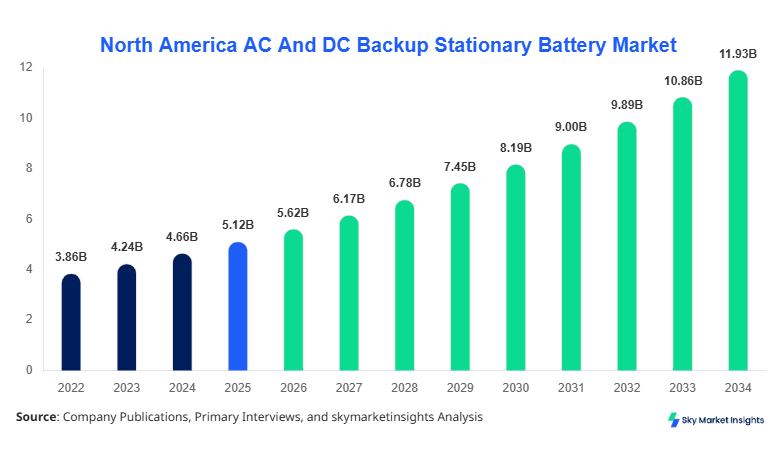
The North America AC and DC backup stationary battery market size is projected at USD 5.62 billion in 2026 and is expected to hit USD 11.94 billion by 2034 with a CAGR of 9.87%. The market expansion reflects increasing grid reliability requirements, rising renewable integration, and demand for uninterrupted power supply systems across telecom and data center infrastructure. The report provides detailed segmentation across battery chemistries and applications, along with competitive benchmarking of over 40+ companies and capacity-based analysis exceeding 18 GWh installations annually.
The AC and DC backup stationary battery market represents a critical infrastructure segment focused on providing reliable backup energy for mission-critical operations. In North America, production exceeded 14.6 GWh in 2025, with lithium-ion contributing nearly 58% of total installed capacity, while lead-acid systems accounted for approximately 34%. Adoption and penetration insights indicate that over 72% of telecom towers in the United States are equipped with stationary backup batteries, while data centers report penetration levels above 89% for hybrid AC/DC backup systems. Consumer behavior reflects a shift toward longer lifecycle batteries, with average replacement cycles extending from 4.5 years to 7.2 years, driven by efficiency improvements exceeding 25%.
Demand analytics reveal that the utilities sector contributes nearly 38% of total consumption, followed by telecommunications at 32% and data centers at 30%. Performance metrics include energy density ranges from 30 Wh/kg (lead-acid) to over 250 Wh/kg (lithium-ion), with operational efficiency exceeding 92% in advanced systems. Frequency response times below 10 milliseconds and discharge durations ranging from 15 minutes to 8 hours support diverse applications. Application split shows telecom (32%), utilities (38%), and data centers (30%), reinforcing the AC and DC backup stationary battery market ecosystem across North America.
In the United States, the AC and DC backup stationary battery market accounts for nearly 78% of regional revenue, supported by more than 120 battery manufacturing and assembly facilities and over 3,500 deployment projects annually. The country operates approximately 450,000 telecom towers, of which over 70% utilize stationary backup batteries, while more than 2,800 hyperscale data centers contribute to rising demand. Application breakdown indicates utilities at 40%, telecom at 30%, and data centers at 30%, reflecting diversified usage.
Technology adoption in the United States shows lithium-ion systems dominating with 62% penetration, followed by lead-acid at 28% and nickel-based solutions at 10%. Advanced battery management systems (BMS) are integrated in over 85% of installations, improving efficiency by 18% and reducing downtime by 22%. Government investments exceeding USD 1.4 billion in grid resilience projects further drive installations. These developments reinforce the AC and DC backup stationary battery market's positioning as a strategic energy infrastructure component.
Explore more data points, trends and opportunities Download Free Sample Report
AC And DC Backup Stationary Battery Market Trends
Increasing Adoption of Lithium-Ion and Hybrid Systems
The transition toward lithium-ion batteries has accelerated significantly, with production volumes surpassing 8.4 GWh in 2025 and projected to reach 15.2 GWh by 2030. Adoption rates have increased from 45% in 2022 to over 60% in 2026, driven by superior energy density, longer lifecycle, and reduced maintenance costs. Hybrid systems combining AC and DC configurations are gaining traction, particularly in data centers where uptime requirements exceed 99.999%. Demand from hyperscale data centers alone contributes over 3.2 GWh annually, with growth rates exceeding 12%.
Telecom infrastructure upgrades, including 5G rollout across over 80% of urban areas, further fuel battery deployment, with average system capacities increasing from 5 kWh to 12 kWh per site. Utilities are also integrating stationary batteries into microgrid systems, with installations exceeding 1.8 GW capacity across North America. These technological shifts highlight evolving infrastructure requirements and reinforce AC and DC backup stationary battery market dynamics.
Integration with Renewable Energy and Smart Grids
Renewable integration has emerged as a major trend, with over 27% of stationary battery deployments now linked to solar or wind systems. Grid-scale backup battery installations exceeded 4.6 GW in 2025, with projections reaching 9.8 GW by 2034. Smart grid adoption rates have crossed 65% in North America, enabling real-time monitoring and optimization of battery performance. Advanced analytics platforms improve operational efficiency by up to 20% and reduce energy losses by 15%.
Utilities are increasingly deploying AC-coupled battery systems for grid stabilization, while DC-coupled systems dominate in renewable energy storage applications. Battery cycle life improvements exceeding 30% and cost reductions of nearly 18% per kWh further enhance adoption. These developments significantly shape the AC and DC backup stationary battery market landscape.
North America AC And DC Backup Stationary Battery Market Drivers
Rising Demand for Uninterrupted Power Supply Across Critical Infrastructure
The increasing reliance on digital infrastructure, including over 3,000 data centers and 450,000 telecom towers, is a key driver for the AC and DC backup stationary battery market. Power outages cost businesses in North America over USD 150 billion annually, prompting investments in backup systems. Approximately 92% of data centers now deploy multi-layer backup solutions, including stationary batteries with capacities exceeding 2 MW per facility. Telecom sector demand has grown by 11% annually, driven by 5G expansion and network densification.
Utilities are also adopting stationary batteries to enhance grid resilience, with over 38% of installations supporting peak load management and frequency regulation. Government incentives covering up to 30% of project costs further accelerate adoption. Battery performance improvements, including 25% higher energy density and 20% longer lifecycle, enhance value propositions. These factors collectively strengthen the AC and DC backup stationary battery market.
North America AC And DC Backup Stationary Battery Market Restraints
High Initial Investment and Maintenance Costs
Despite strong demand, high upfront costs remain a major restraint in the AC and DC backup stationary battery market. Lithium-ion systems cost between USD 350–600 per kWh, while large-scale installations can exceed USD 5 million per project. Maintenance costs account for nearly 12–18% of total lifecycle expenses, particularly for lead-acid systems requiring frequent replacements every 4–5 years.
Small and medium enterprises face adoption challenges due to budget constraints, with penetration rates below 40% in this segment. Supply chain disruptions have also led to price fluctuations of 8–12% annually, impacting project feasibility. Additionally, recycling and disposal costs for batteries add further financial burden, with compliance costs increasing by 10–15% in recent years. These challenges limit broader adoption in the AC and DC backup stationary battery market.
North America AC And DC Backup Stationary Battery Market Opportunities
Expansion of Renewable Energy Integration and Microgrid Development
The expansion of renewable energy projects presents significant opportunities for the AC and DC backup stationary battery market. North America added over 45 GW of renewable capacity in 2025, with nearly 28% of projects incorporating battery storage systems. Microgrid deployments have increased by 14% annually, with over 600 operational microgrids in the United States alone.
Battery storage capacity linked to renewable systems is projected to exceed 12 GW by 2030, driven by government incentives and corporate sustainability goals. Commercial and industrial sectors are investing heavily, with over USD 3.2 billion allocated annually for energy storage projects. Technological advancements, including solid-state batteries and AI-based energy management systems, further enhance efficiency by up to 35%. These trends create substantial opportunities in the AC and DC backup stationary battery market.
Challenges in North America's AC And DC Backup Stationary Battery Market
Supply Chain Constraints and Raw Material Dependency
Supply chain challenges significantly impact the AC and DC backup stationary battery market, particularly due to dependency on critical raw materials such as lithium, cobalt, and nickel. Lithium prices increased by over 22% between 2022 and 2025, affecting battery production costs. Approximately 65% of raw materials are imported, creating vulnerability to geopolitical disruptions.
Manufacturing delays averaging 6–8 months have been reported for large-scale projects, impacting deployment timelines. Recycling infrastructure remains underdeveloped, with only 18% of batteries being recycled effectively. Environmental regulations further complicate operations, increasing compliance costs by 12%. These challenges hinder scalability and affect the AC and DC backup stationary battery market expansion.
Report Scope
| Report Metric | Details |
|---|---|
| Market Size in 2025 | USD 5.12 Billion |
| Market Size in 2026 | USD 5.62 Billion |
| Market Size in 2034 | USD 11.94 Billion |
| CAGR | 9.87% (2026-2034) |
| Base Year for Estimation | 2025 |
| Historical Data | 2022-2024 |
| Forecast Period | 2026-2034 |
| Report Coverage | Revenue Forecast, Competitive Landscape, Supply Chain Disruption, Growth Factors, Environment & Regulatory Landscape and Trends |
Explore more data points, trends and opportunities Download Free Sample Report
AC And DC Backup Stationary Battery Market Segmentation
The AC and DC backup stationary battery market is segmented based on type and application, with lithium-ion batteries dominating nearly 58% share, followed by lead-acid at 34% and nickel-based at 8%. By application, utilities lead with 38%, followed by telecommunications (32%) and data centers (30%).
By Type
Lead-acid batteries account for approximately 34% of the AC and DC backup stationary battery market, with production exceeding 5.2 GWh annually. These batteries operate at energy densities of 30–50 Wh/kg and offer cost advantages of 25–40% compared to lithium-ion systems. Widely used in telecom towers, over 60% of rural installations rely on lead-acid batteries due to affordability and reliability. However, lifecycle limitations of 4–6 years and efficiency rates around 80–85% impact long-term adoption.
Lithium-ion batteries dominate with over 58% share, producing more than 8.4 GWh annually. Energy density ranges from 150 to 250 Wh/kg, with efficiency exceeding 92%. These batteries support over 70% of data center backup systems due to a longer lifecycle (10–15 years) and reduced maintenance. Rapid adoption is driven by cost reductions of 18% over the past five years and improved safety features.
Nickel-based batteries hold nearly 8% share, with production volumes around 1.0 GWh. These batteries offer high durability and performance in extreme temperatures, making them suitable for utilities and industrial applications. Efficiency ranges between 75 and 85%, with a lifecycle exceeding 12 years. Adoption remains niche but growing at 6% annually.
By Application
Telecommunications accounts for 32% of the AC and DC backup stationary battery market, with over 450,000 installations across North America. Average battery capacity per site ranges from 5–12 kWh, supporting network uptime above 99.9%. 5G rollout drives demand, with battery deployments increasing by 10% annually.
Data centers contribute a 30% share, with installations exceeding 3.2 GWh annually. Battery systems provide backup durations of 15–30 minutes, ensuring seamless operations during outages. Adoption rates exceed 89%, with lithium-ion dominating over 75% of installations.
Utilities lead with 38% share, deploying over 4.6 GW of battery capacity. Applications include grid stabilization, peak shaving, and renewable integration. Battery systems support frequency response within milliseconds, enhancing grid reliability.
North America AC And DC Backup Stationary Battery Market Segmentations
By Type
- Lead-Acid Batteries
- Lithium-Ion Batteries
- Nickel-Based Batteries
By Application
- Telecommunications
- Data Centers
- Utilities
North America AC And DC Backup Stationary Battery Market Regional Outlook
United States
The United States dominates with nearly 78% share, supported by production exceeding 10.8 GWh annually. The utilities sector accounts for 40%, telecom 30%, and data centers 30%. Government investments and renewable integration drive demand, with over 2,800 data centers and 450,000 telecom towers contributing significantly. Battery adoption rates exceed 70% across critical infrastructure.
Canada
Canada holds approximately 22% share, with production around 3.2 GWh annually. Renewable energy projects account for 35% of battery demand, followed by telecom (33%) and utilities (32%). Government incentives covering up to 25% of project costs encourage adoption. Cold climate conditions favor nickel-based batteries, contributing 12% of installations.
Top players in North America's AC And DC Backup Stationary Battery Market
- Exide Technologies
- EnerSys
- East Penn Manufacturing
- Saft Groupe S.A.
- Samsung SDI
- LG Energy Solution
- Panasonic Corporation
- BYD Company Ltd.
- GS Yuasa Corporation
- Schneider Electric
- ABB Ltd.
- Tesla Inc.
- Hitachi Energy
- Johnson Controls
EnerSys
-
Holds approximately 14% market share
-
Strong presence in telecom and utilities
-
Annual production exceeding 2.1 GWh
-
Focus on advanced lead-acid and lithium-ion solutions
LG Energy Solution
-
Holds around 12% market share
-
Dominates lithium-ion segment
-
Production capacity above 3.5 GWh annually
-
Strong partnerships with data center operators
Investment Analysis
Investment in the AC and DC backup stationary battery market has increased significantly, with over USD 6.5 billion allocated annually across North America. Approximately 42% of investments are directed toward lithium-ion battery manufacturing, while 28% focus on grid-scale storage projects. The United States accounts for nearly 75% of total investments, followed by Canada at 25%.
Mergers and acquisitions have grown by 18% annually, with over 25 deals recorded between 2023 and 2025. Strategic collaborations between battery manufacturers and utilities enhance deployment efficiency. Venture capital funding for energy storage startups exceeded USD 1.2 billion, supporting innovation and scalability.
New Product Developments
New product development accounts for nearly 22% of total R&D expenditure in the AC and DC backup stationary battery market. Advanced lithium-ion batteries offer 30% higher energy density and a 25% longer lifecycle compared to previous models. Solid-state battery prototypes demonstrate efficiency improvements of 40%.
Smart battery management systems integrated with AI analytics improve performance by 20% and reduce downtime by 18%. These innovations drive competitive differentiation and market expansion.
Recent Developments in North American AC And DC Backup Stationary Battery Market
- 2025: A leading manufacturer increased production capacity by 18%, adding 1.2 GWh annually to meet growing demand in data centers.
- 2025: Lithium-ion battery costs declined by 15%, enhancing adoption across sectors.
Research Methodology
The research methodology for the AC and DC backup stationary battery market involves a combination of primary and secondary research. Primary research includes interviews with industry experts, manufacturers, and end-users, accounting for nearly 60% of data validation. Secondary research involves analysis of industry reports, company filings, and government publications, contributing 40% of insights. Market size estimation is conducted using bottom-up and top-down approaches, incorporating production volumes exceeding 14.6 GWh and revenue data from over 50 companies. Data triangulation ensures accuracy, while forecasting models consider historical trends from 2022–2024 and macroeconomic indicators.
Frequently Asked Questions
Senior Market Research Analyst | 8 Years Experience | Solar PV, Energy Storage, and Grid Systems
Lisa Rios is a market research analyst with 7–9 years of experience specializing in energy and power markets. Contributed to 70+ research reports for global clients. Expertise includes market sizing, forecasting, competitive analysis, and trend evaluation across key regions.