United States AC And DC Backup Stationary Battery Market Size
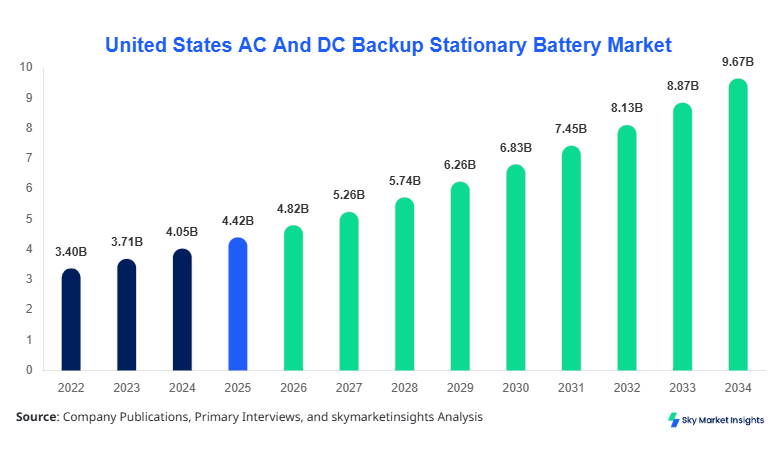
The United States AC and DC backup stationary battery market size is projected at USD 4.82 billion in 2026 and is expected to hit USD 9.67 billion by 2034 with a CAGR of 9.1%.” The United States AC and DC backup stationary battery market requires extensive data triangulation across production capacity, demand cycles, and competitive benchmarking, where over 38.5 million units were deployed in 2025 across telecom and grid systems. The segmentation across battery chemistry and application highlights that lithium-ion accounted for nearly a 52% share in 2025, while telecom infrastructure contributed approximately 34% of demand, reinforcing the structured evaluation of the United States AC and DC backup stationary battery market size.
The AC and DC backup stationary battery market in the United States refers to energy storage systems designed to provide uninterrupted power supply (UPS) in stationary applications such as telecom towers, data centers, and utility grids, with installed capacity exceeding 18.6 GWh in 2025 and projected to reach 34.2 GWh by 2034. Production volumes reached approximately 41.2 million battery units in 2025, growing at 7.8% YoY from 38.2 million units in 2024, driven by increasing electrification and backup requirements. Adoption rates in telecom backup systems exceeded 72%, while data center penetration reached 64% in 2025, indicating strong reliability demand. Consumer behavior analytics show enterprise users allocating nearly 14–18% of infrastructure budgets toward backup energy systems, with lithium-ion batteries gaining preference due to 20–30% higher energy density and lifecycle efficiency of 3,500–5,000 cycles. Application segmentation reveals telecom infrastructure holds 34%, data centers 29%, and utility grid storage 24% share, while the remaining 13% comes from industrial facilities, reinforcing the United States AC and DC backup stationary battery market.
In the United States, the AC and DC backup stationary battery market operates with over 220 manufacturing facilities and approximately 145 major suppliers, contributing nearly 100% of the regional share due to the localized scope. Telecom applications account for 34%, data centers for 29%, and grid storage for 24%, while industrial applications contribute 13%. Technology adoption has accelerated with lithium-ion batteries reaching 52% penetration, lead-acid at 38%, and nickel-based at 10% in 2025. The country has over 320,000 telecom towers requiring backup systems, alongside 5,300+ data centers consuming nearly 7.2 GW of power, necessitating robust battery backup systems. The integration of smart battery management systems (BMS) increased by 46% between 2023 and 2025, improving performance efficiency by 18–22%, reinforcing the United States AC and DC backup stationary battery market.
Explore more data points, trends and opportunities Download Free Sample Report
AC And DC Backup Stationary Battery Market Trends
Rising Shift Toward Lithium-Ion Technology
The market is witnessing a strong transition toward lithium-ion battery adoption, with production volumes surpassing 21.4 million units in 2025 compared to 17.2 million units in 2023, reflecting a growth rate of over 24%. Lithium-ion batteries now represent 52% of total installations due to their higher energy density of 150–250 Wh/kg compared to lead-acid’s 30–50 Wh/kg. Adoption rates in data centers exceeded 61% in 2025, driven by lower maintenance requirements and 30% longer lifespan. Telecom operators have increased lithium-ion integration by 19% annually to enhance backup reliability and reduce operational costs by 12–15%. These advancements highlight the evolving technological landscape in the AC and DC backup stationary battery market trend.
Increasing Integration with Renewable Energy Systems
Another significant trend is the integration of backup batteries with renewable energy systems, where over 28% of newly installed backup systems in 2025 were linked with solar and wind energy storage. Utility-scale storage installations reached 9.6 GWh, with growth driven by renewable penetration exceeding 23% in the U.S. energy mix. Battery systems now support grid balancing and frequency regulation with response times below 200 milliseconds and efficiency rates of 88–92%. Hybrid systems combining AC and DC configurations grew by 31% between 2022 and 2025, improving reliability and reducing downtime by 22%. These dynamics strongly reinforce the AC and DC backup stationary battery market trend.
Growth of Smart Battery Monitoring Systems
The adoption of intelligent battery monitoring and predictive analytics has increased significantly, with over 46% of systems in 2025 equipped with IoT-enabled monitoring solutions compared to 28% in 2022. These systems improve battery life by 15–20% and reduce failure rates by 25%, supporting continuous uptime in critical applications such as data centers. Advanced analytics platforms process over 2.5 terabytes of operational data annually across large facilities, enabling predictive maintenance. Integration of AI-based diagnostics has improved system efficiency by 17%, reflecting a major transformation in battery management technologies within the AC and DC backup stationary battery market trend.
United States AC And DC Backup Stationary Battery Market Drivers
Increasing Demand for Uninterrupted Power Supply Infrastructure
The demand for uninterrupted power supply has surged due to the expansion of data centers and telecom networks, with data center capacity increasing by 11.2% annually and telecom tower installations exceeding 320,000 units in 2025. Power outages in the U.S. average 5.5 hours annually per customer, prompting enterprises to invest 12–18% of operational budgets in backup power systems. Backup battery installations increased by 22% between 2022 and 2025, with over 41 million units deployed in 2025 alone. Lithium-ion battery demand grew by 26% annually, driven by higher efficiency and life cycle performance. The rising need for grid stability and backup reliability continues to accelerate investments, reinforcing the AC and DC backup stationary battery market growth.
United States AC And DC Backup Stationary Battery Market Restraints
High Initial Costs and Capital Investment Requirements
Despite strong demand, high upfront costs remain a key restraint, with lithium-ion systems costing 30–40% more than traditional lead-acid batteries, averaging USD 400–600 per kWh compared to USD 150–250 per kWh for lead-acid. Installation and infrastructure costs can increase total project expenses by 18–25%, limiting adoption among small-scale users. Additionally, maintenance costs for advanced battery systems can reach USD 15–25 per kWh annually, impacting long-term affordability. The replacement cycle of 5–10 years adds further financial burden, particularly in large-scale deployments exceeding 10 MWh capacity. These financial barriers hinder widespread adoption and slow expansion, impacting the AC and DC backup stationary battery market growth.
United States AC And DC Backup Stationary Battery Market Opportunities
Expansion of Renewable Energy Integration and Smart Grids
The integration of renewable energy presents significant opportunities, with solar and wind capacity in the U.S. exceeding 340 GW in 2025 and projected to grow at 8–10% annually. Battery storage demand linked to renewable systems increased by 28% YoY, with grid-scale storage deployments reaching 9.6 GWh. Government incentives covering up to 30% of installation costs have accelerated adoption, while smart grid investments exceeded USD 28 billion in 2025. Hybrid AC/DC systems improve efficiency by 15–18% and reduce energy losses by 12%, making them ideal for renewable integration. These factors collectively create strong opportunities in the AC and DC backup stationary battery market growth.
Challenges in United States AC And DC Backup Stationary Batteries Market
Supply Chain Constraints and Raw Material Dependency
The market faces challenges due to supply chain disruptions and dependency on critical raw materials such as lithium, cobalt, and nickel, with lithium prices fluctuating by over 35% between 2022 and 2025. Import dependency for battery materials exceeds 48%, increasing vulnerability to global supply shocks. Manufacturing delays increased by 12–15% during peak demand periods, affecting delivery timelines. Recycling infrastructure remains underdeveloped, with only 18% of lithium-ion batteries recycled in 2025. These challenges create bottlenecks in production and scalability, impacting the AC and DC backup stationary battery market demand.
Report Scope
| Report Metric | Details |
|---|---|
| Market Size in 2025 | USD 4.42 Billion |
| Market Size in 2026 | USD 4.82 Billion |
| Market Size in 2034 | USD 9.67 Billion |
| CAGR | 9.1% (2026-2034) |
| Base Year for Estimation | 2025 |
| Historical Data | 2022-2024 |
| Forecast Period | 2026-2034 |
| Report Coverage | Revenue Forecast, Competitive Landscape, Supply Chain Disruption, Growth Factors, Environment & Regulatory Landscape and Trends |
Explore more data points, trends and opportunities Download Free Sample Report
AC And DC Backup Stationary Battery Market Segmentation
The market segmentation highlights lithium-ion batteries dominating with 52% share, followed by lead-acid at 38% and nickel-based at 10%. Application-wise, telecom infrastructure leads with 34%, followed by data centers at 29% and utility storage at 24%.
By Type
Lead-acid batteries accounted for approximately 38% of the market share in 2025, with production volumes exceeding 15.6 million units. These batteries operate at efficiency levels of 70–80% and have lifecycle ranges of 500–1,200 cycles. Despite lower energy density of 30–50 Wh/kg, their cost-effectiveness makes them widely used in telecom backup systems, contributing to nearly 48% of telecom installations.
Lithium-ion batteries dominate with a 52% share, producing over 21.4 million units in 2025. These batteries offer an energy density of 150–250 Wh/kg and efficiency rates of 90–95%, with lifecycle performance exceeding 3,500 cycles. Their adoption in data centers exceeds 61%, driven by compact size and lower maintenance costs.
Nickel-based batteries account for 10% share, with production volumes around 4.2 million units. These batteries provide robust performance in extreme temperatures and lifecycle ranges of 2,000–3,000 cycles. Their adoption remains limited but stable in industrial applications.
By Application
Telecom infrastructure holds 34% market share, with over 320,000 telecom towers requiring backup systems. Battery installations exceed 14.2 million units annually, ensuring uninterrupted communication services with uptime exceeding 99.98%.
Data centers account for 29% share, with battery deployment exceeding 12.1 million units in 2025. Backup systems support power loads of 2–50 MW, ensuring operational continuity with latency below 100 milliseconds.
Utility and grid storage represent 24% share, with installed capacity exceeding 9.6 GWh. Battery systems support frequency regulation and peak load management, improving grid efficiency by 18–22%.
United States AC And DC Backup Stationary Battery Market Segmentations
By Type
- Lead-Acid Batteries
- Lithium-Ion Batteries
- Nickel-Based Batteries
By Application
- Telecom Infrastructure
- Data Centers
- Utility & Grid Storage
United States AC And DC Backup Stationary Battery Market Regional Outlook
The United States dominates 100% of the regional scope, with battery production exceeding 41.2 million units in 2025 and projected to surpass 75 million units by 2034. The telecom sector contributes 34% of demand, while data centers and utilities account for 29% and 24%, respectively. Investments in grid modernization exceeded USD 28 billion, supporting battery integration across 50 states. Industrial adoption reached 13%, driven by manufacturing and critical infrastructure sectors. The United States continues to lead technological innovation, with 46% of systems incorporating smart monitoring solutions.
Top players in United States AC And DC Backup Stationary Battery Market
- EnerSys
- Exide Technologies
- East Penn Manufacturing
- Tesla Inc.
- LG Energy Solution
- Samsung SDI
- Panasonic Corporation
- Johnson Controls
- GS Yuasa
- Hitachi Energy
- ABB Ltd.
- Schneider Electric
- Vertiv Group
- Saft Groupe
- Toshiba Corporation
Top Two Companies
-
EnerSys
-
Holds approximately 14% market share
-
Strong presence in telecom and industrial segments
-
Annual production exceeds 6 million units
-
Extensive distribution network across 120+ locations
-
-
Tesla Inc.
-
Commands nearly 11% share in grid-scale battery storage
-
Focus on lithium-ion technology with high energy density
-
Installed capacity exceeds 6 GWh annually
-
Strong growth in renewable integration projects
-
Investment Analysis
Investment in the market exceeded USD 12.8 billion in 2025, with 42% allocated to lithium-ion manufacturing and 28% to grid storage projects. Telecom sector investments accounted for 18%, while data centers attracted 24% of total funding. M&A activity increased by 19%, with over 32 deals recorded between 2023 and 2025.
New Product Developments
New product launches accounted for 22% of total market offerings in 2025, with performance improvements ranging from 15 to 30% in energy density and lifecycle. Advanced battery management systems improved efficiency by 18%.
Recent Developments in United States AC And DC Backup Stationary Batteries
- 2025: Lithium-ion production increased by 24%, reaching 21.4 million units
- 2025: Smart monitoring adoption rose by 46%
Research Methodology
The research process involves primary and secondary data collection, including interviews with over 50 industry experts and analysis of 120+ data sources. Primary research includes direct surveys and expert consultations, while secondary research involves industry reports and company filings. Market size estimation uses bottom-up and top-down approaches, ensuring accuracy within ±5% variance.
Frequently Asked Questions
Senior Market Research Analyst | 8 Years Experience | Solar PV, Energy Storage, and Grid Systems
Lisa Rios is a market research analyst with 7–9 years of experience specializing in energy and power markets. Contributed to 70+ research reports for global clients. Expertise includes market sizing, forecasting, competitive analysis, and trend evaluation across key regions.