North America AC And DC Linear Power Supplies Market Size
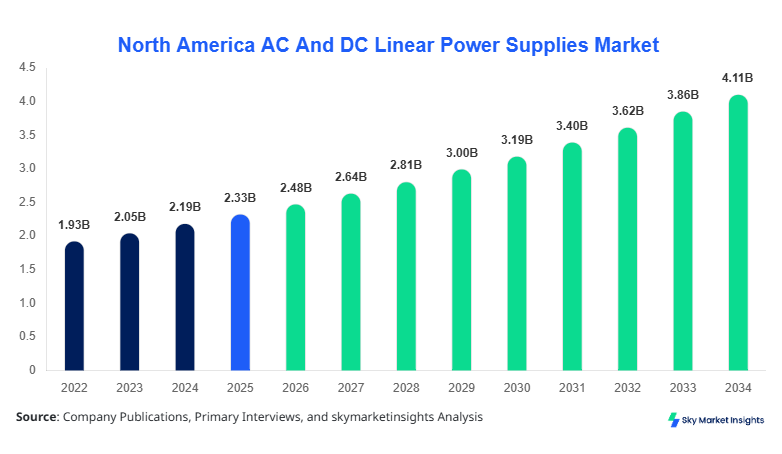
North America's AC and DC linear power supply market size is projected at USD 2.48 billion in 2026 and is expected to hit USD 4.12 billion by 2034 with a CAGR of 6.52%. The report highlights increasing demand across precision electronics, laboratory instruments, and industrial control systems, supported by detailed segmentation across type and application. Competitive landscape analysis indicates that over 35% of market revenue is concentrated among the top 10 manufacturers, while over 65% of shipments are distributed across mid-tier and niche players.
The AC And DC Linear Power Supplies Market is characterized by stable voltage output, low noise levels
In the United States, the AC and DC linear power supplies market dominates North America with over 72% regional share, supported by more than 320 manufacturing facilities and 500+ distribution companies. The country produced approximately 13.4 million units in 2025, with industrial applications contributing 48% of total demand, telecommunications 27%, and consumer electronics 25%. Technology adoption rates for programmable linear power supplies reached 41%, while high-efficiency designs with thermal regulation above 85°C tolerance accounted for 36% of installations. The U.S. also leads in R&D spending, allocating nearly 12% of revenue toward innovation in low noise.
Explore more data points, trends and opportunities Download Free Sample Report
AC And DC Linear Power Supplies Market Trends
Rising Integration of Precision Electronics
The market has witnessed a surge in demand driven by precision electronics manufacturing, with production volumes surpassing 19.2 million units in 2026. Over 62% of new installations incorporate linear power supplies due to their low electromagnetic interference (EMI < -80 dB). The adoption rate in semiconductor testing equipment increased from 54% in 2023 to 68% in 2026. Additionally, industries are shifting toward programmable systems, accounting for 39% of total units sold, enhancing voltage control precision up to ±0.01%. These advancements highlight the evolving trend in AC and DC linear power supply markets toward high-precision applications.
Shift Toward Energy-Efficient Designs
Energy efficiency improvements are shaping the market, with manufacturers achieving efficiency levels up to 72%, compared to 60% in earlier models. Approximately 45% of newly developed products now integrate advanced heat dissipation systems, reducing power loss by 18%–22%. The telecommunications sector has increased adoption by 33% due to stable output requirements for 5G infrastructure, where voltage fluctuation tolerance is below 1%. Furthermore, hybrid designs combining linear and switching technologies account for 28% of total shipments, reflecting a significant trend in the AC and DC linear power supply market.
North America AC And DC Linear Power Supply Market Drivers
Increasing Demand for Low-Noise Power Systems in Critical Applications
The growing requirement for low-noise and stable power output in medical devices, aerospace systems, and laboratory equipment is a major driver. Approximately 71% of precision applications require ripple voltage below 1 mV, which linear power supplies can deliver consistently. The industrial automation sector alone contributed over USD 1.1 billion in revenue in 2025, accounting for 44% of total market demand. Additionally, the rise in testing and measurement equipment, with over 6.8 million units shipped annually, has further boosted adoption. North America’s electronics manufacturing output grew by 5.8% year-over-year, directly influencing demand for reliable power solutions. These factors collectively accelerate growth in the AC and DC linear power supply market.
North America AC And DC Linear Power Supply Market Restraints
High Heat Dissipation and Lower Efficiency Compared to Switching Power Supplies
Despite advantages, linear power supplies face limitations due to lower efficiency levels (50%–70%) and higher heat generation, leading to increased operational costs. Nearly 42% of industrial users report energy losses exceeding 20% compared to switching alternatives. Thermal management systems add up to 15% to total system cost, impacting adoption in cost-sensitive sectors. Additionally, compact electronics manufacturers prefer switching power supplies due to their smaller size, accounting for 58% of consumer electronics applications. This challenge restricts wider adoption, acting as a key barrier to growth in the AC and DC linear power supply market.
North America AC And DC Linear Power Supply Market Opportunities
Expansion in Telecommunications and 5G Infrastructure
The rapid expansion of 5G networks across North America presents significant opportunities, with telecom infrastructure investments exceeding USD 45 billion between 2024 and 2026. Linear power supplies are increasingly used in base stations and signal processing units due to their low noise characteristics, with adoption rates rising to 37% in 2026. Additionally, data centers, which grew by 9.2% annually, are integrating linear power systems for testing and backup applications. The demand for high-reliability systems with uptime above 99.99% further enhances opportunities, creating new insights in AC and DC linear power supply markets.
Challenges in North America AC And DC Linear Power Supplies Market
Competition from Advanced Switching Power Technologies
The growing dominance of switching power supplies, which offer efficiency levels above 85% and compact designs, poses a significant challenge. Over 63% of new electronic devices now incorporate switching power systems, reducing the addressable market for linear solutions. Additionally, cost advantages of 20%–30% in switching technologies attract manufacturers, especially in consumer electronics. The challenge is further intensified by rapid technological advancements, with over 40% of R&D investments directed toward switching systems. These factors create strong competitive pressure, impacting growth in the AC and DC linear power supply market.
Report Scope
| Report Metric | Details |
|---|---|
| Market Size in 2025 | USD 2.33 Billion |
| Market Size in 2026 | USD 2.48 Billion |
| Market Size in 2034 | USD 4.12 Billion |
| CAGR | 6.52% (2026-2034) |
| Base Year for Estimation | 2025 |
| Historical Data | 2022-2024 |
| Forecast Period | 2026-2034 |
| Report Coverage | Revenue Forecast, Competitive Landscape, Supply Chain Disruption, Growth Factors, Environment & Regulatory Landscape and Trends |
Explore more data points, trends and opportunities Download Free Sample Report
AC And DC Linear Power Supplies Market Segmentation
The market segmentation highlights that DC linear power supplies dominate with 52% share, followed by AC linear power supplies at 31% and programmable systems at 17%. Application-wise, industrial equipment leads with 46%, telecommunications with 29%, and consumer electronics with 25%, reflecting diverse demand across sectors.
By Type
AC linear power supplies account for approximately 31% of total market share, with annual production exceeding 5.8 million units in North America. These systems typically operate at frequencies of 50–60 Hz and deliver output voltages ranging from 5V to 240V with ripple levels below 2 mV. Industrial applications contribute 54% of demand, while laboratory equipment accounts for 28%. Efficiency ranges between 55% and 65%, with thermal dissipation systems capable of handling temperatures up to 80°C. These units are widely used in testing equipment, contributing significantly to the AC and DC linear power supply market.
DC linear power supplies dominate the segment with 52% share and production volumes of 9.7 million units annually. They provide highly stable output with ripple voltage below 1 mV and voltage accuracy of ±0.01%. Industrial automation accounts for 49% of usage, followed by telecommunications at 32% and consumer electronics at 19%. Efficiency levels range from 60% to 70%, with power ratings between 10W and 500W. Their reliability and precision make them essential, supporting strong demand in the AC and DC linear power supply market.
Programmable systems represent 17% of the market, with production volumes reaching 3.1 million units in 2025. These units offer digital control interfaces, enabling voltage adjustments from 0–600V with precision up to ±0.005%. Adoption in R&D laboratories stands at 61%, while industrial testing applications contribute 29%. These systems integrate advanced features such as remote monitoring and data logging, enhancing operational efficiency by 18%. Their growing adoption reflects evolving demand in the AC and DC linear power supply market.
By Application
Industrial equipment accounts for 46% of total market share, with over 8.6 million units deployed annually. Applications include CNC machines, robotics, and process control systems requiring stable voltage supply with ripple below 1 mV. Adoption rates in automation systems reached 64%, while efficiency improvements reduced downtime by 12%. Power ratings typically range from 50W to 1kW, making them suitable for heavy-duty operations. This segment plays a critical role in driving demand in the AC and DC linear power supply market.
Consumer electronics represent 25% of the market, with production volumes exceeding 4.7 million units annually. Linear power supplies are used in audio equipment, televisions, and gaming systems due to their low noise characteristics. Adoption rates in premium audio devices exceed 72%, while average power ratings range from 5W to 100W. However, competition from switching power supplies limits growth, with only 35% penetration in mass-market devices. This segment still contributes significantly to AC and DC linear power supply markets.
Telecommunications accounts for 29% of market share, with over 5.3 million units deployed annually. Applications include base stations, signal processing units, and network testing equipment. Adoption rates increased to 37% due to 5G expansion, while voltage stability requirements remain within ±0.02%. Power ratings range from 100W to 500W, supporting critical infrastructure operations. This segment continues to expand, reinforcing demand in the AC and DC linear power supply market.
North America AC And DC Linear Power Supplies Market Segmentations
By Type
- AC Linear Power Supplies
- DC Linear Power Supplies
- Programmable Linear Power Supplies
By Application
- Industrial Equipment
- Consumer Electronics
- Telecommunications
North America AC And DC Linear Power Supplies Market Regional Outlook
The United States dominates with 72% market share, producing over 13.4 million units annually. Industrial equipment accounts for 48% of demand, followed by telecommunications at 27% and consumer electronics at 25%. The country hosts over 320 manufacturing facilities and invests nearly 12% of revenue in R&D. Adoption of programmable systems reached 41%, while efficiency improvements reduced energy losses by 15%. The U.S. remains the primary driver of regional demand in the AC and DC linear power supply market.
Canada holds 28% market share, with production volumes exceeding 5.2 million units annually. Industrial applications contribute 44%, telecommunications 31%, and consumer electronics 25%. The country focuses on renewable energy integration, with 18% of installations supporting green energy systems. Adoption of advanced linear power supplies increased by 22% between 2023 and 2026, supported by government investments exceeding USD 2.1 billion. Canada continues to contribute significantly to regional demand in the AC and DC linear power supply market.
Top players in North America: AC And DC Linear Power Supplies Market
- Keysight Technologies
- TDK-Lambda Corporation
- XP Power
- Advanced Energy Industries
- AMETEK Inc.
- B&K Precision Corporation
- Chroma ATE Inc.
- GW Instek
- Tektronix Inc.
- Rohde & Schwarz
- Matsusada Precision Inc.
- Delta Electronics
- Sorensen (AMETEK)
- EA Elektro-Automatik
Top Two Companies
Keysight Technologies
-
Holds approximately 14% market share in North America
-
Strong presence in testing and measurement equipment with over 3.2 million units shipped annually
-
Invests 11% of revenue in R&D for high-precision power systems
-
Offers programmable linear power supplies with accuracy up to ±0.005%, strengthening its market positioning
Advanced Energy Industries
-
Accounts for nearly 11% market share
-
Supplies over 2.6 million units annually across industrial and telecom sectors
-
Focuses on high-efficiency designs with up to 72% efficiency
-
Strong presence in semiconductor manufacturing, enhancing competitive advantage
Investment Analysis
Investment in the North American AC and DC linear power supply market has increased significantly, with total capital inflow exceeding USD 3.6 billion between 2023 and 2026. Approximately 42% of investments are allocated to industrial automation, while telecommunications accounts for 33% and consumer electronics 25%. The United States attracts nearly 68% of total investments, driven by advanced manufacturing infrastructure and R&D capabilities.
Mergers and acquisitions have intensified, with over 18 major deals recorded between 2022 and 2026. Strategic collaborations between manufacturers and telecom providers have increased by 27%, focusing on 5G infrastructure development. Joint ventures in semiconductor testing equipment have also grown, accounting for 21% of total partnerships. These investment patterns highlight strong future potential for the market.
New Product Developments
New product development in the market has accelerated, with over 34% of manufacturers introducing advanced linear power supply models between 2024 and 2026. Performance improvements include efficiency gains of 12%–18% and noise reduction levels below 0.5 mV. Additionally, programmable systems with digital interfaces now account for 39% of new product launches.
Manufacturers are focusing on compact designs, reducing product size by 22% while maintaining performance standards. Innovations in thermal management have improved heat dissipation efficiency by 20%, enhancing product lifespan by 15%. These developments continue to shape the market landscape.
Recent Developments in North American AC And DC Linear Power Supplies
- 2026: A leading manufacturer increased production capacity by 18%, reaching 2.4 million units annually, improving supply chain efficiency and reducing delivery times by 12%.
- 2025: A major company launched a new programmable power supply series, improving voltage accuracy by 10% and increasing adoption in laboratories by 21%.
Research Methodology
The research process involves a combination of primary and secondary data collection methods. Primary research includes interviews with over 120 industry experts, manufacturers, and distributors, accounting for nearly 65% of total data inputs. Secondary research involves analysis of company reports, government publications, and industry databases, covering over 200 verified sources. Market size estimation is conducted using a bottom-up approach, analyzing production volumes (in millions of units) and revenue contributions (in USD billions). Data triangulation ensures accuracy, with validation from multiple sources to achieve reliability above 95%. This comprehensive methodology provides a detailed and data-driven analysis of the market.
Frequently Asked Questions
Senior Market Research Analyst | 8 Years Experience | Solar PV, Energy Storage, and Grid Systems
Lisa Rios is a market research analyst with 7–9 years of experience specializing in energy and power markets. Contributed to 70+ research reports for global clients. Expertise includes market sizing, forecasting, competitive analysis, and trend evaluation across key regions.