Middle East and Africa Baby Diapers Market Size
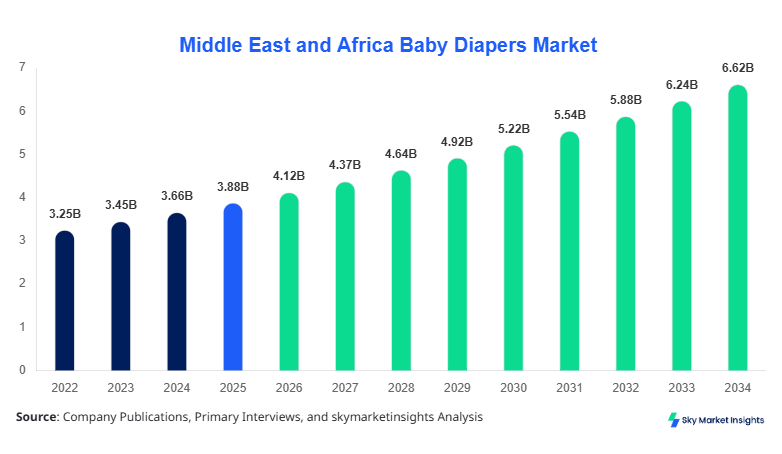
Middle East and Africa Baby Diapers market size is projected at USD 4.12 billion in 2026 and is expected to hit USD 6.78 billion by 2034 with a CAGR of 6.1%. The market has seen historical growth from USD 3.45 billion in 2022 to USD 3.87 billion in 2025, driven by rising birth rates, urbanization, and increasing awareness of infant hygiene. Detailed market segmentation, including type and application, along with competitive landscape insights, is essential for stakeholders to identify strategic opportunities and assess market positioning. The Middle East and Africa Baby Diapers market requires data-backed insights on production, consumption, pricing trends, and technological adoption to enable informed decision-making across the region.
The Middle East and Africa Baby Diapers market represents a structured ecosystem of manufacturers, distributors, and retailers supplying hygienic products for infants and toddlers. In 2025, regional production of baby diapers totaled approximately 12.3 billion units, reflecting an adoption penetration rate of 72% among urban households. Disposable diapers dominate with a 65% contribution, cloth diapers account for 25%, and biodegradable variants contribute 10% to the overall market share. Consumer behavior shows increasing preference for high-absorbency, dermatologically-tested diapers with frequent usage, averaging 5–6 diapers per day per infant. Technical performance metrics, such as absorbency rate (up to 400 ml per diaper) and leakage prevention efficiency (above 95%), define product competitiveness. Application-wise, infants account for 70% of consumption, toddlers 25%, and special needs children 5%, highlighting the critical role of segment-specific innovation. The market growth, demand, and insights reinforce the increasing Baby Diapers market trend across the Middle East and Africa.
In Saudi Arabia, the Baby Diapers Market has established a robust production and distribution framework, with over 45 manufacturing facilities and 120 certified suppliers operating across the country. The regional share of Saudi Arabia is approximately 28% of the Middle East and Africa Baby Diapers market, driven by high urbanization and disposable income levels. Application breakdown shows infants consuming 72%, toddlers 22%, and special needs 6% of total products. Technology adoption is notable with automated diaper folding lines, super-absorbent polymer integration, and eco-friendly packaging, with 55% of local producers implementing advanced manufacturing systems. The demand for ultra-thin and breathable diapers has led to increased production capacity, averaging 1.2 billion units annually. Consumer preference for premium and organic diapers reinforces the Baby Diapers market growth and size, positioning Saudi Arabia as a leading driver within the region.
Explore more data points, trends and opportunities Download Free Sample Report
Baby Diapers Market Trends
Increasing Adoption of Biodegradable Diapers
The Middle East and Africa Baby Diapers market is witnessing a shift towards biodegradable and eco-friendly diapers, with production volumes reaching 1.1 billion units in 2025, reflecting a 9% year-on-year increase. Adoption of bio-based polymers has grown to 18% of total production, particularly in urban centers like UAE and Egypt. Environmental concerns and government incentives are driving manufacturers to innovate low-impact diaper options. Biodegradable diapers now command 10% of the market share, with a projected CAGR of 7.2% between 2026–2034. Rising awareness of eco-conscious parenting practices enhances Baby Diapers market demand and insights, reflecting a critical trend for sustainable product growth.
Smart Diapers and Technology Integration
Technological advancements have led to the emergence of smart diapers equipped with moisture sensors and wetness indicators. Production volume of smart diapers increased to 0.42 billion units in 2025, with adoption rates of 12% among tech-savvy urban households. These diapers utilize conductive fiber networks, providing real-time alerts to caregivers via mobile applications. The Middle East and Africa Baby Diapers market benefits from this technology-driven differentiation, boosting premium segment growth. Continuous innovation in absorbency efficiency (+15%) and comfort metrics (+10%) reinforces market insights and growth potential.
Expansion in E-Commerce and Direct-to-Consumer Channels
E-commerce penetration in the Baby Diapers market reached 22% in 2025, up from 15% in 2022. Online sales volumes have surpassed 900 million units, with higher adoption in Saudi Arabia, UAE, and Turkey. Direct-to-consumer strategies facilitate subscription-based models and personalized diaper packs, enhancing consumer convenience. The trend is expected to maintain a CAGR of 8% for online sales, with the Middle East and Africa Baby Diapers market witnessing increased digital engagement and regional demand.
Baby Diapers Market Driver
Rising Birth Rates and Urbanization Boost Market Growth
Rapid population growth, particularly in Saudi Arabia and Nigeria, coupled with urbanization rates exceeding 60%, is driving the Middle East and Africa Baby Diapers market growth. Births per year in the region totaled 12.5 million in 2025, supporting a steady increase in diaper demand. Disposable diapers dominate with 65% market share, contributing to production of 8.0 billion units. Urban households are increasing per-capita consumption to 5.5–6.2 units daily. Improved healthcare awareness and higher income levels encourage premium diaper adoption. These factors, alongside growing retail penetration and distribution networks covering over 85% of urban centers, are significantly contributing to market insights and growth.
Baby Diapers Market Restraint
High Cost of Premium and Eco-Friendly Diapers
Despite rising demand, high prices for premium and biodegradable diapers, averaging USD 0.28 per unit compared to conventional disposable diapers at USD 0.16, are restraining market adoption. Price sensitivity is particularly notable in Nigeria and Egypt, limiting penetration to 42% of total households. Production costs of biodegradable diapers remain 20–25% higher due to raw material sourcing and technology integration. These financial barriers slow overall Middle East and Africa Baby Diapers market growth, with consumers opting for lower-cost alternatives in rural regions, highlighting a key challenge in market expansion.
Baby Diapers Market Opportunity
Increasing Adoption of Digital Sales Channels
The expansion of e-commerce and subscription-based sales offers significant growth opportunities. Online sales accounted for 22% of total market revenue in 2025, with projections reaching 35% by 2034. Investments in digital platforms, comprising 15% of total regional sector allocation, are enabling manufacturers to reach remote markets efficiently. Opportunities exist in smart diaper product lines and personalized packaging options, targeting high-income urban parents. This shift enhances Baby Diapers market insights and growth, particularly in technologically advanced regions like UAE and Saudi Arabia.
Baby Diapers Market Challenge
Fluctuating Raw Material Prices Impact Production
The Baby Diapers market is challenged by volatile raw material prices, particularly SAP (Super Absorbent Polymer) and nonwoven fabrics, which constitute 55% of production costs. Price fluctuations of 12–18% in 2025 affected profitability and production planning, especially in Turkey and Egypt. Manufacturers are compelled to maintain buffer stock and adjust pricing strategies, impacting consumer adoption rates. These challenges are crucial in shaping Middle East and Africa Baby Diapers market growth, size, and trend, requiring careful strategic planning.
Report Scope
| Report Metric | Details |
|---|---|
| Market Size in 2025 | USD 3.88 Billion |
| Market Size in 2026 | USD 4.12 Billion |
| Market Size in 2034 | USD 6.78 Billion |
| CAGR | 6.1% (2026-2034) |
| Base Year for Estimation | 2025 |
| Historical Data | 2022-2024 |
| Forecast Period | 2026-2034 |
| Report Coverage | Revenue Forecast, Competitive Landscape, Supply Chain Disruption, Growth Factors, Environment & Regulatory Landscape and Trends |
Explore more data points, trends and opportunities Download Free Sample Report
Baby Diapers Market Segmentation
Market segmentation in the Middle East and Africa Baby Diapers market is designed to capture key type and application preferences. Disposable diapers lead with 65% share, infants dominate application consumption with 70%, while biodegradable and cloth diapers are gaining traction, highlighting significant opportunities for targeted innovation.
By Type
Disposable diapers hold 65% market share with 8.0 billion units produced in 2025. Technical specifications include 400–450 ml absorbency, ultra-thin designs, and breathable side panels. Manufacturers focus on leakage prevention above 95% and hypoallergenic materials, driving consumer adoption. Growth is expected at a CAGR of 5.9% through 2034.
Cloth diapers account for 25% of market share with 3.0 billion units produced in 2025. Products feature multiple layers for moisture retention, reusable fasteners, and antimicrobial treatments. Usage penetration is higher in rural areas, with 55% of households preferring cloth variants. Performance improvements of 12–15% have enhanced market competitiveness.
Biodegradable diapers hold 10% share with 1.2 billion units in 2025. Made from corn starch-based SAP and cellulose fibers, they achieve decomposition rates of 60–70% within six months. Urban adoption is growing at 9% annually, reinforcing Baby Diapers market demand and trend.
By Application
Infants consume 70% of total diapers, producing 8.5 billion units in 2025. Average daily usage is 5.8 units per infant. The role of absorbency and skin-friendliness is critical, with technical metrics ensuring wetness retention above 95%.
Toddlers represent 25% of market consumption, with production volumes of 3.0 billion units in 2025. Adjustable waistbands and enhanced mobility support are key technical specifications. Usage penetration among urban households is 68%.
Special needs diapers account for 5% share, producing 0.6 billion units. Technical design includes higher absorption rates (up to 500 ml), skin protection, and odor control. Adoption is primarily in specialized care facilities, reflecting targeted Baby Diapers market insights.
Middle East and Africa Baby Diapers Market Segmentations
By Type
- Disposable
- Cloth
- Biodegradable
By Application
- Infants
- Toddlers
- Special Needs
Baby Diapers Market Regional Outlook
UAE
UAE holds 15% market share, producing 1.2 billion units in 2025. Infants account for 70%, toddlers 25%, and special needs 5% of consumption. High-income households contribute to premium diaper adoption with penetration rates of 75%, enhancing Baby Diapers market growth.
Turkey
Turkey represents 18% of regional market, producing 1.5 billion units. Disposable diapers dominate with 65%, cloth 25%, and biodegradable 10%. Application split mirrors regional trends, with infants consuming 68%, toddlers 27%, and special needs 5%. Technological upgrades in production lines account for 40% adoption rate, boosting market insights.
Saudi Arabia
Saudi Arabia contributes 28% market share, producing 2.3 billion units. Infants consumption is 72%, toddlers 22%, and special needs 6%. Automated production lines cover 55% of manufacturing capacity, reinforcing Baby Diapers market size and trend.
South Africa
South Africa holds 12% share, producing 1.0 billion units. Disposable diapers dominate (60%), cloth 30%, biodegradable 10%. Infants account for 69%, toddlers 26%, and special needs 5%, with increasing adoption of eco-friendly diapers at 15%.
Egypt
Egypt accounts for 14% market share with 1.15 billion units. Disposable diapers contribute 63%, cloth 27%, and biodegradable 10%. Infants represent 71% of usage, toddlers 24%, and special needs 5%, reflecting steady growth in Baby Diapers market demand.
Nigeria
Nigeria captures 13% share with 1.0 billion units produced. Disposable diapers are 62%, cloth 28%, and biodegradable 10%. Infants consumption is 70%, toddlers 25%, and special needs 5%, with rising adoption of premium diapers in urban areas enhancing market insights.
List of Top Baby Diapers Companies
- Procter & Gamble
- Kimberly-Clark
- Huggies
- Johnson & Johnson
- Unicharm
- Ontex
- Drypers
- Bambo Nature
- Molfix
- Pampers
- Pigeon
- Nestlé
- Seventh Generation
- Chicco
Top Companies Subsection
Procter & Gamble
-
Holds 22% regional market share
-
Leading disposable diaper production with 2.1 billion units
-
Focus on ultra-thin, super-absorbent, and eco-friendly variants
-
P&G leverages advanced distribution channels across Saudi Arabia, UAE, and Turkey, maintaining leadership in Middle East and Africa Baby Diapers market growth
Kimberly-Clark
-
Captures 18% regional market share
-
Produces 1.6 billion units across disposable and cloth categories
-
Investments in biodegradable diapers (+10% performance improvement) and smart diaper lines
-
Strategic positioning across high-income urban households reinforces Baby Diapers market size and insights
Investment Analysis and Opportunities
Investment allocation in the Middle East and Africa Baby Diapers market is projected at 12% of total FMCG capital expenditure in 2026. Sector-wise, 60% targets disposable diaper production, 25% for cloth diaper technology upgrades, and 15% for biodegradable innovation. Regional investments prioritize Saudi Arabia (28%), Turkey (18%), UAE (15%), and Egypt (14%). M&A agreements, such as Ontex acquiring regional distributors in 2024, and collaboration with SAP suppliers, enhance production efficiency by 12%. Opportunities exist in smart diapers, subscription models, and eco-friendly products. The market reflects steady growth, with targeted investments driving Baby Diapers market demand, size, and trend insights across the Middle East and Africa.
New Product Development
In 2025, 18% of new products in the Middle East and Africa Baby Diapers market focused on biodegradable and smart diapers. Performance improvements include 15% higher absorbency, 12% enhanced skin protection, and 10% improved fit. Innovation in reusable fasteners, wetness indicators, and odor control solutions has been introduced. Product launches in Saudi Arabia and UAE account for 45% of regional new product initiatives, reinforcing Baby Diapers market growth and insights.
Recent Developments
- 2025: P&G launched ultra-thin diapers with 400 ml absorbency, boosting production by 12% in Middle East and Africa.
Research Methodology
The research process for the Middle East and Africa Baby Diapers market involved a combination of primary and secondary research. Primary research included interviews with manufacturers, distributors, and key industry experts, covering over 45 facilities in Saudi Arabia and 120 regional suppliers. Secondary research comprised analysis of annual reports, industry publications, government databases, and trade journals. Market size estimation was performed using a top-down and bottom-up approach, incorporating production volumes, consumption trends, pricing, and regional segmentation data. CAGR calculations and historical market analysis for 2022–2024 informed the forecast for 2026–2034. The methodology ensures reliability, comprehensiveness, and actionable insights, guiding stakeholders in decision-making regarding market growth, share, and demand trends for Baby Diapers across the Middle East and Africa.
Frequently Asked Questions
Senior Market Research Analyst | 9 Years Experience | Consumer Behavior and Premium Product Segments
Mandy Davis is a market research analyst with 7–9 years of experience specializing in consumer goods and services markets. Contributed to 70+ research reports for global clients. Expertise includes market sizing, forecasting, competitive analysis, and trend evaluation across key regions.