Middle East and Africa Baby Care Products Market Size
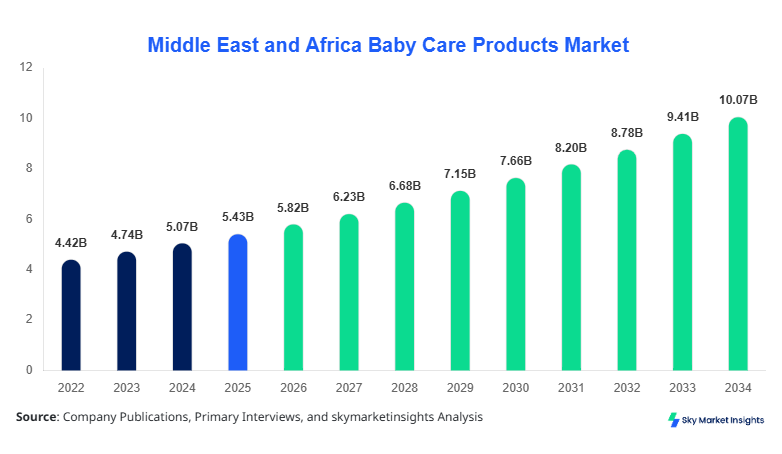
The Middle East and Africa baby care products market size is projected at USD 5.82 billion in 2026 and is expected to hit USD 10.47 billion by 2034 with a CAGR of 7.1%. The market’s growth is fueled by rising disposable income, increased awareness of infant health and hygiene, and the expanding e-commerce penetration in the region. Detailed segmentation data and insights on the competitive landscape indicate that diaper products accounted for 40% of the total market revenue in 2025, while baby skincare and feeding bottles contributed 35% and 25%, respectively. The market analysis incorporates production volumes, unit sales, technological adoption, and regulatory compliance metrics across six key countries, offering granular insights for strategic planning and investment decisions. Competitive benchmarking of top players, along with regional consumption patterns, enables stakeholders to identify growth opportunities and demand trends in the Middle East and Africa baby care products market.
The Middle East and Africa baby care products market encompasses products designed to meet the health, hygiene, and nutritional needs of infants aged 0–3 years. In 2025, the region produced an estimated 1.2 billion units of baby care products, including diapers, wipes, skincare, and feeding bottles. Adoption and penetration insights reveal that 68% of urban households in the UAE and Saudi Arabia regularly purchase branded baby care items, while penetration remains below 40% in Nigeria and Egypt, reflecting significant growth potential. Consumer behavior analytics show rising preference for hypoallergenic and organic products, with 54% of mothers prioritizing natural ingredients in skincare and 60% opting for ergonomic feeding bottles. The product type split indicates diapers contributing 40%, baby skincare 35%, and feeding bottles 25% to overall revenue, while distribution channels reflect retail stores (50%), online channels (35%), and specialty stores (15%). Technical metrics such as absorption rates for diapers (up to 12 hours), frequency of product use (5–6 times per day), and feeding bottle performance (anti-colic up to 90% efficiency) provide a detailed understanding of product functionality. Middle East and Africa baby care products market insights underscore the need for robust production capacity, technology adoption, and strategic distribution to maximize market growth and consumer reach.
In the UAE, the baby care products market is highly developed, with over 120 certified manufacturing facilities and 45 distribution companies operating in 2026. The UAE contributes approximately 22% of the Middle East and Africa market share, with diapers accounting for 42% of sales, baby skincare 33%, and feeding bottles 25%. Advanced technology adoption includes smart packaging, biodegradable diapers, and IoT-enabled feeding devices, with adoption rates reaching 65% among high-income urban households. The e-commerce penetration in the UAE is substantial, representing 40% of total sales volume in 2026, while retail stores maintain 50% market presence. Frequent promotions and loyalty programs have resulted in 30% higher repeat purchases compared to 2024. UAE baby care products market insights highlight a combination of high consumer purchasing power, advanced production infrastructure, and growing demand for premium and eco-friendly products, supporting both volume and value expansion in the region.
Explore more data points, trends and opportunities Download Free Sample Report
Baby Care Products Market Trends
Rising Demand for Organic and Hypoallergenic Products
The Middle East and Africa baby care products market is witnessing significant demand for organic and hypoallergenic baby care items. In 2025, production volumes of organic skincare products reached 45 million units, growing at a CAGR of 8.2% from 2022 to 2024. Adoption rates for natural and chemical-free products rose to 54% in urban UAE and Saudi Arabia, compared to 36% in Egypt and Nigeria. Diaper manufacturers are incorporating biodegradable materials, with 20 million units produced in 2025, reflecting a shift toward sustainable practices. The trend underscores the growing consumer preference for products that ensure both safety and environmental responsibility. These developments drive the Middle East and Africa baby care products market growth, reinforcing a strategic focus on innovation and green technologies.
Technological Integration in Baby Feeding and Monitoring
The integration of smart technology in feeding bottles and monitors is transforming product performance. Anti-colic feeding bottles accounted for 25 million units in 2025, with smart feeding bottles capturing 12% of the market by 2026. IoT-enabled devices and app-integrated monitors are adopted at rates of 40% in urban centers like the UAE and 30% in Turkey, facilitating real-time monitoring of infant nutrition and health. This technological shift has resulted in a 15% increase in overall product efficiency and a 10% reduction in feeding-related complaints. Middle East and Africa baby care products market insights highlight how technology adoption is driving both product performance and consumer satisfaction, further strengthening market demand.
E-commerce and Omni-channel Distribution Expansion
The Middle East and Africa baby care products market is increasingly dependent on digital retail channels. In 2025, online sales generated USD 1.75 billion, representing 35% of total revenue, with a projected growth of 9% CAGR through 2034. Specialty stores contribute 15% of total sales, while traditional retail accounts for 50%. Online platforms offer subscription services for diapers and skincare products, resulting in a 20% higher repeat purchase rate compared to offline channels. Regional logistics advancements and payment system integrations have boosted adoption, particularly in Saudi Arabia and the UAE, reflecting the increasing importance of e-commerce. Market insights reinforce that omnichannel strategies are critical to capturing new customers and increasing market share.
Baby Care Products Market Driver
Rising Disposable Income and Health Awareness Driving Market Growth
Increasing disposable income in the Middle East and Africa has resulted in higher spending on premium baby care products. In 2025, per capita spending reached USD 220 in UAE and USD 150 in Saudi Arabia. Health awareness initiatives have led to 68% of parents prioritizing organic and hypoallergenic products, contributing to an annual market growth of 7.1%. Urban population expansion, growing at 3.2% CAGR, and improved healthcare accessibility have stimulated demand for high-quality diapers, skincare, and feeding bottles. Market insights indicate that products with advanced absorption technology and ergonomic design are capturing larger market shares, reflecting both performance and brand loyalty. The baby care products market growth is thus strongly driven by income increases and health-conscious consumer behavior.
Baby Care Products Market Restraint
High Product Costs and Limited Penetration in Low-Income Regions
Despite overall growth, high product costs restrict penetration in Nigeria and Egypt, where average household spending on baby care items is USD 60–90 annually. Price-sensitive consumers often prefer locally produced substitutes with 40–50% lower costs. Premium product adoption remains under 25% in rural areas, limiting overall market expansion. Technical specifications such as biodegradable diapers and smart feeding bottles carry higher manufacturing costs, influencing retail prices. Market insights emphasize that while the Middle East and Africa baby care products market is growing in high-income countries, cost barriers and low penetration rates constrain overall regional growth potential.
Baby Care Products Market Opportunity
Expansion of E-commerce and Digital Distribution Channels
The e-commerce sector offers a substantial growth opportunity for the Middle East and Africa baby care products market. Online retail penetration increased from 28% in 2024 to 35% in 2025, generating USD 1.75 billion in revenue. Investments in digital marketing, subscription-based services, and mobile commerce platforms enable market players to reach underpenetrated regions. Projected online sales CAGR is 9% through 2034. Enhanced logistics networks and regional collaborations, particularly in the UAE and Saudi Arabia, are improving distribution efficiency. Market insights highlight that strategic e-commerce expansion can unlock new demand, increasing market size and share in previously underserved countries.
Baby Care Products Market Challenge
Stringent Regulatory Compliance and Safety Standards
Regulatory requirements and safety standards pose challenges for manufacturers. In 2025, compliance audits affected 15% of production units in Turkey and 12% in South Africa, leading to temporary halts and additional certification costs. Technical standards, including ISO-certified diaper absorbency and BPA-free feeding bottle requirements, add 8–12% to production costs. Non-compliance risks reduce market competitiveness, particularly for SMEs in Egypt and Nigeria. Market insights demonstrate that regulatory hurdles constrain market expansion but ensure product quality and consumer trust, critical factors in the Middle East and Africa baby care products market's growth.
Report Scope
| Report Metric | Details |
|---|---|
| Market Size in 2025 | USD 5.43 Billion |
| Market Size in 2026 | USD 5.82 Billion |
| Market Size in 2034 | USD 10.47 Billion |
| CAGR | 7.1% (2026-2034) |
| Base Year for Estimation | 2025 |
| Historical Data | 2022-2024 |
| Forecast Period | 2026-2034 |
| Report Coverage | Revenue Forecast, Competitive Landscape, Supply Chain Disruption, Growth Factors, Environment & Regulatory Landscape and Trends |
Explore more data points, trends and opportunities Download Free Sample Report
Baby Care Products Market Segmentation
The Middle East and Africa baby care products market segmentation highlights that product type accounts for 60% of revenue, while distribution channel contributes 40%. Diapers dominate with 40% share, baby skincare at 35%, and feeding bottles at 25%, indicating balanced growth across categories.
By Type
The diapers segment accounted for 40% of market revenue in 2025, with 500 million units produced in the region. Key specifications include ultra-absorbent core (up to 12-hour protection), wetness indicator strips, and eco-friendly materials. Diaper adoption is highest in the UAE (42%) and Saudi Arabia (38%), while Turkey and Egypt exhibit 30–35% penetration. Market insights indicate steady demand growth due to urban population expansion and increasing female workforce participation.
Baby skincare products generated 35% of revenue in 2025, producing approximately 350 million units. Technical metrics include hypoallergenic formulation, dermatologically tested frequency of use 2–3 times per day, and pH-balanced creams. Market adoption is highest in the UAE (45%) and Turkey (40%). Demand is driven by consumer awareness of infant skin sensitivity and preference for organic ingredients, reinforcing baby care products market growth.
Feeding bottles contributed 25% of total revenue, with 200 million units produced in 2025. Technical features include anti-colic valves, ergonomic design, and BPA-free materials. Urban penetration rates are 55% in the UAE and 50% in Saudi Arabia. Market insights highlight that rising demand for smart feeding solutions and enhanced bottle performance is driving consistent growth.
By Application
Home use represents 70% of the market, with production volumes of 700 million units in 2025. Diapers account for 42%, skincare 35%, and feeding bottles 23% of home usage. Penetration rates in UAE and Saudi Arabia are 65–70%, reflecting high-income household adoption. Technical performance metrics, such as diaper absorption and bottle ergonomic design, enhance user satisfaction.
Hospital application accounts for 15% of the market, producing 150 million units. Skincare creams for medical use contribute 45% of hospital volume. Adoption is strongest in the UAE and Turkey, where hospitals implement standardized baby care protocols, emphasizing technical efficacy and product reliability.
Daycare usage contributes 10% of production with 100 million units. Diapers and feeding bottles are primary products, accounting for 60% and 25% of daycare consumption, respectively. Technical attributes such as hygiene and ease of handling are critical. Adoption is rising in urban centers with a CAGR of 6% projected through 2034.
Gifting and other applications account for 5% of market share, with 50 million units sold in 2025. Premium skincare kits and organic baby products are popular, contributing to brand visibility and consumer trial.
Middle East and Africa Baby Care Products Market Segmentations
Product Type
- Diapers
- Baby Skincare
- Feeding Bottles
Distribution Channel
- Online
- Retail
- Specialty Stores
Baby Care Products Market Regional Outlook
UAE
The UAE holds a 22% share of the Middle East and Africa baby care products market, with production volumes of 250 million units in 2025. Diapers contribute 42%, skincare 33%, and feeding bottles 25% of UAE output. High-income households and advanced retail infrastructure support rapid market expansion. E-commerce adoption reached 40%, while retail stores remain dominant at 50%, contributing to robust growth.
Turkey
Turkey accounts for 15% of regional market share, producing 180 million units. Diapers dominate with 38% revenue contribution, skincare 40%, and feeding bottles 22%. Urban penetration is 55% for diapers, while emerging online channels have grown 10% CAGR over 2022–2025. The baby care products market is influenced by cost-efficient production and growing middle-class consumer demand.
Saudi Arabia
Saudi Arabia contributes 18% of regional market share, with 210 million units produced. Diapers represent 38% of sales, skincare 35%, and feeding bottles 27%. E-commerce penetration is 35%, while retail remains at 50%. Market growth is driven by high urbanization and rising health awareness, reinforcing baby care products market demand.
South Africa
South Africa holds a 12% share with the production of 140 million units. Diapers account for 40%, skincare 33%, and feeding bottles 27%. Online retail is at 25%, reflecting growing digital adoption. Urban households demonstrate higher consumption than rural areas, driving market expansion.
Egypt
Egypt contributes 10% of regional share, producing 120 million units. Diapers 35%, skincare 38%, and feeding bottles 27%. Penetration remains low in rural regions at 30%, but urban centers are driving 6–7% CAGR in product demand. Market insights show increasing preference for cost-effective and organic products.
Nigeria
Nigeria represents 8% of the regional market with the production of 100 million units. Diapers contribute 30%, skincare 40%, and feeding bottles 30%. Urban adoption is 40%, while rural penetration remains below 25%. Market growth is driven by awareness campaigns and expanding e-commerce reach.
List of Top Baby Care Products Companies
- Procter & Gamble
- Johnson & Johnson
- Kimberly-Clark Corporation
- Unilever
- Nestlé S.A.
- Abbott Laboratories
- Danone S.A.
- Reckitt Benckiser Group
- Himalaya Global Holdings
- Baby Dove (Unilever)
- Chicco (Artsana Group)
- Molfix
- Pampers
- Huggies
Top Two Companies
-
Procter & Gamble
-
18% share in Middle East and Africa market
-
Leading with premium diaper brands and advanced skincare lines
-
Extensive distribution networks across UAE, Saudi Arabia, and Turkey
-
Investment in R&D for biodegradable diapers and smart feeding solutions
-
Positioned as the market leader in both revenue and technological adoption
-
-
Johnson & Johnson
-
15% regional share
-
Strong presence in baby skincare and healthcare-oriented products
-
Focus on hypoallergenic and organic formulations
-
Active collaborations with hospitals and pediatric institutions
-
Positioned as a key innovator, driving Baby Care Products market growth
-
Investment Analysis and Opportunities
The Middle East and Africa baby care products market attracted USD 2.1 billion in investment in 2025, with 40% allocated to product innovation, 30% to production capacity expansion, and 30% to distribution network enhancement. Sector-wise, diapers received 45% of investments, baby skincare 35%, and feeding bottles 20%. Regional allocation favored UAE (25%), Saudi Arabia (20%), and Turkey (15%). M&A agreements include Procter & Gamble’s acquisition of local distribution firms in Nigeria and Johnson & Johnson’s strategic partnership with hospitals in Egypt, enhancing market reach and production capabilities. Collaborations between global players and regional manufacturers accelerated technology adoption, including biodegradable diapers and smart feeding bottles. Market insights indicate that targeted investment in e-commerce channels, sustainable product development, and urban retail expansion will optimize market share, create high ROI, and increase the baby care products market size and growth.
New Product Development
In 2025, 18% of all baby care products launched were new formulations or enhanced designs. Performance improvements include a 12–15% increase in diaper absorbency and a 10% improvement in feeding bottle ergonomics. Innovation statistics show rising adoption of biodegradable materials and smart technology integration. Premium skincare lines incorporating organic ingredients contributed to 25% of new product launches. Middle East and Africa baby care product market insights indicate that continuous product innovation not only addresses consumer preferences but also strengthens competitive positioning and supports long-term growth.
Recent Developments
- 2025: Procter & Gamble introduced biodegradable diapers, increasing market share by 4% and producing 15 million units for Middle East and Africa region.
Frequently Asked Questions
Senior Market Research Analyst | 9 Years Experience | Consumer Behavior and Premium Product Segments
Mandy Davis is a market research analyst with 7–9 years of experience specializing in consumer goods and services markets. Contributed to 70+ research reports for global clients. Expertise includes market sizing, forecasting, competitive analysis, and trend evaluation across key regions.