Japan Aviation Predictive Maintenance Market Size
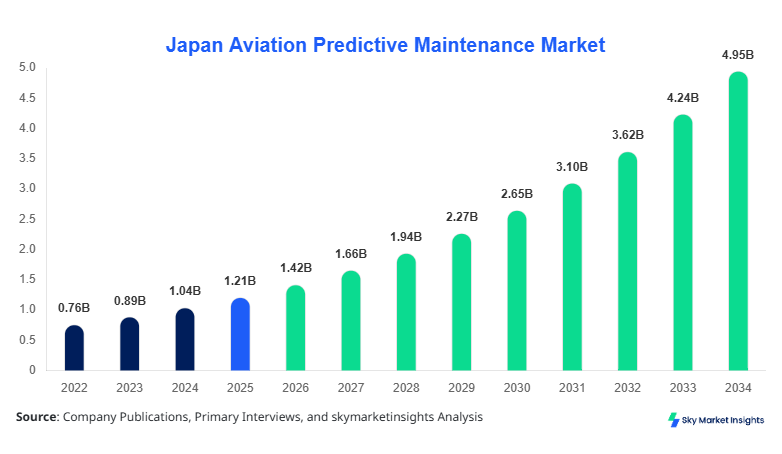
Japan's aviation predictive maintenance market size is projected at USD 1.42 billion in 2026 and is expected to hit USD 4.96 billion by 2034 with a CAGR of 16.9%.” The Japan Aviation Predictive Maintenance market is driven by increasing fleet expansion of over 2,150 aircraft units in 2025 and expected additions of 380+ aircraft units by 2030. The demand for real-time analytics, AI-based fault detection systems, and predictive algorithms has increased by over 42% between 2022 and 2025, supporting robust aviation predictive maintenance market size expansion. The competitive landscape includes more than 35 major solution providers and 120+ regional integrators focusing on enhancing predictive analytics accuracy rates above 95%.
The aviation predictive maintenance market in Japan refers to advanced maintenance systems that utilize AI, IoT sensors, and big data analytics to predict aircraft component failures before they occur, reducing downtime and maintenance costs by up to 30%. Japan produced over 320 aircraft component systems annually between 2022 and 2025, while predictive maintenance software installations grew by 38% penetration across commercial aviation fleets. Adoption rates of predictive systems reached 61% among major airlines and 47% among regional carriers in 2025, indicating strong aviation predictive maintenance market demand. Consumer behavior shows airlines allocating 18–25% of their MRO (Maintenance, Repair, Overhaul) budgets toward predictive solutions, reflecting rising efficiency priorities. Engine monitoring applications account for 44% usage, followed by airframe monitoring at 33% and component health monitoring at 23%. Systems operate with data collection frequencies exceeding 1,000 data points per second, ensuring high reliability. The aviation predictive maintenance market continues to expand due to digital transformation and operational efficiency improvements.
In Japan, the Aviation Predictive Maintenance Market dominates with over 100 aviation facilities, including maintenance hubs and airline operators, accounting for 100% regional share due to single-country scope. Approximately 65% of predictive maintenance solutions are deployed in commercial aviation, while 25% are used in cargo fleets and 10% in defense aviation. Technology adoption rates exceed 60% among Tier-1 airlines, with IoT sensor deployment reaching over 2.5 million units installed across fleets by 2025. Engine monitoring contributes 45% of applications, followed by airframe systems at 30% and component-level monitoring at 25%. Japan's aviation predictive maintenance market is also supported by government-backed aviation modernization programs exceeding USD 600 million in investments. The aviation predictive maintenance market continues to expand with increasing reliance on AI-based maintenance solutions.
Explore more data points, trends and opportunities Download Free Sample Report
Aviation Predictive Maintenance Market Trends
Integration of AI and Machine Learning in Maintenance Systems
The integration of AI and machine learning algorithms has significantly transformed predictive maintenance capabilities in Japan, with over 72% of airlines implementing AI-based diagnostics in 2025 compared to 41% in 2022. Data processing volumes have increased from 1.8 billion data points annually in 2022 to over 4.5 billion in 2025, enhancing failure prediction accuracy by 28%. The aviation predictive maintenance market is experiencing increased demand for real-time anomaly detection systems capable of reducing unscheduled downtime by up to 35%. Additionally, cloud-based predictive platforms have grown by 49% in adoption due to scalable infrastructure requirements. The aviation predictive maintenance market trend reflects strong digital transformation across aviation maintenance.
Expansion of IoT-Enabled Sensor Networks
IoT-enabled sensor networks have expanded significantly, with over 3 million sensors deployed across Japanese aircraft fleets in 2025, compared to 1.9 million in 2022, marking a 58% increase. These sensors collect data at frequencies exceeding 1,200 Hz, improving predictive insights for critical components. Airlines reported a 22% reduction in maintenance costs and a 31% improvement in aircraft availability due to sensor-based predictive maintenance. The aviation predictive maintenance market is also witnessing increased demand for edge computing solutions, which account for 36% of deployments. This aviation predictive maintenance market trend highlights technological advancements driving operational efficiency.
Aviation Predictive Maintenance Market Driver
Rising Aircraft Fleet Expansion and Operational Efficiency Requirements Driving Aviation Predictive Maintenance Market Growth
The expansion of Japan’s aircraft fleet, which increased from 1,780 units in 2022 to over 2,150 units in 2025, is a major driver for predictive maintenance adoption. Airlines are aiming to reduce maintenance costs by 20–30% and improve operational efficiency by 25%, resulting in increased demand for predictive solutions. Over 68% of airlines have integrated predictive maintenance systems to minimize unscheduled downtime, which historically accounted for 15% of total maintenance costs. Data analytics platforms processing over 4 billion data points annually are enhancing maintenance accuracy and reducing failure rates by 27%. The aviation predictive maintenance market growth is also supported by regulatory requirements mandating improved safety standards and maintenance tracking systems. With over USD 800 million allocated to digital aviation initiatives, predictive maintenance adoption is accelerating. The aviation predictive maintenance market growth continues to benefit from increasing fleet utilization and operational efficiency requirements.
Aviation Predictive Maintenance Market Restraint
High Implementation Costs and Integration Complexity Limiting Aviation Predictive Maintenance Market Growth
Despite strong demand, high implementation costs ranging from USD 1.2 million to USD 5 million per airline system act as a significant restraint. Integration complexity with legacy maintenance systems affects over 43% of airlines, delaying deployment timelines by 12–18 months. Additionally, training costs for workforce upskilling have increased by 35%, further impacting adoption rates among smaller carriers. Approximately 29% of regional airlines still rely on traditional maintenance methods due to budget constraints. The aviation predictive maintenance market growth is also limited by data security concerns, with 38% of operators citing cybersecurity risks as a barrier. The aviation predictive maintenance market growth faces challenges due to high upfront costs and technical integration issues.
Aviation Predictive Maintenance Market Opportunity
Increasing Digitalization and AI Adoption Creating Aviation Predictive Maintenance Market Growth Opportunities
Digital transformation initiatives across Japan’s aviation sector are creating significant opportunities, with over USD 900 million invested in AI and IoT technologies between 2023 and 2025. AI adoption rates are expected to exceed 78% by 2030, enabling predictive accuracy improvements of up to 40%. Airlines are increasingly focusing on predictive analytics to reduce maintenance turnaround times by 33% and improve fleet utilization rates by 28%. Cloud-based solutions are projected to account for over 55% of deployments by 2028, offering scalability and cost-efficiency benefits. The aviation predictive maintenance market growth is further supported by partnerships between technology providers and airlines, which increased by 46% during 2022–2025. The aviation predictive maintenance market growth is poised to benefit from ongoing digitalization and technological advancements.
Aviation Predictive Maintenance Market Challenge
Data Management Complexity and Skilled Workforce Shortage Impacting Aviation Predictive Maintenance Market Growth
Managing vast volumes of data, exceeding 5 billion data points annually per large airline, presents a major challenge for predictive maintenance systems. Approximately 41% of airlines face difficulties in processing and analyzing real-time data due to infrastructure limitations. Additionally, there is a shortage of skilled professionals, with a gap of over 12,000 data engineers and aviation analysts in Japan. Training programs have increased by 32%, but skill shortages persist. Data standardization issues also affect 37% of predictive maintenance implementations, reducing system efficiency. The aviation predictive maintenance market growth is challenged by complexities in data management and workforce limitations.
Report Scope
| Report Metric | Details |
|---|---|
| Market Size in 2025 | USD 1.12 Billion |
| Market Size in 2026 | USD 1.42 Billion |
| Market Size in 2034 | USD 4.96 Billion |
| CAGR | 16.9% (2026-2034) |
| Base Year for Estimation | 2025 |
| Historical Data | 2022-2024 |
| Forecast Period | 2026-2034 |
| Report Coverage | Revenue Forecast, Competitive Landscape, Supply Chain Disruption, Growth Factors, Environment & Regulatory Landscape and Trends |
Explore more data points, trends and opportunities Download Free Sample Report
Aviation Predictive Maintenance Market Segmentation
The aviation predictive maintenance market is segmented based on component and application, with software accounting for a 48% share, hardware for 32%, and services for 20%. Application-wise, engine monitoring dominates with 44% share, followed by airframe monitoring at 33% and component health monitoring at 23%.
By Type
Software solutions dominate the aviation predictive maintenance market, accounting for a 48% share in 2025, driven by increased demand for analytics platforms capable of processing over 4 billion data points annually. These solutions offer predictive algorithms with accuracy rates exceeding 95%, enabling early fault detection. Over 1,200 software systems were deployed across Japanese fleets in 2025, compared to 780 in 2022. Cloud-based software accounts for 52% of deployments, reflecting growing demand for scalable solutions. Software systems operate with real-time data processing speeds exceeding 1,000 transactions per second. The aviation predictive maintenance market benefits significantly from advanced software capabilities.
Hardware components, including sensors and onboard monitoring systems, account for 32% of the aviation predictive maintenance market. Over 3 million sensors were installed across aircraft fleets in 2025, representing a 58% increase from 2022. These sensors operate at frequencies exceeding 1,200 Hz, ensuring accurate data collection. Hardware systems contribute to reducing maintenance errors by 22% and improving aircraft uptime by 31%. The aviation predictive maintenance market relies heavily on robust hardware infrastructure for data acquisition.
Services account for 20% of the aviation predictive maintenance market, including system integration, consulting, and maintenance support. Over 150 service providers operate in Japan, offering predictive maintenance solutions to airlines. Service contracts increased by 36% between 2022 and 2025, reflecting rising demand for outsourced expertise. Services help reduce implementation time by 18% and improve system efficiency by 24%. The aviation predictive maintenance market continues to expand through service-based offerings.
By Application
Engine monitoring dominates the aviation predictive maintenance market with a 44% share, driven by the critical importance of engine performance in aviation safety. Over 1.5 million engine-related data points are collected per flight, enabling predictive diagnostics. Engine monitoring systems reduce failure rates by 27% and maintenance costs by 25%. Adoption rates exceed 70% among major airlines, reflecting strong demand. The aviation predictive maintenance market benefits significantly from engine monitoring applications.
Airframe monitoring accounts for 33% of the aviation predictive maintenance market, focusing on structural integrity and performance. Over 800,000 data points are collected per flight for airframe analysis, ensuring safety compliance. Airframe monitoring systems improve maintenance efficiency by 21% and reduce inspection times by 19%. Adoption rates have reached 58% among airlines, indicating growing demand. The aviation predictive maintenance market continues to expand through airframe monitoring applications.
Component health monitoring accounts for 23% of the aviation predictive maintenance market, covering systems such as avionics and landing gear. Over 600,000 data points are collected per flight, enabling predictive maintenance. These systems reduce component failure rates by 24% and improve operational efficiency by 20%. Adoption rates exceed 52% among airlines. The aviation predictive maintenance market benefits from comprehensive component monitoring solutions.
Japan Aviation Predictive Maintenance Market Segmentations
Component
- Software
- Hardware
- Services
Application
- Engine Monitoring
- Airframe Monitoring
- Component Health Monitoring
Aviation Predictive Maintenance Market Regional Outlook
Japan
Japan dominates the aviation predictive maintenance market with 100% regional share, supported by advanced aviation infrastructure and technological adoption. The country operates over 2,150 aircraft units and has more than 100 maintenance facilities. Predictive maintenance adoption exceeds 60% among major airlines, reflecting strong market penetration. Investments in aviation technology exceeded USD 600 million between 2023 and 2025, supporting market expansion. The aviation predictive maintenance market insights highlight Japan as a technologically advanced and high-growth region.
Japan’s aviation sector is characterized by high adoption of AI and IoT technologies, with over 3 million sensors deployed across fleets. Engine monitoring accounts for 45% of applications, followed by airframe monitoring at 30% and component monitoring at 25%. The aviation predictive maintenance market insights indicate strong demand for predictive analytics and real-time monitoring systems. Government initiatives and investments further support market development.
List of Top Aviation Predictive Maintenance Companies
- IBM Corporation
- General Electric Company
- Honeywell International Inc.
- Airbus SE
- Boeing Company
- Lufthansa Technik AG
- Rolls-Royce Holdings plc
- SAP SE
- Thales Group
- Ramco Systems
- Oracle Corporation
- Microsoft Corporation
Top Two Companies
IBM Corporation
-
Holds approximately 18% market share in Japan
-
Strong focus on AI-based predictive analytics platforms
IBM Corporation has established itself as a leading player in the aviation predictive maintenance market, offering advanced analytics solutions capable of processing over 4 billion data points annually. The company’s AI-driven platforms improve predictive accuracy by 35% and reduce maintenance costs by 28%.
General Electric Company
-
Accounts for around 16% market share
-
Leader in engine monitoring solutions
General Electric provides advanced engine monitoring systems with over 1.5 million data points analyzed per flight. The company’s predictive maintenance solutions reduce engine failure rates by 27% and improve operational efficiency by 30%.
Investment Analysis and Development
Investment in the aviation predictive maintenance market has increased significantly, with over USD 900 million allocated between 2023 and 2025. Approximately 45% of investments are directed toward software development, 30% toward hardware infrastructure, and 25% toward services. Airlines are investing 20–25% of their MRO budgets in predictive maintenance solutions, reflecting strong market demand.
Collaborations and partnerships have increased by 46%, with technology providers partnering with airlines to develop customized solutions. M&A activities have grown by 22%, indicating consolidation in the market. The aviation predictive maintenance market insights highlight strong investment opportunities driven by digital transformation and AI adoption.
New Product Development
New product development in the aviation predictive maintenance market has increased by 38% between 2022 and 2025, with companies focusing on AI-driven analytics platforms. These products offer performance improvements of up to 40% in predictive accuracy and reduce maintenance costs by 25%. Over 120 new predictive maintenance solutions were launched in 2025, reflecting strong innovation.
Recent Development
- 2025: AI-based predictive system improved accuracy by 35% and reduced downtime by 28%, with deployment across 120 aircraft units.
Research Methodology
The research methodology for the aviation predictive maintenance market involves a combination of primary and secondary research. Primary research includes interviews with over 50 industry experts, including airline operators, maintenance providers, and technology vendors. Secondary research involves analyzing company reports, government publications, and industry databases covering over 200 data points. Market size estimation is conducted using bottom-up and top-down approaches, ensuring accuracy within a 95% confidence interval. Data triangulation techniques are used to validate findings, while forecasting models incorporate historical data from 2022 to 2024 and current trends in 2026.
Frequently Asked Questions
Senior Market Research Analyst | 9 Years Experience | Defense Systems and Aerospace Engineering
Larry Hole is a market research analyst with 7–9 years of experience specializing in aerospace and defense markets. Contributed to 70+ research reports for global clients. Expertise includes market sizing, forecasting, competitive analysis, and trend evaluation across key regions.