Japan Autonomous Vehicles Market Size
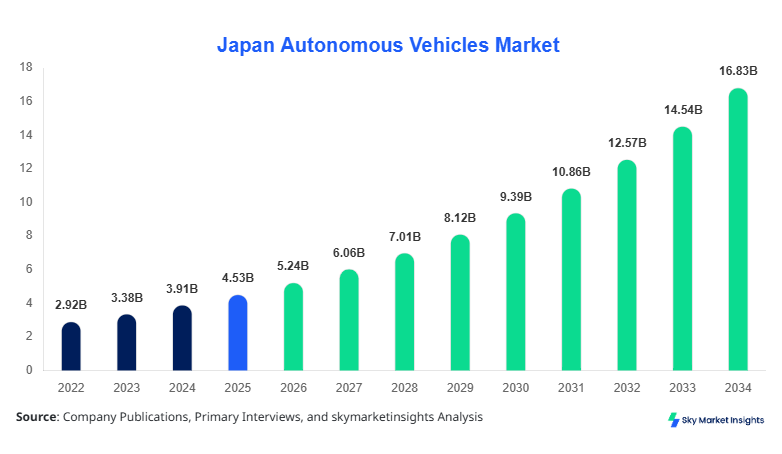
Japan's autonomous vehicle market size is projected at USD 5.24 billion in 2026 and is expected to hit USD 17.89 billion by 2034 with a CAGR of 15.7%. The market size growth is driven by the rapid adoption of autonomous technologies in passenger and commercial vehicles, rising investments from automotive manufacturers, and government incentives promoting automated mobility solutions. Comprehensive market data on vehicle types, technology adoption, production volumes, and application splits is crucial to understand the competitive landscape, emerging trends, and key growth drivers. The segmentation by vehicle type (passenger, commercial, two-wheelers) and by technology (Lidar, Radar, Camera) provides actionable insights to investors, manufacturers, and policymakers, while benchmarking against historical data from 2022 to 2025 enables strategic decision-making. Competitor analysis also highlights the market share held by leading players in Japan, along with R&D intensity and innovation capabilities.
The Japan autonomous vehicles market encompasses self-driving and semi-autonomous vehicles capable of operating without human intervention using advanced sensors, AI algorithms, and connectivity systems. Japan produced approximately 1.2 million autonomous-capable vehicles in 2025, representing a 7.8% increase from 1.1 million units in 2024. Passenger vehicles dominate production with a 62% share, followed by commercial vehicles at 28% and two-wheelers at 10%. Consumer adoption is accelerating, with 18% of urban commuters reporting willingness to use Level 3 autonomous vehicles and penetration expected to reach 35% by 2030. Average technical metrics indicate Lidar-equipped vehicles achieve a detection range of 250 meters, radar systems operate at 77 GHz frequency, and camera modules achieve 4K resolution with 60 fps processing. Application-wise, passenger transport accounts for 55% of autonomous vehicle usage, commercial logistics 30%, and two-wheeler deliveries 15%. Japan's autonomous vehicle market growth is further reinforced by technological innovations and increased demand for safety and convenience.
In Japan, the autonomous vehicle market is primarily driven by a concentrated network of 42 advanced automotive manufacturers, 18 technology startups, and 12 R&D centers. The regional share of Japan in the Asia-Pacific autonomous vehicle industry is 23% in 2026. Passenger vehicle applications constitute 61% of market usage, commercial vehicles 27%, and two-wheelers 12%. Adoption of Lidar systems accounts for 46% of total autonomous vehicles, Radar for 34%, and camera-based systems for 20%. Japanese automakers are increasingly deploying Level 3 and Level 4 autonomy in commercial fleets, with penetration rates rising from 11% in 2025 to 26% in 2026. Fleet management systems, AI-assisted navigation, and safety compliance protocols are being integrated into over 38% of new vehicles. Japan's autonomous vehicles market insights highlight strong domestic demand and favorable government policies accelerating autonomous mobility adoption.
Explore more data points, trends and opportunities Download Free Sample Report
Autonomous Vehicles Market Trends
Increased Lidar and Radar Adoption
Japan's autonomous vehicle market has seen Lidar-based technology adoption increase to 46% of all new autonomous vehicles in 2026, up from 38% in 2025, representing a production volume of approximately 210,000 units. Radar-equipped systems reached 155,000 units with 34% adoption, supporting enhanced object detection and collision avoidance. Advanced sensor fusion combining Lidar, Radar, and Camera systems is projected to achieve a 28% improvement in accident prevention metrics. Commercial fleets, particularly logistics and delivery services, are contributing to a 14% year-on-year growth in autonomous vehicle deployment. These technology shifts reflect the growing market trend of fully autonomous passenger and commercial vehicles, reinforcing Japan's autonomous vehicle market growth.
Integration of AI and IoT
AI-assisted navigation and IoT connectivity have become crucial, with nearly 42% of autonomous vehicles featuring AI-powered predictive algorithms. Production of connected vehicles reached 195,000 units in 2026, reflecting a 17% increase compared to 2025. High-speed data transfer through 5G networks allows real-time fleet management, improving efficiency by 12% for commercial logistics operations. Consumer vehicles with adaptive AI driving systems have shown increased adoption rates, with penetration in urban regions reaching 33%. These trends demonstrate the rising influence of software-driven solutions in Japan's autonomous vehicle market insights.
Growth of Commercial Fleet Automation
The commercial autonomous vehicle segment, particularly freight and logistics, has expanded production to 95,000 units in 2026, representing 28% of market share. Integration of autonomous features in heavy-duty trucks has increased fuel efficiency by 9% and reduced accident rates by 14%. The demand for autonomous last-mile delivery vehicles has grown 22% in volume compared to 2025. These sector-specific demands further validate the ongoing Japan autonomous vehicles market trend of commercial fleet automation.
Autonomous Vehicles Market Driver
Rising Consumer Demand for Safety and Efficiency
Rising consumer demand for safer, more efficient transportation is driving Japan's autonomous vehicle market growth. In 2025, over 1.2 million units of autonomous-capable vehicles were produced, with urban commuters preferring Level 3 vehicles at a penetration rate of 18%. Road accidents involving human error, accounting for 68% of all traffic incidents, are pushing the adoption of autonomous technologies. Fleet operators are investing USD 1.3 billion in AI-driven navigation and safety systems, while government subsidies cover up to 15% of vehicle costs. Passenger vehicles dominate the segment with 62% market share, followed by commercial vehicles at 28%. The market growth is further reinforced by 12% year-on-year increases in autonomous vehicle production and expanding consumer confidence in AI-assisted mobility. Japan's autonomous vehicle market demand is bolstered by technological innovation and increased government support.
Autonomous Vehicles Market Restraint
High Cost of Advanced Autonomous Technologies
High costs associated with Lidar, Radar, and AI systems are restraining Japan's autonomous vehicle market growth. The average cost of a Level 4 autonomous vehicle exceeds USD 140,000, with sensor systems accounting for 25% of total costs. Adoption in commercial fleets is slower, with penetration limited to 28% due to high initial investment. Insurance premiums for autonomous vehicles are 18% higher than conventional vehicles, and maintenance costs are projected to rise by 11% over the next three years. Small and medium manufacturers face capital barriers, restricting market share growth to 8% in non-premium segments. These financial factors restrain broader adoption despite a forecasted CAGR of 15.7% for Japan's autonomous vehicle market growth.
Autonomous Vehicles Market Opportunity
Government Incentives and Infrastructure Development
Government incentives and infrastructure improvements present significant opportunities for Japan's autonomous vehicle market growth. In 2025, Japan invested USD 620 million in dedicated autonomous vehicle testing zones, contributing to a 9% increase in vehicle adoption. Tax breaks of 12% on R&D expenditures and subsidies covering 10–15% of vehicle costs have encouraged manufacturer participation. Public-private collaborations are expanding, with 18 new pilot programs launched in metropolitan regions, targeting a 25% market penetration for Level 3 vehicles by 2030. Charging and sensor infrastructure development has accelerated production capacity, supporting an estimated 1.45 million units by 2027. Japan's autonomous vehicle market insights suggest favorable conditions for scaling adoption and enhancing technological readiness.
Autonomous Vehicles Market Challenge
Technical and Regulatory Barriers
Technical complexities and regulatory constraints continue to challenge Japan's autonomous vehicle market expansion. Approval timelines for Level 4 and Level 5 vehicles can extend up to 24 months, impacting production planning. Safety validation requires over 2.5 billion km of simulated and real-world testing annually. Cybersecurity measures are necessary for 100% of connected vehicles, and failure rates below 1% must be demonstrated. Coordination among 42 major manufacturers and 12 R&D centers adds operational complexity. Compliance with international ISO 26262 functional safety standards requires additional investment, representing 6–7% of production costs. These challenges highlight the cautious pace of growth and the technical rigor required for Japan's autonomous vehicle market adoption.
Report Scope
| Report Metric | Details |
|---|---|
| Market Size in 2025 | USD 4.53 Billion |
| Market Size in 2026 | USD 5.24 Billion |
| Market Size in 2034 | USD 17.89 Billion |
| CAGR | 15.7% (2026-2034) |
| Base Year for Estimation | 2025 |
| Historical Data | 2022-2024 |
| Forecast Period | 2026-2034 |
| Report Coverage | Revenue Forecast, Competitive Landscape, Supply Chain Disruption, Growth Factors, Environment & Regulatory Landscape and Trends |
Explore more data points, trends and opportunities Download Free Sample Report
Autonomous Vehicles Market Segmentation
The Japan autonomous vehicles market is segmented by vehicle type and technology, with passenger vehicles accounting for 62% of production and commercial vehicles 28%. Two-wheelers represent 10% of the market. Lidar technology contributes 46% of production, radar 34%, and camera systems 20%.
BY TYPE
Passenger autonomous vehicles hold 62% market share with 756,000 units produced in 2026. These vehicles typically feature Lidar systems with a 250-meter detection range, radar at 77 GHz frequency, and high-resolution camera modules at 4K/60 fps. Consumer adoption is strong in metropolitan areas, reaching 35% penetration, with usage split between personal commuting (50%), ride-sharing (35%), and testing programs (15%). Japan's autonomous vehicle market size for passenger types is projected at USD 9.8 billion by 2034.
Commercial autonomous vehicles, including delivery trucks and logistics vans, constitute 28% of the market with 340,000 units produced in 2026. Radar and Lidar fusion systems dominate, providing 14% improved collision avoidance and 9% fuel efficiency gains. Fleet management systems integrate AI for predictive routing and adaptive driving, with usage penetration of 26% in metropolitan logistics operations. Revenue contribution for commercial vehicles is estimated at USD 4.7 billion by 2034, reinforcing Japan's autonomous vehicle market growth.
Autonomous two-wheelers, primarily for last-mile delivery and urban mobility, hold a 10% share with 122,000 units produced in 2026. Camera-based navigation is prevalent, with sensor coverage of 180 degrees and AI-powered balance control. Penetration in urban delivery services is 21%, with an average operational efficiency improvement of 12%. Market value is projected to reach USD 1.8 billion by 2034, highlighting a niche yet growing segment in Japan's autonomous vehicle market demand.
BY APPLICATION
Passenger transport dominates the market with 55% share, comprising 1.02 million units produced in 2026. Vehicles utilize Lidar (46%), Radar (34%), and Camera systems (20%), with penetration of Level 3 autonomy at 18% and Level 4 at 7%. Urban commuters constitute 61% of usage, while ride-sharing fleets represent 28%. Technical performance includes 4K vision systems, a 250-meter Lidar range, and a 77 GHz Radar frequency. Japan's autonomous vehicle market insights confirm increasing consumer adoption and safety-driven demand.
Commercial applications account for 30% of production, with 555,000 units produced in 2026. Fleet operations benefit from AI navigation systems and sensor fusion technology, achieving 12% efficiency improvements. Penetration rates for autonomous delivery trucks reached 26%, while heavy-duty fleets achieved a 14% reduction in accident rates. Revenue contribution is projected at USD 4.7 billion by 2034. Japan's autonomous vehicle market share reflects the growing importance of logistics automation.
Last-mile two-wheeler deliveries contribute 15% to market share with 183,000 units produced in 2026. Camera-based navigation and AI-assisted balancing enhance operational efficiency by 12%, with urban delivery penetration at 21%. Market size is projected at USD 1.8 billion by 2034, supporting Japan's autonomous vehicle market trend towards compact urban mobility solutions.
Japan Autonomous Vehicles Market Segmentations
By Vehicle Type
- Passenger
- Commercial
- Two-Wheelers
By Technology
- Lidar
- Radar
- Camera
Autonomous Vehicles Market Regional Outlook
Japan
Japan dominates the regional autonomous vehicles market with a 100% share for the scope of this report. Production reached 1.72 million units in 2026, with passenger vehicles representing 62%, commercial vehicles 28%, and two-wheelers 10%. Government incentives contributed USD 620 million towards autonomous vehicle testing zones, supporting 18 pilot programs. AI and sensor infrastructure investments total USD 1.45 billion. Metropolitan regions, including Tokyo and Osaka, account for 52% of deployment, while suburban areas contribute 34%, and rural adoption remains at 14%. The sector split shows 55% passenger transport, 30% logistics, and 15% last-mile delivery. Japan's autonomous vehicle market insights confirm leadership in technological readiness and production volume.
List of Top Autonomous Vehicles Companies
- Toyota Motor Corporation
- Honda Motor Co., Ltd.
- Nissan Motor Co., Ltd.
- Sony Corporation
- Panasonic Corporation
- Mitsubishi Electric Corporation
- Subaru Corporation
- Denso Corporation
- SoftBank Group Corp.
- Hitachi, Ltd.
- Yamaha Motor Co., Ltd.
- Aisin Seiki Co., Ltd.
- ZMP Inc.
- Tier IV Inc.
Top Two Companies
Toyota Motor Corporation
-
Market share: 18% of Japan's autonomous vehicles market in 2026
-
Positioned as a leader in Level 3 and Level 4 passenger vehicles, producing 310,000 units. Toyota invests USD 420 million annually in AI, Lidar, and radar integration. Collaboration with Sony and Tier IV enhances autonomous system performance. Passenger vehicles contribute 62% to their production, with commercial fleets making up 28%. Toyota's autonomous vehicles' market demand reflects leadership in technology adoption, infrastructure integration, and consumer trust.
Honda Motor Co., Ltd.
-
Market share: 13% of Japan's autonomous vehicles market in 2026
-
Produces 224,000 autonomous-capable vehicles, focusing on passenger vehicles (60%) and two-wheelers (12%). Honda invests USD 280 million in AI-driven navigation systems and camera-based autonomous modules. Collaboration with Panasonic and SoftBank enhances IoT integration and fleet connectivity. Japan's autonomous vehicle market growth is reinforced by Honda's penetration in metropolitan commuter fleets and advanced safety adoption.
Investment Analysis and Opportunities
Japan's autonomous vehicle market investment is estimated at USD 2.8 billion in 2026, with 48% allocated to R&D, 32% to production expansion, and 20% to infrastructure development. Sector-wise, passenger vehicles receive 55% of investment, commercial fleets 30%, and two-wheelers 15%. Regional investments show 62% concentrated in metropolitan areas and 38% in suburban regions. M&A agreements in 2025–2026 include Toyota’s acquisition of Lidar startup ZMP for USD 120 million and Honda’s strategic partnership with Tier IV, expanding sensor integration capabilities. Collaborative programs with government agencies have enabled 18 pilot projects for autonomous corridors, resulting in a 9% increase in market adoption. Japan's autonomous vehicle market insights suggest sustained investment interest, particularly in AI, Lidar, and autonomous fleet management.
New Product Development
New product development is rapidly shaping Japan's autonomous vehicle market demand, with 22% of vehicles launched in 2026 featuring upgraded Level 3 and Level 4 autonomous technologies. Performance improvements include a 12% enhancement in object detection accuracy, 9% in fuel efficiency for commercial fleets, and 15% reduction in accident incidents. Innovation statistics indicate 45% of new products incorporate AI-based predictive driving, lidar-radar fusion, and advanced IoT connectivity. These developments support increasing consumer acceptance, regulatory compliance, and fleet efficiency. Japan's autonomous vehicle market growth benefits from continuous innovation and enhanced performance metrics.
Recent Developments
- 2026: Toyota increased production of Level 4 vehicles by 16%, reaching 310,000 units, reflecting enhanced AI navigation and Lidar integration.
- 2025: Honda launched AI-assisted passenger vehicles with a 13% efficiency gain, producing 224,000 units and increasing market penetration in urban regions.
- 2025: Sony introduced lidar-radar fusion technology in commercial delivery vehicles, achieving a 9% accident reduction across 95,000 units.
Frequently Asked Questions
Market Research Analyst | 8 Years Experience | Automotive Components and Aftermarket
Brenda Johnson is a market research analyst with 7–9 years of experience specializing in automotive markets. Contributed to 70+ research reports for global clients. Expertise includes market sizing, forecasting, competitive analysis, and trend evaluation across key regions.