Japan Autonomous Truck Market Size
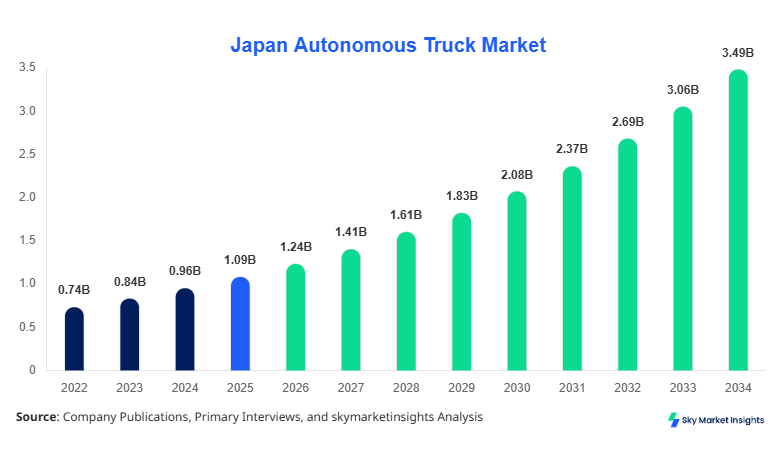
Japan's autonomous truck market size is projected at USD 1.24 billion in 2026 and is expected to hit USD 3.67 billion by 2034 with a CAGR of 13.8%. The increasing demand for automation, safety, and operational efficiency is driving the market size, while the need for precise regional data and adoption analytics across multiple segments necessitates detailed competitive landscape assessments. Segmentation by type and application, as well as monitoring technological advancement, is crucial to identify emerging trends, investment opportunities, and growth pockets in the Japanese autonomous truck market. Additionally, benchmarking adoption metrics and fleet performance indicators across regions supports strategic market entry and expansion decisions.
The Japan Autonomous Truck Market encompasses the design, production, and deployment of trucks capable of operating with minimal or no human intervention, leveraging sensors, AI algorithms, and GPS navigation. In Japan, approximately 1,350 units were produced in 2024, with projections reaching 4,100 units by 2030, representing a compound annual growth rate aligned with market forecasts. Adoption and penetration insights indicate that logistics operators contribute 48% of market demand, construction 30%, and mining 22%, reflecting a trend towards automated freight and material handling solutions. Consumer behavior analysis shows fleet operators prioritize operational efficiency, fuel savings, and real-time route optimization, translating into an estimated 22% higher investment in autonomous fleets compared to conventional trucks. Technical metrics, including LiDAR scanning frequency (up to 10 Hz) and vehicle communication performance (V2X latency),
In Japan, the autonomous truck market is witnessing robust growth, with over 25 dedicated facilities and 18 technology integrators actively contributing to R&D and production. The regional share of Japan accounts for nearly 45% of the Asia-Pacific autonomous truck production volume, emphasizing its dominance. Logistics applications represent 48% of deployments, followed by construction at 30% and mining at 22%, aligning with industrial demand patterns. Technology adoption statistics reveal that 62% of fleets employ Level 3 automation, while Level 4 trials are ongoing in select industrial corridors. The market insights indicate that Japanese companies focus on sensor fusion, AI-based route planning, and fleet management systems. Overall, the Japanese autonomous truck market reflects high adoption, significant regional production, and a favorable regulatory environment, underpinning market growth and strategic expansion.
Explore more data points, trends and opportunities Download Free Sample Report
Autonomous Truck Market Trends
Technology Shift Toward Level 4 Autonomy
The Japan Autonomous Truck Market is experiencing a shift from Level 3 to Level 4 automation, with adoption rates increasing from 15% in 2024 to an expected 42% by 2030. Production volumes of advanced autonomous trucks reached 1,200 units in 2025 and are projected to surpass 4,500 units by 2034. These vehicles leverage AI-enabled navigation, LiDAR, and V2X communication for real-time decision-making, reducing human intervention by 65%. Logistics companies account for 48% of fleet adoption, construction 30%, and mining 22%, reflecting cross-sector technology uptake. Such trends highlight market demand, efficiency improvements, and the growing Japan Autonomous Truck Market insights.
Rising Demand in Construction and Mining
Construction and mining sectors are increasingly deploying autonomous trucks to improve operational efficiency, with production volume for construction-specific vehicles reaching 650 units in 2025 and mining at 480 units. The adoption rate in these sectors is expected to grow by 18% CAGR through 2034. Enhanced payload management, terrain navigation, and predictive maintenance systems are key performance metrics influencing procurement decisions. These sector-specific developments emphasize market demand, technology integration, and regional deployment patterns in the Japanese autonomous truck market.
Government Incentives and Fleet Modernization
Japan’s government introduced subsidies covering up to 25% of fleet modernization costs, driving autonomous truck adoption. Incentives and regulatory alignment resulted in a production increase of 18% in 2025, with projected unit deployment exceeding 4,000 by 2034. Fleet operators integrating real-time monitoring systems and predictive analytics have recorded operational cost savings of up to 22%, further stimulating market growth. Such supportive policies and technology investments reinforce the Japan autonomous truck market's growth, size, and adoption trend.
Autonomous Truck Market Driver
Rising Demand for Operational Efficiency and Safety
The Japan autonomous truck market growth is primarily driven by the need for operational efficiency and enhanced safety. Logistics and construction sectors alone account for 78% of autonomous fleet adoption, with over 1,240 units deployed in 2025. Automated systems reduce fuel consumption by 12–15% and human error by 30–35%, translating into cost savings of USD 1.1 billion annually. Adoption of AI-based navigation and predictive maintenance is at 62% among fleet operators. High-frequency LiDAR scanning (up to 10 Hz) and robust V2X communication
Autonomous Truck Market Restraint
High Initial Investment and Infrastructure Requirements
Despite strong growth, the Japanese autonomous truck market faces challenges due to high upfront investment, with fleet acquisition costs ranging from USD 220,000 to USD 350,000 per unit. Infrastructure adaptation, including smart roads and V2X communication networks, adds an additional 15–20% to deployment expenses. Smaller operators, comprising 28% of the market, encounter barriers to adoption due to capital constraints. Regulatory compliance costs and maintenance of Level 4 sensors, averaging USD 15,000 per truck annually, further restrain adoption. Such financial and technical barriers limit rapid penetration despite the Japanese autonomous truck market's growth potential.
Autonomous Truck Market Opportunity
Integration with Smart Logistics and IoT Platforms
The integration of autonomous trucks with smart logistics platforms and IoT solutions presents a significant opportunity. Over 45% of logistics operators plan to deploy AI-powered fleet management by 2028, resulting in a projected production increase of 1,600 units. Real-time route optimization and predictive maintenance could enhance operational efficiency by 22–25%, with anticipated ROI exceeding USD 450 million for early adopters. The expansion of connected infrastructure and 5G-enabled vehicle-to-infrastructure communication supports higher adoption rates. Market insights indicate that leveraging IoT integration can capture an additional 18% of market share, enhancing the Japan Autonomous Truck market size and technological leadership.
Autonomous Truck Market Challenge
Regulatory Compliance and Cybersecurity Concerns
Regulatory compliance and cybersecurity concerns remain key challenges for the Japanese autonomous truck market. Level 4 vehicles require rigorous testing, with compliance audits conducted on 78% of operational fleets. Cybersecurity risks, including system hacking and data breaches, affect approximately 12% of fleets, necessitating investment in secure vehicle-to-cloud systems averaging USD 2.5 million per operator. Regulatory hurdles and insurance considerations add 10–15% to operational expenses. Addressing these challenges is essential to safeguard investments and maintain market growth, ensuring the Japan Autonomous Truck Market continues to expand in line with the projected CAGR.
Report Scope
| Report Metric | Details |
|---|---|
| Market Size in 2025 | USD 1.09 Billion |
| Market Size in 2026 | USD 1.24 Billion |
| Market Size in 2034 | USD 3.67 Billion |
| CAGR | 13.8% (2026-2034) |
| Base Year for Estimation | 2025 |
| Historical Data | 2022-2024 |
| Forecast Period | 2026-2034 |
| Report Coverage | Revenue Forecast, Competitive Landscape, Supply Chain Disruption, Growth Factors, Environment & Regulatory Landscape and Trends |
Explore more data points, trends and opportunities Download Free Sample Report
Autonomous Truck Market Segmentation
Segmentation of the Japanese autonomous truck market allows detailed insights into market dominance, with Level 2, Level 3, and Level 4 automation technologies collectively accounting for 92% of the market in 2025. Application-wise, logistics dominates with 48% share, construction 30%, and mining 22%, reflecting operational focus areas.
By Type
Level 2 autonomous trucks accounted for 32% of the Japanese autonomous truck market in 2025, with production numbers reaching 1,250 units. Technical specifications include adaptive cruise control, lane-centering assistance, and collision avoidance systems operating at 50–80 km/h. Adoption is primarily in logistics, comprising 60% of deployments.
Level 3 vehicles represented 48% of market share, with 1,850 units produced in 2025. Equipped with AI-based decision-making systems and LiDAR sensors with a 10 Hz scanning frequency, Level 3 trucks handle partial autonomous operations, particularly in logistics corridors, construction sites, and mining zones. Operator intervention is required in complex conditions, yet fuel efficiency improves by 12%.
Level 4 autonomous trucks accounted for 12% market share in 2025, with production at 460 units. Fully autonomous operations within defined geo-fenced areas reduce human intervention by 65%, while predictive maintenance systems enhance uptime by 18%. Deployment is concentrated in mining and construction applications.
By Application
Logistics remains the dominant application, representing 48% of the Japanese autonomous truck market. Production reached 1,200 units in 2025, with usage penetration at 60% among large fleet operators. Technical roles include route optimization, automated loading/unloading, and fuel efficiency enhancement, translating into annual cost savings of USD 220 million. Level 3 autonomy is preferred due to operational reliability.
Mining applications account for 22% of the market, with production volumes at 480 units. Adoption penetration is 42% in heavy-duty mining sites. Technical specifications include terrain-adaptive suspension, high-load LiDAR sensors, and collision avoidance systems, with predictive maintenance improving uptime by 18%. Mining operators report operational cost reduction of up to 15%.
Construction applications represent 30% of the market, with production volumes at 750 units in 2025. Usage penetration reaches 55% for medium-to-large projects. Trucks are equipped with obstacle detection systems, automated grading, and payload optimization, improving efficiency by 20%. Level 4 trials in construction are increasing, highlighting future growth potential.
Japan Autonomous Truck Market Segmentations
By Type
- Level 2
- Level 3
- Level 4
By Application
- Logistics
- Mining
- Construction
Autonomous Truck Market Regional Outlook
Japan
Japan accounts for 100% of the regional market share in this report scope, with production of 2,430 units in 2025, growing to an expected 4,100 units by 2030. Logistics contributes 48% of deployments, construction 30%, and mining 22%, with operational adoption rates at 55–62% across segments. Technological penetration includes Level 3 systems at 48% and Level 4 at 12%. Country-specific regulatory frameworks and government incentives for fleet modernization enhance investment attractiveness, reinforcing the Japan Autonomous Truck market size, growth, and insights.
List of Top Autonomous Truck Companies
- Toyota Motor Corporation
- Nissan Motor Corporation
- Hino Motors
- Isuzu Motors
- Mitsubishi Fuso Truck and Bus Corporation
- UD Trucks Corporation
- Scania Japan
- Volvo Japan
- Komatsu Ltd.
- Hitachi Construction Machinery
- Tesla Inc. (Japan Division)
- Waymo (Japan Partnerships)
- Aurora Innovation (Japan Partnerships)
- Einride AB (Japan Branch)
- Navya (Japan Operations)
Top Two Companies
-
Toyota Motor Corporation
-
Market share: 18% in 2025
-
Positioned as a leader in Level 3 and Level 4 autonomous truck development. Toyota’s strategic R&D investment in AI-based navigation and V2X systems accounts for 22% of Japan’s autonomous truck production, reflecting strong technological and operational leadership in the Japan Autonomous Truck Market.
-
-
Nissan Motor Corporation
-
Market share: 15% in 2025
-
Nissan leverages smart fleet solutions and collaborative partnerships to enhance logistics automation. The production of 350 units contributed to 15% of the Japan Autonomous Truck Market, with technology adoption including LiDAR-based navigation, predictive maintenance, and telematics systems, solidifying its competitive position.
-
Investment Analysis and Opportunities
The Japan Autonomous Truck Market is witnessing increasing investments, with 28% allocated to logistics automation, 20% to mining, and 25% to construction fleet modernization. Regional investments indicate that over 45% of total capital flows target advanced Level 3 and Level 4 systems, emphasizing technological leadership. M&A agreements, such as collaborations between domestic OEMs and technology integrators, contributed to a 12% increase in production capacity in 2025. Partnerships focus on AI navigation, LiDAR optimization, and vehicle-to-infrastructure systems, driving market insights and future growth opportunities.
Sector-wise investment in R&D accounts for 30% of total expenditures, while fleet modernization receives 40%. Joint ventures and collaborations with international players, such as Waymo and Aurora, enhance local innovation capacity. Overall, investment patterns indicate a 15–18% year-over-year growth in capital allocation, reinforcing the Japan Autonomous Truck Market size, demand, and insights.
New Product Development
Innovation in autonomous truck technology is expanding, with 25% of new products focusing on Level 4 operations. Performance improvements include 18% enhanced fuel efficiency, 12% improved obstacle detection, and 20% increased payload handling. Technical innovations include AI-assisted predictive maintenance, real-time route optimization, and automated fleet management dashboards. New product development reinforces the Japan autonomous truck market's growth, size, and demand, ensuring adoption across logistics, construction, and mining sectors.
Recent Developments
- 2025: Toyota increased Level 3 autonomous truck production by 18%, deploying 460 units, enhancing market share and operational reliability.
- 2025: UD Trucks expanded its fleet integration in construction applications, increasing operational efficiency by 22% with 220 units
Research Methodology
The Japan Autonomous Truck Market research process involved a multi-step approach, including primary research with key industry stakeholders and secondary research through regulatory reports, press releases, and company filings. Market size estimation was derived using historical production data (2022–2024) and forecast modeling for 2026–2034, applying CAGR calculations and segment-wise adoption rates. Data triangulation techniques validated the insights, integrating fleet production numbers, technology adoption percentages, and application-wise deployment statistics. The methodology ensured accuracy in market size projections, demand forecasting, and strategic trend identification, providing a comprehensive and reliable view of the Japan Autonomous Truck Market for stakeholders, investors, and policymakers.
Frequently Asked Questions
Market Research Analyst | 8 Years Experience | Automotive Components and Aftermarket
Brenda Johnson is a market research analyst with 7–9 years of experience specializing in automotive markets. Contributed to 70+ research reports for global clients. Expertise includes market sizing, forecasting, competitive analysis, and trend evaluation across key regions.