Europe Aluminum Trailer Market Size
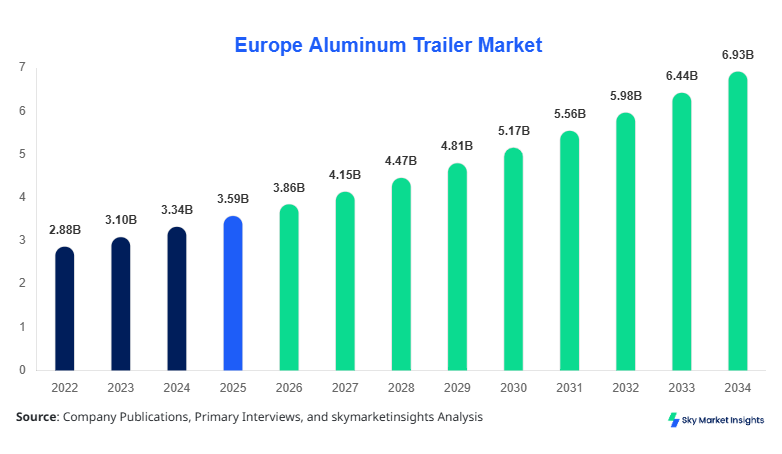
Europe's aluminum trailer market size is projected at USD 3.86 billion in 2026 and is expected to hit USD 6.92 billion by 2034 with a CAGR of 7.58%.
The increasing requirement for lightweight transportation equipment across Europe is accelerating demand for aluminum trailers in logistics, industrial freight, construction, and recreational applications. Rising fleet modernization programs, emission reduction targets, and lightweight vehicle regulations are supporting adoption across regional transport networks. The report evaluates detailed market segmentation, pricing structures, production capacity, consumption analysis, import-export statistics, and the competitive landscape across major European economies.
The aluminum trailer industry refers to the manufacturing, distribution, and utilization of lightweight trailers fabricated primarily from aluminum alloys for cargo transportation, industrial hauling, and commercial logistics. Europe produced more than 1.24 million trailer units in 2025, of which aluminum-based trailer production accounted for approximately 31.4% of total output. The penetration of aluminum trailers increased from 24.8% in 2022 to nearly 32.6% in 2025 due to rising fuel-efficiency mandates and reduced life cycle maintenance requirements. Commercial logistics applications represented nearly 42% of total demand, while construction and recreational transport contributed 28% and 18%, respectively. Aluminum trailer adoption among medium-duty logistics fleets reached 37% across Western Europe owing to weight reduction benefits ranging between 18% and 25% compared to steel-based alternatives. Consumer purchasing behavior indicates that fleet operators prioritize corrosion resistance, payload efficiency, and long-term operational savings, with nearly 61% of buyers preferring aluminum trailers for cross-border freight operations exceeding 500 km weekly. Utility trailers under 3.5 tons contributed 39% of annual sales volume, while enclosed aluminum trailers represented 27% of revenue generation. The increasing integration of anti-corrosion coatings, telematics systems, and modular chassis platforms is strengthening Europe's aluminum trailer market share across industrial transportation ecosystems.
In France, the aluminum trailer market accounted for approximately 23.8% of total European revenue in 2025 owing to strong industrial manufacturing activity and high logistics infrastructure investments. France operated more than 210 aluminum trailer production facilities and component assembly plants across regions including Auvergne-Rhône-Alpes, Île-de-France, and Hauts-de-France. Commercial logistics applications represented nearly 46% of national trailer demand, while agricultural transportation and construction hauling accounted for 22% and 19%, respectively. More than 138,000 aluminum trailer units were sold in France during 2025, reflecting an annual increase of 9.4% compared to 2024. Technology adoption in France accelerated significantly with 58% of manufacturers integrating lightweight composite flooring systems and 41% implementing smart braking technologies. Fleet operators reported average payload efficiency improvements of 17% after transitioning from steel trailers to aluminum variants. Electric commercial vehicle compatibility also increased, with nearly 33% of new trailer platforms designed specifically for EV towing applications. The rapid modernization of freight transport infrastructure and increasing cross-border trade activity continue to strengthen Europe's aluminum trailer market growth.
Explore more data points, trends and opportunities Download Free Sample Report
Aluminum Trailer Market Trends
Increasing Adoption of Lightweight Transport Platforms
The transition toward lightweight freight transportation solutions is emerging as one of the most influential trends across the European trailer manufacturing industry. In 2025, lightweight aluminum trailer shipments exceeded 386,000 units across Europe, compared to 291,000 units in 2022. Fleet operators reported fuel-efficiency improvements ranging between 12% and 18% through the adoption of aluminum chassis structures. Germany, France, and the United Kingdom collectively contributed more than 64% of regional lightweight trailer demand due to expanding logistics operations and stricter carbon-emission regulations. Advanced aluminum alloys with tensile strength exceeding 310 MPa are increasingly replacing conventional steel frameworks, particularly in long-haul freight operations. Approximately 48% of newly manufactured flatbed trailers in Europe incorporated corrosion-resistant marine-grade aluminum during 2025. The increasing penetration of smart load-balancing technologies, digital braking systems, and aerodynamic trailer designs is further improving transportation efficiency. Growing investments in sustainable transport infrastructure continue supporting the European aluminum trailer market trend.
Integration of Smart Trailer Technologies
Smart trailer integration has accelerated significantly as manufacturers adopt telematics, predictive maintenance systems, and IoT-enabled monitoring platforms. More than 36% of newly produced aluminum trailers in Europe included integrated GPS tracking and load monitoring systems in 2025, compared to only 18% in 2022. Digital fleet management technologies reduced maintenance costs by approximately 14% and improved fleet utilization efficiency by 19% among logistics operators. Enclosed aluminum trailers equipped with temperature-monitoring systems recorded annual shipment growth exceeding 11.2%, particularly within the pharmaceutical and food distribution sectors. Manufacturers across Italy and Spain increased investments in electronic stability control systems and remote diagnostic technologies to enhance operational safety standards. Nearly USD 420 million was invested in smart trailer component manufacturing facilities across Europe during 2025. Growing adoption of autonomous fleet technologies and connected transport ecosystems is strengthening Europe's aluminum trailer market demand.
Rising Demand from Recreational and Specialty Transport Applications
Recreational transportation and specialty cargo applications are emerging as major growth areas for aluminum trailer manufacturers. Recreational aluminum trailer registrations increased by 13.7% in 2025, reaching nearly 91,000 units across Europe. Lightweight utility trailers for camping, motorsports, and marine transport represented approximately 16% of total consumer trailer purchases. Scandinavian countries and the United Kingdom reported strong demand growth due to increasing outdoor recreational spending and tourism activities. Specialized horse trailers and motorsport transport trailers recorded production increases exceeding 9.8% annually between 2023 and 2025. Manufacturers introduced modular interior systems and aerodynamic shell structures that improved fuel efficiency by approximately 11% for towing vehicles. Increasing demand for customized lightweight transport platforms and enhanced durability features continues supporting Europe's aluminum trailer market share.
Europe Aluminum Trailer Market Drivers
Expansion of Cross-border Freight and Logistics Infrastructure
The rapid expansion of European logistics and freight transportation infrastructure is driving significant demand for aluminum trailers. Cross-border freight volumes across Europe exceeded 19.4 billion ton-kilometers in 2025, increasing by nearly 8.6% compared to 2023 levels. Logistics operators are increasingly investing in lightweight aluminum trailers to maximize payload efficiency while complying with axle-weight restrictions and emission standards. Approximately 52% of long-haul freight operators across Germany, France, and Italy shifted procurement strategies toward aluminum trailer fleets between 2023 and 2025. The adoption of lightweight trailer systems reduced average fuel consumption by 13% and increased payload capacity by up to 2.4 tons per vehicle. E-commerce expansion also accelerated trailer demand, with online retail freight shipments increasing by 17.1% during 2025. Investments exceeding USD 3.1 billion in European logistics infrastructure modernization projects further stimulated trailer procurement activities. Increasing demand for efficient transportation systems continues supporting Europe's aluminum trailer market growth.
Europe Aluminum Trailer Market Restraints
Volatility in Aluminum Raw Material Pricing and Supply Chain Costs
Fluctuations in aluminum pricing remain a major restraint affecting trailer manufacturers across Europe. Aluminum alloy prices increased by approximately 18% between 2023 and 2025 due to energy cost inflation and global raw material supply disruptions. Manufacturing costs for aluminum trailers increased by nearly 11.6%, reducing profit margins among small and medium-scale manufacturers. More than 43% of trailer producers reported procurement delays related to aluminum sheet and extrusion shortages during 2025. Supply chain disruptions also affected transportation costs, with logistics expenses increasing by 9.3% annually across European industrial corridors. The higher upfront cost of aluminum trailers, which remains approximately 22% to 28% above steel trailer pricing, continues limiting adoption among small fleet operators and budget-sensitive transportation companies. Financing limitations and rising interest rates further constrained purchasing activities across Eastern Europe. Despite long-term operational savings advantages, pricing volatility continues affecting European aluminum trailer market growth.
Europe Aluminum Trailer Market Opportunities
Rising Adoption of Electric Commercial Vehicles and Sustainable Transport
The expansion of electric commercial vehicle fleets across Europe presents substantial opportunities for aluminum trailer manufacturers. Electric trucks require lightweight towing systems to optimize battery efficiency and driving range, increasing demand for aluminum-based trailer platforms. Europe recorded more than 162,000 electric commercial vehicle registrations in 2025, representing annual growth of 31.4%. Approximately 44% of EV fleet operators preferred lightweight aluminum trailers due to weight reduction benefits exceeding 20% compared to conventional alternatives. Government incentives supporting low-emission transport investments reached nearly USD 5.8 billion across Europe during 2025. Trailer manufacturers are increasingly developing EV-compatible chassis systems, regenerative braking integrations, and aerodynamic trailer designs to improve towing efficiency. France and Germany collectively accounted for nearly 57% of electric trailer-related infrastructure investments. The transition toward sustainable logistics systems and emission reduction policies is creating strong European aluminum trailer market demand.
Challenges in Europe: Aluminum Trailer Market
Intensifying Competition from Composite and Hybrid Trailer Materials
The growing adoption of composite and hybrid trailer materials is creating competitive pressure for traditional aluminum trailer manufacturers. Composite trailer platforms offering weight reductions between 28% and 34% compared to steel systems gained approximately 14% market penetration in Europe during 2025. Several logistics operators are evaluating fiber-reinforced polymer trailer technologies for long-haul transportation due to durability and thermal efficiency benefits. Research and development investments in hybrid aluminum-composite structures exceeded USD 290 million across Europe between 2024 and 2025. Smaller aluminum trailer manufacturers face challenges in upgrading production facilities and adopting advanced material engineering technologies due to capital limitations. Additionally, increasing environmental regulations regarding aluminum processing emissions are raising compliance costs for manufacturers. Intense competition, technological transformation requirements, and rising production costs continue impacting the European aluminum trailer market trend.
Report Scope
| Report Metric | Details |
|---|---|
| Market Size in 2025 | USD 3.59 Billion |
| Market Size in 2026 | USD 3.86 Billion |
| Market Size in 2034 | USD 6.92 Billion |
| CAGR | 7.58% (2026-2034) |
| Base Year for Estimation | 2025 |
| Historical Data | 2022-2024 |
| Forecast Period | 2026-2034 |
| Report Coverage | Revenue Forecast, Competitive Landscape, Supply Chain Disruption, Growth Factors, Environment & Regulatory Landscape and Trends |
Explore more data points, trends and opportunities Download Free Sample Report
Aluminum Trailer Market Segmentation
The European aluminum trailer industry is segmented by trailer type and end-use application. Flatbed aluminum trailers accounted for nearly 38% of total revenue in 2025 owing to widespread industrial freight utilization. Commercial logistics remained the leading application segment with approximately 42% market contribution due to expanding transportation and warehousing operations.
By Type
Flatbed aluminum trailers represented the dominant product category with approximately 38% of regional revenue generation in 2025. More than 146,000 flatbed aluminum units were manufactured across Europe during the year due to high utilization in industrial freight transportation and heavy equipment hauling. These trailers typically feature payload capacities ranging between 7 tons and 28 tons while maintaining structural weight reductions of 18% to 24% compared to steel alternatives. Germany and France collectively accounted for over 57% of flatbed trailer production capacity owing to strong logistics and construction industries. The integration of reinforced cross-member designs and corrosion-resistant aluminum alloys improved operational lifespan by approximately 21% in high-humidity environments. Fleet operators increasingly prefer flatbed aluminum trailers for cross-border freight transportation because they reduce fuel consumption by nearly 14% during long-haul operations. Growing industrial cargo movement continues supporting Europe's aluminum trailer market size.
Enclosed aluminum trailers accounted for approximately 31% of total market revenue in 2025, supported by rising demand from pharmaceutical distribution, food logistics, and specialty cargo transport. More than 118,000 enclosed aluminum trailer units were sold across Europe during 2025. These trailers typically utilize insulated sidewall structures with thermal conductivity reduction rates exceeding 19% compared to conventional steel cargo systems. Approximately 46% of pharmaceutical logistics operators in Europe adopted enclosed aluminum trailers equipped with temperature monitoring systems and anti-corrosion interiors. Payload capacities ranged between 3 tons and 14 tons depending on chassis configurations and axle designs. The increasing expansion of cold-chain logistics infrastructure across Spain, Italy, and the United Kingdom contributed significantly to segment growth. Manufacturers also introduced aerodynamic roof structures that improved towing fuel efficiency by approximately 9%. Rising demand for specialized cargo transportation continues driving Europe's aluminum trailer market growth.
Utility aluminum trailers represented nearly 24% of overall sales volume due to increasing demand from recreational transportation, agriculture, and small commercial hauling operations. Utility trailer production exceeded 97,000 units in Europe during 2025, increasing by approximately 12.8% compared to 2023 levels. These trailers typically weigh between 320 kg and 1,400 kg and support payload capacities ranging from 1 ton to 5 tons. Recreational transport applications accounted for approximately 37% of utility trailer demand, while agricultural operations contributed 29%. Scandinavian countries and the United Kingdom emerged as major consumption hubs owing to increasing outdoor recreational activities and motorsport participation. Manufacturers introduced foldable chassis systems, modular sidewall attachments, and lightweight alloy wheel systems to improve towing flexibility and durability. The increasing popularity of lightweight recreational transportation continues to strengthen the European aluminum trailer market trend.
By Application
Commercial logistics represented the largest application segment with approximately 42% of total market revenue in 2025. Europe operated more than 1.8 million commercial freight trailers, with aluminum variants accounting for nearly 34% of the active fleet. Logistics operators increasingly adopted aluminum trailers because payload efficiency improvements reached nearly 17% while maintenance costs declined by approximately 13%. Long-haul freight transportation generated more than 58% of commercial logistics trailer demand. Germany, France, and the United Kingdom collectively contributed nearly 61% of logistics-related trailer consumption. Smart fleet management systems integrated into commercial aluminum trailers improved route optimization efficiency by approximately 11%. The expansion of e-commerce distribution networks and cross-border freight operations continues driving Europe's aluminum trailer market share.
Construction applications accounted for approximately 28% of total aluminum trailer demand due to rising infrastructure development and industrial construction projects across Europe. Construction-related aluminum trailer shipments exceeded 102,000 units in 2025. Heavy-duty flatbed trailers and utility transport systems are widely utilized for hauling industrial equipment, aggregates, and construction materials. Aluminum trailer adoption in construction fleets increased from 18% in 2022 to nearly 27% in 2025 owing to corrosion resistance benefits and improved load efficiency. Italy, Spain, and France reported strong demand growth linked to renewable energy infrastructure projects and highway modernization investments. Specialized construction trailers equipped with reinforced flooring systems and hydraulic loading technologies improved material handling productivity by approximately 16%. Expanding construction activity continues supporting the European aluminum trailer market demand.
Recreational transport applications represented approximately 18% of overall market revenue due to increasing consumer spending on tourism, outdoor sports, and marine transportation activities. Recreational trailer registrations exceeded 91,000 units across Europe during 2025, increasing by approximately 13.7% annually. Utility aluminum trailers used for camping equipment, boats, motorcycles, and motorsports recorded particularly strong demand growth in Scandinavian countries and the United Kingdom. Lightweight trailer designs reduced towing fuel consumption by approximately 10% while improving vehicle maneuverability and safety performance. Manufacturers introduced aerodynamic trailer bodies, foldable utility structures, and corrosion-resistant marine-grade aluminum systems to attract recreational consumers. Increasing recreational mobility and tourism investments continue strengthening Europe's aluminum trailer market growth.
Europe Aluminum Trailer Market Segmentations
Trailer Type
- Flatbed Aluminum Trailers
- Enclosed Aluminum Trailers
- Utility Aluminum Trailers
End-use Application
- Commercial Logistics
- Construction
- Recreational Transport
Europe Aluminum Trailer Market Regional Outlook
United Kingdom
The United Kingdom accounted for approximately 18% of Europe’s aluminum trailer revenue in 2025 due to strong logistics modernization and recreational transport demand. More than 76,000 aluminum trailers were registered across the country during 2025. Commercial freight transportation represented nearly 44% of domestic trailer demand, while recreational applications accounted for approximately 21%. The country’s rapidly expanding e-commerce sector increased regional freight trailer utilization by nearly 14% annually between 2023 and 2025. Aluminum utility trailers gained strong consumer adoption because of lightweight towing compatibility with electric SUVs and commercial EV fleets. Government investments exceeding USD 620 million in sustainable transportation initiatives further accelerated aluminum trailer procurement. Fleet operators across the United Kingdom increasingly adopted telematics-enabled trailer systems and advanced braking technologies to improve logistics efficiency and safety standards.
Germany
Germany remained one of the largest manufacturing hubs for aluminum trailers in Europe, contributing approximately 26% of regional production volume in 2025. The country manufactured more than 158,000 aluminum trailer units during the year owing to strong industrial infrastructure and export-oriented logistics activity. Commercial logistics applications accounted for nearly 48% of domestic demand, while construction and industrial freight represented approximately 24%. Germany’s advanced engineering ecosystem accelerated adoption of aerodynamic trailer technologies, smart fleet monitoring systems, and reinforced aluminum chassis structures. Nearly 53% of German trailer manufacturers integrated IoT-based diagnostics and predictive maintenance technologies into premium trailer platforms. Investments in electric freight mobility and hydrogen-powered transport infrastructure also stimulated lightweight trailer procurement. Germany continues to play a critical role in Europe's aluminum trailer market size.
France
France represented approximately 23.8% of total regional revenue owing to strong freight transportation activity and extensive logistics infrastructure. More than 138,000 aluminum trailer units were sold in France during 2025, supported by industrial modernization and increasing adoption of lightweight transport systems. Commercial logistics applications represented 46% of domestic demand, while agricultural transportation contributed nearly 22%. France also emerged as a major production hub for utility and flatbed aluminum trailers with more than 210 manufacturing and assembly facilities operating nationwide. Technology adoption accelerated significantly with approximately 58% of domestic manufacturers integrating advanced aluminum alloy engineering and telematics-enabled fleet systems. Rising EV fleet deployment and cross-border freight movement continue supporting Europe's aluminum trailer market share.
Spain
Spain accounted for approximately 11% of regional aluminum trailer revenue during 2025 due to expanding agricultural exports and construction infrastructure development. More than 49,000 aluminum trailer units were manufactured or imported across the country during the year. Construction-related applications represented nearly 31% of total trailer demand, while logistics transportation contributed 39%. Spain experienced strong growth in refrigerated enclosed aluminum trailer demand owing to expanding food export operations and pharmaceutical distribution activities. Fleet modernization programs and logistics automation investments improved operational efficiency by approximately 12%. Increasing adoption of corrosion-resistant aluminum utility trailers among agricultural transport operators further strengthened regional demand patterns.
Italy
Italy contributed approximately 12% of Europe’s aluminum trailer revenue in 2025. Industrial freight transport and construction hauling applications represented the primary demand drivers, accounting for nearly 61% of domestic consumption. Italy produced approximately 52,000 aluminum trailer units during 2025, including utility trailers, enclosed cargo systems, and heavy-duty flatbed platforms. Manufacturers increasingly invested in aerodynamic trailer engineering and modular chassis technologies to improve operational efficiency. Recreational aluminum trailer demand also expanded significantly, particularly in marine and motorsport transport sectors. Government infrastructure spending and renewable energy projects contributed substantially to construction-related trailer procurement. The increasing focus on sustainable transport technologies continues strengthening Europe's aluminum trailer market trend.
Russia
Russia represented approximately 10% of regional aluminum trailer consumption in 2025 due to rising industrial freight movement and infrastructure transportation demand. More than 41,000 aluminum trailers were utilized across logistics, mining, and industrial transportation applications during the year. Heavy-duty flatbed trailers accounted for approximately 47% of domestic trailer demand owing to large-scale industrial material transportation requirements. Utility trailer demand also increased by approximately 9% annually across agricultural and recreational sectors. Investments in regional freight corridors and industrial logistics modernization improved aluminum trailer adoption among commercial transport operators. Harsh climatic conditions increased demand for corrosion-resistant aluminum trailer structures capable of operating in extreme weather environments.
Top players in Europe: Aluminum Trailer Market
- Wabash National Corporation
- Great Dane LLC
- Utility Trailer Manufacturing Company
- Featherlite Trailers
- ATC Trailers
- Aluma Ltd.
- Sundowner Trailers
- Bri-Mar Manufacturing
- Ifor Williams Trailers
- Boeckmann Fahrzeugwerke
- Schmitz Cargobull
- Kögel Trailer GmbH
- Humbaur GmbH
- Brian James Trailers
- Cheval Liberté
Schmitz Cargobull
-
Estimated regional market share: 14.2%
-
Strong presence across Germany, France, and Spain
-
Focus on smart logistics and refrigerated aluminum trailer systems
Schmitz Cargobull remains one of the dominant manufacturers in the European trailer industry with strong specialization in lightweight freight transportation systems. The company operates multiple manufacturing facilities across Germany and Spain with annual production capacity exceeding 62,000 trailer units. Approximately 44% of its portfolio includes aluminum-based trailer systems for logistics, refrigerated cargo, and industrial transportation. The company significantly expanded smart telematics integration during 2025, increasing digital fleet compatibility across more than 58% of newly delivered trailer systems. Its extensive dealer and maintenance network across Europe strengthens competitive positioning within the European aluminum trailer market share.
Kögel Trailer GmbH
-
Estimated regional market share: 10.6%
-
Major supplier for industrial freight and construction transport
-
Strong adoption of lightweight aerodynamic trailer platforms
Kögel Trailer GmbH maintains a strong market presence through advanced engineering capabilities and extensive commercial logistics partnerships across Europe. The company produced more than 39,000 trailer units during 2025, with aluminum trailer systems representing approximately 36% of production output. Kögel increased investments in aerodynamic trailer technologies and lightweight structural platforms, reducing vehicle weight by nearly 18% while improving fuel efficiency. The company also expanded modular trailer configurations designed for electric commercial vehicle compatibility. Strategic partnerships with logistics fleet operators and aftermarket service providers continue strengthening its position within the European aluminum trailer market growth.
Investment Analysis
Investments across the European aluminum trailer industry accelerated significantly due to increasing fleet modernization and sustainable transportation initiatives. More than USD 4.8 billion was invested in trailer manufacturing infrastructure, lightweight material engineering, and logistics modernization projects between 2024 and 2025. Approximately 39% of investments were allocated toward commercial logistics trailer production, while construction transport systems accounted for nearly 24%. France and Germany collectively represented 52% of regional manufacturing investments owing to strong industrial infrastructure and government support programs for low-emission transportation technologies.
Private equity participation and strategic acquisitions also increased across the trailer manufacturing ecosystem. Several mid-sized trailer manufacturers entered joint ventures focused on smart telematics integration, EV-compatible trailer platforms, and lightweight modular chassis systems. Mergers and acquisitions activity increased by approximately 16% during 2025, with logistics technology providers and trailer manufacturers forming collaborative partnerships to enhance fleet optimization solutions. Investments in IoT-enabled monitoring systems, predictive maintenance platforms, and aerodynamic trailer technologies improved operational efficiency by approximately 13%.
Infrastructure modernization projects and freight corridor expansion initiatives further stimulated capital expenditure across the region. Spain, Italy, and the United Kingdom collectively allocated more than USD 1.2 billion toward logistics infrastructure upgrades supporting trailer demand expansion. Strategic collaborations between trailer manufacturers and electric vehicle companies also accelerated innovation within the European aluminum trailer market demand.
New Product Developments
Manufacturers across Europe increasingly focused on advanced lightweight engineering, smart telematics integration, and EV-compatible trailer systems. Approximately 27% of newly introduced trailer models during 2025 incorporated high-strength aluminum alloy structures with payload optimization capabilities exceeding 16%. Several manufacturers launched aerodynamic enclosed trailer platforms capable of reducing towing drag by nearly 11%, improving transportation fuel efficiency significantly.
Innovation activity also accelerated in smart trailer technologies. More than 34% of new aluminum trailer products launched in 2025 included GPS-based diagnostics, predictive maintenance systems, and digital load-balancing sensors. Utility trailer manufacturers introduced foldable chassis systems and modular sidewall designs that improved storage flexibility and towing convenience. Increasing R&D investments in corrosion-resistant coatings and lightweight structural engineering continue supporting the European aluminum trailer market trend.
Recent Developments in European Aluminum Trailer Market
- 2025: Schmitz Cargobull expanded its aluminum trailer production capacity by approximately 12% through the establishment of a new lightweight chassis assembly line in Germany. The expansion increased annual production capability by nearly 7,000 units while improving operational automation efficiency by 18%. The facility also integrated smart robotic welding technologies to reduce manufacturing defects and improve structural consistency across logistics trailer platforms.
- 2025: Kögel Trailer GmbH introduced a new EV-compatible flatbed aluminum trailer platform designed specifically for electric commercial vehicles. The newly launched system reduced trailer weight by approximately 19% and improved towing energy efficiency by nearly 14%. The company also expanded aerodynamic engineering capabilities to improve freight transportation sustainability and operational cost efficiency across long-haul logistics operations.
Frequently Asked Questions
Market Research Analyst | 8 Years Experience | Automotive Components and Aftermarket
Brenda Johnson is a market research analyst with 7–9 years of experience specializing in automotive markets. Contributed to 70+ research reports for global clients. Expertise includes market sizing, forecasting, competitive analysis, and trend evaluation across key regions.