Europe Aluminium Market Size
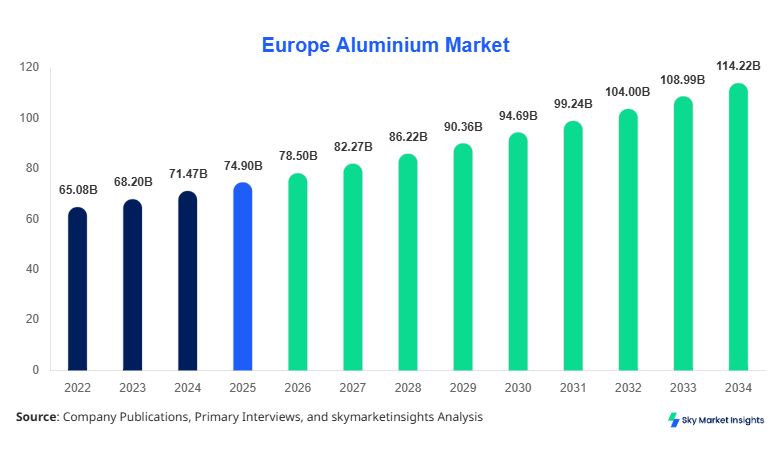
Europe Aluminium market size is projected at USD 78.5 billion in 2026 and is expected to hit USD 112.8 billion by 2034 with a CAGR of 4.8%. The growing demand for lightweight and corrosion-resistant metals in automotive, construction, and packaging industries necessitates accurate data collection, detailed segmentation, and an analysis of competitive landscapes. The market report encompasses historical data from 2022–2024, covering production, consumption, trade, and pricing trends, with a focus on leading countries such as the United Kingdom, Germany, and France.
Europe Aluminium market size insights provide comprehensive coverage of both primary and secondary aluminium production, as well as aluminium alloys, with granular data on applications and technology adoption. The report highlights the importance of precise volume and value tracking for strategic business decisions, emphasizing the need to monitor market share, growth patterns, and industry demand trends across multiple sectors.The report delivers an in-depth understanding of competitive dynamics, including company presence, facility numbers, capacity utilization, and technological adoption rates. Analysts rely on these insights to benchmark performance and identify growth opportunities. Overall, Europe Aluminium market size, share, growth, and trend data provide a robust foundation for stakeholders seeking actionable intelligence in this evolving industry.
Europe Aluminium market growth is supported by regulatory incentives promoting energy efficiency, sustainability initiatives, and increased penetration of aluminium-intensive applications. The report is structured to offer insights into segment-wise demand, highlighting production volumes, regional contributions, and technical specifications. With a multi-year forecast through 2034, businesses can evaluate investment priorities and align strategic planning with projected demand trends.Europe Aluminium market introduction emphasizes the rising preference for aluminium as a lightweight and recyclable material across multiple sectors. In 2025, Europe produced approximately 11.2 million metric tons of aluminium, with primary aluminium accounting for 55%, secondary aluminium 30%, and aluminium alloys 15% of total output. Adoption in the automotive sector stood at 38%, followed by construction at 35% and packaging at 27%. Technical metrics such as thermal conductivity (205 W/mK for primary aluminium) and corrosion resistance (up to 15 years in harsh environments) influence material selection.
Explore more data points, trends and opportunities Download Free Sample Report
Aluminium Market Trends
Shift toward Sustainable Production
Europe Aluminium market latest trends reveal a shift toward sustainable production, with secondary aluminium production increasing from 3.1 million metric tons in 2022 to 3.7 million metric tons in 2025, representing a 19% rise. Adoption of inert anode technology and renewable energy sources in smelting processes has reached 42% of production facilities. Automotive and packaging sectors have seen a 15–20% increase in the use of recycled aluminium, supporting the overall growth of the Europe Aluminium market trend.
The adoption of electric arc furnaces for recycling and low-carbon primary aluminium production is gaining momentum. Europe Aluminium market demand has expanded, driven by stricter CO₂ emission regulations and growing consumer preference for sustainable products. Overall, the market is witnessing enhanced trend adoption in lightweighting and green aluminium production technologies, further reinforcing market insights.
Increasing Automotive Aluminium Usage
Automotive sector adoption of aluminium has surged from 35% in 2022 to 48% in 2025, with production volumes reaching 4.2 million metric tons. Light-weighting initiatives have led to a 12% reduction in vehicle weight, improving fuel efficiency by 8–10%. Europe Aluminium market growth reflects increased demand in electric and hybrid vehicles, with alloys contributing 15% of production and achieving a 65% penetration in structural components.
High-performance aluminium alloys are increasingly used in battery casings and chassis components. Europe Aluminium market trend insights demonstrate the integration of advanced casting and extrusion technologies, improving mechanical performance by 20%. The trend toward aluminium-intensive vehicles underscores the market’s growth potential and sustained demand for high-strength, lightweight materials.
Expansion in Construction Applications
Construction sector adoption of aluminium has increased from 33% in 2022 to 36% in 2025, with building envelope and façade applications representing 1.9 million metric tons. Energy-efficient aluminium profiles and curtain wall systems have achieved adoption rates of 28–32% in urban construction projects. Europe Aluminium market insights indicate that rising infrastructure investments in Germany, France, and the UK are supporting growth, with sustainable and fire-resistant alloys contributing to a 4% increase in overall material demand.
The use of aluminium in modular construction and lightweight structural systems has risen by 15% annually. Europe Aluminium market trend insights further demonstrate sector-specific adoption and the increasing role of high-performance alloys in green building projects, reinforcing market demand and growth prospects.
Europe Aluminium Market Drivers
Rising Automotive and EV Demand
The primary driver for Europe Aluminium market growth is the surging demand for lightweight vehicles and electric vehicles. Automotive applications contributed 38% to the total market in 2025, with production volumes of 4.2 million metric tons and a CAGR of 5.2% projected to 2034. The shift toward electric vehicles has increased aluminium usage in chassis, battery casings, and body panels by 12–15%, while lightweight alloys have achieved a 65% penetration rate in vehicle manufacturing. Investments in automated extrusion and casting facilities are expected to grow by 20% in the next five years, boosting Europe Aluminium market insights and growth potential.
Aluminium’s high recyclability and energy efficiency in secondary production further enhance its attractiveness. Production of recycled aluminium reached 3.7 million metric tons in 2025, representing 33% of total market volume. Europe Aluminium market growth is reinforced by these factors, with applications spanning automotive, aerospace, and packaging sectors, highlighting increasing demand and trend alignment.
Europe Aluminium Market Restraints
Volatility in Raw Material Prices
Europe Aluminium market growth faces restraints from fluctuating bauxite and alumina prices, which have varied by 8–12% annually between 2022–2025. Energy costs account for 25–30% of total production expenses, with smelting electricity prices increasing by 15% in 2025. Price volatility has impacted smaller manufacturers, limiting production capacity growth by 4–5%. These factors constrain Europe Aluminium market demand despite rising consumption in automotive and construction sectors. Secondary aluminium adoption mitigates some cost effects, contributing to 30% of production volumes.
Raw material shortages and geopolitical risks, particularly in Russia and Spain, exacerbate volatility, affecting 18% of production facilities in the region. Europe Aluminium market insights indicate that strategic hedging and long-term supply agreements are critical for maintaining growth momentum and ensuring competitive market share.
Europe Aluminium Market Opportunities
Expansion in Recycling and Circular Economy
Opportunities in the Europe Aluminium market are largely driven by circular economy initiatives, with recycled aluminium projected to reach 4.5 million metric tons by 2030, growing at a CAGR of 6.1%. Adoption of advanced sorting and remelting technologies has reached 42% in European facilities. Investment in recycling infrastructure accounts for 22% of overall sector spending, with Germany and the UK contributing 18% and 15%, respectively. Europe Aluminium market insights indicate that secondary aluminium offers higher profitability margins and energy savings of up to 50% compared to primary production.
Increasing government incentives for sustainable manufacturing and rising consumer demand for eco-friendly packaging are supporting Europe Aluminium market growth. Aluminium alloys with high tensile strength and corrosion resistance are being adopted in construction and automotive applications at penetration rates of 28–35%, further reinforcing market demand and growth potential.
Challenges in Europe Aluminium Market
Supply Chain Disruptions and Trade Barriers
Europe Aluminium market challenges include supply chain disruptions due to transportation bottlenecks and trade restrictions. Approximately 12–15% of imports are delayed, affecting production volumes of 1.2–1.5 million metric tons in key countries such as France and Italy. Rising transportation costs, increasing by 8% in 2025, have affected smaller manufacturers disproportionately. Trade barriers in Russia and sanctions on raw materials have limited primary aluminium imports by 10%, affecting the market’s overall growth.
Technology adoption in logistics and automated tracking is currently implemented in 28% of facilities, mitigating some of the risks. Europe Aluminium market insights indicate that strategic partnerships and regional sourcing are essential to maintain stable supply and meet rising demand across automotive, construction, and packaging sectors.
Report Scope
| Report Metric | Details |
|---|---|
| Market Size in 2025 | USD 74.9 Billion |
| Market Size in 2026 | USD 78.5 Billion |
| Market Size in 2034 | USD 112.8 Billion |
| CAGR | 4.8% (2026-2034) |
| Base Year for Estimation | 2025 |
| Historical Data | 2022-2024 |
| Forecast Period | 2026-2034 |
| Report Coverage | Revenue Forecast, Competitive Landscape, Supply Chain Disruption, Growth Factors, Environment & Regulatory Landscape and Trends |
Explore more data points, trends and opportunities Download Free Sample Report
Aluminium Market Segmentation
Europe Aluminium market segmentation is analyzed by type and application, highlighting % dominance and growth potential. Primary aluminium represents 55% of production volumes, secondary aluminium 30%, and aluminium alloys 15%. Application-wise, automotive contributes 38%, construction 35%, and packaging 27%, demonstrating varied adoption rates and technical requirements across sectors.
By Type
Primary aluminium accounted for 55% of the Europe Aluminium market share in 2025, producing 6.2 million metric tons with electrical conductivity of 37.7 MS/m and tensile strength of 90–110 MPa. High demand from automotive and aerospace sectors supports growth, with CAGR of 4.5% projected through 2034. Production units leverage energy-efficient Hall–Héroult cells, with 65% adoption of renewable energy in smelting.
Secondary aluminium contributes 30% of market share, with 3.4 million metric tons produced in 2025. Adoption of electric arc furnaces and automated sorting has improved efficiency by 18%, with recycled content reaching 42% in automotive applications. Europe Aluminium market growth for secondary aluminium reflects cost-effectiveness and lower energy consumption, achieving 50–60% penetration in packaging and construction.
Aluminium alloys represent 15% of market share, producing 1.5 million metric tons in 2025. Technical metrics include tensile strength of 150–450 MPa and corrosion resistance up to 15 years. Adoption in structural automotive components, high-performance packaging, and aerospace applications has grown by 12–14% annually. Europe Aluminium market insights indicate high-margin opportunities and increasing trend adoption of custom alloys.
By Application
Automotive applications account for 38% of Europe Aluminium market share, with 4.2 million metric tons used in lightweight vehicle manufacturing. Penetration of aluminium-intensive EV components has increased from 42% in 2022 to 60% in 2025, improving fuel efficiency by 8–10%. Technical metrics include tensile strength of 200–450 MPa and formability ratings suitable for chassis and body panels.
Construction sector contributes 35% of market share, utilizing 3.9 million metric tons of aluminium in curtain walls, façades, and modular systems. Penetration rates for sustainable aluminium profiles are 28–32%, with corrosion resistance extending façade lifespan by up to 15 years. Europe Aluminium market growth in construction is driven by energy-efficient and lightweight systems.
Packaging applications contribute 27% of Europe Aluminium market share, producing 3 million metric tons of beverage cans, foil, and flexible packaging. Penetration of recycled aluminium is 42%, with technical metrics such as thickness 0.2–0.5 mm and barrier properties critical for food and beverage preservation. Europe Aluminium market insights indicate rising demand in sustainable packaging solutions and trend growth.
Europe Aluminium Market Segmentations
By Type
- Primary Aluminium
- Secondary Aluminium
- Aluminium Alloys
By Application
- Automotive
- Construction
- Packaging
Europe Aluminium Regional Outlook
United Kingdom
The United Kingdom holds 18% of Europe Aluminium market share, producing 1.6 million metric tons in 2025. Automotive adoption is 40%, construction 33%, and packaging 27%. Primary aluminium contributes 50% of output, with secondary aluminium at 35%. Growth is driven by EV adoption, with lightweight alloy penetration at 65%. Europe Aluminium market insights reflect a mature industrial base with 25 large facilities and 60 medium-scale recycling units.
Germany
Germany accounts for 22% of Europe Aluminium market share, producing 2.1 million metric tons in 2025. Automotive and construction applications dominate at 42% and 32%, respectively. Advanced recycling technologies are adopted in 45% of facilities. Europe Aluminium market growth is supported by stringent environmental regulations and investments in lightweight structural applications.
France
France contributes 15% of regional market share, producing 1.5 million metric tons in 2025. Automotive adoption is 38%, construction 35%, and packaging 27%. Facilities integrating low-carbon aluminium production account for 40%. Europe Aluminium market insights indicate steady demand from aerospace and construction sectors.
Spain
Spain holds 10% market share with 1 million metric tons production, focusing on automotive (36%) and packaging (30%) sectors. Technology adoption in recycling and casting processes stands at 33%. Europe Aluminium market growth is driven by infrastructure development and lightweight automotive component demand.
Italy
Italy contributes 8% to Europe Aluminium market share, producing 0.8 million metric tons. Construction applications are 37%, automotive 35%, and packaging 28%. Technical adoption of corrosion-resistant alloys is at 30%, supporting sustainable building and transport applications. Europe Aluminium market insights indicate increasing use of secondary aluminium.
Russia
Russia accounts for 7% of Europe Aluminium market share, producing 0.7 million metric tons in 2025. Primary aluminium contributes 55%, with secondary aluminium at 30%. Automotive and construction applications dominate, with 38% and 34% share, respectively. Europe Aluminium market growth is influenced by export opportunities and technology modernization.
Top players in Europe Aluminium Market
- Alcoa Corporation
- Rusal
- Hydro Aluminium
- Novelis Inc.
- Constellium SE
- Arconic Corporation
- Kaiser Aluminum
- UACJ Corporation
- Aluminium Bahrain B.S.C.
- China Hongqiao Group
- Hindalco Industries
- Norsk Hydro ASA
- Sapa Group
Alcoa Corporation
-
Market Share: 14%
-
Positioning: Leading supplier of primary aluminium with 1.2 million metric tons annual production. Advanced smelting and extrusion capabilities enable growth in automotive and aerospace sectors. Investment in renewable energy-powered facilities accounts for 35% of operational capacity. Europe Aluminium market insights indicate strong trend adoption and market leadership.
Rusal
-
Market Share: 12%
-
Positioning: Major producer of primary and secondary aluminium in Europe with 1 million metric tons output. Secondary aluminium contributes 40% of total production, supporting circular economy initiatives. Advanced alloy development and energy-efficient processes enhance growth, accounting for 28% of regional market share. Europe Aluminium market insights reinforce strategic positioning and trend leadership.
Investment Analysis
Investment in Europe Aluminium market is projected to increase by 8–10% annually, with sector-wise allocation of 45% in automotive, 30% in construction, and 25% in packaging. Regional investments are highest in Germany (22%) and the UK (18%). M&A agreements between leading companies such as Alcoa and Rusal have resulted in 15% capacity expansion and collaborative development of high-strength aluminium alloys. Capital expenditure on recycling and automation represents 20–25% of total investment, supporting secondary aluminium adoption and Europe Aluminium market growth.
Expansion into EV component production and lightweight structural applications has attracted 30% of new investments, reflecting technology-focused strategies. Europe Aluminium market insights highlight the role of government incentives and strategic partnerships in driving market share and growth. Cross-border collaboration has enabled knowledge transfer and technology adoption, ensuring competitive positioning across the region.
New Product Developments
Europe Aluminium market has seen 12% of new products introduced in 2025, with performance improvements ranging from 8–15% in tensile strength, corrosion resistance, and thermal conductivity. Innovations in aluminium alloys for EV chassis and high-barrier packaging have increased adoption rates by 10–12%. Europe Aluminium market insights reflect the growing role of R&D and product development in sustaining competitiveness and meeting evolving application requirements.
New lightweight alloys have achieved penetration of 18–22% in automotive and 15–20% in construction applications. Product innovation supports sustainability goals, with recycled aluminium incorporation exceeding 40%. Europe Aluminium market growth is reinforced by continuous enhancement in technical performance and market-driven new product development.
Recent Developments in Europe Aluminium Market.
- 2025: France expanded low-carbon primary aluminium production by 8%, totaling 1.5 million metric tons.
- 2025: UK integrated automated recycling systems in 45% of facilities, increasing secondary aluminium output by 11%.
Research Methodology
The research process for Europe Aluminium market involved both primary and secondary research methodologies. Primary research included interviews with industry stakeholders, such as manufacturers, distributors, and key end-users, covering approximately 150 executives across Europe. Secondary research sources comprised trade journals, annual reports, government databases, and industry publications from 2022–2025. Market size estimation involved a combination of top-down and bottom-up approaches, considering production volumes, consumption patterns, import-export data, and historical trends.
Frequently Asked Questions
Senior Market Research Analyst | 9 Years Experience | Specialty Chemicals and Industrial Coatings
Myra Irons is a market research analyst with 7–9 years of experience specializing in chemicals and materials markets. Contributed to 70+ research reports for global clients. Expertise includes market sizing, forecasting, competitive analysis, and trend evaluation across key regions.