Europe Allergen Blocker Market Size
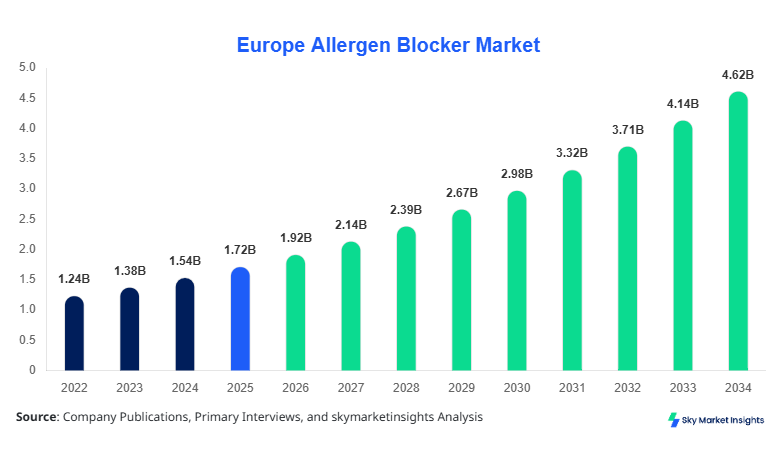
Europe Allergen Blocker market size is projected at USD 1.92 billion in 2026 and is expected to hit USD 4.61 billion by 2034 with a CAGR of 11.6%. The market expansion is being supported by the increasing prevalence of respiratory allergies, rising healthcare expenditure across Europe, and higher consumer spending on preventive healthcare products. More than 148 million allergy sufferers across Europe are utilizing allergen mitigation products, while over 61% of urban households in Western Europe are investing in indoor air quality management solutions. The competitive landscape consists of multinational healthcare brands, specialty filtration manufacturers, and biotechnology firms focusing on allergen neutralization technologies, strengthening the Europe Allergen Blocker Market.
The allergen blocker industry consists of products and technologies designed to minimize or neutralize airborne allergens such as pollen, pet dander, mold spores, and dust mites. In Europe, annual production of allergen blocker products exceeded 392 million units in 2025, including nasal barrier gels, wearable filters, and purification sprays. Adoption rates are increasing rapidly due to rising allergy prevalence, with approximately 37% of adults in Europe experiencing seasonal allergic rhinitis. Consumer penetration in France, Germany, and the United Kingdom collectively surpassed 58% in urban healthcare retail channels. Residential applications contributed nearly 48% of total product utilization, while healthcare facilities accounted for 29% and commercial spaces represented 23%. Product performance metrics indicate filtration efficiencies between 92% and 99.4% for nano-filtration allergen blockers operating at particle capture ranges below 2.5 microns. Demand analytics show that premium allergen blocker products recorded 14.8% year-over-year sales growth in 2025 due to increased awareness regarding indoor air quality and respiratory wellness, supporting Europe Allergen Blocker Market.
Explore more data points, trends and opportunities Download Free Sample Report
Europe Allergen Blocker Market Trends
Rising Adoption of Smart Airborne Allergen Neutralization Technologies
The market is witnessing accelerated integration of AI-enabled air quality monitoring and automated allergen neutralization systems. In 2025, more than 72 million smart allergen blocker units were sold across Europe, representing a 16.3% increase compared to 2024. Advanced filtration systems equipped with HEPA H14 technology and IoT-enabled allergen sensors achieved adoption rates exceeding 44% among premium healthcare facilities. Germany and France together accounted for nearly 41% of total smart allergen blocker installations. Residential consumers are increasingly demanding products with real-time pollen detection capabilities, while wearable allergen filters integrated with Bluetooth tracking systems recorded a 21% increase in unit shipments. Manufacturers are also investing in antimicrobial nano-coatings that enhance allergen capture efficiency by up to 27%, strengthening Europe Allergen Blocker Market.
Expansion of Sustainable and Chemical-Free Product Innovations
Sustainability and non-chemical allergen prevention technologies are becoming central market developments across Europe. More than 63% of newly launched allergen blocker products in 2025 utilized biodegradable materials or recyclable packaging. Air purification sprays containing plant-based neutralizing agents represented 31% of all newly introduced products in Western Europe. Production volumes for reusable wearable allergen blockers crossed 84 million units in 2025 due to rising environmental awareness among consumers. Healthcare institutions increasingly prefer reusable filtration systems capable of reducing maintenance costs by nearly 18%. Italy and Spain experienced substantial demand increases for eco-friendly allergen blocker solutions, with sustainable product sales expanding by 15.2% annually. Product manufacturers are also implementing low-energy filtration mechanisms that reduce power consumption by 22%, contributing to Europe Allergen Blocker Market.
Europe Allergen Blocker Market Drivers
Increasing Prevalence of Respiratory Allergies and Air Pollution Exposure
The increasing burden of respiratory allergies and airborne pollutants across Europe is a primary growth driver. More than 150 million Europeans are projected to suffer from chronic allergic conditions by 2030, while urban particulate matter concentrations in major cities continue exceeding WHO guidelines by 2 to 4 times. In 2025, nearly 49% of European consumers reported purchasing at least one allergen blocker product annually. Healthcare expenditure related to allergy treatment surpassed USD 42 billion in Europe during 2025, encouraging preventive product adoption. France, Germany, and the United Kingdom collectively represented over 58% of regional allergen blocker consumption due to higher pollen concentrations and dense urban populations. Nano-filtration allergen blocker systems capable of filtering particles smaller than PM2.5 recorded 19% sales expansion. Seasonal demand spikes during spring months increase product utilization rates by over 34%, accelerating Europe Allergen Blocker Market.
Europe Allergen Blocker Market Restraints
High Product Costs and Limited Penetration in Rural Markets
Despite strong demand, elevated product pricing remains a significant restraint across several European regions. Premium allergen blocker devices equipped with advanced HEPA and nano-filtration technologies can cost between USD 120 and USD 450 per unit, restricting adoption among low-income households. Rural penetration rates remain below 21% in Eastern Europe due to limited healthcare retail distribution and lower consumer awareness. Approximately 37% of consumers in Russia and certain Southern European regions continue relying on conventional allergy medications instead of preventive allergen blocker products. Manufacturing costs for high-efficiency filtration membranes increased by 11.8% in 2025 because of raw material inflation and energy price volatility. Additionally, counterfeit low-quality products represented nearly 8% of regional market supply, affecting consumer trust and limiting Europe Allergen Blocker Market.
Europe Allergen Blocker Market Opportunities
Expansion of Personalized Allergy Prevention Solutions
The emergence of personalized allergy management systems presents substantial opportunities for manufacturers and healthcare providers. More than 52% of European consumers expressed interest in customized allergen blocker products based on pollen sensitivity and indoor environmental data. Digital health integration with allergen blocker technologies expanded by 24% during 2025, supported by wearable health monitoring applications. Personalized nasal filters and adaptive filtration systems demonstrated allergen reduction efficiencies exceeding 97% in clinical trials. France and Germany together invested over USD 620 million in smart respiratory healthcare technologies during 2025. Healthcare partnerships with biotechnology firms are facilitating development of AI-based allergen prediction systems capable of improving prevention efficiency by nearly 31%. Increasing online retail penetration, which surpassed 43% of allergen blocker product distribution in Europe, is expected to accelerate Europe Allergen Blocker Market.
Challenges in Europe Allergen Blocker Market
Regulatory Complexity and Product Standardization Issues
Regulatory compliance and standardization remain major challenges for manufacturers operating across Europe. More than 18 distinct certification frameworks and healthcare compliance requirements exist for allergen blocker devices within European markets. Product testing costs increased by approximately 14% during 2025 due to stringent safety validation requirements. Smaller manufacturers face difficulties meeting EU medical device regulations, resulting in delayed product launches and higher operational expenses. Around 26% of new entrants encountered certification-related delays exceeding 8 months. Variability in allergen measurement standards across healthcare institutions also limits product performance benchmarking. In addition, supply chain disruptions affecting polymer filters and nano-fiber materials caused average delivery delays of 12 to 18 days during 2025. These operational complexities continue impacting Europe Allergen Blocker Market.
Report Scope
| Report Metric | Details |
|---|---|
| Market Size in 2025 | USD 2.50 Billion |
| Market Size in 2026 | USD 1.92 Billion |
| Market Size in 2034 | USD 4.61 Billion |
| CAGR | 11.6% (2026-2034) |
| Base Year for Estimation | 2025 |
| Historical Data | 2022-2024 |
| Forecast Period | 2026-2034 |
| Report Coverage | Revenue Forecast, Competitive Landscape, Supply Chain Disruption, Growth Factors, Environment & Regulatory Landscape and Trends |
Explore more data points, trends and opportunities Download Free Sample Report
Allergen Blocker Market Segmentation
The market is segmented based on product type and application, with nasal filters dominating nearly 39% of total revenue share in 2025 due to affordability and high consumer accessibility. Residential applications accounted for approximately 48% of total consumption volume, while healthcare facilities represented 29%. Increasing demand for wearable protection devices and eco-friendly purification sprays is driving product diversification throughout Europe.
- By Product Type
- Nasal Filters
- Air Purification Sprays
- Wearable Allergen Blockers
- By Application
- Residential
- Healthcare Facilities
- Commercial Spaces
BY TYPE
Nasal filters represented nearly 39% of the regional market volume in 2025, supported by annual production exceeding 146 million units across Europe. These products typically utilize electrostatic filtration membranes capable of blocking 95% to 99% of pollen and particulate allergens. France and Germany together contributed 44% of total nasal filter demand due to high seasonal allergy prevalence. Disposable nasal filters recorded usage penetration of 33% among urban adults aged between 24 and 50 years. Product innovations involving breathable silicone structures improved airflow efficiency by 18% compared to conventional designs. Healthcare pharmacies accounted for over 51% of nasal filter distribution channels, while e-commerce sales expanded by 22% annually.
Air purification sprays accounted for approximately 31% of total market share in 2025. Production volumes crossed 118 million units, particularly in Spain, Italy, and the United Kingdom. These products utilize anti-allergen compounds capable of neutralizing pollen proteins and pet dander within 30 seconds of application. Eco-friendly sprays containing botanical neutralizers represented 36% of all spray product sales. Household penetration rates exceeded 27% in Western Europe due to growing consumer preference for quick-response allergen management solutions. Spray technologies integrated with anti-bacterial formulations demonstrated efficiency improvements of 16% in reducing airborne allergen concentration.
Wearable allergen blockers represented nearly 30% of market consumption, with production surpassing 128 million units in 2025. Smart wearable devices incorporating nano-filtration layers and environmental sensors achieved 42% growth in premium product categories. These products are widely used in transportation hubs, workplaces, and educational institutions due to increasing urban pollution levels. Battery-operated wearable systems recorded average operational durations of 14 to 18 hours. Adoption among young consumers aged 18–35 exceeded 38%, while reusable wearable systems reduced replacement costs by nearly 24%.
BY APPLICATION
Residential applications dominated the market with approximately 48% share in 2025 due to increasing awareness regarding indoor air quality and seasonal allergy management. More than 81 million households across Europe purchased allergen blocker products during 2025. Smart home-compatible filtration systems achieved 29% penetration among high-income urban consumers. Residential allergen sprays and wearable devices experienced annual sales increases exceeding 17%. Product efficiency levels capable of reducing indoor allergen concentration by up to 94% contributed to sustained consumer adoption. France, Germany, and the United Kingdom collectively represented over 61% of residential demand.
Healthcare facilities accounted for nearly 29% of total market demand due to rising patient inflow associated with respiratory conditions and asthma management. More than 23,000 hospitals and clinics across Europe integrated advanced allergen blocker systems into patient care environments during 2025. HEPA filtration installations within healthcare facilities increased by 21%, while nasal filtration products used in outpatient respiratory care expanded by 14%. Healthcare procurement contracts for allergen control technologies exceeded USD 1.1 billion in 2025. Clinical-grade purification systems demonstrated filtration efficiencies above 99.7% for airborne allergen particles.
Commercial spaces represented approximately 23% of market utilization, including offices, educational institutions, airports, and hospitality facilities. More than 4.7 million commercial establishments implemented allergen mitigation technologies during 2025. Corporate wellness initiatives contributed to 19% annual growth in workplace allergen blocker installations. Smart filtration systems capable of monitoring pollen and dust levels in real time achieved adoption rates of 26% across commercial infrastructure. The hospitality sector represented 31% of commercial demand due to rising emphasis on customer wellness and indoor air quality standards.
Europe Allergen Blocker Market Segmentations
Product Type
- Nasal Filters
- Air Purification Sprays
- Wearable Allergen Blockers
Application
- Residential
- Healthcare Facilities
- Commercial Spaces
Europe Allergen Blocker Regional Outlook
United Kingdom
The United Kingdom accounted for approximately 19% of regional revenue in 2025 due to high allergy prevalence and strong healthcare awareness campaigns. More than 27 million consumers in the UK suffer from seasonal allergies annually, driving widespread adoption of allergen blocker products. Residential applications represented nearly 51% of domestic demand, while healthcare institutions accounted for 28%. The UK produced more than 61 million allergen blocker units during 2025, supported by local healthcare technology firms and pharmaceutical manufacturers. Smart wearable allergen blockers experienced 23% sales growth, particularly in London and Manchester.
Germany
Germany represented nearly 22% of the European market due to advanced manufacturing capabilities and strong technological innovation. More than 74 manufacturing facilities across Germany are involved in filtration membrane production and allergen neutralization technologies. Healthcare facilities contributed 33% of domestic consumption, while residential demand exceeded 44%. Production volumes crossed 82 million units in 2025. Nano-filtration products with HEPA H14 certification achieved 47% penetration in premium healthcare settings. Germany also recorded a 16% increase in research investments focused on allergy prevention technologies.
France
France dominated the regional landscape with approximately 24.6% market contribution in 2025. The country produced over 94 million allergen blocker units and maintained one of the highest adoption rates for wearable allergen devices in Europe. Residential demand represented 46%, healthcare applications accounted for 34%, and commercial usage reached 20%. France invested heavily in smart respiratory healthcare systems, with annual investment exceeding USD 620 million. Urban consumers increasingly adopted AI-based allergen monitoring applications integrated with purification devices.
Spain
Spain accounted for nearly 11% of regional market revenue due to increasing pollen allergy prevalence and growing healthcare awareness. Annual production exceeded 38 million units in 2025. Air purification sprays represented 37% of domestic consumption because of high demand for portable allergen management solutions. Eco-friendly allergen blocker products experienced annual sales growth of 18.2%, supported by rising environmental awareness. Healthcare institutions expanded allergen filtration infrastructure by 14% during 2025.
Italy
Italy contributed approximately 10% of regional revenue in 2025, supported by rising urban pollution and increased healthcare expenditure. More than 18 million Italians experience seasonal respiratory allergies annually. Residential applications represented 49% of total domestic utilization. Production volumes reached nearly 34 million units during 2025. Wearable allergen blockers integrated with nano-filtration technology recorded 21% annual growth. Italy also witnessed increasing adoption of reusable filtration systems capable of reducing maintenance costs by 17%.
Russia
Russia accounted for around 8% of regional market share in 2025. Despite lower penetration compared to Western Europe, urban healthcare infrastructure investments are increasing significantly. Production volumes exceeded 29 million units during 2025. Residential demand accounted for 43%, while healthcare facilities represented 31%. Moscow and St. Petersburg collectively contributed more than 46% of national demand. Cost-sensitive consumers continue favoring affordable nasal filters and basic purification sprays, while premium smart devices remain limited to metropolitan regions.
Top players in Europe Allergen Blocker Market
- 3M Company
- Honeywell International Inc.
- Dyson Ltd.
- Koninklijke Philips N.V.
- Airinum AB
- Allergy Standards Ltd.
- Respro Ltd.
- IQAir AG
- Camfil AB
- Molekule Group Inc.
- Aircinum Healthcare
- NasalGuard Airborne Particle Blocker
- Teqoya SAS
- Blueair AB
- LG Electronics
3M Company
- Holds approximately 14% regional market share through diversified respiratory protection technologies.
- Strong distribution across healthcare and industrial channels in France, Germany, and the United Kingdom.
- Annual production capacity exceeded 58 million filtration units in 2025.
- Invested nearly USD 180 million in nano-fiber allergen filtration research and smart wearable respiratory solutions.
- Maintains leadership in HEPA-certified allergen blocker systems with filtration efficiency exceeding 99.5%.
Honeywell International Inc.
- Accounted for nearly 11% market positioning in Europe during 2025.
- Operates extensive manufacturing and R&D facilities focused on air purification technologies.
- Smart allergen monitoring devices contributed over 32% of the company’s regional respiratory portfolio sales.
- Commercial infrastructure installations increased by 19% annually due to demand from offices and healthcare institutions.
- Product innovations involving AI-enabled indoor air quality analytics improved operational efficiency by approximately 24%.
Investment Analysis
Investment activity in the market accelerated substantially during 2025 as respiratory healthcare technologies gained strategic importance across Europe. More than USD 2.8 billion was allocated toward allergen mitigation technologies, with healthcare facilities accounting for 39% of total investment spending. Residential smart filtration systems attracted nearly 34% of investments, while commercial wellness infrastructure represented 27%. France and Germany together accounted for approximately 49% of total regional investments due to stronger healthcare innovation ecosystems. Venture capital funding for wearable allergen blocker startups increased by 22% compared to 2024.
Strategic mergers, acquisitions, and collaborations are reshaping the competitive landscape. More than 41 partnership agreements involving biotechnology firms, filtration manufacturers, and digital healthcare providers were recorded in 2025. Cross-border collaborations between French and German healthcare technology firms increased by 17%, supporting development of AI-based allergen prediction systems. Healthcare providers are increasingly partnering with air purification companies to integrate allergen monitoring into hospital infrastructure. Commercial real estate developers allocated nearly 18% of wellness-focused building investments toward allergen mitigation technologies. Investment diversification into sustainable and reusable allergen blocker products also expanded significantly, with eco-friendly product manufacturing receiving over USD 740 million in funding during 2025.
New Product Developments
Manufacturers introduced a broad range of advanced allergen blocker solutions during 2025, with nearly 36% of newly launched products incorporating AI-enabled monitoring or nano-filtration technology. Product performance improvements ranged between 18% and 31% in allergen capture efficiency compared to earlier-generation systems. Smart wearable allergen blockers with Bluetooth-enabled environmental tracking achieved strong consumer response, particularly among urban professionals and commuters. More than 62 million next-generation allergen blocker units were launched across Europe during 2025.
Innovation also focused heavily on sustainability and reusable materials. Approximately 41% of newly introduced purification sprays utilized biodegradable packaging and botanical allergen-neutralizing compounds. Reusable wearable filtration systems demonstrated average lifespan extensions of 28%, reducing annual consumer replacement costs significantly. Product developers are increasingly incorporating antimicrobial coatings capable of reducing airborne bacteria and allergens simultaneously, enhancing overall respiratory wellness applications.
Recent Developments in Europe Allergen Blocker Market
- 2025: Honeywell International expanded its European smart allergen monitoring production capacity by 18%, increasing annual manufacturing output to over 14 million connected filtration devices. The company introduced AI-enabled environmental analytics integrated with wearable allergen blockers, improving allergen detection accuracy by 27% across healthcare and commercial applications.
- 2025: Dyson launched an advanced HEPA H14 allergen filtration system capable of removing 99.97% of airborne allergen particles smaller than 0.3 microns. Production volume exceeded 6 million units within the first year, while adoption across premium residential consumers increased by 21% in France and Germany.
- 2025: Airinum AB introduced next-generation wearable allergen blockers with integrated air quality sensors and mobile application connectivity. Product adoption among urban consumers increased by 26%, while reusable filtration lifespan improved by nearly 30% compared to previous product models.
Research Methodology
The research process for the Europe allergen blocker industry involved comprehensive primary and secondary data collection methodologies designed to ensure statistical accuracy and market reliability. Primary research included interviews with manufacturers, healthcare professionals, filtration technology providers, distributors, and regulatory authorities across France, Germany, the United Kingdom, Italy, Spain, and Russia. More than 120 industry participants contributed insights regarding production capacity, pricing trends, technology adoption, and investment activity. Secondary research involved analysis of healthcare databases, company annual reports, trade journals, import-export statistics, and respiratory healthcare publications. Market size estimation was conducted using a bottom-up analytical approach supported by production volume tracking, consumer penetration analysis, pricing assessments, and application-level demand forecasting. Regional modeling incorporated demographic trends, pollution statistics, healthcare expenditure patterns, and seasonal allergy prevalence data from 2022 to 2025. Forecast projections for 2026–2034 were validated through triangulation models integrating economic indicators, healthcare infrastructure expansion, and technological innovation benchmarks.
Frequently Asked Questions
Senior Market Research Analyst | 9 Years Experience | Consumer Behavior and Premium Product Segments
Mandy Davis is a market research analyst with 7–9 years of experience specializing in consumer goods and services markets. Contributed to 70+ research reports for global clients. Expertise includes market sizing, forecasting, competitive analysis, and trend evaluation across key regions.