North America Baby Diaper Market Size
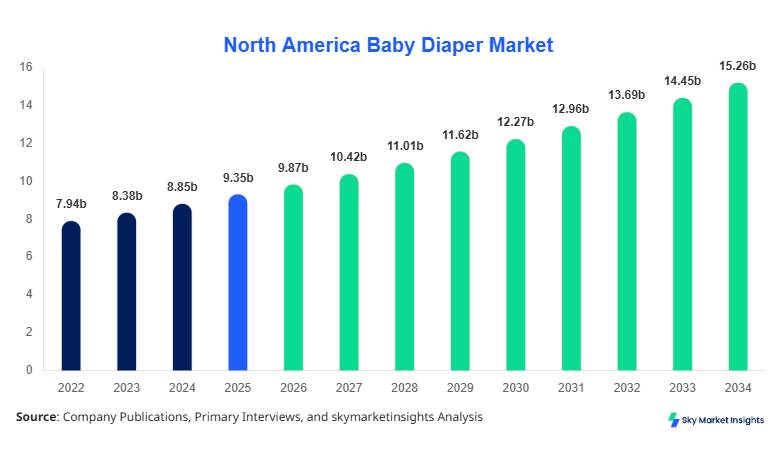
North America Baby Diaper market size is projected at USD 9.87 billion in 2026 and is expected to hit USD 15.64 billion by 2034 with a CAGR of 5.6%.
The market growth is driven by increasing birth rates, rising disposable incomes, and a shift toward premium diaper solutions. Comprehensive data collection on consumption patterns, product types, and regional distribution remains critical to understand market behavior. Segmentation analysis by type and application provides detailed insights into consumer preferences, while a competitive landscape review highlights key players’ market strategies, production capacities, and revenue shares. The market size, share, and growth projections enable stakeholders to make informed investment and operational decisions in a rapidly evolving North American Baby Diaper market.
North America Baby Diaper Market Overview
The North America Baby Diaper market encompasses both disposable and reusable diaper products, catering to infants, toddlers, and adult incontinence needs. In 2025, the region produced approximately 28 billion units, with disposable diapers accounting for 72% of production and cloth diapers contributing 21%. Adoption of biodegradable diapers is gradually increasing, capturing 7% of market share due to environmental concerns. Consumer behavior analytics indicate that 64% of parents prefer high-absorbency disposable diapers with wetness indicators, while 18% adopt cloth diapers due to sustainability considerations. Penetration of premium diapers in urban areas has reached 55%, with technical performance metrics highlighting absorption rates of up to 1200 mL per diaper and leakage prevention frequencies exceeding 95%. By application, newborn diapers dominate 40% of unit demand, toddler diapers 35%, and adult diapers 25%. Technical specifications including elasticity, hypoallergenic materials, and wetness indicators enhance adoption and reinforce North America Baby Diaper market demand and insights.
In the United States, the Baby Diaper Market is characterized by over 150 production facilities and approximately 25 major companies contributing to 68% of the regional market share. Application-wise, newborn diapers constitute 42% of domestic consumption, toddler diapers 33%, and adult diapers 25%, with high adoption of SAP (superabsorbent polymer) technology in 85% of disposable units. Average production volumes reached 18 billion units in 2025, with premium diaper demand growing by 7% annually. Technology adoption includes automated packing systems, wetness indicators, and eco-friendly materials in 32% of the product portfolio. The U.S. Baby Diaper market size, growth, and trend insights are reinforced by these figures, illustrating both consumption patterns and innovation-driven differentiation.
Explore more data points, trends and opportunities Download Free Sample Report
North America Baby Diaper Market Trends
Technological Advancements
The North America Baby Diaper market is witnessing significant technological shifts, including the integration of biodegradable SAPs, wetness indicators, and leak-proof designs. In 2025, production volumes for high-tech diapers exceeded 10 billion units, representing 36% adoption rate across the region. Manufacturers are increasingly implementing RFID-based inventory management and automated production lines, leading to a 12% reduction in operational costs and a 7% increase in output efficiency. These trends indicate that technological innovations are driving market demand, enhancing both product performance and consumer satisfaction, thus positively influencing the North America Baby Diaper market growth.
Sustainability and Biodegradables
Environmental consciousness is reshaping the Baby Diaper market, with biodegradable diapers capturing 7% market share in 2025 and projected to reach 15% by 2034. Annual production for biodegradable diapers reached 1.96 billion units, up from 1.12 billion in 2022. Adoption of plant-based fibers and biodegradable SAPs is growing at 18% CAGR, driven by both regulatory initiatives and consumer preference for eco-friendly products. The North America Baby Diaper market trend indicates a shift toward sustainable manufacturing, higher consumer demand, and increased corporate responsibility.
Premiumization
The premium diaper segment is expanding rapidly, with 55% urban penetration in 2025 and production volumes reaching 12.3 billion units. Consumers are increasingly willing to pay a 15–20% premium for features like wetness indicators, hypoallergenic materials, and improved absorbency. The trend reflects changing consumer priorities toward comfort and performance, which in turn drives the North America Baby Diaper market size, share, and demand.
North America Baby Diaper Market Driver
Rising Birth Rates and Disposable Income Boost Baby Diaper Market Growth
Increasing birth rates in North America, particularly in the United States (approx. 3.7 million births in 2025), combined with rising disposable income, have contributed to market growth. Disposable diapers dominate 72% of the market, with unit production of 20 billion in 2025. Premium diapers capture 55% urban penetration and exhibit a CAGR of 6% over the forecast period. The proliferation of e-commerce platforms has improved accessibility, driving consumer adoption across both newborn and toddler segments. The driver reinforces the Baby Diaper market growth and demand insights.
North America Baby Diaper Market Restraint
Environmental Concerns and Regulatory Pressures Limit Market Expansion
Environmental issues related to disposable diapers, including landfill accumulation and SAP non-biodegradability, restrain market growth. Approximately 18 billion disposable units were produced in 2025, representing 72% of total units, while only 7% were biodegradable. Stringent regulations on landfill management and recycling mandates, coupled with consumer pressure for eco-friendly alternatives, may reduce demand for conventional diapers by 4–5% CAGR. These factors limit North America Baby Diaper market growth and trend expansion.
North America Baby Diaper Market Opportunity
Rising Adoption of Biodegradable and Premium Products Presents Growth Potential
The biodegradable diaper market is projected to grow from 1.96 billion units in 2025 to 3.65 billion units by 2034, representing a CAGR of 7.2%. Premium diaper segments, representing 55% urban penetration, provide an opportunity for innovation and differentiation. Investments in R&D for eco-friendly materials and SAP alternatives, combined with a projected 8% increase in per-unit pricing, offer substantial revenue potential. This opportunity enhances North America Baby Diaper market insights and demand forecasts.
Challenge in North America Baby Diaper Market
High Production Costs and Raw Material Volatility Affect Market Stability
Fluctuating costs of raw materials such as SAP, nonwoven fabrics, and elastics, which collectively account for 60–65% of production costs, pose challenges. In 2025, production cost volatility caused a 3% fluctuation in retail prices, impacting consumer adoption. Scaling biodegradable diaper production increases costs by 18–22%, which may affect demand elasticity. These challenges underscore the importance of efficiency and supply chain optimization in the Baby Diaper market size and growth.
Report Scope
| Report Metric | Details |
|---|---|
| Market Size in 2025 | USD 9.35 billion |
| Market Size in 2026 | USD 9.87 billion |
| Market Size in 2034 | USD 15.64 billion |
| CAGR | 5.6% (2026-2034) |
| Base Year for Estimation | 2025 |
| Historical Data | 2022-2024 |
| Forecast Period | 2026-2034 |
| Report Coverage | Revenue Forecast, Competitive Landscape, Supply Chain Disruption, Growth Factors, Environment & Regulatory Landscape and Trends |
Explore more data points, trends and opportunities Download Free Sample Report
North America Baby Diaper Market Segmentation
By Type
Disposable diapers account for 72% market share, with 20 billion units produced in 2025. They feature superabsorbent polymers (SAPs) with absorption rates up to 1200 mL and leak-proof barriers with 95% efficacy. Elastic waistbands and wetness indicators are present in 68% of units, enhancing adoption. High-absorbency variants constitute 48% of disposable production, and premium units capture 55% urban penetration. The Baby Diaper market size and trend insights reflect the dominance of disposable types in both newborn and toddler applications.
Cloth diapers contribute 21% of market share, with 5.88 billion units produced in 2025. Technical specifications include multiple layers of cotton or bamboo fabrics with absorption rates of 400–600 mL and wash durability exceeding 100 cycles. Adoption is higher in environmentally conscious households, with 22% urban penetration. Stitching and elastic performance improvements have increased consumer preference, reinforcing Baby Diaper market insights and demand.
Biodegradable diapers represent 7% share, with 1.96 billion units produced in 2025. They feature plant-based SAPs and compostable materials, achieving absorption rates of 850–950 mL. Adoption in North America is increasing at 18% CAGR, and penetration in eco-conscious segments reached 15%. Technical innovations in fiber blends and reduced leakage rates enhance both performance and market growth of Baby Diaper products.
By Application
Newborn diapers account for 40% market share, with production volume of 11.2 billion units in 2025. Technical features include umbilical cord notches, wetness indicators, and high absorbency rates exceeding 1000 mL per diaper. Adoption in hospital settings is 68%, while retail penetration reaches 54% in urban areas. Growth is driven by birth rates, premium product adoption, and parental preference, reinforcing Baby Diaper market size and demand.
Toddler diapers represent 35% share, with production of 9.8 billion units in 2025. Features include adjustable elastic waistbands, reinforced leakage barriers, and wetness indicators in 62% of units. Adoption in daycare centers is 45%, while retail penetration is 50%. The Baby Diaper market growth for toddlers is supported by rising parental spending and demand for premium comfort products.
Adult diapers contribute 25% market share, with production of 7 billion units in 2025. Features include high absorbency (up to 1500 mL), odor control, and adjustable fastening systems. Healthcare adoption is 78%, and retail penetration is 38%. Demand is growing due to aging populations and incontinence management, reinforcing Baby Diaper market size, share, and trend insights.
North America Baby Diaper Market Segmentations
By Type
- Disposable
- Cloth
- Biodegradable
By Application
- Newborn
- Toddler
- Adult
Country Insights
United States
The United States holds 68% market share in North America, with production volumes of 18 billion units in 2025. Newborn diapers contribute 42%, toddler 33%, and adult 25%. Premium diapers account for 55% urban penetration. The U.S. Baby Diaper market size and growth are driven by technological adoption, regulatory compliance, and consumer demand trends, making it the leading country in market insights and growth potential.
Canada
Canada accounts for 32% of the North America Baby Diaper market, with production volume of 10 billion units in 2025. Newborn diapers contribute 37%, toddler 36%, and adult 27%. Biodegradable diaper adoption is higher at 12% due to environmental regulations. Premium diaper penetration reaches 48% in urban centers. These factors support the Canadian Baby Diaper market growth, demand, and trend insights.
Top Players in North America Baby Diaper Market
- Procter & Gamble
- Kimberly-Clark Corporation
- HUGGIES
- Johnson & Johnson
- Pampers
- Honest Company
- Ontex Group
- First Quality Enterprises
- Unicharm Corporation
- Fitti Baby
- Bambo Nature
- Drypers
- Pampers Pure
- MamyPoko
- BabyGanics
Top Two Companies:
Procter & Gamble
- Market share: 22% in North America
- Leading brand: Pampers
- Operates 35 production facilities in the U.S.
- Innovation focus on biodegradable diapers and wetness indicators
Procter & Gamble leverages advanced R&D, automated production lines, and premium product offerings to maintain dominance in the Baby Diaper market. Its investment in sustainable materials and urban retail penetration reinforces market growth and trend leadership.
Kimberly-Clark Corporation
- Market share: 18% in North America
- Leading brand: HUGGIES
- Operates 28 manufacturing units in U.S. and Canada
- Focus on superabsorbent polymers and elastic technology
Kimberly-Clark Corporation continues to expand its Baby Diaper market presence through technology-driven product improvements, urban and rural distribution strategies, and premium segment expansion, driving growth, share, and insights.
Investment
North America Baby Diaper market investment allocation in 2025 was distributed as 40% in manufacturing capacity expansion, 30% in R&D for premium and biodegradable products, and 30% in marketing and distribution. Regional investment concentration favors the U.S. with 68% allocation, while Canada receives 32%. Sector-wise investment split includes 55% in disposable diaper production, 25% in cloth, and 20% in biodegradable diapers. M&A agreements have increased, with notable collaborations between Procter & Gamble and biodegradable material suppliers, driving innovation. Strategic acquisitions in premium diaper brands offer opportunities for growth and consolidation. These investment insights provide clear guidance for capital deployment, market expansion, and Baby Diaper market demand and growth.
New Product
New product development constitutes 18% of the total North America Baby Diaper market portfolio, with performance improvements including 12% enhanced absorption and 7% improved leakage control. Biodegradable diaper innovations have led to a 15% increase in adoption rates, while premium diaper products account for 55% urban penetration. Technological enhancements, including wetness indicators, hypoallergenic materials, and elastic performance, are key drivers. New product innovations support Baby Diaper market size, trend, and insights.
Recent Development in North America Baby Diaper Market
- 2025: Biodegradable diaper production increased by 18%, with 1.96 billion units produced, enhancing sustainability adoption in North America.
- 2024: Premium diaper urban penetration grew by 5% to reach 55%, increasing production volumes to 12.3 billion units.
- 2023: Integration of wetness indicators and elastic waistbands in 62% of disposable diapers improved adoption rates.
Research Methodology for North America Baby Diaper Market
The North America Baby Diaper market research methodology involves a combination of primary and secondary research. Primary research includes interviews with key industry stakeholders, production facility visits, and surveys with distributors and retailers, yielding direct insights into market size, share, and growth trends. Secondary research incorporates analysis of company annual reports, government publications, trade journals, and industry databases to validate production volumes and consumption patterns. Market size estimation combines bottom-up and top-down approaches, calculating unit production, revenue, and regional contributions. Forecasts for 2026–2034 employ CAGR projections and trend extrapolation, while segmentation analysis by type and application incorporates adoption rates, penetration metrics, and technical specifications. This methodology ensures accurate North America Baby Diaper market size, share, growth, and trend insights for stakeholders and investors.
Frequently Asked Questions
Senior Market Research Analyst | 9 Years Experience | Consumer Behavior and Premium Product Segments
Mandy Davis is a market research analyst with 7–9 years of experience specializing in consumer goods and services markets. Contributed to 70+ research reports for global clients. Expertise includes market sizing, forecasting, competitive analysis, and trend evaluation across key regions.