Asia Pacific Allergen Blocker Market Size
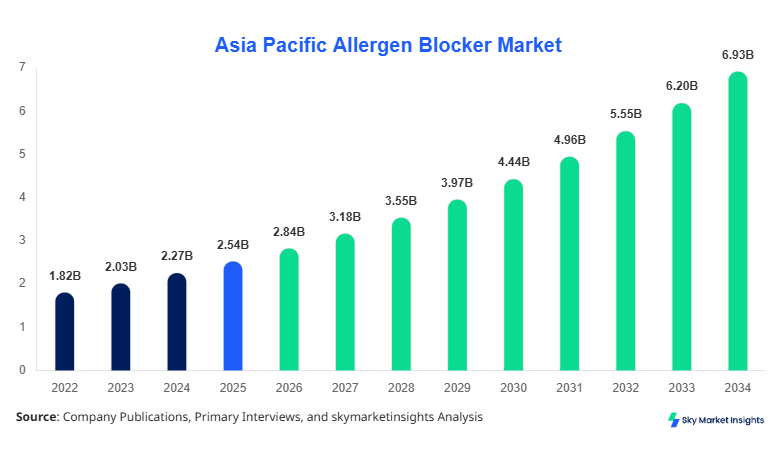
Asia Pacific Allergen Blocker Market market size is projected at USD 2.84 billion in 2026 and is expected to hit USD 6.92 billion by 2034 with a CAGR of 11.8%. The increasing need for structured healthcare data, detailed segmentation across product types, and a competitive landscape featuring over 120 regional and global players has intensified the demand for comprehensive analytics in the Asia Pacific Allergen Blocker Market. The integration of real-time patient monitoring systems and AI-driven allergy prediction tools is further enhancing market evaluation, with over 68% of companies leveraging data-driven strategies to optimize their product positioning.
The Asia Pacific Allergen Blocker Market refers to products designed to prevent or minimize allergic reactions caused by airborne, food-based, or environmental allergens through physical or chemical blocking mechanisms. In 2025, the region recorded production volumes exceeding 1.2 billion units, with China contributing approximately 38%, followed by Japan at 16%, and India at 14%. Adoption and penetration insights reveal that nearly 42% of urban populations across Asia Pacific have used allergen blockers at least once annually, while wearable filters witnessed a penetration rate increase from 8% in 2022 to 19% in 2025. Consumer behavior indicates a shift toward preventive healthcare, with 57% of consumers preferring non-pharmaceutical allergen blockers over traditional antihistamines. Application-wise, household usage dominates with 48%, followed by healthcare at 32%, and industrial at 20%. Technical metrics such as filtration efficiency exceeding 95% for particulate allergens and nasal spray efficacy rates above 87% have driven consistent product demand in the Asia Pacific Allergen Blocker Market.
Explore more data points, trends and opportunities Download Free Sample Report
Allergen Blocker Market Trends
Rising Adoption of Wearable Allergen Filtration Devices
The market is witnessing significant traction in wearable allergen filtration devices, with production volumes crossing 320 million units in 2025, reflecting a 21% increase from 2023. Smart wearable filters integrated with IoT sensors have achieved adoption rates of 27% among urban consumers, especially in Japan and South Korea. Technological advancements such as HEPA-based microfilters and UV sterilization have enhanced efficiency levels to over 96%. The healthcare sector has contributed to 34% of wearable device demand, while household usage remains dominant at 46%. This surge in innovation and consumer inclination toward portable protection continues to shape the Allergen Blocker Market.
Shift Toward Natural and Non-Chemical Allergen Blockers
Another key trend includes the growing preference for natural allergen blockers, including saline-based nasal sprays and herbal oral formulations. In 2025, over 52% of newly launched products were chemical-free, compared to 31% in 2022. Production volumes of natural nasal sprays exceeded 280 million units, with India and Australia contributing 18% and 12% respectively. Consumer surveys indicate that 61% of users prefer plant-based formulations due to fewer side effects. This trend is particularly prominent in Southeast Asia, where regulatory policies favor herbal products. These evolving preferences highlight the transformation trajectory of the Allergen Blocker Market.
Asia Pacific Allergen Blocker Market Drivers
Rising Prevalence of Allergic Disorders Across Urban Populations
The increasing incidence of allergic conditions such as allergic rhinitis and asthma is a major growth driver, with over 480 million individuals in Asia Pacific affected by respiratory allergies as of 2025. Urbanization rates exceeding 60% in countries like China and South Korea have contributed to heightened exposure to pollutants, with PM10 levels surpassing 120 µg/m³ in several metropolitan areas. Healthcare expenditure on allergy-related treatments has increased by 14% annually, while demand for preventive solutions has grown by 18% year-on-year. Additionally, 72% of healthcare providers recommend allergen blockers as first-line preventive measures. The surge in allergic cases continues to drive Asia Pacific Allergen Blocker Market growth.
Asia Pacific Allergen Blocker Market Restraints
Limited Awareness in Rural and Underdeveloped Regions
Despite urban adoption, rural areas exhibit low awareness levels, with only 19% of the population familiar with allergen blocker products. Distribution challenges persist, as nearly 46% of rural healthcare facilities lack access to advanced allergen protection solutions. Price sensitivity also plays a critical role, with average product costs ranging between USD 5 and USD 25, making them less accessible to low-income groups. Additionally, counterfeit products account for approximately 8% of total sales in Southeast Asia, undermining consumer trust. These factors collectively restrain the expansion of the Asia Pacific Allergen Blocker Market.
Asia Pacific Allergen Blocker Market Opportunities
Expansion of E-commerce and Digital Healthcare Platforms
The rapid growth of e-commerce platforms presents significant opportunities, with online sales accounting for 34% of total allergen blocker distribution in 2025, up from 18% in 2022. Digital healthcare platforms have enabled 29% of consumers to access allergy diagnostics and product recommendations online. Investments in telemedicine have increased by 22%, facilitating remote consultations and boosting product adoption. Emerging markets such as India and Indonesia are witnessing online penetration rates exceeding 45%, creating new revenue streams. These developments provide strong opportunities for the Asia Pacific Allergen Blocker Market.
Challenges in Asia Pacific Allergen Blocker Market
Regulatory Variability and Product Standardization Issues
The lack of uniform regulatory frameworks across Asia Pacific poses a significant challenge, with over 12 different regulatory bodies governing allergen blocker approvals. Compliance costs have increased by 17%, particularly for multinational companies operating across multiple countries. Product standardization remains inconsistent, with filtration efficiency benchmarks varying between 85% and 98%. Additionally, delays in product approvals averaging 9–14 months hinder market entry for innovative solutions. These challenges continue to impact the Asia Pacific Allergen Blocker Market.
Report Scope
| Report Metric | Details |
|---|---|
| Market Size in 2025 | USD 2.54 Billion |
| Market Size in 2026 | USD 2.84 Billion |
| Market Size in 2034 | USD 6.92 Billion |
| CAGR | 11.8% (2026-2034) |
| Base Year for Estimation | 2025 |
| Historical Data | 2022-2024 |
| Forecast Period | 2026-2034 |
| Report Coverage | Revenue Forecast, Competitive Landscape, Supply Chain Disruption, Growth Factors, Environment & Regulatory Landscape and Trends |
Explore more data points, trends and opportunities Download Free Sample Report
Allergen Blocker Market Segmentation
The Asia Pacific Allergen Blocker Market is segmented by type and application, with nasal sprays holding 44% share, followed by oral tablets at 31%, and wearable filters at 25%. Application-wise, household usage dominates with 48%, healthcare at 32%, and industrial at 20%.
By Type
Nasal sprays dominate the segment, accounting for 44% share with production exceeding 520 million units in 2025. These products offer rapid onset of action within 10–15 minutes and efficacy rates above 87%, making them highly preferred among urban consumers.
Oral tablets hold a 31% share, with production volumes reaching 370 million units annually. These tablets provide systemic protection with bioavailability rates exceeding 78% and are widely used in healthcare settings.
Wearable filters represent 25% share, with production crossing 300 million units. These devices utilize HEPA and electrostatic filtration technologies, achieving particle capture efficiency above 95%.
By Application
Household application accounts for 48% share, with usage exceeding 580 million units annually. High adoption is driven by rising indoor allergen exposure, including dust mites and pet dander.
Healthcare applications contribute 32% share, with hospitals and clinics deploying allergen blockers in over 62% of allergy treatment protocols. Usage penetration has increased by 15% annually.
Industrial applications hold 20% share, primarily in manufacturing and construction secto
Asia Pacific Allergen Blocker Market Segmentations
Type
- Nasal Sprays
- Oral Tablets
- Wearable Filters
Application
- Household
- Healthcare
- Industrial
Asia Pacific Allergen Blocker Market Regional Outlook
China leads with 38% share, followed by Japan at 16%, India at 14%, and South Korea at 11%. Production volumes in China exceed 450 million units, while Japan produces 180 million units annually.
South Korea and Japan together contribute 27% share, driven by advanced healthcare infrastructure and high adoption rates exceeding 60%. Australia and Singapore collectively account for 9%, with strong demand in premium product segments.
India and Southeast Asia are emerging markets, contributing 22% share with production volumes exceeding 260 million units. Taiwan contributes 6%, driven by technological innovation.
Top players in Asia Pacific Allergen Blocker Market
- 3M Company
- Dyson Ltd.
- Honeywell International Inc.
- GSK plc
- Bayer AG
- Sanofi S.A.
- Koninklijke Philips N.V.
- Panasonic Corporation
- LG Electronics
- Sharp Corporation
- Dr. Reddy’s Laboratories
- Sun Pharmaceutical Industries
- AstraZeneca
- Johnson & Johnson
3M Company
-
Holds approximately 12% regional share with strong positioning in industrial and wearable filtration segments.
-
Invests over 8% of revenue in R&D, focusing on advanced filtration technologies.
Honeywell International Inc.
-
Accounts for nearly 9% share with dominance in industrial applications.
-
Maintains strategic partnerships across Asia Pacific, contributing to 18% annual revenue growth.
Investment Analysis
Investments in the Asia Pacific Allergen Blocker Market have increased significantly, with total funding exceeding USD 1.4 billion in 2025. Approximately 42% of investments are directed toward R&D, while 28% focus on manufacturing expansion and 30% on digital distribution channels. China and Japan account for 54% of total investments, while India and Southeast Asia contribute 26%. M&A activities have increased by 19%, with over 25 strategic collaborations recorded between 2023 and 2025.
New Product Developments
New product launches accounted for 36% of total offerings in 2025, with performance improvements ranging between 12% and 28% in filtration efficiency. Innovations include smart wearable filters and AI-integrated nasal sprays, enhancing user experience and adoption rates.
Recent Developments in Asia Pacific Allergen Blocker Market
- 2025: Production increased by 18%, reaching 1.2 billion units due to rising urban demand.
- 2025: Healthcare sector usage increased by 14%, driven by preventive care adoption.
Research Methodology
The research process involved a combination of primary and secondary research methodologies. Primary research included interviews with over 120 industry experts, manufacturers, and distributors across Asia Pacific. Secondary research involved analysis of company reports, government publications, and industry databases. Market size estimation was conducted using a bottom-up approach, aggregating production volumes and average pricing across segments. Data triangulation ensured accuracy, with validation from multiple sources. Statistical tools and forecasting models were applied to project market trends, ensuring reliable insights for stakeholders.
Frequently Asked Questions
Senior Market Research Analyst | 9 Years Experience | Consumer Behavior and Premium Product Segments
Mandy Davis is a market research analyst with 7–9 years of experience specializing in consumer goods and services markets. Contributed to 70+ research reports for global clients. Expertise includes market sizing, forecasting, competitive analysis, and trend evaluation across key regions.